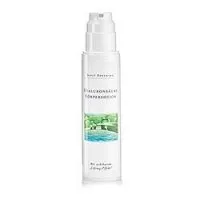
Sanct Bernhard Hyaluronsäure-Körperlotion
Works for
MoisturizingUrea, Ceramide np + 23 moreWorks well
“Hyaluronsäure ist ein natürlicher, bioaktiver Feuchtigkeitsspender, der sehr große Mengen Wasser an sich binden kann.”
This product can help improve hydration of the skin with the two types of ingredients.
The first type is called “humectants”:
these ingredients help attract water.
When humectants are on the surface of the skin, they “pull in” the moisture from the outside environment, or from
within deeper layers of the skin. The following ingredients in this product do the job:
alanine, aspartic acid.
This product also contains ingredients called “occlusives”. They help reduce the speed with which our skin loses moisture to the outside environment. These ingredients also help soften the upper layer of the skin, so it feels less tight and nicer to the touch. The following ingredients in this product do the job: caprylic/capric triglyceride, helianthus annuus seed oil.
The following ingredients in this product are especially good for supporting the skin barrier and helping with the hydration level: ceramide ap, ceramide eop, ceramide np, phytosphingosine, urea
Anti-agingAspartic acid, Prunus amygdalus dulcis oil + 2 moreMay help
“Bei regelmäßiger Anwendung werden selbst ausgeprägte Falten gemildert, neuer Faltenbildung wird vorgebeugt.”
This product contains aspartic acid. This ingredient might be able to help reduce and prevent fine lines and wrinkles, improve skin elasticity and firmness, but there is not enough evidence that it actually works.
Can it cause trouble?
Irritancy1 strong irritant: ParfumMedium risk
Comedogenic2 ingredients rated 2 or more on the 0–5 pore-clogging scale2 flagged


User reviews
Be the first — your take helps the next person decide.
Ingredients
Filter by role to see what each ingredient is doing.
Water~45–55%
Caprylic/capric triglyceride~6.5–8%
- Irritation risk
- Medium
A good mix of fatty acids that forms a protective layer on the skin. Improves the shelf life of products. Derived from coconut and glycerin
More about Caprylic/capric triglycerideUrea~4.4–5.4%
- Irritation risk
- Low
Naturally present in skin (urea makes up about 7% of natural moisturizing factors in skin). Attracts water to the upper layer of the skin. Also has a positive effect on the skin barrier beyond the humectant action. Can enhance penetration of other ingredients. Is an exfoliating ingredient when used in high concentrations
More about UreaPentylene glycol~3.5–4.2%
- Irritation risk
- Medium
Used to preserve products, dissolve other ingredients and create a nice product texture
More about Pentylene glycolGlycerin~2.8–3.4%
- Irritation risk
- Low
One of the best moisturizing ingredients. Naturally present in skin. It attracts water to the upper layer of the skin working as a humectant
More about GlycerinCetearyl alcohol~2.3–2.8%
- Irritation risk
- Low
- Comedogenicity
- 2/5
A non-drying alcohol. Works as an emollient. Helps water and oil mix together and creates a nice product texture
More about Cetearyl alcoholGlyceryl stearate citrate~1.9–2.3%
- Irritation risk
- Low
Helps oil and water mix together while softening the upper layer of the skin
More about Glyceryl stearate citrateSimmondsia chinensis seed oil~1.7–2%
- Irritation risk
- Medium
Softens the upper layer of skin and helps restore the healthy skin barrier. Has shown to help calm down inflammation in skin. It is a stable oil, meaning that it retains its properties even when exposed to air.
More about Simmondsia chinensis seed oilSucrose stearate~1.4–1.7%
Hexylene glycol~1.1–1.3%
- Irritation risk
- Medium
Helps create a more spreadable product texture
More about Hexylene glycolPrunus amygdalus dulcis oil~0.95–1.2%
- Irritation risk
- Low
An emollient that softens the skin
More about Prunus amygdalus dulcis oilTriticum vulgare germ oil~0.8–1.2%
- Irritation risk
- Low
- Comedogenicity
- 3/5
A good emoillient. Contains vitamin E which can help neutralise free radicals, however the oil is unstable. Avoid if you have gluten or wheat sensitivity (including food allergies).
More about Triticum vulgare germ oilSodium hyaluronate~0.7–1.05%
- Irritation risk
- Low
One of the best moisturizing ingredients. Attracts water into the upper layer of the skin
More about Sodium hyaluronateCeramide np~0.7–1.05%
- Irritation risk
- Low
A type of lipid similar to ceramides naturally present in skin. Helps to soften the upper layer of the skin and supports the skin barrier function to keep it hydrated. Can help to prevent inflammation in skin
More about Ceramide npCeramide ap~0.65–1%
- Irritation risk
- Low
A type of lipid similar to ceramides naturally present in skin. Helps to soften the upper layer of the skin and supports the skin barrier function to keep it hydrated. Can help to prevent inflammation in skin
More about Ceramide apPhytosphingosine~0.7–1.05%
- Irritation risk
- Low
A type of lipid that is naturally present in skin. It might help in repairing skin barrier function and has anti-bacterial effect
More about PhytosphingosineFructose~0.55–0.85%
- Irritation risk
- Low
Helps attract water to the upper layer of the skin
More about FructoseLecithin~0.6–0.9%
- Irritation risk
- Low
Used mostly for creating emulsions - helping oil and water mix together. Helps soften the upper layer of the skin
More about LecithinGlucose~0.5–0.75%
- Irritation risk
- Low
Helps attract water to the upper layer of the skin. Could be helpful in restoring the skin barrier function
More about GlucoseAspartic acid~0.45–0.7%
- Irritation risk
- Low
An amino-acid that helps increase skin hydration and might help to slightly improve skin firmness, potentially reducing lines and wrinkles
More about Aspartic acidGlutamic acid~0.45–0.65%
- Irritation risk
- Low
An amino-acid that helps attract water to the upper layer of the skin
More about Glutamic acidTocopherol~0.3–0.6%
- Irritation risk
- Low
Pure form of vitamin E. Can help moisturise and protect the skin from free radicals. Often used to help stabilise other ingredients or the formula itself
More about TocopherolAscorbyl palmitate~0.3–0.5%
- Irritation risk
- Medium
Being a lipid soluble form of vitamin C, it is more stable and can penetrate the skin better than L-Ascorbic acid. It is effective in protecting the skin from free radicals, as well as evening the skin tone, but is less effective in stimulating collagen production compared to L-Ascorbic acid.
More about Ascorbyl palmitateXanthan gum~0.3–0.55%
- Irritation risk
- Low
Used to create a thicker product consistency
More about Xanthan gumSodium lauroyl lactylate~0.3–0.55%
- Irritation risk
- Medium
Helps water and oil mix together
More about Sodium lauroyl lactylateDextrin~0.3–0.5%
- Irritation risk
- Low
A sugar that is used to stabilize the product formulation. Can help attract water to the upper layer of the skin
More about DextrinSucrose~0.25–0.45%
- Irritation risk
- Low
Can help attract water to the upper layer of the skin. In crystal form, it can work as a gentle exfoliant, gentler than the salt scrub. Helps stabilize the emulsion
More about SucroseCholesterol~0.3–0.5%
- Irritation risk
- Low
An emollient that is naturally found in skin
More about CholesterolCarbomer~0.2–0.4%
- Irritation risk
- Low
Helps create a thicker or gel-like product texture. It is not a surfactant but can be used in gentle cleansing formulations
More about CarbomerAlanine~0.2–0.4%
- Irritation risk
- Low
An amino-acid that helps to attract water to the upper layer of the skin and might help to lighten the skin, but solid evidence is lacking
More about AlaninePhenoxyethanol~0.15–0.3%
- Irritation risk
- Low
A preservative. It helps prevent bacterial growth in cosmetic products
More about PhenoxyethanolEthylhexylglycerin~0.15–0.3%
Helianthus annuus seed oil~0.15–0.3%
- Irritation risk
- Low
A great emollient due to its high linoleic acid content. One of the most effective plant oils in helping skin hydration and repairing skin barrier function
More about Helianthus annuus seed oilCeramide eop~0.15–0.3%
- Irritation risk
- Low
A type of lipid similar to ceramides naturally present in skin. Helps to soften the upper layer of the skin and supports the skin barrier function to keep it hydrated. Can help to prevent inflammation in skin
More about Ceramide eopBht~0.05–0.15%
Parfum~0.05–0.1%
- Irritation risk
- High
An aromatic blend of unspecified and possibly irritating ingredients
More about ParfumTetramethyl acetyloctahydronaphthalenes~0.05–0.1%
- Irritation risk
- Low
Ingredient list view
Water, Caprylic/capric triglyceride, Urea, Pentylene glycol, Glycerin, Cetearyl alcohol, Glyceryl stearate citrate, Simmondsia chinensis seed oil, Sucrose stearate, Hexylene glycol, Prunus amygdalus dulcis oil, Triticum vulgare germ oil, Sodium hyaluronate, Ceramide np, Ceramide ap, Phytosphingosine, Fructose, Lecithin, Glucose, Aspartic acid, Glutamic acid, Tocopherol, Ascorbyl palmitate, Xanthan gum, Sodium lauroyl lactylate, Dextrin, Sucrose, Cholesterol, Carbomer, Alanine, Phenoxyethanol, Ethylhexylglycerin, Helianthus annuus seed oil, Ceramide eop, Bht, Parfum, Tetramethyl acetyloctahydronaphthalenes
Compare prices
Retailers ranked by price — lowest first.

Worth comparing, line by line.
Match % combines shared ingredients, the first five ingredients, shared actives and hero ingredients, irritancy (lower counts in the alternative's favour), texture and body area. Only products in the same routine step are compared.
| Sanct BernhardHyaluronsäure-KörperlotionYOUR PRODUCT | CeraVeDaily Moisturising Lotion | KrogerDaily Moisturizing Lotion | Skin HelpersУльтрапитательная эмульсия | |
|---|---|---|---|---|
| Match | — | 58% | 57% | 54% |
| Price | — | $5.79 | — | — |
| Shared key ingredients | — | 8 of 18 | 8 of 18 | 6 of 18 |
| Key difference | — | Dimethicone | Dimethicone | Niacinamide |
| Irritancy | Medium | Low | Low | Low |
| Drying alcohol | — | — | — | — |
| View product | Shop | Shop | Shop |

More alternatives: Hypothesis Eczema Therapy CreamEvereden Kids Multi-Vitamin Body Lotion
Product summary
"Sanct Bernhard - Hyaluronsäure-Körperlotion" is effective for: Moisturizing
This product could be helpful for: Anti-aging, but its actives are not the most effective or are not well-studied.
Ingredient callouts
- Ceramides (ceramide eop 0.10% - 0.20%, phytosphingosine 0.65% - 1.00%, ceramide ap 0.60% - 0.90% and ceramide np 0.70% - 1.05%). Ceramides are an important part of our natural skin barrier. The Ceramides used in skincare are synthetic or come from plants. They help soften the skin and can help "fill the gaps" in the skin barrier, keeping the skin hydrated and resilient for longer.
- Humectants (alanine 0.15% - 0.30%, sucrose 0.20% - 0.40%, glutamic acid 0.30% - 0.60%, aspartic acid 0.30% - 0.60%, fructose 0.55% - 0.85%, sodium hyaluronate 0.70% - 1.05%, glycerin 2.80% - 3.40% and urea 4.40% - 5.40%). These ingredients help attract water to the upper layer of the skin and improve the skin hydration.
Sources cited in this review
Every concentration estimate and effectiveness label is anchored to one of these 18 studies and safety reviews.
- 1Topical urea in skincare: A reviewpubmed.ncbi.nlm.nih.gov
- 2
- 3
- 4Hyaluronic acid: A key molecule in skin agingncbi.nlm.nih.gov
- 5
- 6

Affiliate links · As an Amazon Associate, WIMJ earns from qualifying purchases.