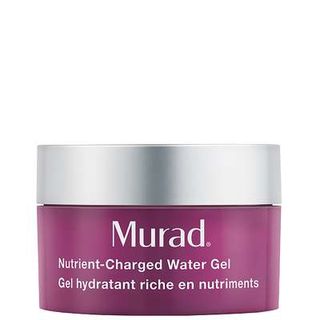
Murad Moisturisers Nutrient-Charged Water Gel
Works for
2 of 2 advertised claims delivered
MoisturizingCeramide eop, Sh-polypeptide-11 + 32 moreStrong evidence
“Moisturisers Nutrient-Charged Water Gel”
This product can help improve hydration of the skin with the two types of ingredients.
The first type is called “humectants”:
these ingredients help attract water.
When humectants are on the surface of the skin, they “pull in” the moisture from the outside environment, or from
within deeper layers of the skin. The following ingredients in this product do the job:
betaine, glycerin.
This product also contains ingredients called “occlusives”. They help reduce the speed with which our skin loses moisture to the outside environment. These ingredients also help soften the upper layer of the skin, so it feels less tight and nicer to the touch. The following ingredients in this product do the job: dimethicone, cholesterol.
The following ingredients in this product are especially good for supporting the skin barrier and helping with the hydration level: ceramide ap, ceramide eop, ceramide np, phytosphingosine, sh-oligopeptide-1, sh-polypeptide-11, urea
Anti-agingSerine, Sh-oligopeptide-1 + 3 moreModerate evidence
“Treating dry or dull skin. . Reducing fine lines and wrinkles. . Correcting rough skin texture.”
This product contains serine, sh-oligopeptide-1, sh-polypeptide-11. These ingredients might be able to help reduce and prevent fine lines and wrinkles, improve skin elasticity and firmness, but there is not enough evidence that it actually works.
ExfoliationNot advertised by the brand · Hydroxyethyl urea, UreaStrong evidence
This product can help exfoliate the skin. In other words, it helps break down the bonds between dead cells on the surface of the skin and speed up the skin turnover. Skin often appears softer and brighter after exfoliation, but overdoing it can result in disrupted skin barrier. The following ingredient is doing the exfoliating job in this product: hydroxyethyl urea.
Can it cause trouble?
Irritancy1 strong irritant: ParfumMedium risk
Comedogenic1 ingredient rated 2 or more on the 0–5 pore-clogging scale1 flagged

User reviews
Be the first — your take helps the next person decide.
Ingredients
Filter by role to see what each ingredient is doing.
Water~45–55%
Dimethicone~5.6–6.8%
- Irritation risk
- Low
A silicone that helps to reduce water loss from the surface of the skin. Can temporarily "fill in" lines and wrinkles, absorb oil, and create a nice product finish
More about DimethiconeGlycerin~4.2–5.1%
- Irritation risk
- Low
One of the best moisturizing ingredients. Naturally present in skin. It attracts water to the upper layer of the skin working as a humectant
More about GlycerinPropanediol~3.1–3.8%
- Irritation risk
- Low
Acts as a solvent for other ingredients. Speeds up the absorption of other ingredients into the skin
More about PropanediolSaccharide isomerate~2.3–2.8%
- Irritation risk
- Low
Helps attract water to the upper layer of the skin
More about Saccharide isomeratePolymethylsilsesquioxane/silica crosspolymer~1.9–2.4%
- Irritation risk
- Low
A type of silicone that helps add a "soft focus" effect on the surface of the skin and create a nice product texture
More about Polymethylsilsesquioxane/silica crosspolymerHydroxyethyl acrylate/sodium acryloyldimethyl taurate copolymer~1.6–2%
- Irritation risk
- Medium
A gelling agent that thickens the product consistency and leaves the skin with a velvety finish
More about Hydroxyethyl acrylate/sodium acryloyldimethyl taurate copolymerHydroxyethyl urea~1.4–1.7%
- Irritation risk
- Low
A derivative of urea, a compound that is naturally present in skin. Attracts water to the upper layer of the skin. Can enhance penetration of other ingredients
More about Hydroxyethyl ureaIsononyl isononanoate~1.2–1.5%
- Irritation risk
- Low
Forms a protective film on the surface of the skin to prevent moisture loss. Gives a velvety feel to products while reducing tackiness
More about Isononyl isononanoateCeramide np~0.95–1.15%
- Irritation risk
- Low
A type of lipid similar to ceramides naturally present in skin. Helps to soften the upper layer of the skin and supports the skin barrier function to keep it hydrated. Can help to prevent inflammation in skin
More about Ceramide npCeramide ap~0.65–0.95%
- Irritation risk
- Low
A type of lipid similar to ceramides naturally present in skin. Helps to soften the upper layer of the skin and supports the skin barrier function to keep it hydrated. Can help to prevent inflammation in skin
More about Ceramide apCeramide eop~0.55–0.85%
- Irritation risk
- Low
A type of lipid similar to ceramides naturally present in skin. Helps to soften the upper layer of the skin and supports the skin barrier function to keep it hydrated. Can help to prevent inflammation in skin
More about Ceramide eopSh-oligopeptide-1~0.45–0.7%
- Irritation risk
- Low
A type of peptide. Peptides are excellent moisturizers and might be able support collagen production reducing fine lines and wrinkles
More about Sh-oligopeptide-1Sh-polypeptide-7 sh-polypeptide-94 sh-polypeptide-95~0.4–0.65%
- Irritation risk
- Low
Sh-polypeptide-11~0.4–0.6%
- Irritation risk
- Low
A type of peptide. Peptides are excellent moisturizers and might be able support collagen production reducing fine lines and wrinkles
More about Sh-polypeptide-11Saccharomyces/zinc ferment~0.35–0.65%
- Irritation risk
- Low
Yeast extract that contains zinc. Can help to attract water to the upper layer of the skin. Evidence of effectiveness for other benefits is missing
More about Saccharomyces/zinc fermentSaccharomyces/copper ferment~0.35–0.6%
- Irritation risk
- Low
Yeast extract that contains copper. Can help to attract water to the upper layer of the skin and can help in skin wound healing
More about Saccharomyces/copper fermentSaccharomyces/magnesium ferment~0.3–0.55%
- Irritation risk
- Low
Yeast extract that contains magnesium. Can help to attract water to the upper layer of the skin. Evidence of effectiveness for other benefits is missing
More about Saccharomyces/magnesium fermentSaccharomyces/iron ferment~0.25–0.5%
- Irritation risk
- Low
Yeast extract that contains iron. Can help to attract water to the upper layer of the skin. Evidence of effectiveness for other benefits is missing
More about Saccharomyces/iron fermentSaccharomyces/silicon ferment~0.25–0.45%
- Irritation risk
- Low
Yeast extract that contains silicon. Can help to attract water to the upper layer of the skin. Evidence of effectiveness for other benefits is missing
More about Saccharomyces/silicon fermentLeuconostoc/radish root ferment filtrate~0.25–0.45%
- Irritation risk
- Medium
A preservative that comes from radishes fermented by a bacteria. New research suggests that the preservation properties in the ingredient come from an ammonium salt that is not present naturally in radish root but used in its cultivation. Is problematic because the exact amount of the preservative agents is difficult to determine
More about Leuconostoc/radish root ferment filtrateBacillus/folic acid ferment extract~0.2–0.4%
- Irritation risk
- Low
Trehalose~0.2–0.4%
- Irritation risk
- Low
A sugar that attracts water to the upper layer of the skin
More about TrehaloseTaurine~0.25–0.4%
- Irritation risk
- Medium
Could be helpful in reducing inflammation in skin, evening out the skin tone and neutralizing free radicals, but more research is needed to confirm its effectiveness
More about TaurineSerine~0.25–0.4%
- Irritation risk
- Low
An amino-acid that helps to attract water to the upper layer of the skin. In combination with other amino-acids, might help to reduce fine lines and wrinkles
More about SerineTocopheryl acetate~0.25–0.45%
- Irritation risk
- Medium
A more stable but less bio-available form of vitamin E compared to Tocopherol. Might help moisturize and protect the skin from free radicals, but mostly used in low concentrations to stabilize other ingredients.
More about Tocopheryl acetateCalcium pantothenate~0.25–0.45%
- Irritation risk
- Low
Helps support skin barrier function improving skin hydration and reducing sensitivity
More about Calcium pantothenateNiacinamide~0.25–0.45%
- Irritation risk
- Low
Is proven to be effective in reducing blemishes, evening out skin tone and helping to improve lines and wrinkles. It helps the skin to repair sun damage, calm down inflammation and keep maintain good levels of moisture. The concentration of about 2% is effective for supporting the skin barrier and evening out the skin tone. Concentration of 4-6% is better for helping with acne and balancing the sebum production
More about NiacinamidePhytantriol~0.25–0.45%
- Irritation risk
- Low
Acetyl glutamine~0.25–0.4%
- Irritation risk
- Low
Urea~0.25–0.45%
- Irritation risk
- Low
Naturally present in skin (urea makes up about 7% of natural moisturizing factors in skin). Attracts water to the upper layer of the skin. Also has a positive effect on the skin barrier beyond the humectant action. Can enhance penetration of other ingredients. Is an exfoliating ingredient when used in high concentrations
More about UreaCholesterol~0.3–0.55%
- Irritation risk
- Low
An emollient that is naturally found in skin
More about CholesterolYeast amino acids~0.25–0.45%
- Irritation risk
- Low
Phytosphingosine~0.3–0.5%
- Irritation risk
- Low
A type of lipid that is naturally present in skin. It might help in repairing skin barrier function and has anti-bacterial effect
More about PhytosphingosineInositol~0.25–0.45%
Betaine~0.25–0.4%
- Irritation risk
- Low
Helps attract water to the upper layer of the skin and improves the product texture
More about BetaineLecithin~0.25–0.5%
- Irritation risk
- Low
Used mostly for creating emulsions - helping oil and water mix together. Helps soften the upper layer of the skin
More about LecithinSodium ascorbyl phosphate~0.25–0.45%
- Irritation risk
- Medium
A stable derivative of vitamin C. It is oil-soluble which means it is more likely to penetrate the skin compared to the pure form of vitamin C (which is water-soluble), but it is less bio-available and is way less effective in stimulating collagen and reducing wrinkles compared to the pure form of vitamin C (L-ascorbic acid) and its other derivatives (for example, magnesium ascorbyl phosphate). At the same time, this vitamin C derivative has been shown in studies to be effective in reducing acne, blemishes and clogged pores. It is less irritating then the pure form of vitamin C
More about Sodium ascorbyl phosphateSodium hyaluronate~0.25–0.45%
- Irritation risk
- Low
One of the best moisturizing ingredients. Attracts water into the upper layer of the skin
More about Sodium hyaluronatePyridoxine hcl~0.25–0.4%
- Irritation risk
- Medium
Might help neutralize free radicals in skin
More about Pyridoxine hclSucrose~0.2–0.4%
- Irritation risk
- Low
Can help attract water to the upper layer of the skin. In crystal form, it can work as a gentle exfoliant, gentler than the salt scrub. Helps stabilize the emulsion
More about SucroseAlgin~0.25–0.45%
- Irritation risk
- Low
- Comedogenicity
- 3/5
Used to thicken product formulation. Can help attract water to the upper layer of the skin
More about AlginPullulan~0.25–0.45%
- Irritation risk
- High
Creates a thin drying film on the skin resulting in a short-term tightening effect
More about PullulanMaltodextrin~0.25–0.45%
- Irritation risk
- Low
Used to stabilize the product formulation and can help absorb oil
More about MaltodextrinPolysilicone-11~0.25–0.5%
- Irritation risk
- Low
A silicone that forms a light film on the skin surface helping to bind water and temporarily absorb oils creating a matt and powdery feel
More about Polysilicone-11Glyceryl polyacrylate~0.25–0.5%
- Irritation risk
- Low
Helps to create a nice product texture and spread the product more easily on the skin
More about Glyceryl polyacrylateDecyl glucoside~0.3–0.6%
- Irritation risk
- High
Helps oil and water mix together. Can be irritating
More about Decyl glucosidePentylene glycol~0.3–0.5%
- Irritation risk
- Medium
Used to preserve products, dissolve other ingredients and create a nice product texture
More about Pentylene glycolHexylene glycol~0.25–0.45%
- Irritation risk
- Medium
Helps create a more spreadable product texture
More about Hexylene glycolCaprylyl glycol~0.25–0.5%
- Irritation risk
- Medium
Helps preserve products and creates a nice product texture
More about Caprylyl glycolButylene glycol~0.25–0.45%
- Irritation risk
- Low
Used to create a nice product texture and help delivery of other ingredients. Might be somewhat helpful in attracting water to the upper layer of the skin
More about Butylene glycolEthylhexyl isononanoate~0.25–0.5%
- Irritation risk
- Low
Helps soften the upper layer of the skin and improve the product consistency
More about Ethylhexyl isononanoatePolyisobutene~0.25–0.5%
Silica~0.35–0.6%
Sodium starch octenylsuccinate~0.25–0.45%
- Irritation risk
- Low
Peg-7 trimethylolpropane coconut ether~0.25–0.45%
Trisodium ethylenediamine disuccinate~0.2–0.4%
- Irritation risk
- Medium
Used to improve stability of the formulation
More about Trisodium ethylenediamine disuccinateDisodium phosphate~0.2–0.4%
- Irritation risk
- Low
Helps adjust the product pH and stabilize the formulation
More about Disodium phosphatePotassium phosphate~0.2–0.4%
Carbomer~0.2–0.35%
- Irritation risk
- Low
Helps create a thicker or gel-like product texture. It is not a surfactant but can be used in gentle cleansing formulations
More about CarbomerXanthan gum~0.2–0.4%
- Irritation risk
- Low
Used to create a thicker product consistency
More about Xanthan gumSodium lauroyl lactylate~0.2–0.35%
- Irritation risk
- Medium
Helps water and oil mix together
More about Sodium lauroyl lactylate1,2-hexanediol~0.1–0.2%
Phenoxyethanol~0.1–0.25%
- Irritation risk
- Low
A preservative. It helps prevent bacterial growth in cosmetic products
More about PhenoxyethanolEthylhexylglycerin~0.15–0.25%
Parfum~0.1–0.2%
- Irritation risk
- High
An aromatic blend of unspecified and possibly irritating ingredients
More about ParfumCi 17200~0.1–0.15%
Ci 14700~0.1–0.15%
Ingredient list view
Water, Dimethicone, Glycerin, Propanediol, Saccharide isomerate, Polymethylsilsesquioxane/silica crosspolymer, Hydroxyethyl acrylate/sodium acryloyldimethyl taurate copolymer, Hydroxyethyl urea, Isononyl isononanoate, Ceramide np, Ceramide ap, Ceramide eop, Sh-oligopeptide-1, Sh-polypeptide-7 sh-polypeptide-94 sh-polypeptide-95, Sh-polypeptide-11, Saccharomyces/zinc ferment, Saccharomyces/copper ferment, Saccharomyces/magnesium ferment, Saccharomyces/iron ferment, Saccharomyces/silicon ferment, Leuconostoc/radish root ferment filtrate, Bacillus/folic acid ferment extract, Trehalose, Taurine, Serine, Tocopheryl acetate, Calcium pantothenate, Niacinamide, Phytantriol, Acetyl glutamine, Urea, Cholesterol, Yeast amino acids, Phytosphingosine, Inositol, Betaine, Lecithin, Sodium ascorbyl phosphate, Sodium hyaluronate, Pyridoxine hcl, Sucrose, Algin, Pullulan, Maltodextrin, Polysilicone-11, Glyceryl polyacrylate, Decyl glucoside, Pentylene glycol, Hexylene glycol, Caprylyl glycol, Butylene glycol, Ethylhexyl isononanoate, Polyisobutene, Silica, Sodium starch octenylsuccinate, Peg-7 trimethylolpropane coconut ether, Trisodium ethylenediamine disuccinate, Disodium phosphate, Potassium phosphate, Carbomer, Xanthan gum, Sodium lauroyl lactylate, 1,2-hexanediol, Phenoxyethanol, Ethylhexylglycerin, Parfum, Ci 17200, Ci 14700
Compare prices
Retailers ranked by price — lowest first.

Worth comparing, line by line.
Match % combines shared ingredients, the first five ingredients, shared actives and hero ingredients, irritancy (lower counts in the alternative's favour), texture and body area. Only products in the same routine step are compared.
| MuradMoisturisers Nutrient-Charged Water GelYOUR PRODUCT | CeraVeUltra-Light Moisturizing Gel | THE formularxBarrier Relief Lightweight Ceramide Moisturizer | DermaticaSoothing Centella Gel Moisturiser | |
|---|---|---|---|---|
| Match | — | 84% | 81% | 79% |
| Price | $59.69 | $14.19−$45.50 | $8.94−$50.75 | $17.31−$42.38 |
| Shared key ingredients | — | 9 of 27 | 9 of 27 | 8 of 27 |
| Key difference | — | Biosaccharide Gum-1 | Colloidal Oatmeal | Panthenol |
| Irritancy | Medium | Low | Low | Low |
| Drying alcohol | — | — | — | — |
| View product | Shop | Shop | Shop |
Product summary
Based on the ingredient list, "Murad - Moisturisers Nutrient-Charged Water Gel" can work well for skin moisturization. To work well, any moisturizer needs to include a combination of water-binding and emollient ingredients. Murad - Moisturisers Nutrient-Charged Water Gel ticks this box. Urea, betaine, glycerin, hydroxyethyl urea and inositol in this product (humectants) attract water molecules to the upper layer of the skin (the water comes from the outside air or from the deeper layers of the skin if the air is dry). Emollients in this formulation (ceramide eop, ceramide np, phytosphingosine, cholesterol and dimethicone) help to reduce the moisture loss from the skin. They also soften the skin surface and relieve the feeling of dryness and tightness.
Ingredient callouts
- Another benefit is that this moisturizer contain ceramides (phytosphingosine 0.30% - 0.50%, ceramide eop 0.55% - 0.85%, ceramide ap 0.65% - 0.95% and ceramide np 0.95% - 1.15%). Ceramides are an important part of our natural skin barrier. The Ceramides used in skincare are synthetic or come from plants. They help soften the skin and can help "fill the gaps" in the skin barrier, keeping the skin hydrated and resilient for longer.
- This moisturizer also contains Peptides (sh-polypeptide-11 0.40% - 0.60% and sh-oligopeptide-1 0.45% - 0.70%). Peptides are a very big group of ingredients. They all consist of a different combination of aminoacids. Our skin produces Peptides naturally. Some of them work as natural antibiotics, promote wound-healing and production of collagen. The scientists are still studying how effective the topical application of Peptides is, but it is very likely that they are helpful. Peptides might be able to support skin barrier restoration and even have an anti-aging benefit. At the very least, they certainly help attract water to the skin and support the hydration in this way.
Irritation risk
There are some common irritants in this product, including ingredients that do not have benefits for the skin. We assess the overall irritancy of this moisturizer to be medium. For a detailed overview of all potential irritants: click here
You can see the detailed formula review with the breakdown of all actives in the product and the full ingredient list with estimated concentrations in the tables below.
About the brand
According to Cruelty-Free Kitty "Murad" is cruelty free, but its parent company is not.
Price
The product retails from 44.10£ up to 52.50£ in the United Kingdom.
For a detailed price comparison: click here.
Sources cited in this review
Every concentration estimate and effectiveness label is anchored to one of these 29 studies and safety reviews.
- 1
- 2Final Report on the Safety Assessment of Dimethicone Copolyoljournals.sagepub.com
- 3
- 4
- 5
- 6

Affiliate links · As an Amazon Associate, WIMJ earns from qualifying purchases.