Works for:
based on ingredients and %- Anti-aging
- Moisturizing
- Evens skin tone
Can it cause trouble?
- Irritation risk: high
- Comedogenic risk ingredients: 12
Key actives
Product Summary
"Algenist - All You Need 5-Step" is effective for: Anti-aging and Moisturizing
This product could be helpful for: Evens skin tone, but its actives are not the most effective or are not well-studied.
Ingredient callouts
- this product includes a form of Retinoids (vitamin A) - retinyl palmitate 0.10% - 0.50% and retinyl palmitate 0.10% - 0.50%, but this type of vitamin A is not very effective. It could in theory help with fine lines and wrinkles, but the effect is most likely minimal.
- Ceramides (ceramide ng 0.15% - 0.60% and ceramide np 0.15% - 0.65%). Ceramides are a type of lipids that our skin produces itself. They are a building block of the skin's barrier. Ceramides used in skincare are synthetic or extracted from plants. They work well for softening the skin surface and "patch holes" in the skin's barrier.
- Peptides (palmitoyl tripeptide-5 0.15% - 0.55%, palmitoyl hexapeptide-12 0.15% - 0.55%, palmitoyl tetrapeptide-7 0.15% - 0.65%, dipeptide-2 0.15% - 0.55%, palmitoyl tripeptide-1 0.35% - 0.85% and palmitoyl tetrapeptide-7 0.35% - 0.80%). There are many different kind of Peptides and they are naturally present in our skin. They all are a combination of aminoacids. Some of them work as natural antibiotics, promote wound-healing and production of collagen. The science is still not settled on how effective Peptides are in skincare, but it is very likely that they have a benefit. They might help restore the skin barrier and fight the signs of aging. At the very least, Peptides work as humectants: they attract water to the upper layer of the skin and improve its hydration.
- Adenosine 0.15% - 0.55%. It is a compound that in involved in many biological processes inside the skin cells. According one high-quality clinical trial, topical Adenosine in low concentrations can somewhat help improve "deep wrinkles" - the wrinkles that appear with age in places where our faces are most dynamic (for example, on the forehead or in the corners of the eyes).
- Humectants (pantolactone 0.15% - 0.55%, glucosamine hcl 0.15% - 0.60%, sodium hyaluronate 0.15% - 0.55%, parachlorella beijerinckii exopolysaccharides 0.20% - 0.70%, glycerin 0.15% - 0.65%, glycerin 0.15% - 0.65%, parachlorella beijerinckii exopolysaccharides 0.20% - 0.70%, diglycerin 0.15% - 0.55%, sodium lactate 0.15% - 0.55%, parachlorella beijerinckii exopolysaccharides 0.20% - 0.70%, parachlorella beijerinckii exopolysaccharides 0.60% - 1.35%, glycerin 0.15% - 0.65%, glycerin 1.90% - 2.90%, cylindrotheca fusiformis extract 0.35% - 0.80%, glycerin 0.15% - 0.65% and betaine 1.40% - 2.10%). These ingredients help attract water to the upper layer of the skin and improve the skin hydration.
Works for
Anti-aging
What does the product description say?
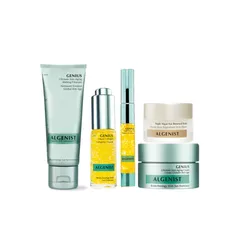
2mLGENIUS Liquid Collagen Lip 10mLGENIUS Anti-Aging Cream 30mL Triple Algae Eye Renewal Balm 5mL GENIUS Ultimate Anti-Aging Melting Cleanser 45mL
Source: Algenist
This product can help reduce and prevent fine lines and wrinkles, improve skin elasticity and firmness because it contains adenosine, palmitoyl hexapeptide-12.
These ingredients in the product can also be helpful, even though there is less evidence for their effectiveness: dipeptide-2, palmitoyl tetrapeptide-7, palmitoyl tripeptide-1, palmitoyl tripeptide-5.
Keep in mind that it typically takes at least 6 weeks to notice any results because the changes that are needed to improve fine lines and elasticity happen in the deeper layers of the skin. No topical anti-aging product can “erase” wrinkles or fully reverse signs of aging.
A type of peptide. Peptides are excellent moisturizers and might be able support collagen production reducing fine lines and wrinkles
Might help improve cell turnover and reduce inflammation in skin. One study shows that the ingredients might be able to help reduce dynamic wrinkles (for example, in the corners of the eyes or on the forehead)
A type of peptide. Peptides are excellent moisturizers and might be able support collagen production reducing fine lines and wrinkles
A type of peptide. Peptides are excellent moisturizers and might be able support collagen production reducing fine lines and wrinkles
A type of peptide. Peptides are excellent moisturizers and might be able support collagen production reducing fine lines and wrinkles
A type of peptide. Peptides are excellent moisturizers and might be able support collagen production reducing fine lines and wrinkles
Might be able to stimulate production of skin's natural moisturizing compounds such as hyaluronic acid. Could be helpful for evening the skin tone.
This oil's cmposition is closest to rapeseed oil. It is a very stable oil and serves as an emoillient
Is proven to be effective in reducing blemishes, evening out skin tone and helping to improve lines and wrinkles. It helps the skin to repair sun damage, calm down inflammation and keep maintain good levels of moisture. The concentration of about 2% is effective for supporting the skin barrier and evening out the skin tone. Concentration of 4-6% is better for helping with acne and balancing the sebum production
Being a lipid soluble form of vitamin C, it is more stable than ascorbic acid, but still degrades quickly and needs to be stabilized in a formulation with another ingredient. It is claimed to penetrate skin better than pure vitamin C and have the the similar benefits, but solid studies of its effectiveness are lacking. Is likely to require a higher concentration in a product than pure vitamin C to be effective. It might be able to help reduce pore clogging.
An exfoliating and moisturizing alpha-hydroxy acid (AHA). Typically causes less irritation than other AHAs, for example, glycolic acid. At high concentrations (about 15%), lactic acid can help reduce lines and wrinkles. Recent studies show that lactic acid can support the "good" bacteria living on skin's surface (healthy skin microbiome)
Three steps removed from the active form of vitamin A - retinoic acid. To have an effect in the skin, it first needs to be converted twice to become the retinoic acid. This means it is less potent than retinol, but could also be less irritating. Once converted to the retinoic acid in the skin, it helps against all signs of aging, improves skin cell turnover and helps fight blemishes and clogged pores. However, in many cosmetic formulations, it is used in a concentration that is too low to have the full effect
Can contain potent anti-oxidant compounds (abbreviated ECG, GCG, EGC, and EGCG) that might help protect the skin from free radicals. Can help calm down inflammation and has some anti-bacterial properties. Unfortunately, these antioxidants are unstable and lose their effectiveness very quickly in products. The concentration of the antioxidant compounds in the extract also tends to be low to be effective in topical formulation
A great moisturising ingredient that softens the skin and reduces water loss from its upper layer. It also can be helpful in protecting skin from free radicals
Pure form of vitamin E. Can help moisturise and protect the skin from free radicals. Often used to help stabilise other ingredients or the formula itself
Traditionally used to treat sunburns, dermatitis and inflammation, but evidence for its effectiveness is lacking. The extract can contain humectants that help attract water into the skin
Moisturizing
This product can help improve hydration of the skin with the two types of ingredients.
The first type is called “humectants”:
these ingredients help attract water.
When humectants are on the surface of the skin, they “pull in” the moisture from the outside environment, or from
within deeper layers of the skin. The following ingredients in this product do the job:
betaine, cylindrotheca fusiformis extract.
This product also contains ingredients called “occlusives”. They help reduce the speed with which our skin loses moisture to the outside environment. These ingredients also help soften the upper layer of the skin, so it feels less tight and nicer to the touch. The following ingredients in this product do the job: chlorella protothecoides oil, dimethicone.
The following ingredients in this product are especially good for supporting the skin barrier and helping with the hydration level: ceramide ng, ceramide np, dipeptide-2, palmitoyl hexapeptide-12, palmitoyl tetrapeptide-7, palmitoyl tripeptide-1, palmitoyl tripeptide-5
Might be able to stimulate production of skin's natural moisturizing compounds such as hyaluronic acid. Could be helpful for evening the skin tone.
Compounds extracted from green algae that could help neutralize free radicals, but evidence of effectiveness in skincare products (topical applicaiton) is missing. Helps moisturize the skin by attracting water to its upper layer
A type of peptide. Peptides are excellent moisturizers and might be able support collagen production reducing fine lines and wrinkles
A type of peptide. Peptides are excellent moisturizers and might be able support collagen production reducing fine lines and wrinkles
Helps soften the upper layer of the skin
A type of lipid similar to ceramides naturally present in skin. Helps to soften the upper layer of the skin and supports the skin barrier function to keep it hydrated. Can help to prevent inflammation in skin
A type of lipid similar to ceramides naturally present in skin. Helps to soften the upper layer of the skin and supports the skin barrier function to keep it hydrated. Can help to prevent inflammation in skin
An emollient. Is unlikely to have additional benefits for the skin
Help attract water to the upper layer of the skin, soften it and support the skin barrier function
Red algae extract that helps attract water to the upper layer of the skin and might contain antioxidants
Helps skin moisturization by attracting water to the upper layer of the skin. Might have some anti-oxidant properties but research confirming effectiveness in skin is lacking
Helps attract water to the upper layer of the skin
A silicone that helps to reduce water loss from the surface of the skin. Can temporarily "fill in" lines and wrinkles, absorb oil, and create a nice product finish
A type of peptide. Peptides are excellent moisturizers and might be able support collagen production reducing fine lines and wrinkles
One of the best moisturizing ingredients. Naturally present in skin. It attracts water to the upper layer of the skin working as a humectant
A great emollient due to its high linoleic acid content. One of the most effective plant oils in helping skin hydration and repairing skin barrier function
One of the best moisturizing ingredients. Attracts water into the upper layer of the skin
Helps attract water to the upper layer of the skin
This oil's cmposition is closest to rapeseed oil. It is a very stable oil and serves as an emoillient
A type of peptide. Peptides are excellent moisturizers and might be able support collagen production reducing fine lines and wrinkles
Helps attract water to the upper layer of the skin. Is often used to adjust the pH level of the product
Helps attract water to the upper layer of the skin and improves the product texture
A seaweed extract that helps attract water to the upper layer of the skin and might have an anti-oxidant effect
A type of peptide. Peptides are excellent moisturizers and might be able support collagen production reducing fine lines and wrinkles
Used to stabilize the product formulations and works as an emollient
A non-drying alcohol that works to soften the skin and stabilize product formulations helping oil and water mix together
Enhances the product texture and makes it more spreadable. Helps reduce water loss from the outer layer of skin. Extands the shelf life by preventing bacteria growth
Might help improve cell turnover and reduce inflammation in skin. One study shows that the ingredients might be able to help reduce dynamic wrinkles (for example, in the corners of the eyes or on the forehead)
Used to create a thicker product texture. Helps soften the upper layer of the skin and might be able to prevent moisture loss from its surface
Helps attract water to the upper layer of the skin and soften it
Cannot penetrate the skin barrier so is not particularly useful in skincare products
Helps to soften the upper layer of the skin and attract water to it
An emollient that helps soften the skin and create a nice product texture
A green micro-algae extract that might help neutralize free radicals in skin, but solid evidence is lacking. It helps to soften the upper layer of the skin
An emollient that helps soften the skin but is not effective for restoring its barrier function. Might be helpful to calm down inflammation
Emollients that are naturaly present in skin. In addition, they help water and oil mix together in the product
A non-drying alcohol. Works as an emollient. Helps water and oil mix together and creates a nice product texture
Used to create a nice product texture and help delivery of other ingredients. Might be somewhat helpful in attracting water to the upper layer of the skin
A plant extract that adds a sweat taste to products (for example, for lip products). Might help to attract water to the upper layer of the skin and have some anti-oxidant effect
Used to create a thicker product consistency and soften the upper layer of the skin
Traditionally used to treat sunburns, dermatitis and inflammation, but evidence for its effectiveness is lacking. The extract can contain humectants that help attract water into the skin
A plant extract that might help to attract water to the upper layer of the skin, but it is not well studied. It can be irritating
Helps preserve products and creates a nice product texture
An emollient that softens the skin and forms a protective layer on its surface. Helps water and oil mix together
Used to improve the product consistency and soften the upper layer of the skin
Forms a protective film on the surface of the skin to prevent moisture loss. Gives a velvety feel to products while reducing tackiness
An emollient that helps soften the skin
An emollient that is naturally present in skin and helps soften it
Used to preserve products, dissolve other ingredients and create a nice product texture
Is used to dissolve other ingredients and create nice product texture
Is proven to be effective in reducing blemishes, evening out skin tone and helping to improve lines and wrinkles. It helps the skin to repair sun damage, calm down inflammation and keep maintain good levels of moisture. The concentration of about 2% is effective for supporting the skin barrier and evening out the skin tone. Concentration of 4-6% is better for helping with acne and balancing the sebum production
A good mix of fatty acids that forms a protective layer on the skin. Improves the shelf life of products. Derived from coconut and glycerin
An exfoliating and moisturizing alpha-hydroxy acid (AHA). Typically causes less irritation than other AHAs, for example, glycolic acid. At high concentrations (about 15%), lactic acid can help reduce lines and wrinkles. Recent studies show that lactic acid can support the "good" bacteria living on skin's surface (healthy skin microbiome)
Mineral oil. One of the most effective and well studied occlusive and emollient moisturizing ingredients. Helps reduce moisture loss in skin and repair skin barrier function
An emollient that helps soften the skin and could be helpful in repairing its barrier function
Helps attract water to the upper layer of the skin and can help improve skin barrier function
A great moisturising ingredient that softens the skin and reduces water loss from its upper layer. It also can be helpful in protecting skin from free radicals
Sugars produced by sea bacteria that can help to attract water to the upper layer of the skin
Pure form of vitamin E. Can help moisturise and protect the skin from free radicals. Often used to help stabilise other ingredients or the formula itself
Might be somewhat helpful in reducing hyperpigmentation and neutralizing free radicals but its typical concentration in a product is too low for having an effect
Traditionally used to treat sunburns, dermatitis and inflammation, but evidence for its effectiveness is lacking. The extract can contain humectants that help attract water into the skin
Helps oil and water mix together and works as an emollient
Can contain potent anti-oxidant compounds (abbreviated ECG, GCG, EGC, and EGCG) that might help protect the skin from free radicals. Can help calm down inflammation and has some anti-bacterial properties. Unfortunately, these antioxidants are unstable and lose their effectiveness very quickly in products. The concentration of the antioxidant compounds in the extract also tends to be low to be effective in topical formulation
Evens skin tone
The following ingredient (ingredients) in this product might be helpful, but there is no evidence to confirm that it actually works: glucosamine hcl.
Might be able to stimulate production of skin's natural moisturizing compounds such as hyaluronic acid. Could be helpful for evening the skin tone.
Is proven to be effective in reducing blemishes, evening out skin tone and helping to improve lines and wrinkles. It helps the skin to repair sun damage, calm down inflammation and keep maintain good levels of moisture. The concentration of about 2% is effective for supporting the skin barrier and evening out the skin tone. Concentration of 4-6% is better for helping with acne and balancing the sebum production
Being a lipid soluble form of vitamin C, it is more stable than ascorbic acid, but still degrades quickly and needs to be stabilized in a formulation with another ingredient. It is claimed to penetrate skin better than pure vitamin C and have the the similar benefits, but solid studies of its effectiveness are lacking. Is likely to require a higher concentration in a product than pure vitamin C to be effective. It might be able to help reduce pore clogging.
An exfoliating and moisturizing alpha-hydroxy acid (AHA). Typically causes less irritation than other AHAs, for example, glycolic acid. At high concentrations (about 15%), lactic acid can help reduce lines and wrinkles. Recent studies show that lactic acid can support the "good" bacteria living on skin's surface (healthy skin microbiome)
Three steps removed from the active form of vitamin A - retinoic acid. To have an effect in the skin, it first needs to be converted twice to become the retinoic acid. This means it is less potent than retinol, but could also be less irritating. Once converted to the retinoic acid in the skin, it helps against all signs of aging, improves skin cell turnover and helps fight blemishes and clogged pores. However, in many cosmetic formulations, it is used in a concentration that is too low to have the full effect
Can contain potent anti-oxidant compounds (abbreviated ECG, GCG, EGC, and EGCG) that might help protect the skin from free radicals. Can help calm down inflammation and has some anti-bacterial properties. Unfortunately, these antioxidants are unstable and lose their effectiveness very quickly in products. The concentration of the antioxidant compounds in the extract also tends to be low to be effective in topical formulation
Might be helpful in protecting skin collagen and elastin from breaking down but solid research is lacking
How honest is this product?
| Promise | Can it deliver? |
|---|---|
| Anti-aging |
Total Promises Fulfilled score: 100/100.
Potential irritants
Comedogenic ingredients
User reviews (0)
Averages from community submissions.
No reviews yet for this product.
Be the first to share your experience!
Tried this product?
Help capture what the ingredient list can't—texture, finish, pilling, scent, and more. Answer what you can, skip the rest.
Takes ~30 seconds.
Reviews are shown in aggregate. No personal details.
| Product | Similarity | Price | Irritancy |
|---|---|---|---|
 Algenist All You Need 5-Step | Current | - | |
 TIRTIR Matcha Calming Cream 50ml | 76% | ≈ $23.14 | |
 NACIFIC Uyu cream | 73% | $16.99 | |
Medicube Hyaluronic Multi Peptide Serum | 72% | $18.90 | |
 BLANC DIVA Rebirth Serum | 72% | $36.73 | |
Purito SEOUL Wonder Releaf Centella Serum Unscented | 72% | $16.10 |
Key Actives
Is proven to be effective in reducing blemishes, evening out skin tone and helping to improve lines and wrinkles. It helps the skin to repair sun damage, calm down inflammation and keep maintain good levels of moisture. The concentration of about 2% is effective for supporting the skin barrier and evening out the skin tone. Concentration of 4-6% is better for helping with acne and balancing the sebum production
Can contain potent anti-oxidant compounds (abbreviated ECG, GCG, EGC, and EGCG) that might help protect the skin from free radicals. Can help calm down inflammation and has some anti-bacterial properties. Unfortunately, these antioxidants are unstable and lose their effectiveness very quickly in products. The concentration of the antioxidant compounds in the extract also tends to be low to be effective in topical formulation
Might be able to stimulate production of skin's natural moisturizing compounds such as hyaluronic acid. Could be helpful for evening the skin tone.
Pure form of vitamin E. Can help moisturise and protect the skin from free radicals. Often used to help stabilise other ingredients or the formula itself
Three steps removed from the active form of vitamin A - retinoic acid. To have an effect in the skin, it first needs to be converted twice to become the retinoic acid. This means it is less potent than retinol, but could also be less irritating. Once converted to the retinoic acid in the skin, it helps against all signs of aging, improves skin cell turnover and helps fight blemishes and clogged pores. However, in many cosmetic formulations, it is used in a concentration that is too low to have the full effect
Pure form of vitamin E. Can help moisturise and protect the skin from free radicals. Often used to help stabilise other ingredients or the formula itself
Three steps removed from the active form of vitamin A - retinoic acid. To have an effect in the skin, it first needs to be converted twice to become the retinoic acid. This means it is less potent than retinol, but could also be less irritating. Once converted to the retinoic acid in the skin, it helps against all signs of aging, improves skin cell turnover and helps fight blemishes and clogged pores. However, in many cosmetic formulations, it is used in a concentration that is too low to have the full effect
Might help improve cell turnover and reduce inflammation in skin. One study shows that the ingredients might be able to help reduce dynamic wrinkles (for example, in the corners of the eyes or on the forehead)
A great moisturising ingredient that softens the skin and reduces water loss from its upper layer. It also can be helpful in protecting skin from free radicals
A type of lipid similar to ceramides naturally present in skin. Helps to soften the upper layer of the skin and supports the skin barrier function to keep it hydrated. Can help to prevent inflammation in skin
This oil's cmposition is closest to rapeseed oil. It is a very stable oil and serves as an emoillient
Might help improve cell turnover and reduce inflammation in skin. One study shows that the ingredients might be able to help reduce dynamic wrinkles (for example, in the corners of the eyes or on the forehead)
A great moisturising ingredient that softens the skin and reduces water loss from its upper layer. It also can be helpful in protecting skin from free radicals
This oil's cmposition is closest to rapeseed oil. It is a very stable oil and serves as an emoillient
Helps attract water to the upper layer of the skin and can help improve skin barrier function
Compounds extracted from green algae that could help neutralize free radicals, but evidence of effectiveness in skincare products (topical applicaiton) is missing. Helps moisturize the skin by attracting water to its upper layer
A type of peptide. Peptides are excellent moisturizers and might be able support collagen production reducing fine lines and wrinkles
A type of peptide. Peptides are excellent moisturizers and might be able support collagen production reducing fine lines and wrinkles
A silicone that helps to reduce water loss from the surface of the skin. Can temporarily "fill in" lines and wrinkles, absorb oil, and create a nice product finish
Compounds extracted from green algae that could help neutralize free radicals, but evidence of effectiveness in skincare products (topical applicaiton) is missing. Helps moisturize the skin by attracting water to its upper layer
Compounds extracted from green algae that could help neutralize free radicals, but evidence of effectiveness in skincare products (topical applicaiton) is missing. Helps moisturize the skin by attracting water to its upper layer
A silicone that helps to reduce water loss from the surface of the skin. Can temporarily "fill in" lines and wrinkles, absorb oil, and create a nice product finish
Compounds extracted from green algae that could help neutralize free radicals, but evidence of effectiveness in skincare products (topical applicaiton) is missing. Helps moisturize the skin by attracting water to its upper layer
Red algae extract that helps attract water to the upper layer of the skin and might contain antioxidants
A seaweed extract that helps attract water to the upper layer of the skin and might have an anti-oxidant effect
A type of peptide. Peptides are excellent moisturizers and might be able support collagen production reducing fine lines and wrinkles
A type of peptide. Peptides are excellent moisturizers and might be able support collagen production reducing fine lines and wrinkles
A type of peptide. Peptides are excellent moisturizers and might be able support collagen production reducing fine lines and wrinkles
A type of peptide. Peptides are excellent moisturizers and might be able support collagen production reducing fine lines and wrinkles
Might be helpful in neutralizing free radicals. Can have a dehydration effect that might somewhat decrease the look of puffy eyes
A type of lipid similar to ceramides naturally present in skin. Helps to soften the upper layer of the skin and supports the skin barrier function to keep it hydrated. Can help to prevent inflammation in skin
One of the best moisturizing ingredients. Naturally present in skin. It attracts water to the upper layer of the skin working as a humectant
Helps attract water to the upper layer of the skin and improves the product texture
Help attract water to the upper layer of the skin, soften it and support the skin barrier function
An emollient. Is unlikely to have additional benefits for the skin
Helps skin moisturization by attracting water to the upper layer of the skin. Might have some anti-oxidant properties but research confirming effectiveness in skin is lacking
A great emollient due to its high linoleic acid content. One of the most effective plant oils in helping skin hydration and repairing skin barrier function
A good mix of fatty acids that forms a protective layer on the skin. Improves the shelf life of products. Derived from coconut and glycerin
Helps attract water to the upper layer of the skin. Is often used to adjust the pH level of the product
Avobenzone. An organic, or so-called "chemical" UV filter. Protects against both UVA and UVB rays. Needs to be combined with other filters in a formulation to be stable.
A weak sunscreen that protects against the sun rays that cause sunburn (UVB) and is somewhat effective against the UVA rays. It is quite stable and can help stabilize other, more vulnerable, sunscreen ingredients like Avobenzone. It is an organic, or so called "chemical" sunscreen
Mineral oil. One of the most effective and well studied occlusive and emollient moisturizing ingredients. Helps reduce moisture loss in skin and repair skin barrier function
A good mix of fatty acids that forms a protective layer on the skin. Improves the shelf life of products. Derived from coconut and glycerin
One of the best moisturizing ingredients. Naturally present in skin. It attracts water to the upper layer of the skin working as a humectant
An emollient. Is unlikely to have additional benefits for the skin
One of the best moisturizing ingredients. Naturally present in skin. It attracts water to the upper layer of the skin working as a humectant
Helps attract water to the upper layer of the skin
Help attract water to the upper layer of the skin, soften it and support the skin barrier function
An emollient. Is unlikely to have additional benefits for the skin
A great emollient due to its high linoleic acid content. One of the most effective plant oils in helping skin hydration and repairing skin barrier function
Avobenzone. An organic, or so-called "chemical" UV filter. Protects against both UVA and UVB rays. Needs to be combined with other filters in a formulation to be stable.
A weak sunscreen that protects against the sun rays that cause sunburn (UVB) and is somewhat effective against the UVA rays. It is quite stable and can help stabilize other, more vulnerable, sunscreen ingredients like Avobenzone. It is an organic, or so called "chemical" sunscreen
A good mix of fatty acids that forms a protective layer on the skin. Improves the shelf life of products. Derived from coconut and glycerin
One of the best moisturizing ingredients. Naturally present in skin. It attracts water to the upper layer of the skin working as a humectant
An emollient that helps soften the skin and could be helpful in repairing its barrier function
An emollient. Is unlikely to have additional benefits for the skin
Helps soften the upper layer of the skin
One of the best moisturizing ingredients. Naturally present in skin. It attracts water to the upper layer of the skin working as a humectant
One of the best moisturizing ingredients. Attracts water into the upper layer of the skin
Helps attract water to the upper layer of the skin
Potential irritants
A plant extract that might have some anti-oxidant properties. Contains an essential oil that can irritate the skin
An aromatic blend of unspecified and possibly irritating ingredients
A common frangrance that can easily irritate skin, especially if exposed to air, light or heat
Can be drying and contribute to skin irritation. Used in formulars to dissolve other ingredients, create a thinner product consistency or for its antibacterial properties
A plant extract that might have some anti-oxidant properties. It might be irritating
Three steps removed from the active form of vitamin A - retinoic acid. To have an effect in the skin, it first needs to be converted twice to become the retinoic acid. This means it is less potent than retinol, but could also be less irritating. Once converted to the retinoic acid in the skin, it helps against all signs of aging, improves skin cell turnover and helps fight blemishes and clogged pores. However, in many cosmetic formulations, it is used in a concentration that is too low to have the full effect
A plant extract that might help to attract water to the upper layer of the skin, but it is not well studied. It can be irritating
It is a derivative of isoeugenol, an aromatic compound in clove essential oil. It is sold to cosmetic companies under the name Sym3D. The ingredient's manufacturer claims that it is able to plump lips and have an anti-aging effect. The evidence of effectiveness, however, is weak. The lab tests with skin models (not with real people) show that it, in theory, it can increase the number and size of fat cells underneath the skin and can work as an anti-oxidant. To impact the fat cells, the ingredient, however, needs to penetrate deep through the skin - and it is unlikely that it can do this. A clinical test with 44 female volunteers conducted by the manufacturer showed that twice daily application of this ingredient in 0.25% concentration on lips increased their volume by 6% in 28 days. It is unclear where the effect is coming from. It is possible that this visible effect appears because of the skin irritation
Fragrance with sweet balsamic smell. Help to preserve products and dissolve other ingredients. Could trigger allergic reactions and be irritating
Might help neutralize free radicals in skin. Is claimed to be able to improve the appearance of undereye darkness but evidence is missing. Can be an allergen and cause irritation
A preservative. Can be used to mask unpleasant smell. Can be irritating
Used to preserve products, dissolve other ingredients and create a nice product texture
A preservative that comes from radishes fermented by a bacteria. New research suggests that the preservation properties in the ingredient come from an ammonium salt that is not present naturally in radish root but used in its cultivation. Is problematic because the exact amount of the preservative agents is difficult to determine
A good mix of fatty acids that forms a protective layer on the skin. Improves the shelf life of products. Derived from coconut and glycerin
Helps attract water to the upper layer of the skin. Is often used to adjust the pH level of the product
A weak sunscreen that offers some protection against the sun rays that cause sunburn (UVB), but does not offer meaningful protection against protect against the most aging sun rays (UVA). It loses its effectiveness quickly when exposed to sunlight. It is an organic, or so called "chemical" sunscreen. When used in low concentrations, helps to stabilize the product formulation
Avobenzone. An organic, or so-called "chemical" UV filter. Protects against both UVA and UVB rays. Needs to be combined with other filters in a formulation to be stable.
Helps preserve products and creates a nice product texture
A weak sunscreen that protects against the sun rays that cause sunburn (UVB) and is somewhat effective against the UVA rays. It is quite stable and can help stabilize other, more vulnerable, sunscreen ingredients like Avobenzone. It is an organic, or so called "chemical" sunscreen
Maintains the texture of skincare products. Allows the product to spread evenly. Helps oil and water mix together
A plant extract that adds a sweat taste to products (for example, for lip products). Might help to attract water to the upper layer of the skin and have some anti-oxidant effect
An emollient that helps soften the skin but is not effective for restoring its barrier function. Might be helpful to calm down inflammation
An emollient that helps soften the skin and could be helpful in repairing its barrier function
Sugars produced by sea bacteria that can help to attract water to the upper layer of the skin
A more stable but less bio-available form of vitamin E compared to Tocopherol. Might help moisturize and protect the skin from free radicals, but mostly used in low concentrations to stabilize other ingredients.
Might be helpful in neutralizing free radicals. Can have a dehydration effect that might somewhat decrease the look of puffy eyes
Might be helpful in neutralizing free radicals in skin
Being a lipid soluble form of vitamin C, it is more stable than ascorbic acid, but still degrades quickly and needs to be stabilized in a formulation with another ingredient. It is claimed to penetrate skin better than pure vitamin C and have the the similar benefits, but solid studies of its effectiveness are lacking. Is likely to require a higher concentration in a product than pure vitamin C to be effective. It might be able to help reduce pore clogging.
Traditionally used to treat sunburns, dermatitis and inflammation, but evidence for its effectiveness is lacking. The extract can contain humectants that help attract water into the skin
The extract can contain up to 70% of silica. In cosmetics, silica helps absorb oil and creates a thicker product texture
Might be helpful in protecting skin collagen and elastin from breaking down but solid research is lacking
Might be somewhat helpful in reducing hyperpigmentation and neutralizing free radicals but its typical concentration in a product is too low for having an effect
Helps oil and water mix together. Can be used as a cleansing agent
A plant extract that might have some anti-oxidant properties but evidence of effectiveness in skin is lacking
Traditionally used to treat sunburns, dermatitis and inflammation, but evidence for its effectiveness is lacking. The extract can contain humectants that help attract water into the skin
Helps oil and water mix together. Has some emollient properties
An exfoliating and moisturizing alpha-hydroxy acid (AHA). Typically causes less irritation than other AHAs, for example, glycolic acid. At high concentrations (about 15%), lactic acid can help reduce lines and wrinkles. Recent studies show that lactic acid can support the "good" bacteria living on skin's surface (healthy skin microbiome)
Can work as an exfoliant but is typically used to adjust the product pH
Helps to control the skin's pH level. Maintains the skin's natural film of amino-lactic acids and oils. Helps to preserve products
Comedogenic ingredients
An emollient. Is unlikely to have additional benefits for the skin
An emollient. Is unlikely to have additional benefits for the skin
A great moisturising ingredient that softens the skin and reduces water loss from its upper layer. It also can be helpful in protecting skin from free radicals
An emollient. Is unlikely to have additional benefits for the skin
An emollient that helps soften the skin and create a nice product texture
An emollient. Is unlikely to have additional benefits for the skin
An emollient that helps soften the skin
Used to stabilize the product formulations and works as an emollient
A non-drying alcohol. Works as an emollient. Helps water and oil mix together and creates a nice product texture
A great moisturising ingredient that softens the skin and reduces water loss from its upper layer. It also can be helpful in protecting skin from free radicals
Red algae extract that helps attract water to the upper layer of the skin and might contain antioxidants
Helps oil and water mix together. Has some emollient properties
All ingredients
Cannot penetrate the skin barrier so is not particularly useful in skincare products
Acts as a solvent for other ingredients. Speeds up the absorption of other ingredients into the skin
Forms a protective film on the surface of the skin to prevent moisture loss. Gives a velvety feel to products while reducing tackiness
Used to create a nice product texture and help delivery of other ingredients. Might be somewhat helpful in attracting water to the upper layer of the skin
One of the best moisturizing ingredients. Naturally present in skin. It attracts water to the upper layer of the skin working as a humectant
Helps attract water to the upper layer of the skin and improves the product texture
Used to preserve products, dissolve other ingredients and create a nice product texture
Help attract water to the upper layer of the skin, soften it and support the skin barrier function
Compounds extracted from green algae that could help neutralize free radicals, but evidence of effectiveness in skincare products (topical applicaiton) is missing. Helps moisturize the skin by attracting water to its upper layer
An emollient. Is unlikely to have additional benefits for the skin
A plant extract that might have some anti-oxidant properties. Contains an essential oil that can irritate the skin
Helps skin moisturization by attracting water to the upper layer of the skin. Might have some anti-oxidant properties but research confirming effectiveness in skin is lacking
Is proven to be effective in reducing blemishes, evening out skin tone and helping to improve lines and wrinkles. It helps the skin to repair sun damage, calm down inflammation and keep maintain good levels of moisture. The concentration of about 2% is effective for supporting the skin barrier and evening out the skin tone. Concentration of 4-6% is better for helping with acne and balancing the sebum production
Pure form of vitamin E. Can help moisturise and protect the skin from free radicals. Often used to help stabilise other ingredients or the formula itself
A type of peptide. Peptides are excellent moisturizers and might be able support collagen production reducing fine lines and wrinkles
A type of peptide. Peptides are excellent moisturizers and might be able support collagen production reducing fine lines and wrinkles
Might help improve cell turnover and reduce inflammation in skin. One study shows that the ingredients might be able to help reduce dynamic wrinkles (for example, in the corners of the eyes or on the forehead)
A great emollient due to its high linoleic acid content. One of the most effective plant oils in helping skin hydration and repairing skin barrier function
A preservative that comes from radishes fermented by a bacteria. New research suggests that the preservation properties in the ingredient come from an ammonium salt that is not present naturally in radish root but used in its cultivation. Is problematic because the exact amount of the preservative agents is difficult to determine
A good mix of fatty acids that forms a protective layer on the skin. Improves the shelf life of products. Derived from coconut and glycerin
An emollient that is naturally present in skin and helps soften it
Helps create a thicker or gel-like product texture. It is not a surfactant but can be used in gentle cleansing formulations
Helps attract water to the upper layer of the skin. Is often used to adjust the pH level of the product
A weak sunscreen that offers some protection against the sun rays that cause sunburn (UVB), but does not offer meaningful protection against protect against the most aging sun rays (UVA). It loses its effectiveness quickly when exposed to sunlight. It is an organic, or so called "chemical" sunscreen. When used in low concentrations, helps to stabilize the product formulation
Avobenzone. An organic, or so-called "chemical" UV filter. Protects against both UVA and UVB rays. Needs to be combined with other filters in a formulation to be stable.
Helps preserve products and creates a nice product texture
A weak sunscreen that protects against the sun rays that cause sunburn (UVB) and is somewhat effective against the UVA rays. It is quite stable and can help stabilize other, more vulnerable, sunscreen ingredients like Avobenzone. It is an organic, or so called "chemical" sunscreen
A preservative. It helps prevent bacterial growth in cosmetic products
An aromatic blend of unspecified and possibly irritating ingredients
A common frangrance that can easily irritate skin, especially if exposed to air, light or heat
Can be drying and contribute to skin irritation. Used in formulars to dissolve other ingredients, create a thinner product consistency or for its antibacterial properties
Mineral oil. One of the most effective and well studied occlusive and emollient moisturizing ingredients. Helps reduce moisture loss in skin and repair skin barrier function
A good mix of fatty acids that forms a protective layer on the skin. Improves the shelf life of products. Derived from coconut and glycerin
Used to improve the product consistency and soften the upper layer of the skin
One of the best moisturizing ingredients. Naturally present in skin. It attracts water to the upper layer of the skin working as a humectant
An emollient. Is unlikely to have additional benefits for the skin
A silicone that helps to reduce water loss from the surface of the skin. Can temporarily "fill in" lines and wrinkles, absorb oil, and create a nice product finish
Used to create a nice product texture and help delivery of other ingredients. Might be somewhat helpful in attracting water to the upper layer of the skin
An emollient that softens the skin and forms a protective layer on its surface. Helps water and oil mix together
Helps oil and water mix togehter and creates a nice product texture
A great moisturising ingredient that softens the skin and reduces water loss from its upper layer. It also can be helpful in protecting skin from free radicals
Used to preserve products, dissolve other ingredients and create a nice product texture
Compounds extracted from green algae that could help neutralize free radicals, but evidence of effectiveness in skincare products (topical applicaiton) is missing. Helps moisturize the skin by attracting water to its upper layer
Cannot penetrate the skin barrier so is not particularly useful in skincare products
A type of lipid similar to ceramides naturally present in skin. Helps to soften the upper layer of the skin and supports the skin barrier function to keep it hydrated. Can help to prevent inflammation in skin
A plant extract that might have some anti-oxidant properties. It might be irritating
Three steps removed from the active form of vitamin A - retinoic acid. To have an effect in the skin, it first needs to be converted twice to become the retinoic acid. This means it is less potent than retinol, but could also be less irritating. Once converted to the retinoic acid in the skin, it helps against all signs of aging, improves skin cell turnover and helps fight blemishes and clogged pores. However, in many cosmetic formulations, it is used in a concentration that is too low to have the full effect
A plant extract that might help to attract water to the upper layer of the skin, but it is not well studied. It can be irritating
Maintains the texture of skincare products. Allows the product to spread evenly. Helps oil and water mix together
Helps preserve products and creates a nice product texture
A non-drying alcohol that works to soften the skin and stabilize product formulations helping oil and water mix together
Is used to dissolve other ingredients and create nice product texture
A preservative. It helps prevent bacterial growth in cosmetic products
A preservative that comes from radishes fermented by a bacteria. New research suggests that the preservation properties in the ingredient come from an ammonium salt that is not present naturally in radish root but used in its cultivation. Is problematic because the exact amount of the preservative agents is difficult to determine
An aromatic blend of unspecified and possibly irritating ingredients
Cannot penetrate the skin barrier so is not particularly useful in skincare products
One of the best moisturizing ingredients. Naturally present in skin. It attracts water to the upper layer of the skin working as a humectant
Forms a protective film on the surface of the skin to prevent moisture loss. Gives a velvety feel to products while reducing tackiness
This oil's cmposition is closest to rapeseed oil. It is a very stable oil and serves as an emoillient
Used to preserve products, dissolve other ingredients and create a nice product texture
Acts as a solvent for other ingredients. Speeds up the absorption of other ingredients into the skin
Help attract water to the upper layer of the skin, soften it and support the skin barrier function
Compounds extracted from green algae that could help neutralize free radicals, but evidence of effectiveness in skincare products (topical applicaiton) is missing. Helps moisturize the skin by attracting water to its upper layer
An emollient. Is unlikely to have additional benefits for the skin
A great emollient due to its high linoleic acid content. One of the most effective plant oils in helping skin hydration and repairing skin barrier function
It is a derivative of isoeugenol, an aromatic compound in clove essential oil. It is sold to cosmetic companies under the name Sym3D. The ingredient's manufacturer claims that it is able to plump lips and have an anti-aging effect. The evidence of effectiveness, however, is weak. The lab tests with skin models (not with real people) show that it, in theory, it can increase the number and size of fat cells underneath the skin and can work as an anti-oxidant. To impact the fat cells, the ingredient, however, needs to penetrate deep through the skin - and it is unlikely that it can do this. A clinical test with 44 female volunteers conducted by the manufacturer showed that twice daily application of this ingredient in 0.25% concentration on lips increased their volume by 6% in 28 days. It is unclear where the effect is coming from. It is possible that this visible effect appears because of the skin irritation
Might help improve cell turnover and reduce inflammation in skin. One study shows that the ingredients might be able to help reduce dynamic wrinkles (for example, in the corners of the eyes or on the forehead)
Pure form of vitamin E. Can help moisturise and protect the skin from free radicals. Often used to help stabilise other ingredients or the formula itself
A preservative that comes from radishes fermented by a bacteria. New research suggests that the preservation properties in the ingredient come from an ammonium salt that is not present naturally in radish root but used in its cultivation. Is problematic because the exact amount of the preservative agents is difficult to determine
Helps attract water to the upper layer of the skin and soften it
Helps create a thicker or gel-like product texture. It is not a surfactant but can be used in gentle cleansing formulations
An emollient that is naturally present in skin and helps soften it
Avobenzone. An organic, or so-called "chemical" UV filter. Protects against both UVA and UVB rays. Needs to be combined with other filters in a formulation to be stable.
A weak sunscreen that offers some protection against the sun rays that cause sunburn (UVB), but does not offer meaningful protection against protect against the most aging sun rays (UVA). It loses its effectiveness quickly when exposed to sunlight. It is an organic, or so called "chemical" sunscreen. When used in low concentrations, helps to stabilize the product formulation
A weak sunscreen that protects against the sun rays that cause sunburn (UVB) and is somewhat effective against the UVA rays. It is quite stable and can help stabilize other, more vulnerable, sunscreen ingredients like Avobenzone. It is an organic, or so called "chemical" sunscreen
A preservative. It helps prevent bacterial growth in cosmetic products
A plant extract that adds a sweat taste to products (for example, for lip products). Might help to attract water to the upper layer of the skin and have some anti-oxidant effect
Fragrance with sweet balsamic smell. Help to preserve products and dissolve other ingredients. Could trigger allergic reactions and be irritating
Enhances the product texture and makes it more spreadable. Helps reduce water loss from the outer layer of skin. Extands the shelf life by preventing bacteria growth
An emollient that helps soften the skin and create a nice product texture
A good mix of fatty acids that forms a protective layer on the skin. Improves the shelf life of products. Derived from coconut and glycerin
One of the best moisturizing ingredients. Naturally present in skin. It attracts water to the upper layer of the skin working as a humectant
Helps oil and water mix together. Can be used as a cleansing agent
An emollient that helps soften the skin but is not effective for restoring its barrier function. Might be helpful to calm down inflammation
An emollient that helps soften the skin and could be helpful in repairing its barrier function
An emollient. Is unlikely to have additional benefits for the skin
Sugars produced by sea bacteria that can help to attract water to the upper layer of the skin
Three steps removed from the active form of vitamin A - retinoic acid. To have an effect in the skin, it first needs to be converted twice to become the retinoic acid. This means it is less potent than retinol, but could also be less irritating. Once converted to the retinoic acid in the skin, it helps against all signs of aging, improves skin cell turnover and helps fight blemishes and clogged pores. However, in many cosmetic formulations, it is used in a concentration that is too low to have the full effect
A more stable but less bio-available form of vitamin E compared to Tocopherol. Might help moisturize and protect the skin from free radicals, but mostly used in low concentrations to stabilize other ingredients.
Helps preserve products and creates a nice product texture
A preservative. It helps prevent bacterial growth in cosmetic products
An aromatic blend of unspecified and possibly irritating ingredients
Fragrance with sweet balsamic smell. Help to preserve products and dissolve other ingredients. Could trigger allergic reactions and be irritating
An emollient that helps soften the skin
A silicone that helps to reduce water loss from the surface of the skin. Can temporarily "fill in" lines and wrinkles, absorb oil, and create a nice product finish
One of the best moisturizing ingredients. Naturally present in skin. It attracts water to the upper layer of the skin working as a humectant
Used to preserve products, dissolve other ingredients and create a nice product texture
Used to stabilize the product formulations and works as an emollient
A non-drying alcohol. Works as an emollient. Helps water and oil mix together and creates a nice product texture
A great moisturising ingredient that softens the skin and reduces water loss from its upper layer. It also can be helpful in protecting skin from free radicals
Enhances the product texture and makes it more spreadable. Helps reduce water loss from the outer layer of skin. Extands the shelf life by preventing bacteria growth
This oil's cmposition is closest to rapeseed oil. It is a very stable oil and serves as an emoillient
Compounds extracted from green algae that could help neutralize free radicals, but evidence of effectiveness in skincare products (topical applicaiton) is missing. Helps moisturize the skin by attracting water to its upper layer
Red algae extract that helps attract water to the upper layer of the skin and might contain antioxidants
A green micro-algae extract that might help neutralize free radicals in skin, but solid evidence is lacking. It helps to soften the upper layer of the skin
A seaweed extract that helps attract water to the upper layer of the skin and might have an anti-oxidant effect
A type of peptide. Peptides are excellent moisturizers and might be able support collagen production reducing fine lines and wrinkles
A type of peptide. Peptides are excellent moisturizers and might be able support collagen production reducing fine lines and wrinkles
A type of peptide. Peptides are excellent moisturizers and might be able support collagen production reducing fine lines and wrinkles
A type of peptide. Peptides are excellent moisturizers and might be able support collagen production reducing fine lines and wrinkles
One of the best moisturizing ingredients. Attracts water into the upper layer of the skin
Might be helpful in neutralizing free radicals. Can have a dehydration effect that might somewhat decrease the look of puffy eyes
Might be helpful in neutralizing free radicals in skin
Used to create a thicker product consistency and soften the upper layer of the skin
A type of lipid similar to ceramides naturally present in skin. Helps to soften the upper layer of the skin and supports the skin barrier function to keep it hydrated. Can help to prevent inflammation in skin
Being a lipid soluble form of vitamin C, it is more stable than ascorbic acid, but still degrades quickly and needs to be stabilized in a formulation with another ingredient. It is claimed to penetrate skin better than pure vitamin C and have the the similar benefits, but solid studies of its effectiveness are lacking. Is likely to require a higher concentration in a product than pure vitamin C to be effective. It might be able to help reduce pore clogging.
Traditionally used to treat sunburns, dermatitis and inflammation, but evidence for its effectiveness is lacking. The extract can contain humectants that help attract water into the skin
A more stable but less bio-available form of vitamin E compared to Tocopherol. Might help moisturize and protect the skin from free radicals, but mostly used in low concentrations to stabilize other ingredients.
The extract can contain up to 70% of silica. In cosmetics, silica helps absorb oil and creates a thicker product texture
Might be helpful in protecting skin collagen and elastin from breaking down but solid research is lacking
Might be able to stimulate production of skin's natural moisturizing compounds such as hyaluronic acid. Could be helpful for evening the skin tone.
A preservative that comes from radishes fermented by a bacteria. New research suggests that the preservation properties in the ingredient come from an ammonium salt that is not present naturally in radish root but used in its cultivation. Is problematic because the exact amount of the preservative agents is difficult to determine
Can contain potent anti-oxidant compounds (abbreviated ECG, GCG, EGC, and EGCG) that might help protect the skin from free radicals. Can help calm down inflammation and has some anti-bacterial properties. Unfortunately, these antioxidants are unstable and lose their effectiveness very quickly in products. The concentration of the antioxidant compounds in the extract also tends to be low to be effective in topical formulation
Might be somewhat helpful in reducing hyperpigmentation and neutralizing free radicals but its typical concentration in a product is too low for having an effect
Used to create a thicker product texture. Helps soften the upper layer of the skin and might be able to prevent moisture loss from its surface
Helps attract water to the upper layer of the skin and can help improve skin barrier function
Helps oil and water mix together. Can be used as a cleansing agent
A plant extract that might have some anti-oxidant properties but evidence of effectiveness in skin is lacking
Traditionally used to treat sunburns, dermatitis and inflammation, but evidence for its effectiveness is lacking. The extract can contain humectants that help attract water into the skin
A type of silicone that create a smooth product finish and can create an optical soft-focus effect on the skin. Helps to thicken the product consistency
Emollients that are naturaly present in skin. In addition, they help water and oil mix together in the product
Helps oil and water mix together. Has some emollient properties
Maintains the texture of skincare products. Allows the product to spread evenly. Helps oil and water mix together
Helps preserve products and creates a nice product texture
An exfoliating and moisturizing alpha-hydroxy acid (AHA). Typically causes less irritation than other AHAs, for example, glycolic acid. At high concentrations (about 15%), lactic acid can help reduce lines and wrinkles. Recent studies show that lactic acid can support the "good" bacteria living on skin's surface (healthy skin microbiome)
Might help neutralize free radicals in skin. Is claimed to be able to improve the appearance of undereye darkness but evidence is missing. Can be an allergen and cause irritation
Can work as an exfoliant but is typically used to adjust the product pH
Helps to control the skin's pH level. Maintains the skin's natural film of amino-lactic acids and oils. Helps to preserve products
A preservative. It helps prevent bacterial growth in cosmetic products
A preservative. Can be used to mask unpleasant smell. Can be irritating
Ingredient list view
Unknown, Collagen, Water, Propanediol, Isononyl isononanoate, Butylene glycol, Glycerin, Betaine, Pentylene glycol, Dextrin palmitate, Collagen amino acids, Parachlorella beijerinckii exopolysaccharides, Chlorella protothecoides oil, Helichrysum stoechas extract, Cylindrotheca fusiformis extract, Niacinamide, Tocopherol, Palmitoyl tripeptide-1, Palmitoyl tetrapeptide-7, Adenosine, Helianthus annuus seed oil, Leuconostoc/radish root ferment filtrate, Caprylic/capric triglyceride, Palmitic acid, Disodium edta, Carbomer, Sodium lactate, Amodimethicone, Homosalate, Polysorbate 20, Butyl methoxydibenzoylmethane, 1,2-hexanediol, Caprylyl glycol, Octocrylene, Sodium hydroxide, Phenoxyethanol, Parfum, Limonene, Beta-carotene, Ci 75130, Alcohol, Triclosan, Paraffinum liquidum, Cream, Water, Caprylic/capric triglyceride, Hydrogenated polyisobutene, Glycerin, Chlorella protothecoides oil, Dimethicone, Butylene glycol, Glyceryl stearate, Peg-100 stearate, Butyrospermum parkii butter, Pentylene glycol, Potassium cetyl phosphate, Parachlorella beijerinckii exopolysaccharides, Collagen, Ceramide np, Cynara scolymus leaf extract, Retinyl palmitate, Astragalus membranaceus root extract, Atractylodes macrocephala root extract, Iris florentina root extract, Bupleurum falcatum root extract, Copper lysinate/prolinate, Methylglucoside phosphate, Stearalkonium bentonite, Acrylates/c10-30 alkyl acrylate crosspolymer, Silica, Caprylyl glycol, Sodium hydroxide, Disodium edta, Ethylhexylglycerin, Cetyl alcohol, Propylene carbonate, Quartz, Phenoxyethanol, Leuconostoc/radish root ferment filtrate, Chlorphenesin, Parfum, Coumarin, Collagen, Water, Glycerin, Isononyl isononanoate, Limnanthes alba seed oil, Dextrin palmitate, Pentylene glycol, Diglycerin, Propanediol, Menthoxypropanediol, Collagen amino acids, Parachlorella beijerinckii exopolysaccharides, Chlorella protothecoides oil, Acmella oleracea extract, Brassica alba sprout extract, Helianthus annuus seed oil, Hydroxymethoxyphenyl propylmethylmethoxybenzofuran, Adenosine, Tocopherol, Leuconostoc/radish root ferment filtrate, Methyl gluceth-20, Carbomer, Palmitic acid, Sodium hydroxide, Disodium edta, Amodimethicone, Butyl methoxydibenzoylmethane, Homosalate, Octocrylene, Sorbic acid, Sodium benzoate, Potassium sorbate, Phenoxyethanol, Stevia rebaudiana extract, Aroma, Benzyl benzoate, Beta-carotene, Ci 40800, Mel, Tin, C12-15 alkyl benzoate, Ethylhexyl palmitate, Caprylic/capric triglyceride, Glycerin, Water, Sucrose laurate, Olea europaea fruit oil, Persea gratissima oil, Chlorella protothecoides oil, Algae exopolysaccharides, Prunus amygdalus dulcis seed, Vaccinium myrtillus seed oil, Retinyl palmitate, Tocopheryl acetate, Caprylyl glycol, Chlorphenesin, Phenoxyethanol, Parfum, Chromium oxide greens, Ci 77288, Benzyl benzoate, Algae, Water, Stearic acid, Isopropyl isostearate, Dimethicone, Glycerin, Pentylene glycol, Glyceryl stearate se, Cetearyl alcohol, Butyrospermum parkii butter, C12-15 alkyl benzoate, Limnanthes alba seed oil, Parachlorella beijerinckii exopolysaccharides, Corallina officinalis extract, Dunaliella salina extract, Undaria pinnatifida extract, Dipeptide-2, Palmitoyl tetrapeptide-7, Palmitoyl hexapeptide-12, Palmitoyl tripeptide-5, Sodium hyaluronate, Caffeine, Coffea arabica seed oil, Tribehenin, Ceramide ng, Peg-10 phytosterol, Tetrahexyldecyl ascorbate, Aloe barbadensis leaf juice, Tocopheryl acetate, Bambusa vulgaris leaf/stem extract, Pisum sativum extract, Glucosamine hcl, Leuconostoc/radish root ferment filtrate, Camellia sinensis leaf extract, Cucumis sativus fruit extract, Dimethicone crosspolymer, Panthenol, Pantolactone, Caprylyl/capryl glucoside, Pfaffia paniculata root extract, Ptychopetalum olacoides bark/stem extract, Lilium candidum flower extract, Rubus idaeus leaf extract, Aloe barbadensis leaf juice powder, Vinyl dimethicone/methicone silsesquioxane crosspolymer, Phospholipids, Ceteareth-20, Acrylates/c10-30 alkyl acrylate crosspolymer, Disodium edta, Aminomethyl propanol, Caprylyl glycol, Lactic acid, Ethylhexylglycerin, Hexylene glycol, Hesperidin methyl chalcone, Steareth-20, Citric acid, Sodium citrate, Chlorhexidine digluconate, Phenoxyethanol, Potassium sorbate, Benzyl alcohol, Sodium benzoate
- Glycerol and the skin: holistic approach to its origin and functions
- Safety Assessment of Polysaccharide Gums as Used in Cosmetics
- Exopolysaccharides extracted from Parachlorella kessleri inhibit colon carcinoma growth in mice via stimulation of host antitumor immune responses
- Microalgal polysaccharide compositions
- Helichrysum italicum: from traditional use to scientific data
- Fucoxanthin: A Promising Medicinal and Nutritional Ingredient. Evidence-Based Complementary and Alternative Medicine, 2015, 1–10.
- Niacinamide - mechanisms of action and its topical use in dermatology
- Gehring, W. (2004). Nicotinic acid/niacinamide and the skin. Journal of Cosmetic Dermatology, 3(2), 88–93. doi:10.1111/j.1473-2130.2004.00115.x
- Vitamin E in dermatology
- Vitamin E and Skin Health
- Evaluation of anti-wrinkle efficacy of adenosine-containing products using the FOITS technique
- Effect of Olive and Sunflower Seed Oil on the Adult Skin Barrier: Implications for Neonatal Skin Care
- Topically Applied Sunflower Seed Oil Prevents Invasive Bacterial Infections in Preterm Infants in Egypt
- Effect of topically applied lipids on surfactant-irritated skin
- Impact of topical oils on the skin barrier: possible implications for neonatal health in developing countries
- Opinion on Homosalate - Scientific Committee on Consumer Products
- The influence of alkane chain length on the skin irritation potential of 1,2-alkanediols
- A review on the extensive skin benefits of mineral oil
- Final report of the cosmetic ingredient review expert panel on the safety assessment of Polyisobutene and Hydrogenated Polyisobutene as used in cosmetics
- Dimethicone as a protective ingredient in topical medications
- Final Report on the Safety Assessment of Dimethicone Copolyol
- Skin hydration is significantly increased by a cream formulated to mimic the skin’s own natural moisturizing systems
- Topically Applied Ceramides Interact with the Stratum Corneum Lipid Matrix in Compromised Ex Vivo Skin
- Stevia Rebaudiana Bert. Leaf Extracts as a Multifunctional Source of Natural Antioxidants
- Use of “natural” oils for moisturization: Review of olive, coconut, and sunflower seed oil
- The Potential Use of Marine Microalgae and Cyanobacteria in Cosmetics and Thalassotherapy
- Exopolysaccharides produced by marine bacteria and their applications as glycosaminoglycan-like molecules
- Anti-elastase and anti-collagenase potential of Lactobacilli exopolysaccharides on human fibroblast
- Dunaliella salina alga extract inhibits the production of interleukin-6, nitric oxide, and reactive oxygen species by regulating nuclear factor-κB/Janus kinase/signal transducer and activator of transcription in virus-infected RAW264.7 cells
- Biochemical composition and bioactivity screening of various extracts from Dunaliella salina, a green microalga
- Hyaluronic acid: A key molecule in skin aging
- Hyaluronan (Hyaluronic Acid): a natural moisturizer for skin care
- Effect of green Coffea arabica L. seed oil on extracellular matrix components and water-channel expression in in vitro and ex vivo human skin models
- Topical emulsions containing ceramides: Effects on the skin barrier function and anti‐inflammatory properties
- Double-blind, half-face study comparing topical vitamin C and vehicle for rejuvenation of photodamage
- Application of tetra-isopalmitoyl ascorbic acid in cosmetic formulations: Stability studies and in vivo efficacy
- Glucosamine: an ingredient with skin and other benefits
- Skin moisturizing effects of panthenol-based formulations
- Safety Assessment of Panthenol, Pantothenic Acid, and Derivatives as Used in Cosmetics
- Safety Assessment of Panthenol, Pantothenic Acid, and Derivatives as Used in Cosmetics
- Epidermal and dermal effects of topical lactic acid
- Dual Effects of Alpha-Hydroxy Acids on the Skin
- Hesperidin methyl chalcone - a new cosmetic contact allergen
- Benefits of Hesperidin for Cutaneous Functions