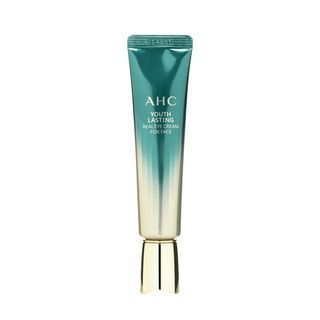
AHC Youth Lasting Real Eye Cream For Face
Works for
2 of 2 advertised claims delivered
Moisturizing114 ingredients credited for this claimStrong support
“Youth Lasting Real Eye Cream For Face”
This product can help improve hydration of the skin with the two types of ingredients.
The first type is called “humectants”:
these ingredients help attract water.
When humectants are on the surface of the skin, they “pull in” the moisture from the outside environment, or from
within deeper layers of the skin. The following ingredients in this product do the job:
alanine, anhydroxylitol.
This product also contains ingredients called “occlusives”. They help reduce the speed with which our skin loses moisture to the outside environment. These ingredients also help soften the upper layer of the skin, so it feels less tight and nicer to the touch. The following ingredients in this product do the job: arginine, caprylic/capric triglyceride.
The following ingredients in this product are especially good for supporting the skin barrier and helping with the hydration level: acetyl dipeptide-1 cetyl ester, acetyl hexapeptide-8, acetyl octapeptide-3, acetyl tetrapeptide-2, acetyl tetrapeptide-3, acetyl tetrapeptide-5, ascorbic acid polypeptide, ceramide np, copper tripeptide-1, dipeptide diaminobutyroyl benzylamide diacetate, dipeptide-2, dipeptide-4, hexapeptide-2, hexapeptide-9, nonapeptide-1, palmitoyl hexapeptide-12, palmitoyl pentapeptide-4, palmitoyl tetrapeptide-7, palmitoyl tripeptide-1, palmitoyl tripeptide-5, saccharomyces polypeptides, sh-oligopeptide-1, sh-oligopeptide-2, sh-polypeptide-1, sh-polypeptide-11, sh-polypeptide-3, sh-polypeptide-9, tripeptide-1, tripeptide-3
Anti-aging48 ingredients credited for this claimStrong support
“This eye cream offers brightening and anti-wrinkle care for youthful-looking eyes.”
This product can help reduce and prevent fine lines and wrinkles, improve skin elasticity and firmness because it contains retinal, adenosine, palmitoyl hexapeptide-12.
These ingredients in the product can also be helpful, even though there is less evidence for their effectiveness: acetyl dipeptide-1 cetyl ester, acetyl hexapeptide-8, acetyl octapeptide-3, acetyl tetrapeptide-2, acetyl tetrapeptide-5, ascorbic acid polypeptide, aspartic acid, atelocollagen, carnosine, copper tripeptide-1, dipeptide diaminobutyroyl benzylamide diacetate, dipeptide-1, dipeptide-2, dipeptide-4, folic acid, hexapeptide-2, hexapeptide-9, hydroxydecyl ubiquinone, lysine, nonapeptide-1, palmitoyl pentapeptide-4, palmitoyl tetrapeptide-7, palmitoyl tripeptide-1, palmitoyl tripeptide-5, saccharomyces polypeptides, serine, sh-oligopeptide-1, sh-oligopeptide-2, sh-polypeptide-1, sh-polypeptide-11, sh-polypeptide-3, sh-polypeptide-9, threonine, tripeptide-1, tripeptide-3.
Keep in mind that it typically takes at least 6 weeks to notice any results because the changes that are needed to improve fine lines and elasticity happen in the deeper layers of the skin. No topical anti-aging product can “erase” wrinkles or fully reverse signs of aging.
Anti-oxidationNot advertised by the brand · 23 ingredients credited for this claimStrong support
This product contains antioxidants (carnosine, hydroxydecyl ubiquinone) that can help neutralize free radicals in skin. By doing so, they can lessen the damage the skin gets from the UV light (sun).
The following ingredients - ascorbic acid polypeptide, cysteine, ficus carica fruit extract, pyridoxine also can have an antioxidant effect, but there is less evidence to confirm their effectiveness in skin.
Evens skin toneNot advertised by the brand · 9 ingredients credited for this claimStrong support
This product can help reduce hypepigmentation and even out the skin tone because it contains the following effective ingredients: retinal.
The following ingredient (ingredients) in this product might be helpful, but there is no evidence to confirm that it actually can help even out the skin tone: alanine, cysteine, pancratium maritimum extract.
Keep in mind that you would need to apply any topical skincare targetted at hypigmentation consistently for a couple of months to get a result. No topical skincare product can help get rid of hyperpigmentation (including post-acne marks and age spots) instantly.
Can it cause trouble?
Irritancy4 strong irritants: Calendula officinalis flower extract, Alcohol + 2 more — patch-test recommendedHigh risk
Comedogenic7 ingredients rated 2 or more on the 0–5 pore-clogging scale7 flagged


User reviews
Be the first — your take helps the next person decide.
Ingredients
Filter by role to see what each ingredient is doing.
Calendula officinalis flower extract~22–34%
- Irritation risk
- High
A plant extract that has some anti-oxidant and anti-bacterial properties. Can be irritating
More about Calendula officinalis flower extractLactobacillus ferment lysate~3.8–5.7%
- Irritation risk
- Low
A "broth" with parts of dead cells of lactobacteria. Might be helpful supporting diverse microbiome in skin, but evidence is lacking
More about Lactobacillus ferment lysateGlycerin~4.2–6.3%
- Irritation risk
- Low
One of the best moisturizing ingredients. Naturally present in skin. It attracts water to the upper layer of the skin working as a humectant
More about GlycerinDipropylene glycol~3.3–5%
- Irritation risk
- Low
Helps to dissolve other ingredients in a formulation. Slows down the rate of product drying
More about Dipropylene glycolCyclohexasiloxane~2.8–4.1%
- Irritation risk
- Low
A silicone that serves as an emollient. Helps create a nice non-greasy feels
More about CyclohexasiloxaneBifida ferment lysate~1.9–2.9%
- Irritation risk
- Low
Consists of remains of dead yeast bacteria cells. Helps to hydrate the skin and reduce irritation. Might has some anti-oxidant effect
More about Bifida ferment lysateHydrogenated polydecene~1.5–2.3%
- Irritation risk
- Low
Helps to soften the upper layer of the skin and create a nice product texture
More about Hydrogenated polydeceneWater~1.2–1.9%
Caprylic/capric triglyceride~1.3–1.9%
- Irritation risk
- Medium
A good mix of fatty acids that forms a protective layer on the skin. Improves the shelf life of products. Derived from coconut and glycerin
More about Caprylic/capric triglycerideNiacinamide~0.85–1.25%
- Irritation risk
- Low
Is proven to be effective in reducing blemishes, evening out skin tone and helping to improve lines and wrinkles. It helps the skin to repair sun damage, calm down inflammation and keep maintain good levels of moisture. The concentration of about 2% is effective for supporting the skin barrier and evening out the skin tone. Concentration of 4-6% is better for helping with acne and balancing the sebum production
More about NiacinamideDicaprylyl carbonate~0.55–1.3%
- Irritation risk
- Low
Helps products spread more easily and works as an emollient to soften skin
More about Dicaprylyl carbonateCetyl alcohol~0.55–1.25%
- Irritation risk
- Low
A non-drying alcohol that works to soften the skin and stabilize product formulations helping oil and water mix together
More about Cetyl alcoholLycium chinense leaf extract~0.35–0.85%
- Irritation risk
- Low
Camellia sinensis leaf extract~0.35–0.85%
- Irritation risk
- Low
Can contain potent anti-oxidant compounds (abbreviated ECG, GCG, EGC, and EGCG) that might help protect the skin from free radicals. Can help calm down inflammation and has some anti-bacterial properties. Unfortunately, these antioxidants are unstable and lose their effectiveness very quickly in products. The concentration of the antioxidant compounds in the extract also tends to be low to be effective in topical formulation
More about Camellia sinensis leaf extractButyrospermum parkii butter~0.4–0.9%
- Irritation risk
- Low
- Comedogenicity
- 3/5
A great moisturising ingredient that softens the skin and reduces water loss from its upper layer. It also can be helpful in protecting skin from free radicals
More about Butyrospermum parkii butterMethylpropanediol~0.3–0.75%
Centella asiatica extract~0.35–0.85%
- Irritation risk
- Medium
A plant extract that has been shown to be able to reduce inflammation in skin, support restoration of skin barrier function, as well as support collagen production. Contains active compounds called centelloids: asiaticoside, madecasosside, asiatic acid and madecassic acid. Might be helpful in preventing stretch marks. It can be itself be irritating though.
More about Centella asiatica extractFicus carica fruit extract~0.2–0.75%
- Irritation risk
- Medium
A plant extract that can help neutralize free radicals. The concentrations typically used in cosmetics are too small to have an effect
More about Ficus carica fruit extractDioscorea japonica root extract~0.15–0.7%
- Irritation risk
- Low
Malt extract~0.15–0.6%
- Irritation risk
- Low
Aloe barbadensis leaf extract~0.3–0.7%
- Irritation risk
- Medium
Traditionally used to treat sunburns, dermatitis and inflammation, but evidence for its effectiveness is lacking. The extract can contain humectants that help attract water into the skin
More about Aloe barbadensis leaf extractSpilanthes acmella extract~0.15–0.55%
- Irritation risk
- Low
Hydrolyzed collagen extract~0.15–0.55%
- Irritation risk
- Low
Oryza sativa extract~0.15–0.65%
- Irritation risk
- Low
A grain extract that helps to create a thicker product consistency. It might have some anti-oxidant properties and help attract water to the upper layer of the skin
More about Oryza sativa extractCollagen extract~0.15–0.55%
- Irritation risk
- Low
Pseudoalteromonas ferment extract~0.15–0.55%
- Irritation risk
- Low
Gossypium herbaceum seed extract~0.15–0.55%
- Irritation risk
- Low
- Comedogenicity
- 3/5
Solanum lycopersicum fruit extract~0.15–0.55%
- Irritation risk
- Low
Lepidium meyenii root extract~0.15–0.55%
- Irritation risk
- Low
Persea gratissima fruit extract~0.15–0.65%
Salicornia herbacea extract~0.15–0.55%
- Irritation risk
- Low
Pancratium maritimum extract~0.15–0.55%
- Irritation risk
- High
A plant extract that might help neutralize free radicals in skin. It might help reduce hyperpigmentation
More about Pancratium maritimum extractTriticum aestivum peptide~0.2–0.75%
- Irritation risk
- Low
Nymphaea alba flower extract~0.15–0.5%
- Irritation risk
- Low
Phaseolus lunatus seed extract~0.2–0.7%
- Irritation risk
- Low
Bean seed extract. It might have some anti-oxidant properties
More about Phaseolus lunatus seed extractCocos nucifera oil~0.15–0.6%
- Irritation risk
- Low
- Comedogenicity
- 3/5
An emollient. Found to be as effective as a moisturizer for dry skin as mineral oil. Could be comedogenic
More about Cocos nucifera oilMacadamia ternifolia seed oil~0.15–0.7%
- Irritation risk
- Medium
Plant oil from nuts that helps soften the upper layer of the skin. Contains a high concentration of oleic acid that can weaken skin's barrier function and increase water-loss while enhancing penetration of other ingredients
More about Macadamia ternifolia seed oilHydrogenated lecithin~0.15–0.6%
- Irritation risk
- Low
Helps to retain moisture by creating a protective barrier on the skin. Rich in fatty acids. Improves product texture and helps with the penetration of other ingredients.
More about Hydrogenated lecithinElaeis guineensis oil~0.15–0.7%
- Irritation risk
- Low
Helps soften the upper layer of the skin
More about Elaeis guineensis oilCamellia sinensis leaf water~0.1–0.45%
- Irritation risk
- Low
Green tea leaf water. Might have some minimal anti-oxidant effect
More about Camellia sinensis leaf waterSoluble collagen~0.2–0.7%
- Irritation risk
- Low
A typically plant-derived compound that is supposed mimic human collagen. Cannot penetrate the skin barrier so is not particularly useful in skincare products beyond attracting water to the upper layer of the skin
More about Soluble collagenOryza sativa germ oil~0.15–0.7%
Simmondsia chinensis seed oil~0.2–0.75%
- Irritation risk
- Medium
Softens the upper layer of skin and helps restore the healthy skin barrier. Has shown to help calm down inflammation in skin. It is a stable oil, meaning that it retains its properties even when exposed to air.
More about Simmondsia chinensis seed oilSodium hyaluronate~0.15–0.55%
- Irritation risk
- Low
One of the best moisturizing ingredients. Attracts water into the upper layer of the skin
More about Sodium hyaluronateSh-polypeptide-19~0.15–0.55%
- Irritation risk
- Low
Polyglyceryl-10 myristate~0.15–0.55%
- Irritation risk
- Low
Candida bombicola/glucose/methyl rapeseedate ferment~0.2–0.7%
- Irritation risk
- Low
Helps water and oil mix together and preserve the product formulation
More about Candida bombicola/glucose/methyl rapeseedate fermentPolyacrylate-13~0.2–0.75%
- Irritation risk
- Low
Used to create a thicker product consistency and stabilize the product formulation
More about Polyacrylate-13Polyglyceryl-2 stearate~0.15–0.6%
- Irritation risk
- Medium
Helps water and oil mix together
More about Polyglyceryl-2 stearatePolyglyceryl-10 laurate~0.15–0.6%
- Irritation risk
- Medium
Helps water and oil mix together
More about Polyglyceryl-10 laurateDimethicone/vinyl dimethicone crosspolymer~0.15–0.55%
- Irritation risk
- Low
Used to stabilize product formulations and create a nice product texture
More about Dimethicone/vinyl dimethicone crosspolymerCetearyl olivate~0.15–0.6%
Sorbitan olivate~0.15–0.6%
Glyceryl stearate~0.2–0.75%
- Irritation risk
- Low
An emollient that softens the skin and forms a protective layer on its surface. Helps water and oil mix together
More about Glyceryl stearateBehenyl alcohol~0.2–0.75%
- Irritation risk
- Low
Non-drying alcohol that helps water and oil mix together. Also serves as an emollient
More about Behenyl alcoholStearyl alcohol~0.2–0.75%
- Irritation risk
- Low
An emollient that helps soften the skin
More about Stearyl alcoholSodium stearoyl glutamate~0.15–0.7%
- Irritation risk
- Medium
Helps oil and water mix together
More about Sodium stearoyl glutamateHydrogenated polyisobutene~0.15–0.7%
- Irritation risk
- Low
Used to improve the product consistency and soften the upper layer of the skin
More about Hydrogenated polyisobuteneCetearyl alcohol~0.2–0.75%
- Irritation risk
- Low
- Comedogenicity
- 2/5
A non-drying alcohol. Works as an emollient. Helps water and oil mix together and creates a nice product texture
More about Cetearyl alcoholDimethicone~0.2–0.75%
- Irritation risk
- Low
A silicone that helps to reduce water loss from the surface of the skin. Can temporarily "fill in" lines and wrinkles, absorb oil, and create a nice product finish
More about DimethiconePanthenol~0.15–0.55%
- Irritation risk
- Low
Helps attract water to the upper layer of the skin and can help improve skin barrier function
More about PanthenolButylene glycol~0.15–0.55%
- Irritation risk
- Low
Used to create a nice product texture and help delivery of other ingredients. Might be somewhat helpful in attracting water to the upper layer of the skin
More about Butylene glycolGlyceryl stearate se~0.15–0.6%
- Irritation risk
- Low
- Comedogenicity
- 2/5
Used to stabilize the product formulations and works as an emollient
More about Glyceryl stearate seMicrococcus ferment lysate~0.15–0.55%
- Irritation risk
- Low
Glycosyl trehalose~0.2–0.75%
Ethylhexyl palmitate~0.15–0.7%
- Irritation risk
- Low
- Comedogenicity
- 3/5
An emollient that helps soften the skin and create a nice product texture
More about Ethylhexyl palmitateXanthan gum~0.15–0.55%
- Irritation risk
- Low
Used to create a thicker product consistency
More about Xanthan gumHydrogenated starch hydrolysate~0.15–0.55%
- Irritation risk
- Low
Helps to attract water to the upper layer of the skin. Can add sweet taste to lip products
More about Hydrogenated starch hydrolysateAdenosine~0.15–0.55%
- Irritation risk
- Low
Might help improve cell turnover and reduce inflammation in skin. One study shows that the ingredients might be able to help reduce dynamic wrinkles (for example, in the corners of the eyes or on the forehead)
More about AdenosineRaffinose~0.15–0.55%
- Irritation risk
- Low
Cholesterol~0.2–0.75%
- Irritation risk
- Low
An emollient that is naturally found in skin
More about CholesterolSorbitan isostearate~0.15–0.6%
- Irritation risk
- Low
Helps oil and water mix together
More about Sorbitan isostearateDisodium edta~0.15–0.55%
Lecithin~0.2–0.7%
- Irritation risk
- Low
Used mostly for creating emulsions - helping oil and water mix together. Helps soften the upper layer of the skin
More about LecithinPolyglyceryl-10 stearate~0.15–0.55%
- Irritation risk
- Medium
Helps water and oil mix together and softens the upper layer of the skin
More about Polyglyceryl-10 stearateInulin lauryl carbamate~0.15–0.55%
Ceramide np~0.15–0.7%
- Irritation risk
- Low
A type of lipid similar to ceramides naturally present in skin. Helps to soften the upper layer of the skin and supports the skin barrier function to keep it hydrated. Can help to prevent inflammation in skin
More about Ceramide npTromethamine~0.15–0.55%
Polyquaternium-51~0.2–0.75%
- Irritation risk
- Low
An emollient that helps create a nice silky finish on the skin
More about Polyquaternium-51Sodium laurate~0.2–0.7%
Potassium cetyl phosphate~0.15–0.6%
- Irritation risk
- Medium
Helps oil and water mix together
More about Potassium cetyl phosphateLauric acid~0.2–0.75%
- Irritation risk
- Medium
- Comedogenicity
- 3/5
Helps water and oil mix together. Has anti-bacterial properties that might be helpful in preventing blemishes
More about Lauric acidTocopheryl acetate~0.15–0.6%
- Irritation risk
- Medium
A more stable but less bio-available form of vitamin E compared to Tocopherol. Might help moisturize and protect the skin from free radicals, but mostly used in low concentrations to stabilize other ingredients.
More about Tocopheryl acetateSoluble elastin~0.15–0.55%
- Irritation risk
- Low
Propanediol~0.15–0.6%
- Irritation risk
- Low
Acts as a solvent for other ingredients. Speeds up the absorption of other ingredients into the skin
More about PropanediolFolic acid~0.15–0.55%
- Irritation risk
- Low
Can help stimulate collagen production in skin. While available studies are promising, more research is needed to confirm the efficacy in skin
More about Folic acidCarnosine~0.15–0.5%
- Irritation risk
- Low
A type of peptide. It attracts water to the upper layer of the skin. It can help neutralize free radicals in skin combatting the sun damage
More about CarnosineCocoyl hydrolyzed collagen~0.2–0.7%
Hydrolyzed collagen~0.3–0.75%
- Irritation risk
- Low
A typically plant-derived compound that is supposed mimic human collagen. Cannot penetrate the skin barrier so is not particularly useful in skincare products beyond attracting water to the upper layer of the skin
More about Hydrolyzed collagenOlive oil polyglyceryl-6 esters~0.2–0.75%
Biosaccharide gum-1~0.15–0.55%
- Irritation risk
- Low
Helps attract water to the upper layer of the skin and is claimed to provide a longer-lasting hydration because of its ability to create a water-binding film on the surface of the skin
More about Biosaccharide gum-1Schizosaccharomyces ferment filtrate~0.15–0.5%
- Irritation risk
- Low
Glycolipids~0.15–0.55%
- Irritation risk
- Low
Potassium cocoyl hydrolyzed collagen~0.15–0.55%
Glycine~0.15–0.5%
- Irritation risk
- Low
Helps to attract water to the upper layer of the skin and can help restore the skin barrier function
More about GlycineLactobacillus ferment~0.15–0.5%
- Irritation risk
- Low
A fermentation product created by bacteria Lactobacillus. The fermented product has anti-bacterial properties and might be helpful in calming down inflammation, but studies are lacking. Helps attract water to the upper layer of the skin. Can be used as a preservative
More about Lactobacillus fermentMaltodextrin~0.15–0.65%
- Irritation risk
- Low
Used to stabilize the product formulation and can help absorb oil
More about MaltodextrinSqualane~0.2–0.75%
- Irritation risk
- Low
An oil naturally present in skin. Works as an emollient to soften the skin and form a protective layer on its surface without a greasy feeling.
More about SqualaneSerine~0.15–0.55%
- Irritation risk
- Low
An amino-acid that helps to attract water to the upper layer of the skin. In combination with other amino-acids, might help to reduce fine lines and wrinkles
More about SerineGlutamic acid~0.15–0.55%
- Irritation risk
- Low
An amino-acid that helps attract water to the upper layer of the skin
More about Glutamic acidCrithmum maritimum callus culture filtrate~0.15–0.55%
- Irritation risk
- Low
A plant cell extract that helps attract water to the upper layer of the skin and might have some anti-oxidant properties
More about Crithmum maritimum callus culture filtrateAscorbic acid polypeptide~0.15–0.55%
- Irritation risk
- Low
A type of peptide. Might help neutralize free radicals in skin. Peptides are excellent moisturizers and might be able support collagen production reducing fine lines and wrinkles
More about Ascorbic acid polypeptideCollagen~0.15–0.55%
- Irritation risk
- Low
Cannot penetrate the skin barrier so is not particularly useful in skincare products
More about CollagenCollagen amino acids~0.15–0.55%
- Irritation risk
- Low
Help attract water to the upper layer of the skin, soften it and support the skin barrier function
More about Collagen amino acidsTetrahydropiperine~0.15–0.55%
- Irritation risk
- Low
Hydroxydecyl ubiquinone~0.15–0.55%
- Irritation risk
- Medium
An analogue of coenzyme Q10 that has a lower molecular weight, which can improve its ability to penetrate the skin. It helps neutralize free radicals in skin, improves skin hydration and might be helpful agains fine lines and wrinkles. It can be an allergen
More about Hydroxydecyl ubiquinoneHydrolyzed lupine protein~0.15–0.55%
- Irritation risk
- Low
Pentaerythrityl tetraisostearate~0.2–0.75%
- Irritation risk
- Medium
Used to create a thicker product consistency
More about Pentaerythrityl tetraisostearateAspartic acid~0.15–0.5%
- Irritation risk
- Low
An amino-acid that helps increase skin hydration and might help to slightly improve skin firmness, potentially reducing lines and wrinkles
More about Aspartic acidMannitol~0.15–0.5%
- Irritation risk
- Low
Helps to attract water to the upper layer of the skin
More about MannitolLeucine~0.15–0.55%
- Irritation risk
- Low
Dipeptide diaminobutyroyl benzylamide diacetate~0.15–0.55%
- Irritation risk
- Low
A type of peptide. Peptides are excellent moisturizers and might be able support collagen production reducing fine lines and wrinkles
More about Dipeptide diaminobutyroyl benzylamide diacetatePalmitoyl pentapeptide-4~0.15–0.55%
- Irritation risk
- Low
A type of peptide. Peptides are excellent moisturizers and might be able support collagen production reducing fine lines and wrinkles
More about Palmitoyl pentapeptide-4Saccharide hydrolysate~0.15–0.55%
Hydrolyzed vegetable protein~0.15–0.55%
Alanine~0.15–0.5%
- Irritation risk
- Low
An amino-acid that helps to attract water to the upper layer of the skin and might help to lighten the skin, but solid evidence is lacking
More about AlanineLysine~0.15–0.55%
- Irritation risk
- Low
An amino-acid that helps to attract water to the upper layer of the skin. In combination with other amino-acids, might help to reduce fine lines and wrinkles
More about LysineXylitylglucoside~0.15–0.55%
- Irritation risk
- Low
Helps attract water to the upper layer of the skin and repair the skin barrier function
More about XylitylglucosideArginine~0.1–0.5%
- Irritation risk
- Low
An amino acid that is naturally present in skin and helps keep it hydrated. When used together with AHAs, it can reduce their irritating effect on the skin
More about ArginineTyrosine~0.15–0.55%
Phenylalanine~0.15–0.55%
- Irritation risk
- Low
Sodium palmitoyl proline~0.15–0.55%
- Irritation risk
- Low
Valine~0.15–0.55%
- Irritation risk
- Low
Threonine~0.15–0.55%
- Irritation risk
- Low
An amino-acid that helps to attract water to the upper layer of the skin. In combination with other amino-acids, might help to reduce fine lines and wrinkles
More about ThreonineProline~0.15–0.6%
Anhydroxylitol~0.15–0.55%
- Irritation risk
- Low
Helps attract water to the upper layer of the skin and repair the skin barrir function
More about AnhydroxylitolIsoleucine~0.15–0.55%
- Irritation risk
- Low
An amino acid that can help attract water to the upper layer of the skin and support skin's barrier function
More about IsoleucineLactobacillus extracellular vesicles~0.15–0.5%
- Irritation risk
- Low
Dimethylsilanol hyaluronate~0.15–0.5%
- Irritation risk
- Low
Hydrolyzed sodium hyaluronate~0.15–0.55%
- Irritation risk
- Low
Attracts water into the upper layer of the skin
More about Hydrolyzed sodium hyaluronateHydrolyzed hyaluronic acid~0.15–0.5%
- Irritation risk
- Low
One of the best moisturizing ingredients. Attracts water into the upper layer of the skin. A version of it is naturally present in skin
More about Hydrolyzed hyaluronic acidHistidine~0.15–0.5%
Xylitol~0.15–0.5%
- Irritation risk
- Low
Helps attract water to the upper layer of the skin and repair the skin barrier function
More about XylitolMethionine~0.15–0.55%
- Irritation risk
- Low
Cysteine~0.15–0.55%
- Irritation risk
- Low
Might help neutralize free radicals in skin and might be helpful against hyperpigmentation
More about CysteinePalmitoyl tripeptide-5~0.15–0.55%
- Irritation risk
- Low
A type of peptide. Peptides are excellent moisturizers and might be able support collagen production reducing fine lines and wrinkles
More about Palmitoyl tripeptide-5Potassium hyaluronate~0.15–0.55%
- Irritation risk
- Low
Pvp~0.15–0.65%
- Irritation risk
- Medium
Helps evenly disperse other ingredients in a formulation and create an even layer on the surface of the skin
More about PvpHydrogenated poly(c6-14 olefin)~0.15–0.7%
- Irritation risk
- Low
Helps soften the upper layer of the skin and create a nice product texture
More about Hydrogenated poly(c6-14 olefin)Hydroxypropyl cyclodextrin~0.15–0.7%
- Irritation risk
- Medium
Used to stabilize product formulations and help soften the upper layer of the skin
More about Hydroxypropyl cyclodextrinHyaluronic acid~0.15–0.55%
- Irritation risk
- Low
One of the best moisturizing ingredients. Attracts water into the upper layer of the skin. Naturally present in skin. Typically has large molecule size unless advertised otherwise on the product label. Helps support skin's barrier function and may help to reduce inflammation
More about Hyaluronic acidHeptasodium hexacarboxymethyl dipeptide-12~0.15–0.55%
- Irritation risk
- Low
Sodium hyaluronate crosspolymer~0.15–0.55%
- Irritation risk
- Medium
Attracts water into the upper layer of the skin
More about Sodium hyaluronate crosspolymerHydroxypropyltrimonium hyaluronate~0.2–0.75%
- Irritation risk
- Low
Acetyl hexapeptide-8~0.15–0.5%
- Irritation risk
- Low
A type of peptide. Peptides are excellent moisturizers and might be able support collagen production reducing fine lines and wrinkles
More about Acetyl hexapeptide-8Gluconolactone~0.15–0.55%
- Irritation risk
- Medium
A polyhydroxy acid (PHA) that helps shed the dead cells from the skin surface revealing smoother skin. Is believed to be genter than AHAs. It helps attract water to the upper layer of the skin and can stimulate production of skin's own hyaluronic acid resulting in improved hydration levels. It has been shown to be helpful against acne and clogged pores if used consistently (e.g over a period of 12 weeks) in high enough concentration. It can help reduce fine lines and wrinkles and improve skin tone with long-term application. Can help neutralize free radicals
More about GluconolactoneGlycine soja peptide~0.2–0.75%
- Irritation risk
- Low
Sodium hyaluronate dimethylsilanol~0.15–0.5%
- Irritation risk
- Low
Sorbitan laurate~0.15–0.6%
Polyglyceryl-10 diisostearate~0.15–0.6%
Saccharomyces polypeptides~0.15–0.55%
Glucose~0.15–0.55%
- Irritation risk
- Low
Helps attract water to the upper layer of the skin. Could be helpful in restoring the skin barrier function
More about GlucoseSodium acetylated hyaluronate~0.15–0.55%
- Irritation risk
- Low
A type of hyaluronic acid that works as an excellent moisturizer by attracting water into the upper layer of the skin. Is typically feels less sticky on the skin compared to the usual hyaluronic acid
More about Sodium acetylated hyaluronateAlcohol~0.15–0.55%
- Irritation risk
- High
Can be drying and contribute to skin irritation. Used in formulars to dissolve other ingredients, create a thinner product consistency or for its antibacterial properties
More about AlcoholSilica dimethyl silylate~0.15–0.7%
Avena sativa peptide~0.2–0.75%
- Irritation risk
- Low
Retinal~0.15–0.55%
- Irritation risk
- High
One step removed from the biologically active in skin form of vitamin A. Once converted to the retinoic acid in the skin, retinal is proven to be effective against all signs of aging. It improves skin cell turnover, helps fight blemishes and clogged pores, can regulate excess oil production and even skin tone. Concentrations of 0.05% and 0.1% are shown to be effective. It can, however, be irritating
More about RetinalMenadione~0.15–0.55%
- Irritation risk
- Low
Silica~0.3–0.75%
Brassica campestris sterols~0.15–0.7%
- Irritation risk
- Low
Help soften the upper layer of the skin
More about Brassica campestris sterolsGlycine max polypeptide~0.15–0.55%
- Irritation risk
- Low
Hydroxyethylcellulose~0.15–0.65%
- Irritation risk
- Low
Used to thicken product formulations and create gel-like textures
More about HydroxyethylcelluloseLactic acid~0.15–0.5%
- Irritation risk
- Medium
An exfoliating and moisturizing alpha-hydroxy acid (AHA). Typically causes less irritation than other AHAs, for example, glycolic acid. At high concentrations (about 15%), lactic acid can help reduce lines and wrinkles. Recent studies show that lactic acid can support the "good" bacteria living on skin's surface (healthy skin microbiome)
More about Lactic acidAcetyl dipeptide-1 cetyl ester~0.15–0.55%
- Irritation risk
- Low
A type of peptide. Peptides are excellent moisturizers and might be able support collagen production reducing fine lines and wrinkles
More about Acetyl dipeptide-1 cetyl esterCeteth-3~0.15–0.6%
Ceteth-5~0.15–0.6%
Sodium chondroitin sulfate~0.15–0.5%
- Irritation risk
- Low
Is naturally present in skin. Helps to attract water to its upper layer
More about Sodium chondroitin sulfateSodium ascorbyl phosphate~0.15–0.55%
- Irritation risk
- Medium
A stable derivative of vitamin C. It is oil-soluble which means it is more likely to penetrate the skin compared to the pure form of vitamin C (which is water-soluble), but it is less bio-available and is way less effective in stimulating collagen and reducing wrinkles compared to the pure form of vitamin C (L-ascorbic acid) and its other derivatives (for example, magnesium ascorbyl phosphate). At the same time, this vitamin C derivative has been shown in studies to be effective in reducing acne, blemishes and clogged pores. It is less irritating then the pure form of vitamin C
More about Sodium ascorbyl phosphateAluminum/magnesium hydroxide stearate~0.15–0.55%
- Irritation risk
- Low
Tocopherol~0.15–0.55%
- Irritation risk
- Low
Pure form of vitamin E. Can help moisturise and protect the skin from free radicals. Often used to help stabilise other ingredients or the formula itself
More about TocopherolCetyl hydroxyethylcellulose~0.3–0.7%
- Irritation risk
- Low
Used to create a thicker product consistency and stabilize formulations
More about Cetyl hydroxyethylcelluloseSucrose distearate~0.2–0.8%
Atelocollagen~0.15–0.6%
- Irritation risk
- Low
A protein that helps to attract moisture to the upper layer of the skin and might be helpful in reducing fine lines and wrinkles
More about AtelocollagenRutin~0.15–0.65%
- Irritation risk
- Low
An antioxidant that might help neutralize free radicals in skin
More about RutinPentaerythrityl tetra-di-t-butyl hydroxyhydrocinnamate~0.15–0.65%
- Irritation risk
- Low
Used to increase stability of product formulations
More about Pentaerythrityl tetra-di-t-butyl hydroxyhydrocinnamateSodium phosphate~0.15–0.6%
Acetyl octapeptide-3~0.15–0.6%
- Irritation risk
- Low
A type of peptide. Peptides are excellent moisturizers and might be able support collagen production reducing fine lines and wrinkles
More about Acetyl octapeptide-3Sh-oligopeptide-1~0.15–0.6%
- Irritation risk
- Low
A type of peptide. Peptides are excellent moisturizers and might be able support collagen production reducing fine lines and wrinkles
More about Sh-oligopeptide-1Sh-oligopeptide-2~0.15–0.6%
- Irritation risk
- Low
A type of peptide. Peptides are excellent moisturizers and might be able support collagen production reducing fine lines and wrinkles
More about Sh-oligopeptide-2Sh-polypeptide-1~0.15–0.6%
- Irritation risk
- Low
A type of peptide. Peptides are excellent moisturizers and might be able support collagen production reducing fine lines and wrinkles
More about Sh-polypeptide-1Dipotassium phosphate~0.15–0.65%
Calcium gluconate~0.15–0.7%
- Irritation risk
- Low
Helps attract water to the upper layer of the skin and helps to improve appearance of the product
More about Calcium gluconateNonapeptide-1~0.15–0.6%
- Irritation risk
- Low
A type of peptide. Peptides are excellent moisturizers and might be able support collagen production reducing fine lines and wrinkles
More about Nonapeptide-1Dipeptide-1~0.15–0.6%
- Irritation risk
- Low
A type of peptide. Helps attract water to the upper layer of the skin and might have anti-aging benefits
More about Dipeptide-1Dipeptide-2~0.15–0.6%
- Irritation risk
- Low
A type of peptide. Peptides are excellent moisturizers and might be able support collagen production reducing fine lines and wrinkles
More about Dipeptide-2Dipeptide-4~0.15–0.6%
- Irritation risk
- Low
A type of peptide. Peptides are excellent moisturizers and might be able support collagen production reducing fine lines and wrinkles
More about Dipeptide-4Acetyl tetrapeptide-2~0.15–0.6%
- Irritation risk
- Low
A type of peptide. Peptides are excellent moisturizers and might be able support collagen production reducing fine lines and wrinkles
More about Acetyl tetrapeptide-2Acetyl tetrapeptide-3~0.15–0.65%
- Irritation risk
- Low
A type of peptide. Peptides are excellent moisturizers and might be able support collagen production reducing fine lines and wrinkles
More about Acetyl tetrapeptide-3Acetyl tetrapeptide-5~0.15–0.6%
- Irritation risk
- Low
A type of peptide. Peptides are excellent moisturizers and might be able support collagen production reducing fine lines and wrinkles
More about Acetyl tetrapeptide-5Acetyl tripeptide-1~0.15–0.6%
- Irritation risk
- Low
Alanine/histidine/lysine polypeptide copper hcl~0.15–0.6%
- Irritation risk
- Low
Oligopeptide-6~0.15–0.6%
- Irritation risk
- Low
Copper tripeptide-1~0.15–0.6%
- Irritation risk
- Low
A naturally occurring peptide. One of the most studied peptides in dermatology. It is sometimes abbreviated GHK-Cu. Belongs to the class of carrier peptides. It stimulates both synthesis and breakdown of collagen in skin. It is released in skin wounds and inflammation to support healing. It accelerates wound-healing of the skin and can stimulate hair growth. There are preliminary studies that confirm that copper tripeptide can help support collagen production reducing fine lines and wrinkles and decrease inflammation in skin.
More about Copper tripeptide-1Tripeptide-1~0.2–0.75%
- Irritation risk
- Low
A type of peptide. Peptides are excellent moisturizers and might be able support collagen production reducing fine lines and wrinkles
More about Tripeptide-1Tripeptide-2~0.15–0.6%
- Irritation risk
- Low
Tripeptide-3~0.15–0.6%
Pentapeptide-3~0.15–0.65%
- Irritation risk
- Low
Hexapeptide-2~0.15–0.6%
- Irritation risk
- Low
A type of peptide. Peptides are excellent moisturizers and might be able support collagen production reducing fine lines and wrinkles
More about Hexapeptide-2Hexapeptide-9~0.15–0.6%
- Irritation risk
- Low
A type of peptide. Peptides are excellent moisturizers and might be able support collagen production reducing fine lines and wrinkles
More about Hexapeptide-9Palmitoyl tetrapeptide-7~0.2–0.8%
- Irritation risk
- Low
A type of peptide. Peptides are excellent moisturizers and might be able support collagen production reducing fine lines and wrinkles
More about Palmitoyl tetrapeptide-7Palmitoyl tripeptide-1~0.2–0.8%
- Irritation risk
- Low
A type of peptide. Peptides are excellent moisturizers and might be able support collagen production reducing fine lines and wrinkles
More about Palmitoyl tripeptide-1Fullerenes~0.15–0.6%
- Irritation risk
- Low
Biotin~0.15–0.6%
- Irritation risk
- Low
Might have some moisturising properties. Is not effective when applied topically beyond some moisturizing effect
More about BiotinSh-polypeptide-3~0.15–0.6%
- Irritation risk
- Low
A type of peptide. Peptides are excellent moisturizers and might be able support collagen production reducing fine lines and wrinkles
More about Sh-polypeptide-3Thiamine hcl~0.15–0.6%
- Irritation risk
- Medium
Can help attract water to the upper layer of the skin. Is studied as a mosquito repellent
More about Thiamine hclPalmitoyl dipeptide-7~0.15–0.6%
- Irritation risk
- Low
Palmitoyl hexapeptide-12~0.15–0.65%
- Irritation risk
- Low
A type of peptide. Peptides are excellent moisturizers and might be able support collagen production reducing fine lines and wrinkles
More about Palmitoyl hexapeptide-12Pyridoxine~0.15–0.65%
- Irritation risk
- High
Might help neutralize free radicals in skin, but evidence of effectiveness in skin is lacking. It might be irritating
More about PyridoxineCyanocobalamin~0.15–0.65%
- Irritation risk
- Low
Can support skin barrier function and reduce inflammation in skin
More about CyanocobalaminSh-polypeptide-11~0.15–0.65%
- Irritation risk
- Low
A type of peptide. Peptides are excellent moisturizers and might be able support collagen production reducing fine lines and wrinkles
More about Sh-polypeptide-11Sh-polypeptide-9~0.15–0.65%
- Irritation risk
- Low
A type of peptide. Peptides are excellent moisturizers and might be able support collagen production reducing fine lines and wrinkles
More about Sh-polypeptide-91,2-hexanediol~0.15–0.6%
Phytosteryl/behenyl/octyldodecyl lauroyl glutamate~0.15–0.65%
- Irritation risk
- Low
Polysorbate 20~0.15–0.65%
Peg-5 rapeseed sterol~0.3–0.7%
Parfum~0.1–0.45%
- Irritation risk
- High
An aromatic blend of unspecified and possibly irritating ingredients
More about ParfumHydroxyacetophenone~0.1–0.45%
Ethylhexylglycerin~0.1–0.45%
Caprylyl glycol~0.15–0.65%
- Irritation risk
- Medium
Helps preserve products and creates a nice product texture
More about Caprylyl glycolSodium benzoate~0.1–0.4%
Pentylene glycol~0.15–0.65%
- Irritation risk
- Medium
Used to preserve products, dissolve other ingredients and create a nice product texture
More about Pentylene glycolIngredient list view
Calendula officinalis flower extract, Lactobacillus ferment lysate, Glycerin, Dipropylene glycol, Cyclohexasiloxane, Bifida ferment lysate, Hydrogenated polydecene, Water, Caprylic/capric triglyceride, Niacinamide, Dicaprylyl carbonate, Cetyl alcohol, Lycium chinense leaf extract, Camellia sinensis leaf extract, Butyrospermum parkii butter, Methylpropanediol, Centella asiatica extract, Ficus carica fruit extract, Dioscorea japonica root extract, Malt extract, Aloe barbadensis leaf extract, Spilanthes acmella extract, Hydrolyzed collagen extract, Oryza sativa extract, Collagen extract, Pseudoalteromonas ferment extract, Gossypium herbaceum seed extract, Solanum lycopersicum fruit extract, Lepidium meyenii root extract, Persea gratissima fruit extract, Salicornia herbacea extract, Pancratium maritimum extract, Triticum aestivum peptide, Nymphaea alba flower extract, Phaseolus lunatus seed extract, Cocos nucifera oil, Macadamia ternifolia seed oil, Hydrogenated lecithin, Elaeis guineensis oil, Camellia sinensis leaf water, Soluble collagen, Oryza sativa germ oil, Simmondsia chinensis seed oil, Sodium hyaluronate, Sh-polypeptide-19, Polyglyceryl-10 myristate, Candida bombicola/glucose/methyl rapeseedate ferment, Polyacrylate-13, Polyglyceryl-2 stearate, Polyglyceryl-10 laurate, Dimethicone/vinyl dimethicone crosspolymer, Cetearyl olivate, Sorbitan olivate, Glyceryl stearate, Behenyl alcohol, Stearyl alcohol, Sodium stearoyl glutamate, Hydrogenated polyisobutene, Cetearyl alcohol, Dimethicone, Panthenol, Butylene glycol, Glyceryl stearate se, Micrococcus ferment lysate, Glycosyl trehalose, Ethylhexyl palmitate, Xanthan gum, Hydrogenated starch hydrolysate, Adenosine, Raffinose, Cholesterol, Sorbitan isostearate, Disodium edta, Lecithin, Polyglyceryl-10 stearate, Inulin lauryl carbamate, Ceramide np, Tromethamine, Polyquaternium-51, Sodium laurate, Potassium cetyl phosphate, Lauric acid, Tocopheryl acetate, Soluble elastin, Propanediol, Folic acid, Carnosine, Cocoyl hydrolyzed collagen, Hydrolyzed collagen, Olive oil polyglyceryl-6 esters, Biosaccharide gum-1, Schizosaccharomyces ferment filtrate, Glycolipids, Potassium cocoyl hydrolyzed collagen, Glycine, Lactobacillus ferment, Maltodextrin, Squalane, Serine, Glutamic acid, Crithmum maritimum callus culture filtrate, Ascorbic acid polypeptide, Collagen, Collagen amino acids, Tetrahydropiperine, Hydroxydecyl ubiquinone, Hydrolyzed lupine protein, Pentaerythrityl tetraisostearate, Aspartic acid, Mannitol, Leucine, Dipeptide diaminobutyroyl benzylamide diacetate, Palmitoyl pentapeptide-4, Saccharide hydrolysate, Hydrolyzed vegetable protein, Alanine, Lysine, Xylitylglucoside, Arginine, Tyrosine, Phenylalanine, Sodium palmitoyl proline, Valine, Threonine, Proline, Anhydroxylitol, Isoleucine, Lactobacillus extracellular vesicles, Dimethylsilanol hyaluronate, Hydrolyzed sodium hyaluronate, Hydrolyzed hyaluronic acid, Histidine, Xylitol, Methionine, Cysteine, Palmitoyl tripeptide-5, Potassium hyaluronate, Pvp, Hydrogenated poly(c6-14 olefin), Hydroxypropyl cyclodextrin, Hyaluronic acid, Heptasodium hexacarboxymethyl dipeptide-12, Sodium hyaluronate crosspolymer, Hydroxypropyltrimonium hyaluronate, Acetyl hexapeptide-8, Gluconolactone, Glycine soja peptide, Sodium hyaluronate dimethylsilanol, Sorbitan laurate, Polyglyceryl-10 diisostearate, Saccharomyces polypeptides, Glucose, Sodium acetylated hyaluronate, Alcohol, Silica dimethyl silylate, Avena sativa peptide, Retinal, Menadione, Silica, Brassica campestris sterols, Glycine max polypeptide, Hydroxyethylcellulose, Lactic acid, Acetyl dipeptide-1 cetyl ester, Ceteth-3, Ceteth-5, Sodium chondroitin sulfate, Sodium ascorbyl phosphate, Aluminum/magnesium hydroxide stearate, Tocopherol, Cetyl hydroxyethylcellulose, Sucrose distearate, Atelocollagen, Rutin, Pentaerythrityl tetra-di-t-butyl hydroxyhydrocinnamate, Sodium phosphate, Acetyl octapeptide-3, Sh-oligopeptide-1, Sh-oligopeptide-2, Sh-polypeptide-1, Dipotassium phosphate, Calcium gluconate, Nonapeptide-1, Dipeptide-1, Dipeptide-2, Dipeptide-4, Acetyl tetrapeptide-2, Acetyl tetrapeptide-3, Acetyl tetrapeptide-5, Acetyl tripeptide-1, Alanine/histidine/lysine polypeptide copper hcl, Oligopeptide-6, Copper tripeptide-1, Tripeptide-1, Tripeptide-2, Tripeptide-3, Pentapeptide-3, Hexapeptide-2, Hexapeptide-9, Palmitoyl tetrapeptide-7, Palmitoyl tripeptide-1, Fullerenes, Biotin, Sh-polypeptide-3, Thiamine hcl, Palmitoyl dipeptide-7, Palmitoyl hexapeptide-12, Pyridoxine, Cyanocobalamin, Sh-polypeptide-11, Sh-polypeptide-9, 1,2-hexanediol, Phytosteryl/behenyl/octyldodecyl lauroyl glutamate, Polysorbate 20, Peg-5 rapeseed sterol, Parfum, Hydroxyacetophenone, Ethylhexylglycerin, Caprylyl glycol, Sodium benzoate, Pentylene glycol
Compare prices
Retailers ranked by price — lowest first.

Affiliate links · prices updated regularly
Worth comparing, line by line.
Match % combines shared ingredients, the first five ingredients, shared actives and hero ingredients, irritancy (lower counts in the alternative's favour), texture and body area. Only products in the same routine step are compared.
| AHCYouth Lasting Real Eye Cream For FaceYOUR PRODUCT | HSGNRetinally Liposomal Retinal Cream | AbibYesStyle Exclusive PDRN Volume Fill-it Booster Crème 2.5 Tube Mini 5pcs Bundle Set | KsecretSEOUL 1988 Eye Cream : Retinal Liposome 4% + Fermented Bean | |
|---|---|---|---|---|
| Match | — | 70% | 69% | 66% |
| Price | $7.91 | $13.20+$5.29 | $37.53+$29.62 | $9.84+$1.93 |
| Shared key ingredients | — | 22 of 85 | 16 of 85 | 10 of 85 |
| Key difference | — | Laminaria Japonica Extract | Phytosphingosine | Bakuchiol |
| Irritancy | High | Medium | Medium | Medium |
| Drying alcohol | Contains drying alcohol | — | — | — |
| View product | Shop | Shop | Shop |



Product summary
"AHC - Youth Lasting Real Eye Cream For Face" is a well-rounded moisturizing product. As we expect from a proper moisturizer, the formula includes a combo of effective humectants and emollients. These are the two different types of ingredients that are essential for improving the skin hydration and supporting a healthy skin barrier. Humectants in this product (acetyl hexapeptide-8, acetyl octapeptide-3, acetyl tetrapeptide-5, hexapeptide-9 and alanine) help to increase the water content in the upper layer of the skin. (These ingredients do so by "capturing" water molecules from the outside air or from within the deeper layers of the skin). Emollients in this formulation (ceramide np, palmitoyl tetrapeptide-7, palmitoyl tripeptide-1, tripeptide-1 and cholesterol) help to reduce the moisture loss from the skin. They also soften the skin surface and relieve the feeling of dryness and tightness.
Ingredient callouts
- This product contains acids (gluconolactone 0.15% - 0.55% and lactic acid 0.15% - 0.50%). Their concentration is low, and they will not have a strong exfoliating effect. Instead, they work to support the skin natural acid mantle and to attract water (as humectants). PHAs (gluconolactone) especially are great for improving skin hydration. They might be even able to stimulate the production of skin's natural humectants and support the healthy skin microbiome.
- This moisturizer contains an effective form of Retinoids (vitamin A): retinal 0.15% - 0.55%. Retinoids are potent multitasking actives. They work to improve and prevent early signs of aging, reduce hyperpigmentation (age spots and post-acne marks), and prevent inflamed blemishes and clogged pores. The downside of Retinoids is that they can be irritating. If you are not already using a Retinoid in your routine, it is best to start slowly and apply the Retinoid product only a few times per week. If your skin tolerates it well, you can gradually increase the frequency to daily. Because of the irritation risk of Retinoids, we recommend to have another, retinoid-free moisturizer in your routine to use on the alternate days or when your skin feels dry.
- Another benefit is that this moisturizer contain ceramides (ceramide np 0.15% - 0.70%). Ceramides are an important part of our natural skin barrier. The Ceramides used in skincare are synthetic or come from plants. They help soften the skin and can help "fill the gaps" in the skin barrier, keeping the skin hydrated and resilient for longer.
- We like that this moisturizer contains peptides (sh-polypeptide-9 0.15% - 0.65%, sh-polypeptide-11 0.15% - 0.65%, palmitoyl hexapeptide-12 0.15% - 0.65%, sh-polypeptide-3 0.15% - 0.60%, palmitoyl tripeptide-1 0.20% - 0.80%, palmitoyl tetrapeptide-7 0.20% - 0.80%, hexapeptide-9 0.15% - 0.60%, hexapeptide-2 0.15% - 0.60%, tripeptide-3 0.15% - 0.60%, tripeptide-1 0.20% - 0.75%, copper tripeptide-1 0.15% - 0.60%, acetyl tetrapeptide-5 0.15% - 0.60%, acetyl tetrapeptide-3 0.15% - 0.65%, acetyl tetrapeptide-2 0.15% - 0.60%, dipeptide-4 0.15% - 0.60%, dipeptide-2 0.15% - 0.60%, nonapeptide-1 0.15% - 0.60%, sh-polypeptide-1 0.15% - 0.60%, sh-oligopeptide-2 0.15% - 0.60%, sh-oligopeptide-1 0.15% - 0.60%, acetyl octapeptide-3 0.15% - 0.60%, acetyl dipeptide-1 cetyl ester 0.15% - 0.55%, saccharomyces polypeptides 0.15% - 0.55%, acetyl hexapeptide-8 0.15% - 0.50%, palmitoyl tripeptide-5 0.15% - 0.55%, palmitoyl pentapeptide-4 0.15% - 0.55%, dipeptide diaminobutyroyl benzylamide diacetate 0.15% - 0.55% and ascorbic acid polypeptide 0.15% - 0.55%). There are many different kind of Peptides and they are naturally present in our skin. They all are a combination of aminoacids. Some of them work as natural antibiotics, promote wound-healing and production of collagen. The science is still not settled on how effective Peptides are in skincare, but it is very likely that they have a benefit. Peptides might help restore the skin barrier and fight the signs of aging. At the very least, Peptides work as humectants: they attract water to the upper layer of the skin and improve its hydration.
- Adenosine 0.15% - 0.55%. It is a compound that in involved in many biological processes inside the skin cells. According one high-quality clinical trial, topical Adenosine in low concentrations can somewhat help improve "deep wrinkles" - the wrinkles that appear with age in places where our faces are most dynamic (for example, on the forehead or in the corners of the eyes).
Irritation risk
There are some common irritants in this product, including ingredients that do not have benefits for the skin. We assess the overall irritancy of this moisturizer to be high. For a detailed overview of all potential irritants: click here
You can see the detailed formula review with the breakdown of all actives in the product and the full ingredient list with estimated concentrations in the tables below.
Price
The product retails for 15.20A$ in Australia, for 17.50£ in the United Kingdom and for 7.91$ in the United States.
For a detailed price comparison: click here.
Sources cited in this review
Every concentration estimate and effectiveness label is anchored to one of these 92 studies and safety reviews.
- 1
- 2
- 3
- 4
- 5
- 6Bifidobacterium longumlysate, a new ingredient forreactive skinonlinelibrary.wiley.com

Affiliate links · As an Amazon Associate, WIMJ earns from qualifying purchases.