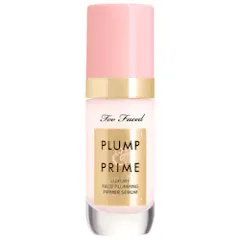
Works for:
based on ingredients and %- Anti-aging
- Moisturizing
- Evens skin tone
- Anti-blemish
Can it cause trouble?
- Irritation risk: high
- Comedogenic risk ingredients: 9
Key actives


Product Summary
"Too Faced - Plump & Prime Face Plumping Primer Serum" is effective for: Anti-aging, Moisturizing, Evens skin tone and Anti-blemish
Ingredient callouts
- A good concentration of Niacinamide (3.20% - 3.90%). Niacinamide is a well-studied multi-tasking active. It is stable, and can work well in almost any hydrating formulation. There is solid evidence that Niacinamide can help support skin barrier, regulate oil production and reduce acne and clogged pores. It also helps to fight photodamage and improve the skin tone, reducing pigmentation marks.
- Peptides (palmitoyl hexapeptide-12 0.30% - 0.50% and acetyl hexapeptide-8 0.25% - 0.50%). Peptides are a very big group of ingredients. They all consist of a different combination of aminoacids. Our skin produces Peptides naturally. Some of them work as natural antibiotics, promote wound-healing and production of collagen. The scientists are still studying how effective the topical application of Peptides is, but it is very likely that theynare helpful. Peptides might be able to support skin barrier restoration and even have an anti-aging benefit. At the very least, they certainly help attract water to the skin and support the hydration in this way.
- Humectants (urea 0.10% - 0.20%, trehalose 0.15% - 0.25%, sodium pca 0.10% - 0.20%, sodium hyaluronate 0.10% - 0.25%, saccharide isomerate 0.10% - 0.20%, lactobacillus ferment 0.45% - 0.65%, glycerin 2.00% - 2.50%, glucosamine hcl 0.10% - 0.25%, faex 0.10% - 0.20%, algae extract 0.20% - 0.35% and acetyl hexapeptide-8 0.25% - 0.50%). These ingredients help attract water to the upper layer of the skin and improve the skin hydration.
About the brand
According to Cruelty-Free Kitty "Too Faced" is cruelty free, but its parent company is not.
Price
The product retails for 34.00£ in the United Kingdom, for 59.00CA$ in Canada, for 45.00$ in the United States and for 330.00HK$ in Hong Kong.
For a detailed price comparison: click here.
Anti-aging
What does the product description say?
A "collagen-plump" elixir and a superstar peptide help skin boost natural collagen to diminish the appearance of lines and wrinkles.
Source: Sephora
This product can help reduce and prevent fine lines and wrinkles, improve skin elasticity and firmness because it contains niacinamide, palmitoyl hexapeptide-12.
These ingredients in the product can also be helpful, even though there is less evidence for their effectiveness: acetyl hexapeptide-8.
Keep in mind that it typically takes at least 6 weeks to notice any results because the changes that are needed to improve fine lines and elasticity happen in the deeper layers of the skin. No topical anti-aging product can “erase” wrinkles or fully reverse signs of aging.
Is proven to be effective in reducing blemishes, evening out skin tone and helping to improve lines and wrinkles. It helps the skin to repair sun damage, calm down inflammation and keep maintain good levels of moisture. The concentration of about 2% is effective for supporting the skin barrier and evening out the skin tone. Concentration of 4-6% is better for helping with acne and balancing the sebum production
A type of peptide. Peptides are excellent moisturizers and might be able support collagen production reducing fine lines and wrinkles
A type of peptide. Peptides are excellent moisturizers and might be able support collagen production reducing fine lines and wrinkles
A plant extract that helps to attract water to the upper layer of the skin and soften it. It might be helpful in neutralizing free radicals. It might be somewhat helpful for evening out the skin tone. It might be able to support elastin production but solid research is lacking
Plant extract that helps the skin to attract water and make it more smooth for touch. Also shows promise of anti-aging properties, but research is not extensive yet
Might be able to stimulate production of skin's natural moisturizing compounds such as hyaluronic acid. Could be helpful for evening the skin tone.
This oil's cmposition is closest to rapeseed oil. It is a very stable oil and serves as an emoillient
An effective moisturizing ingredient that also has been shown to be effective in evening out the skin tone and reducing hyperpigmentation. It can help somewhat reduce wrinkles in skin
An exfoliating and moisturizing alpha-hydroxy acid (AHA). Typically causes less irritation than other AHAs, for example, glycolic acid. At high concentrations (about 15%), lactic acid can help reduce lines and wrinkles. Recent studies show that lactic acid can support the "good" bacteria living on skin's surface (healthy skin microbiome)
A more stable but less potent derivative of vitamin C. It can help neautralize free radicals and even out the skin tone if used in high enough concentration (required levels are likely to be much higher than for pure vitamin C, and solid studies are lacking at the moment)
A seaweed extract that contains sugars and can be helpful in attracting water to the upper layers of the skin if used in high enough concentrations
Pure form of vitamin E. Can help moisturise and protect the skin from free radicals. Often used to help stabilise other ingredients or the formula itself
Seaweed extract that helps the skin to attract water and make it more smooth for touch. Also shows promise of anti-aging properties, but good research is lacking at the moment
Anti-blemish
What does the product description say?
Improves texture and minimizes the appearance of pores.
Source: Sephora
This product can help reduce breakouts and clogged pores because it contains the following ingredient: niacinamide. This ingredient is used for treating acne and can have a noticeable effect.
Is proven to be effective in reducing blemishes, evening out skin tone and helping to improve lines and wrinkles. It helps the skin to repair sun damage, calm down inflammation and keep maintain good levels of moisture. The concentration of about 2% is effective for supporting the skin barrier and evening out the skin tone. Concentration of 4-6% is better for helping with acne and balancing the sebum production
Helps soften the upper layer of the skin and can support skin barrier function
An excellent emollient. Helps soften the skin, restore its barrier function, and can help to calm down inflammation. It can be helpful to prevent blemishes and clogged pores
Evens skin tone
What does the product description say?
Skin Type Normal, Oily, Dry, Combination Concerns Dryness, Pores, Uneven skin tone Highlighted Ingredients , Peptides, St John's Wort, Hydrolyzed Rice Extract, and Vitamin C Support collagen production. Ingredient Callouts Free of parabens. It is also cruelty-free.
Source: Sephora
This product can help reduce hypepigmentation and even out the skin tone because it contains the following effective ingredients: niacinamide
The following ingredient (ingredients) in this product might be helpful, but there is no evidence to confirm that it actually can help even out the skin tone: glucosamine hcl, glycine soja protein, glycyrrhiza glabra root extract.
Keep in mind that you would need to apply any topical skincare targetted at hypigmentation consistently for a couple of months to get a result. No topical skincare product can help get rid of hyperpigmentation (including post-acne marks and age spots) instantly.
Is proven to be effective in reducing blemishes, evening out skin tone and helping to improve lines and wrinkles. It helps the skin to repair sun damage, calm down inflammation and keep maintain good levels of moisture. The concentration of about 2% is effective for supporting the skin barrier and evening out the skin tone. Concentration of 4-6% is better for helping with acne and balancing the sebum production
Might be able to stimulate production of skin's natural moisturizing compounds such as hyaluronic acid. Could be helpful for evening the skin tone.
A plant extract that helps to attract water to the upper layer of the skin and soften it. It might be helpful in neutralizing free radicals. It might be somewhat helpful for evening out the skin tone. It might be able to support elastin production but solid research is lacking
A plant extract that can help lighten the skin and calm down inflammation. Might be helpful in neutralizing free radicals
A plant extract that is claimed to be helpful in moisturizing and lightening the skin, but evidence is missing
An effective moisturizing ingredient that also has been shown to be effective in evening out the skin tone and reducing hyperpigmentation. It can help somewhat reduce wrinkles in skin
An exfoliating and moisturizing alpha-hydroxy acid (AHA). Typically causes less irritation than other AHAs, for example, glycolic acid. At high concentrations (about 15%), lactic acid can help reduce lines and wrinkles. Recent studies show that lactic acid can support the "good" bacteria living on skin's surface (healthy skin microbiome)
A more stable but less potent derivative of vitamin C. It can help neautralize free radicals and even out the skin tone if used in high enough concentration (required levels are likely to be much higher than for pure vitamin C, and solid studies are lacking at the moment)
Helps attract water to the upper layer of the skin and might have some anti-oxidant and skin lightening properties. It can help calm down inflammation in skin
Might be helpful in protecting skin collagen and elastin from breaking down but solid research is lacking
Moisturizing
What does the product description say?
Clinical Results After testing on 30 women, results included -Skin looked immediately visibly plumped with moisture -In just 3 days, cheeks and jawline felt more lifted -In just 3 days, skin felt firmer and looked more lifted
Source: Sephora
This product can help improve hydration of the skin with the two types of ingredients.
The first type is called “humectants”:
these ingredients help attract water.
When humectants are on the surface of the skin, they “pull in” the moisture from the outside environment, or from
within deeper layers of the skin. The following ingredients in this product do the job:
algae extract, faex.
This product also contains ingredients called “occlusives”. They help reduce the speed with which our skin loses moisture to the outside environment. These ingredients also help soften the upper layer of the skin, so it feels less tight and nicer to the touch. The following ingredients in this product do the job: caprylic/capric triglyceride, dimethicone.
The following ingredients in this product are especially good for supporting the skin barrier and helping with the hydration level: acetyl hexapeptide-8, niacinamide, palmitoyl hexapeptide-12, urea
A good moisturizing plant oil. Due to the high linoleic acid content, it helps soften the upper layer of the skin, reduce water loss and support skin barrier function
A type of peptide. Peptides are excellent moisturizers and might be able support collagen production reducing fine lines and wrinkles
Plant extract that helps the skin to attract water and make it more smooth for touch. Also shows promise of anti-aging properties, but research is not extensive yet
A plant extract that can help attract water to the upper layer of the skin and might help to reduce inflammation
A good mix of fatty acids that forms a protective layer on the skin. Improves the shelf life of products. Derived from coconut and glycerin
A silicone that helps to reduce water loss from the surface of the skin. Can temporarily "fill in" lines and wrinkles, absorb oil, and create a nice product finish
Yeast extract. Helps to attract water to the upper layer of the skin
An algae extract that can help attract water to the upper layer of the skin and have some anti-oxidant properties
Might be able to stimulate production of skin's natural moisturizing compounds such as hyaluronic acid. Could be helpful for evening the skin tone.
One of the best moisturizing ingredients. Naturally present in skin. It attracts water to the upper layer of the skin working as a humectant
A fermentation product created by bacteria Lactobacillus. The fermented product has anti-bacterial properties and might be helpful in calming down inflammation, but studies are lacking. Helps attract water to the upper layer of the skin. Can be used as a preservative
Helps attract water to the upper layer of the skin
This oil's cmposition is closest to rapeseed oil. It is a very stable oil and serves as an emoillient
Helps to soften the upper layer of the skin and might have some anti-oxidant effect
Is proven to be effective in reducing blemishes, evening out skin tone and helping to improve lines and wrinkles. It helps the skin to repair sun damage, calm down inflammation and keep maintain good levels of moisture. The concentration of about 2% is effective for supporting the skin barrier and evening out the skin tone. Concentration of 4-6% is better for helping with acne and balancing the sebum production
Helps soften the upper layer of the skin and can support skin barrier function
A type of peptide. Peptides are excellent moisturizers and might be able support collagen production reducing fine lines and wrinkles
Helps attract water to the upper layer of the skin
One of the best moisturizing ingredients. Attracts water into the upper layer of the skin
Naturally present in skin and helps to attract water to its upper layer
An oil naturally present in skin. Works as an emollient to soften the skin and form a protective layer on its surface without a greasy feeling.
A sugar that attracts water to the upper layer of the skin
Helps soften the upper layer of the skin
A good emoillient. Contains vitamin E which can help neutralise free radicals, however the oil is unstable. Avoid if you have gluten or wheat sensitivity (including food allergies).
Naturally present in skin (urea makes up about 7% of natural moisturizing factors in skin). Attracts water to the upper layer of the skin. Also has a positive effect on the skin barrier beyond the humectant action. Can enhance penetration of other ingredients. Is an exfoliating ingredient when used in high concentrations
A great emollient that can also have anti-oxidant properties
A plant extract that helps to attract water to the upper layer of the skin and soften it. It might be helpful in neutralizing free radicals. It might be somewhat helpful for evening out the skin tone. It might be able to support elastin production but solid research is lacking
Helps soften the upper layer of the skin
Helps soften the upper layer of the skin
Helps attract water to the upper layer of the skin and soften it
Might help to attract water to the upper layer of the skin
Emollients that are naturaly present in skin. In addition, they help water and oil mix together in the product
Help soften the upper layer of the skin
An emollient that helps soften the skin but is not effective for restoring its barrier function. Might be helpful to calm down inflammation
A type of silicone that helps to soften upper layer of the skin and create a nice product texture
A protein derived from milk. In skincare products, might help to soften the upper layer of the skin
Helps soften the upper layer of the skin. At the same time, it can weaken the skin's barrier enhancing penetration of other ingredients and increasing the risk of skin dryness
An emollient that is naturally present in skin and helps soften it
Used to create a nice product consistency
Used to preserve products, dissolve other ingredients and create a nice product texture
A type of silicone that helps soften the upper layer of the skin and create a nice product texture
Used to create a nice product texture and help delivery of other ingredients. Might be somewhat helpful in attracting water to the upper layer of the skin
Helps preserve products and creates a nice product texture
An emollient that helps create a nice silky finish on the skin
A silicone that forms a light film on the skin surface helping to bind water and temporarily absorb oils creating a matt and powdery feel
An emollient that helps soften the upper layer of the skin
Improves the texture of the product and helps soften the skin. Helps oil and water mix together and can be used as a cleansing agent
Used to create a nice product texture
A plant extract that is claimed to be helpful in moisturizing and lightening the skin, but evidence is missing
An emollient that helps soften the skin
A great emollient. Contains vitamin E (tocopherol) which may give it some anti-oxidant properties. Can contain volatile compounds and can be irritating
An exfoliating and moisturizing alpha-hydroxy acid (AHA). Typically causes less irritation than other AHAs, for example, glycolic acid. At high concentrations (about 15%), lactic acid can help reduce lines and wrinkles. Recent studies show that lactic acid can support the "good" bacteria living on skin's surface (healthy skin microbiome)
An effective moisturizing ingredient that also has been shown to be effective in evening out the skin tone and reducing hyperpigmentation. It can help somewhat reduce wrinkles in skin
An excellent emollient. Helps soften the skin, restore its barrier function, and can help to calm down inflammation. It can be helpful to prevent blemishes and clogged pores
An emollient that helps soften the skin and could be helpful in repairing its barrier function
Softens the upper layer of skin and helps restore the healthy skin barrier. Has shown to help calm down inflammation in skin. It is a stable oil, meaning that it retains its properties even when exposed to air.
A seaweed extract that contains sugars and can be helpful in attracting water to the upper layers of the skin if used in high enough concentrations
Helps attract water to the upper layer of the skin and might have some anti-oxidant and skin lightening properties. It can help calm down inflammation in skin
Seaweed extract that helps the skin to attract water and make it more smooth for touch. Also shows promise of anti-aging properties, but good research is lacking at the moment
Plant extract that might have moisturizing properties. Avoid if you suffer from wheat or gluten intolerance
Helps oil and water mix together and works as an emollient
Pure form of vitamin E. Can help moisturise and protect the skin from free radicals. Often used to help stabilise other ingredients or the formula itself
Might be somewhat helpful in reducing hyperpigmentation and neutralizing free radicals but its typical concentration in a product is too low for having an effect
How honest is this product?
| Promise | Can it deliver? |
|---|---|
| Anti-aging | |
| Moisturizing | |
| Evens skin tone | |
| Anti-blemish |
Total Promises Fulfilled score: 100/100.
We receive a small commission for purchases made through these links at no cost for you. Thank you for your support! Learn more
Potential irritants
Comedogenic ingredients
User reviews (0)
Averages from community submissions.
No reviews yet for this product.
Be the first to share your experience!
Tried this product?
Help capture what the ingredient list can't—texture, finish, pilling, scent, and more. Answer what you can, skip the rest.
Takes ~30 seconds.
Reviews are shown in aggregate. No personal details.
| Product | Similarity | Price | Irritancy |
|---|---|---|---|
 Too Faced Plump & Prime Face Plumping Primer Serum | Current | ≈ $41.39 | |
 MAC Hyper Real Mini Serumizer | 75% | - | |
Bliv:U Collagen Bouncing Serum Pad (50 Pads) | 75% | ≈ $19.43 | |
 Perricone MD High Potency Classics Hyaluronic Intensive Hydrating Serum GWP | 74% | - | |
 numbuzin No.2 Rose PDRN Collagen 2x Plumping Serum 30ml | 73% | ≈ $21.51 | |
 Origins PLANTSCRIPTION Multi-powered Anti-Aging Peptide Serum | 72% | ≈ $48.59 |
Key Actives
Is proven to be effective in reducing blemishes, evening out skin tone and helping to improve lines and wrinkles. It helps the skin to repair sun damage, calm down inflammation and keep maintain good levels of moisture. The concentration of about 2% is effective for supporting the skin barrier and evening out the skin tone. Concentration of 4-6% is better for helping with acne and balancing the sebum production
Might be able to stimulate production of skin's natural moisturizing compounds such as hyaluronic acid. Could be helpful for evening the skin tone.
A fermentation product created by bacteria Lactobacillus. The fermented product has anti-bacterial properties and might be helpful in calming down inflammation, but studies are lacking. Helps attract water to the upper layer of the skin. Can be used as a preservative
An effective moisturizing ingredient that also has been shown to be effective in evening out the skin tone and reducing hyperpigmentation. It can help somewhat reduce wrinkles in skin
Helps soften the upper layer of the skin and can support skin barrier function
This oil's cmposition is closest to rapeseed oil. It is a very stable oil and serves as an emoillient
An excellent emollient. Helps soften the skin, restore its barrier function, and can help to calm down inflammation. It can be helpful to prevent blemishes and clogged pores
A silicone that helps to reduce water loss from the surface of the skin. Can temporarily "fill in" lines and wrinkles, absorb oil, and create a nice product finish
A silicone that forms a light film on the skin surface helping to bind water and temporarily absorb oils creating a matt and powdery feel
A type of peptide. Peptides are excellent moisturizers and might be able support collagen production reducing fine lines and wrinkles
A type of peptide. Peptides are excellent moisturizers and might be able support collagen production reducing fine lines and wrinkles
An emollient that helps soften the skin
A plant extract that can help attract water to the upper layer of the skin and might help to reduce inflammation
Might be helpful in neutralizing free radicals. Can have a dehydration effect that might somewhat decrease the look of puffy eyes
Helps to soften the upper layer of the skin and might have some anti-oxidant effect
An algae extract that can help attract water to the upper layer of the skin and have some anti-oxidant properties
A good emoillient. Contains vitamin E which can help neutralise free radicals, however the oil is unstable. Avoid if you have gluten or wheat sensitivity (including food allergies).
Plant extract that helps the skin to attract water and make it more smooth for touch. Also shows promise of anti-aging properties, but research is not extensive yet
Naturally present in skin (urea makes up about 7% of natural moisturizing factors in skin). Attracts water to the upper layer of the skin. Also has a positive effect on the skin barrier beyond the humectant action. Can enhance penetration of other ingredients. Is an exfoliating ingredient when used in high concentrations
A great emollient that can also have anti-oxidant properties
One of the best moisturizing ingredients. Naturally present in skin. It attracts water to the upper layer of the skin working as a humectant
A good mix of fatty acids that forms a protective layer on the skin. Improves the shelf life of products. Derived from coconut and glycerin
One of the best moisturizing ingredients. Attracts water into the upper layer of the skin
Helps attract water to the upper layer of the skin
Naturally present in skin and helps to attract water to its upper layer
Helps attract water to the upper layer of the skin
A good moisturizing plant oil. Due to the high linoleic acid content, it helps soften the upper layer of the skin, reduce water loss and support skin barrier function
An emollient that helps soften the skin and could be helpful in repairing its barrier function
An oil naturally present in skin. Works as an emollient to soften the skin and form a protective layer on its surface without a greasy feeling.
Yeast extract. Helps to attract water to the upper layer of the skin
A sugar that attracts water to the upper layer of the skin
Softens the upper layer of skin and helps restore the healthy skin barrier. Has shown to help calm down inflammation in skin. It is a stable oil, meaning that it retains its properties even when exposed to air.
Works as a UV filter when used in high concentrations. It is photostable and is effective mostly against the UVB light, with some protection in the UVA range. In small concentrations, used for its ability to improve the color of cosmetic products. Is usually well tolerated by the skin
Potential irritants
A berry extract. Might have some anti-oxidant properties
A plant extract that can help attract water to the upper layer of the skin and might help to reduce inflammation
An algae extract that can help attract water to the upper layer of the skin and have some anti-oxidant properties
An aromatic blend of unspecified and possibly irritating ingredients
A common frangrance that can easily irritate skin, especially if exposed to air, light or heat
A good mix of fatty acids that forms a protective layer on the skin. Improves the shelf life of products. Derived from coconut and glycerin
A plant extract tha can have anti-oxidant properties, but evidence of effectiveness in skin is lacking
Might be helpful in neutralizing free radicals in skin
Might be helpful in neutralizing free radicals. Can have a dehydration effect that might somewhat decrease the look of puffy eyes
An exfoliating and moisturizing alpha-hydroxy acid (AHA). Typically causes less irritation than other AHAs, for example, glycolic acid. At high concentrations (about 15%), lactic acid can help reduce lines and wrinkles. Recent studies show that lactic acid can support the "good" bacteria living on skin's surface (healthy skin microbiome)
Might be somewhat helpful in reducing hyperpigmentation and neutralizing free radicals but its typical concentration in a product is too low for having an effect
A plant extract that can contain an anti-inflammatory compound
A plant extract that can help lighten the skin and calm down inflammation. Might be helpful in neutralizing free radicals
Helps soften the upper layer of the skin and can support skin barrier function
Plant extract that might have moisturizing properties. Avoid if you suffer from wheat or gluten intolerance
Might be helpful in protecting skin collagen and elastin from breaking down but solid research is lacking
A great emollient. Contains vitamin E (tocopherol) which may give it some anti-oxidant properties. Can contain volatile compounds and can be irritating
An emollient that helps soften the skin but is not effective for restoring its barrier function. Might be helpful to calm down inflammation
Helps preserve products and creates a nice product texture
A more stable but less bio-available form of vitamin E compared to Tocopherol. Might help moisturize and protect the skin from free radicals, but mostly used in low concentrations to stabilize other ingredients.
Maintains the texture of skincare products. Allows the product to spread evenly. Helps oil and water mix together
An emollient that helps soften the skin and could be helpful in repairing its barrier function
A plant extract that might have some anti-oxidant properties. Avoid if you are sensitive to gluten
Softens the upper layer of skin and helps restore the healthy skin barrier. Has shown to help calm down inflammation in skin. It is a stable oil, meaning that it retains its properties even when exposed to air.
A more stable but less potent derivative of vitamin C. It can help neautralize free radicals and even out the skin tone if used in high enough concentration (required levels are likely to be much higher than for pure vitamin C, and solid studies are lacking at the moment)
Helps to control the skin's pH level. Maintains the skin's natural film of amino-lactic acids and oils. Helps to preserve products
A great emollient that can also have anti-oxidant properties
Helps create a thicker product consistency. Might be irritating
Used to preserve products, dissolve other ingredients and create a nice product texture
Helps soften the upper layer of the skin. At the same time, it can weaken the skin's barrier enhancing penetration of other ingredients and increasing the risk of skin dryness
Can work as an exfoliant but is typically used to adjust the product pH
Helps oil and water mix together
Comedogenic ingredients
Might help to attract water to the upper layer of the skin
Plant extract that might have moisturizing properties. Avoid if you suffer from wheat or gluten intolerance
A good emoillient. Contains vitamin E which can help neutralise free radicals, however the oil is unstable. Avoid if you have gluten or wheat sensitivity (including food allergies).
A seaweed extract that contains sugars and can be helpful in attracting water to the upper layers of the skin if used in high enough concentrations
Plant extract that helps the skin to attract water and make it more smooth for touch. Also shows promise of anti-aging properties, but research is not extensive yet
Helps attract water to the upper layer of the skin
Seaweed extract that helps the skin to attract water and make it more smooth for touch. Also shows promise of anti-aging properties, but good research is lacking at the moment
Helps oil and water mix together
All ingredients
A silicone that helps to reduce water loss from the surface of the skin. Can temporarily "fill in" lines and wrinkles, absorb oil, and create a nice product finish
Used to create a nice product texture and help delivery of other ingredients. Might be somewhat helpful in attracting water to the upper layer of the skin
Is proven to be effective in reducing blemishes, evening out skin tone and helping to improve lines and wrinkles. It helps the skin to repair sun damage, calm down inflammation and keep maintain good levels of moisture. The concentration of about 2% is effective for supporting the skin barrier and evening out the skin tone. Concentration of 4-6% is better for helping with acne and balancing the sebum production
A type of silicone that helps soften the upper layer of the skin and create a nice product texture
One of the best moisturizing ingredients. Naturally present in skin. It attracts water to the upper layer of the skin working as a humectant
A good mix of fatty acids that forms a protective layer on the skin. Improves the shelf life of products. Derived from coconut and glycerin
A type of silicone that helps to soften upper layer of the skin and create a nice product texture
A silicone that forms a light film on the skin surface helping to bind water and temporarily absorb oils creating a matt and powdery feel
A fermentation product created by bacteria Lactobacillus. The fermented product has anti-bacterial properties and might be helpful in calming down inflammation, but studies are lacking. Helps attract water to the upper layer of the skin. Can be used as a preservative
A plant extract tha can have anti-oxidant properties, but evidence of effectiveness in skin is lacking
A berry extract. Might have some anti-oxidant properties
A type of peptide. Peptides are excellent moisturizers and might be able support collagen production reducing fine lines and wrinkles
A type of peptide. Peptides are excellent moisturizers and might be able support collagen production reducing fine lines and wrinkles
Might be helpful in neutralizing free radicals in skin
A plant extract that can help attract water to the upper layer of the skin and might help to reduce inflammation
Might be helpful in neutralizing free radicals. Can have a dehydration effect that might somewhat decrease the look of puffy eyes
An exfoliating and moisturizing alpha-hydroxy acid (AHA). Typically causes less irritation than other AHAs, for example, glycolic acid. At high concentrations (about 15%), lactic acid can help reduce lines and wrinkles. Recent studies show that lactic acid can support the "good" bacteria living on skin's surface (healthy skin microbiome)
Helps to soften the upper layer of the skin and might have some anti-oxidant effect
Might be somewhat helpful in reducing hyperpigmentation and neutralizing free radicals but its typical concentration in a product is too low for having an effect
One of the best moisturizing ingredients. Attracts water into the upper layer of the skin
A plant extract that can contain an anti-inflammatory compound
An effective moisturizing ingredient that also has been shown to be effective in evening out the skin tone and reducing hyperpigmentation. It can help somewhat reduce wrinkles in skin
A plant extract that can help lighten the skin and calm down inflammation. Might be helpful in neutralizing free radicals
An algae extract that can help attract water to the upper layer of the skin and have some anti-oxidant properties
An emollient that helps soften the upper layer of the skin
Helps attract water to the upper layer of the skin and soften it
Helps water and oil mix together and create gel-like textures
Helps soften the upper layer of the skin and can support skin barrier function
Might help to attract water to the upper layer of the skin
Plant extract that might have moisturizing properties. Avoid if you suffer from wheat or gluten intolerance
A good emoillient. Contains vitamin E which can help neutralise free radicals, however the oil is unstable. Avoid if you have gluten or wheat sensitivity (including food allergies).
A seaweed extract that contains sugars and can be helpful in attracting water to the upper layers of the skin if used in high enough concentrations
Might be helpful in protecting skin collagen and elastin from breaking down but solid research is lacking
Plant extract that helps the skin to attract water and make it more smooth for touch. Also shows promise of anti-aging properties, but research is not extensive yet
Naturally present in skin and helps to attract water to its upper layer
A great emollient. Contains vitamin E (tocopherol) which may give it some anti-oxidant properties. Can contain volatile compounds and can be irritating
A protein derived from milk. In skincare products, might help to soften the upper layer of the skin
Helps attract water to the upper layer of the skin
A good moisturizing plant oil. Due to the high linoleic acid content, it helps soften the upper layer of the skin, reduce water loss and support skin barrier function
An emollient that helps soften the skin but is not effective for restoring its barrier function. Might be helpful to calm down inflammation
This oil's cmposition is closest to rapeseed oil. It is a very stable oil and serves as an emoillient
Helps preserve products and creates a nice product texture
Improves the texture of the product and helps soften the skin. Helps oil and water mix together and can be used as a cleansing agent
A more stable but less bio-available form of vitamin E compared to Tocopherol. Might help moisturize and protect the skin from free radicals, but mostly used in low concentrations to stabilize other ingredients.
Maintains the texture of skincare products. Allows the product to spread evenly. Helps oil and water mix together
An emollient that helps soften the skin and could be helpful in repairing its barrier function
An oil naturally present in skin. Works as an emollient to soften the skin and form a protective layer on its surface without a greasy feeling.
Naturally present in skin (urea makes up about 7% of natural moisturizing factors in skin). Attracts water to the upper layer of the skin. Also has a positive effect on the skin barrier beyond the humectant action. Can enhance penetration of other ingredients. Is an exfoliating ingredient when used in high concentrations
A plant extract that helps to attract water to the upper layer of the skin and soften it. It might be helpful in neutralizing free radicals. It might be somewhat helpful for evening out the skin tone. It might be able to support elastin production but solid research is lacking
Helps attract water to the upper layer of the skin and might have some anti-oxidant and skin lightening properties. It can help calm down inflammation in skin
Helps attract water to the upper layer of the skin and might have some anti-oxidant and skin lightening properties. It can help calm down inflammation in skin
A plant extract that is claimed to be helpful in moisturizing and lightening the skin, but evidence is missing
An excellent emollient. Helps soften the skin, restore its barrier function, and can help to calm down inflammation. It can be helpful to prevent blemishes and clogged pores
Might be able to stimulate production of skin's natural moisturizing compounds such as hyaluronic acid. Could be helpful for evening the skin tone.
Emollients that are naturaly present in skin. In addition, they help water and oil mix together in the product
Seaweed extract that helps the skin to attract water and make it more smooth for touch. Also shows promise of anti-aging properties, but good research is lacking at the moment
A plant extract that might have some anti-oxidant properties. Avoid if you are sensitive to gluten
An emollient that helps create a nice silky finish on the skin
Pure form of vitamin E. Can help moisturise and protect the skin from free radicals. Often used to help stabilise other ingredients or the formula itself
Can help neutralize free radicals in skin. Preliminary studies show that it can be more effective than coenzyme Q10 but studies on effective concentration for topical applications are lacking
Softens the upper layer of skin and helps restore the healthy skin barrier. Has shown to help calm down inflammation in skin. It is a stable oil, meaning that it retains its properties even when exposed to air.
A more stable but less potent derivative of vitamin C. It can help neautralize free radicals and even out the skin tone if used in high enough concentration (required levels are likely to be much higher than for pure vitamin C, and solid studies are lacking at the moment)
Helps to control the skin's pH level. Maintains the skin's natural film of amino-lactic acids and oils. Helps to preserve products
A great emollient that can also have anti-oxidant properties
Helps create a thicker product consistency. Might be irritating
Used to preserve products, dissolve other ingredients and create a nice product texture
Helps soften the upper layer of the skin. At the same time, it can weaken the skin's barrier enhancing penetration of other ingredients and increasing the risk of skin dryness
An emollient that is naturally present in skin and helps soften it
An aromatic blend of unspecified and possibly irritating ingredients
A common frangrance that can easily irritate skin, especially if exposed to air, light or heat
Can work as an exfoliant but is typically used to adjust the product pH
Helps oil and water mix together
A preservative. It helps prevent bacterial growth in cosmetic products
A mineral that is used as an optical filter (makes the skin looks nicer through light reflection) and to improve the texture of cosmetic products
A colorant that can add a pearl-like appearance to the formulation
Creates an illusion of smoother and more radiant skin tone. Adds shimmer to the skin by reflecting light
Works as a UV filter when used in high concentrations. It is photostable and is effective mostly against the UVB light, with some protection in the UVA range. In small concentrations, used for its ability to improve the color of cosmetic products. Is usually well tolerated by the skin
Ingredient list view
Water, Dimethicone, Butylene glycol, Niacinamide, Bis-peg-18 methyl ether dimethyl silane, Glycerin, Caprylic/capric triglyceride, Polysorbate 20, Lauryl peg-9 polydimethylsiloxyethyl dimethicone, Polysilicone-11, Prunus persica fruit, Lactobacillus ferment, Vaccinium angustifolium fruit extract, Vaccinium macrocarpon fruit extract, Acetyl hexapeptide-8, Palmitoyl hexapeptide-12, Prunus armeniaca kernel oil, Phoenix dactylifera fruit extract, Coffea arabica seed oil, Althaea officinalis root extract, Caffeine, Lactic acid, Lycium chinense fruit extract, Mangifera indica seed butter, Cucumis sativus fruit extract, Sodium hyaluronate, Sigesbeckia orientalis extract, Bambusa vulgaris extract, Acetyl glucosamine, Glycyrrhiza glabra root extract, Gelidiella acerosa extract, Propylene glycol dicaprate, Saccharide isomerate, Methyl gluceth-20, Ethylhexylglycerin, Acrylamide/sodium acryloyldimethyltaurate copolymer, Oenothera biennis oil, Hypnea musciformis extract, Triticum vulgare germ extract, Triticum vulgare germ oil, Laminaria saccharina extract, Pisum sativum extract, Algae extract, Brassica campestris sterols, Sodium pca, Rosa canina fruit oil, Whey protein, Helianthus annuus seed extract, Laminaria ochroleuca extract, Sesamum indicum seed oil, Olea europaea fruit oil, Limnanthes alba seed oil, Caprylyl glycol, Isohexadecane, Tocopheryl acetate, Acrylates/c10-30 alkyl acrylate crosspolymer, Glyceryl polymethacrylate, Persea gratissima oil, Squalane, Urea, Glycine soja protein, Zea mays kernel extract, Sodium polyacrylate starch, Polysorbate 80, Triolein, Yeast extract, Faex, Yeast extract, Hydrolyzed rice extract, Oryza sativa bran extract, Linoleic acid, Glucosamine hcl, Phospholipids, Laminaria digitata extract, Hordeum vulgare extract, Polyquaternium-51, Tocopherol, Trehalose, Ergothioneine, Simmondsia chinensis seed oil, Aminopropyl ascorbyl phosphate, Sodium citrate, Peg-8, Vitis vinifera seed oil, Calcium chloride, Triacetin, Phytosteryl canola glycerides, Chlorphenesin, Pentylene glycol, Brassica campestris seed oil, Oleic acid, Palmitic acid, Xanthan gum, Parfum, Hexyl cinnamal, Linalool, Geraniol, Limonene, Citronellol, Sodium hydroxide, Citric acid, Sorbic acid, Polyglyceryl-3 diisostearate, Silica, Stearic acid, Disodium edta, Potassium sorbate, Phenoxyethanol, Bht, Synthetic fluorphlogopite, Tin oxide, Mica, Titanium dioxide, Ci 77891, Ci 75470, Ci 17200
- Dimethicone as a protective ingredient in topical medications
- Final Report on the Safety Assessment of Dimethicone Copolyol
- Niacinamide - mechanisms of action and its topical use in dermatology
- Gehring, W. (2004). Nicotinic acid/niacinamide and the skin. Journal of Cosmetic Dermatology, 3(2), 88–93. doi:10.1111/j.1473-2130.2004.00115.x
- Glycerol and the skin: holistic approach to its origin and functions
- The effect of probiotics on immune regulation, acne, and photoaging
- Comparison of clinical and histological effects between lactobacillus-fermented Chamaecyparis obtusa and tea tree oil for the treatment of acne: an eight-week double-blind randomized controlled split-face study
- Use of Probiotics for Dermal Applications
- Anti-Inflammatory and Neuroactive Properties of Selected Fruit Extracts
- Effect of green Coffea arabica L. seed oil on extracellular matrix components and water-channel expression in in vitro and ex vivo human skin models
- Epidermal and dermal effects of topical lactic acid
- Dual Effects of Alpha-Hydroxy Acids on the Skin
- Extraction and Characteristics of Seed Kernel Oil from Mango
- Promising features of mango (Mangifera indica L.) kernel oil: a review
- Evaluation of the fatty acid composition of the seeds of Mangifera indica L. and their application
- Hyaluronic acid: A key molecule in skin aging
- Hyaluronan (Hyaluronic Acid): a natural moisturizer for skin care
- Purified Pland Extracts
- The effect of N-acetyl-glucosamine on stratum corneum desquamation and water content in human skin
- Glucosamine: an ingredient with skin and other benefits
- Genomic expression changes induced by topical N-acetyl glucosamine in skin equivalent cultures in vitro
- Incorporation of D-(^H)glucosamine into normal and psoriatic epidermal glycoconjugates
- Reduction in the appearance of facial hyperpigmentation by topical N-acetyl glucosamine
- Marine Bioactive Compounds and Their Health Benefits: A Review
- Antioxidant Capacity and Lipophilic Content of Seaweeds Collected from the Qingdao Coastline
- Wheat in skin care
- Safety Assessment of Brown Algae-Derived Ingredients as Used in Cosmetics
- The effect of laminaria saccharina extract on suppressing pigmentation in in-vitro system
- TOPICAL COMPOSITIONS CONTAINING WHEY PROTEINS
- Protein and oil composition of sesame seeds (Sesamum indicum, L.) grown in the Gizan area of Saudi Arabia
- Triglyceride composition of Sesamum indicum seed oil
- Seed oil content and fatty acid composition in East African sesame (Sesamum indicum L.) accessions evaluated over 3 years
- Use of “natural” oils for moisturization: Review of olive, coconut, and sunflower seed oil
- Topical urea in skincare: A review
- Dermatological and cosmeceutical benefits of Glycine max (soybean) and its active components
- Extracts from Glycine max (soybean) induce elastin synthesis and inhibit elastase activity
- The natural yeast extract isolated by ethanol precipitation inhibits melanin synthesis by modulating tyrosinase activity and downregulating melanosome transfer
- Evaluation of dermatological effects of cosmetic formulations containing Saccharomyces cerevisiae extract and vitamins
- The Permeability Barrier in Essential Fatty Acid Deficiency: Evidence for a Direct Role for Linoleic Acid in Barrier Function
- Digital image analysis of the effect of topically applied linoleic acid on acne microcomedones.
- Celiac Disease & Skin Care Products
- Preventive and Therapeutic Role of Functional Ingredients of Barley Grass for Chronic Diseases in Human Beings
- Vitamin E in dermatology
- Vitamin E and Skin Health
- A comparison of the relative antioxidant potency of L‐ergothioneine and idebenone
- l-Ergothioneine Protects Skin Cells against UV-Induced Damage—A Preliminary Study
- An exemplary claim substantiation for the firming / filling activity of a synthetic tripeptide
- Final report on the safety assessment of triacetin
- Anti-Inflammatory and Skin Barrier Repair Effects of Topical Application of Some Plant Oils
- https://www.sciencedirect.com/science/article/pii/0168365995000887
- Annex I: Clinical evidence regarding sensitisation to individual fragrance chemicals and to natural extracts
- Safety Assessment of Tin(IV) Oxide as Used in Cosmetics