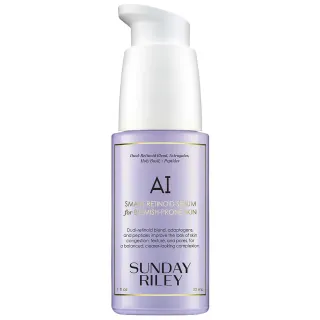
SUNDAY RILEY AI Smart Retinoid for Blemish Prone Skin

SUNDAY RILEY AI Smart Retinoid for Blemish Prone Skin

Efficacy100/100IrritancyMedium

Works for

Evens skin tone
Hydroxypinacolone retinoate, Glycine soja seed extract
Works well
What the product description says
“Electric Daisy: Helps skin appear firmer and more even-toned.”
Source: Dermstore

This product can help reduce hypepigmentation and even out the skin tone because it contains the following effective ingredients: hydroxypinacolone retinoate.

The following ingredient (ingredients) in this product might be helpful, but there is no evidence to confirm that it actually can help even out the skin tone: glycine soja seed extract.

Keep in mind that you would need to apply any topical skincare targetted at hypigmentation consistently for a couple of months to get a result. No topical skincare product can help get rid of hyperpigmentation (including post-acne marks and age spots) instantly.

Hydroxypinacolone retinoateHeroEffect: HighA derivative of the most potent form of vitamin A, retinoic acid. The ingredient can be sold under name Granactive Retinoid. Note that if a skincare brand discloses the concentration of Granactive Retinoid in a product, the concentration refers to a diluted form of Hydroxypinacolone Retinoate: 1% of Granactive Retinoid corresponds to 0.1% of Hydroxypinacolone Retinoate. Hydroxypinacolone Retinoate (HPR) is a unique derivative of retinoic acid because it can directly work in the skin and does not require additional conversion steps. According to studies done by the manufacturer on models of human skin (not real people), this derivative is more effective than other cosmetic versions of retinoids (such as retinol, retinaldehyde, and retinyl palmitate), and, at the same time, causes less irritation. It has been also demonstrated to be more stable than retinol which makes formulating with easier and increases the chances that a product with it will maintain its effectiveness after opening. The packaging should still ideally be air-tight. HPR is available over the counter in the EU, UK, Asia, Australia and New Zealand, but is only with a prescription in Canada.~0.7–1.05%
Glycine soja seed extractEffect: LowAn emollient that helps soften the skin. Might be somewhat helpful in evening the skin tone.~1.2–1.5%
Moisturizing
Acetyl hexapeptide-1, Diisopropyl sebacate + 17 more
Works well
What the product description says
“Beech Seed Oil: Supports skin's natural moisture barrier.”
Source: Dermstore

This product can help improve hydration of the skin with the two types of ingredients.

The first type is called “humectants”:
these ingredients help attract water. When humectants are on the surface of the skin, they “pull in” the moisture from the outside environment, or from within deeper layers of the skin. The following ingredients in this product do the job: glycerin, saccharomyces cerevisiae extract.

This product also contains ingredients called “occlusives”. They help reduce the speed with which our skin loses moisture to the outside environment. These ingredients also help soften the upper layer of the skin, so it feels less tight and nicer to the touch. The following ingredients in this product do the job: chondrus crispus extract, dimethicone.

The following ingredients in this product are especially good for supporting the skin barrier and helping with the hydration level: acetyl hexapeptide-1

Acetyl hexapeptide-1HeroEffect: HighA type of peptide. Peptides are excellent moisturizers and might be able support collagen production reducing fine lines and wrinkles~0.5–0.75%
Diisopropyl sebacateKey active· EmollientEffect: MediumHelps soften the upper layer of the skin without creatng a greasy finish~4.1–5%
GlycerinKey active· HumectantEffect: HighOne of the best moisturizing ingredients. Naturally present in skin. It attracts water to the upper layer of the skin working as a humectant~3–3.7%
DimethiconeKey active· Emollient, OcclusiveEffect: HighA silicone that helps to reduce water loss from the surface of the skin. Can temporarily "fill in" lines and wrinkles, absorb oil, and create a nice product finish~1.7–2.1%
Glycine soja seed extractKey active· EmollientEffect: MediumAn emollient that helps soften the skin. Might be somewhat helpful in evening the skin tone.~1.2–1.5%
Centella asiatica flower/leaf/stem extractKey activeEffect: HighA plant extract that has been shown to be able to reduce inflammation in skin, support restoration of skin barrier function, as well as support collagen production. Contains active compounds called centelloids: asiaticoside, madecasosside, asiatic acid and madecassic acid. Might be helpful in preventing stretch marks. It can be itself be irritating though.~0.6–0.9%
Sodium hyaluronateKey active· HumectantEffect: HighOne of the best moisturizing ingredients. Attracts water into the upper layer of the skin~0.5–0.75%
Saccharomyces ferment lysate filtrateKey activeEffect: HighHelps attract water to the upper layer of the skin~0.45–0.7%
Chondrus crispus extractKey active· OcclusiveEffect: HighRed algae extract that helps attract water to the upper layer of the skin and create a nicer product consistency~0.35–0.65%
Helianthus annuus seed oilKey active· Emollient, OcclusiveEffect: HighA great emollient due to its high linoleic acid content. One of the most effective plant oils in helping skin hydration and repairing skin barrier function~0.3–0.55%
Saccharomyces cerevisiae extractKey active· HumectantEffect: HighA moisturizing ingredient that works as a humectant to attract water to the upper layer of the skin.~0.3–0.6%
PhospholipidsKey activeEffect: MediumEmollients that are naturaly present in skin. In addition, they help water and oil mix together in the product~0.3–0.55%
Carthamus tinctorius seed oilKey active· EmollientEffect: HighAn emollient that helps soften the skin and might help calm down inflammation~0.25–0.45%
Aloe barbadensis leaf juice· HumectantEffect: LowTraditionally used to treat sunburns, dermatitis and inflammation, but evidence for its effectiveness is lacking. The extract can contain humectants that help attract water into the skin~1.9–2.4%
Hydrogenated polydecene· EmollientEffect: LowHelps to soften the upper layer of the skin and create a nice product texture~0.3–0.55%
Polyglyceryl-10 stearateEffect: LowHelps water and oil mix together and softens the upper layer of the skin~0.3–0.55%
Caprylyl glycol· Humectant, EmollientEffect: LowHelps preserve products and creates a nice product texture~0.2–0.35%
Cucumis sativus fruit extractEffect: Low, below effective doseMight be somewhat helpful in reducing hyperpigmentation and neutralizing free radicals but its typical concentration in a product is too low for having an effect~0.4–0.6%
TocopherolEffect: Low, below effective dosePure form of vitamin E. Can help moisturise and protect the skin from free radicals. Often used to help stabilise other ingredients or the formula itself~0.1–0.2%
Anti-blemish
Side benefit · Hydroxypinacolone retinoate, Aloe barbadensis leaf juice
Works well

This product can help reduce breakouts and clogged pores because it contains the following ingredient: hydroxypinacolone retinoate. This ingredient is used for treating acne and can have a noticeable effect.

Hydroxypinacolone retinoateHeroEffect: HighA derivative of the most potent form of vitamin A, retinoic acid. The ingredient can be sold under name Granactive Retinoid. Note that if a skincare brand discloses the concentration of Granactive Retinoid in a product, the concentration refers to a diluted form of Hydroxypinacolone Retinoate: 1% of Granactive Retinoid corresponds to 0.1% of Hydroxypinacolone Retinoate. Hydroxypinacolone Retinoate (HPR) is a unique derivative of retinoic acid because it can directly work in the skin and does not require additional conversion steps. According to studies done by the manufacturer on models of human skin (not real people), this derivative is more effective than other cosmetic versions of retinoids (such as retinol, retinaldehyde, and retinyl palmitate), and, at the same time, causes less irritation. It has been also demonstrated to be more stable than retinol which makes formulating with easier and increases the chances that a product with it will maintain its effectiveness after opening. The packaging should still ideally be air-tight. HPR is available over the counter in the EU, UK, Asia, Australia and New Zealand, but is only with a prescription in Canada.~0.7–1.05%
Aloe barbadensis leaf juiceEffect: LowTraditionally used to treat sunburns, dermatitis and inflammation, but evidence for its effectiveness is lacking. The extract can contain humectants that help attract water into the skin~1.9–2.4%
Anti-aging
Side benefit · Hydroxypinacolone retinoate, Acetyl hexapeptide-1 + 3 more
Works well

This product can help reduce and prevent fine lines and wrinkles, improve skin elasticity and firmness because it contains hydroxypinacolone retinoate.

These ingredients in the product can also be helpful, even though there is less evidence for their effectiveness: acetyl hexapeptide-1.

Keep in mind that it typically takes at least 6 weeks to notice any results because the changes that are needed to improve fine lines and elasticity happen in the deeper layers of the skin. No topical anti-aging product can “erase” wrinkles or fully reverse signs of aging.

Hydroxypinacolone retinoateHeroEffect: HighA derivative of the most potent form of vitamin A, retinoic acid. The ingredient can be sold under name Granactive Retinoid. Note that if a skincare brand discloses the concentration of Granactive Retinoid in a product, the concentration refers to a diluted form of Hydroxypinacolone Retinoate: 1% of Granactive Retinoid corresponds to 0.1% of Hydroxypinacolone Retinoate. Hydroxypinacolone Retinoate (HPR) is a unique derivative of retinoic acid because it can directly work in the skin and does not require additional conversion steps. According to studies done by the manufacturer on models of human skin (not real people), this derivative is more effective than other cosmetic versions of retinoids (such as retinol, retinaldehyde, and retinyl palmitate), and, at the same time, causes less irritation. It has been also demonstrated to be more stable than retinol which makes formulating with easier and increases the chances that a product with it will maintain its effectiveness after opening. The packaging should still ideally be air-tight. HPR is available over the counter in the EU, UK, Asia, Australia and New Zealand, but is only with a prescription in Canada.~0.7–1.05%
Acetyl hexapeptide-1Key activeEffect: MediumA type of peptide. Peptides are excellent moisturizers and might be able support collagen production reducing fine lines and wrinkles~0.5–0.75%
Aloe barbadensis leaf juiceEffect: LowTraditionally used to treat sunburns, dermatitis and inflammation, but evidence for its effectiveness is lacking. The extract can contain humectants that help attract water into the skin~1.9–2.4%
Glycine soja seed extractEffect: LowAn emollient that helps soften the skin. Might be somewhat helpful in evening the skin tone.~1.2–1.5%
TocopherolEffect: Low, below effective dosePure form of vitamin E. Can help moisturise and protect the skin from free radicals. Often used to help stabilise other ingredients or the formula itself~0.1–0.2%

Can it cause trouble?

Irritancy
2 strong irritants: Hydroxypinacolone retinoate, Ocimum sanctum leaf extract
Medium risk
We flagged 20 ingredients with irritancy potential. Severity depends on your sensitivity threshold; the table lists the worst offenders first.
IngredientFunctionIrritationEst. amount
Hydroxypinacolone retinoateA derivative of the most potent form of vitamin A, retinoic acid. The ingredient can be sold under name Granactive Retinoid. Note that if a skincare brand discloses the concentration of Granactive Retinoid in a product, the concentration refers to a diluted form of Hydroxypinacolone Retinoate: 1% of Granactive Retinoid corresponds to 0.1% of Hydroxypinacolone Retinoate. Hydroxypinacolone Retinoate (HPR) is a unique derivative of retinoic acid because it can directly work in the skin and does not require additional conversion steps. According to studies done by the manufacturer on models of human skin (not real people), this derivative is more effective than other cosmetic versions of retinoids (such as retinol, retinaldehyde, and retinyl palmitate), and, at the same time, causes less irritation. It has been also demonstrated to be more stable than retinol which makes formulating with easier and increases the chances that a product with it will maintain its effectiveness after opening. The packaging should still ideally be air-tight. HPR is available over the counter in the EU, UK, Asia, Australia and New Zealand, but is only with a prescription in Canada.High~0.7–1.05%est.
Ocimum sanctum leaf extractA plant extract that is rich in a fragrance compound eugenol that is a frequent allergen and can be irritating. It might also contain anti-oxidants to help neutralize free radicalsHigh~0.45–0.7%est.
Decyl glucosideHelps oil and water mix together. Can be irritatingHigh~0.4–0.65%est.
PhenylpropanolHelps mask the smell of other ingredients and helps preserve the product formulationHigh~0.25–0.45%est.
Aloe barbadensis leaf juiceTraditionally used to treat sunburns, dermatitis and inflammation, but evidence for its effectiveness is lacking. The extract can contain humectants that help attract water into the skinMedium~1.9–2.4%est.
Sodium acrylates copolymerUsed to create a thicker product consistencyMedium~1.4–1.7%est.
Glycine soja seed extractAn emollient that helps soften the skin. Might be somewhat helpful in evening the skin tone.Medium~1.2–1.5%est.
Centella asiatica flower/leaf/stem extractA plant extract that has been shown to be able to reduce inflammation in skin, support restoration of skin barrier function, as well as support collagen production. Contains active compounds called centelloids: asiaticoside, madecasosside, asiatic acid and madecassic acid. Might be helpful in preventing stretch marks. It can be itself be irritating though.Medium~0.6–0.9%est.
Cucumis sativus fruit extractMight be somewhat helpful in reducing hyperpigmentation and neutralizing free radicals but its typical concentration in a product is too low for having an effectMedium~0.4–0.6%est.
Saccharomyces cerevisiae extractA moisturizing ingredient that works as a humectant to attract water to the upper layer of the skin.Medium~0.3–0.6%est.
XanthophyllsA yellow colorantMedium~0.3–0.55%est.
Lauryl glucosideHelps oil and water mix togetherMedium~0.45–0.65%est.
Dehydroacetic acidA preservativeMedium~0.3–0.55%est.
1,2-hexanediolA preservativeMedium~0.3–0.55%est.
Polyglyceryl-10 stearateHelps water and oil mix together and softens the upper layer of the skinMedium~0.3–0.55%est.
Benzoic acidA preservativeMedium~0.3–0.5%est.
Citric acidCan work as an exfoliant but is typically used to adjust the product pHMedium~0.2–0.4%est.
HydroxyacetophenoneUsed to increase effectiveness of preservativesMedium~0.15–0.3%est.
Caprylyl glycolHelps preserve products and creates a nice product textureMedium~0.2–0.35%est.
Potassium sorbateA preservativeMedium~0.15–0.3%est.
Comedogenic
1 ingredient rated 2 or more on the 0–5 pore-clogging scale
1 flagged
These ingredients have a comedogenic rating of 2 or more on a 0–5 scale; the table shows each one's rating. In leave-on products they can clog pores in acne-prone skin.
IngredientFunctionRatingEst. amount
Chondrus crispus extractRed algae extract that helps attract water to the upper layer of the skin and create a nicer product consistency3/5~0.35–0.65%est.
Did this help you decide?

User reviews

Would you recommend?
No community reviews yet.

Be the first — your take helps the next person decide.

Ingredients

Filter by role to see what each ingredient is doing.

Water~45–55%
Formula
Irritation risk
Low

Plain old water

More about Water
Propanediol~4.4–5.4%
Formula
Irritation risk
Low

Acts as a solvent for other ingredients. Speeds up the absorption of other ingredients into the skin

More about Propanediol
Diisopropyl sebacate~4.1–5%
Key active
Irritation risk
Low
Works for
Moisturizing

Helps soften the upper layer of the skin without creatng a greasy finish

More about Diisopropyl sebacate
Glycerin~3–3.7%
Key active
Irritation risk
Low
Works for
Moisturizing

One of the best moisturizing ingredients. Naturally present in skin. It attracts water to the upper layer of the skin working as a humectant

More about Glycerin
Disiloxane~2.3–2.8%
Formula
Irritation risk
Low
More about Disiloxane
Aloe barbadensis leaf juice~1.9–2.4%
Irritant · medium
Irritation risk
Medium
Works for
MoisturizingAnti-inflammatoryAntibacterialReduces rednessReduces irritationAnti-blemishAnti-aging

Traditionally used to treat sunburns, dermatitis and inflammation, but evidence for its effectiveness is lacking. The extract can contain humectants that help attract water into the skin

More about Aloe barbadensis leaf juice
Dimethicone~1.7–2.1%
Key active
Irritation risk
Low
Works for
MoisturizingMattifying

A silicone that helps to reduce water loss from the surface of the skin. Can temporarily "fill in" lines and wrinkles, absorb oil, and create a nice product finish

More about Dimethicone
Sodium acrylates copolymer~1.4–1.7%
Irritant · medium
Irritation risk
Medium

Used to create a thicker product consistency

More about Sodium acrylates copolymer
Glycine soja seed extract~1.2–1.5%
Key activeIrritant · medium
Irritation risk
Medium
Works for
MoisturizingAnti-agingReduces rednessEvens skin toneAnti-oxidation

An emollient that helps soften the skin. Might be somewhat helpful in evening the skin tone.

More about Glycine soja seed extract
Ppg-24-glycereth-24~0.75–1.15%
Formula
Irritation risk
Low
Works for
Cleansing
More about Ppg-24-glycereth-24
Hydroxypinacolone retinoate~0.7–1.05%
Hero · Anti-aging, Evens skin tone, Anti-blemishIrritant · high
Irritation risk
High
Works for
Evens skin toneAnti-blemishAnti-agingExfoliation

A derivative of the most potent form of vitamin A, retinoic acid. The ingredient can be sold under name Granactive Retinoid. Note that if a skincare brand discloses the concentration of Granactive Retinoid in a product, the concentration refers to a diluted form of Hydroxypinacolone Retinoate: 1% of Granactive Retinoid corresponds to 0.1% of Hydroxypinacolone Retinoate. Hydroxypinacolone Retinoate (HPR) is a unique derivative of retinoic acid because it can directly work in the skin and does not require additional conversion steps. According to studies done by the manufacturer on models of human skin (not real people), this derivative is more effective than other cosmetic versions of retinoids (such as retinol, retinaldehyde, and retinyl palmitate), and, at the same time, causes less irritation. It has been also demonstrated to be more stable than retinol which makes formulating with easier and increases the chances that a product with it will maintain its effectiveness after opening. The packaging should still ideally be air-tight. HPR is available over the counter in the EU, UK, Asia, Australia and New Zealand, but is only with a prescription in Canada.

More about Hydroxypinacolone retinoate
Oleyl adapalenate
Not recognized
Centella asiatica flower/leaf/stem extract~0.6–0.9%
Key activeIrritant · medium
Irritation risk
Medium
Works for
Reduces irritationReduces rednessAnti-inflammatoryMoisturizing

A plant extract that has been shown to be able to reduce inflammation in skin, support restoration of skin barrier function, as well as support collagen production. Contains active compounds called centelloids: asiaticoside, madecasosside, asiatic acid and madecassic acid. Might be helpful in preventing stretch marks. It can be itself be irritating though.

More about Centella asiatica flower/leaf/stem extract
Astragalus membranaceus root extract~0.6–0.9%
Formula
Acetyl hexapeptide-1~0.5–0.75%
Hero · Moisturizing
Irritation risk
Low
Works for
MoisturizingAnti-aging

A type of peptide. Peptides are excellent moisturizers and might be able support collagen production reducing fine lines and wrinkles

More about Acetyl hexapeptide-1
Sodium hyaluronate~0.5–0.75%
Key active
Irritation risk
Low
Works for
Moisturizing

One of the best moisturizing ingredients. Attracts water into the upper layer of the skin

More about Sodium hyaluronate
Saccharomyces ferment lysate filtrate~0.45–0.7%
Key active
Irritation risk
Low
Works for
Moisturizing

Helps attract water to the upper layer of the skin

More about Saccharomyces ferment lysate filtrate
Ocimum sanctum leaf extract~0.45–0.7%
Irritant · high
Irritation risk
High
Works for
Anti-oxidation

A plant extract that is rich in a fragrance compound eugenol that is a frequent allergen and can be irritating. It might also contain anti-oxidants to help neutralize free radicals

More about Ocimum sanctum leaf extract
Opuntia ficus-indica fruit extract~0.45–0.65%
Formula
Cucumis sativus fruit extract~0.4–0.6%
Irritant · medium
Irritation risk
Medium
Works for
MoisturizingAnti-oxidation

Might be somewhat helpful in reducing hyperpigmentation and neutralizing free radicals but its typical concentration in a product is too low for having an effect

More about Cucumis sativus fruit extract
Glucosylrutin~0.35–0.65%
Formula
Irritation risk
Low
More about Glucosylrutin
Saccharomyces cerevisiae extract~0.3–0.6%
Key activeIrritant · medium
Irritation risk
Medium
Works for
Moisturizing

A moisturizing ingredient that works as a humectant to attract water to the upper layer of the skin.

More about Saccharomyces cerevisiae extract
Chondrus crispus extract~0.35–0.65%
Key activeComedogenic 3/5
Irritation risk
Low
Comedogenicity
3/5
Works for
Moisturizing

Red algae extract that helps attract water to the upper layer of the skin and create a nicer product consistency

More about Chondrus crispus extract
Xanthophylls~0.3–0.55%
Irritant · medium
Irritation risk
Medium

A yellow colorant

More about Xanthophylls
Phospholipids~0.3–0.55%
Key active
Irritation risk
Low
Works for
Moisturizing

Emollients that are naturaly present in skin. In addition, they help water and oil mix together in the product

More about Phospholipids
Cyclodextrin~0.3–0.55%
Formula
Irritation risk
Low

A type of sugar that is used to support delivery of active ingredients and can enhance their penetration into the skin without disrupting the skin's barrier

More about Cyclodextrin
Lauryl glucoside~0.45–0.65%
Irritant · medium
Irritation risk
Medium
Works for
Cleansing

Helps oil and water mix together

More about Lauryl glucoside
Dehydroacetic acid~0.3–0.55%
Irritant · medium
Irritation risk
Medium

A preservative

More about Dehydroacetic acid
Hydrogenated polydecene~0.3–0.55%
Formula
Irritation risk
Low
Works for
Moisturizing

Helps to soften the upper layer of the skin and create a nice product texture

More about Hydrogenated polydecene
Decyl glucoside~0.4–0.65%
Irritant · high
Irritation risk
High
Works for
Cleansing

Helps oil and water mix together. Can be irritating

More about Decyl glucoside
1,2-hexanediol~0.3–0.55%
Irritant · medium
Irritation risk
Medium

A preservative

More about 1,2-hexanediol
Xylitol~0.3–0.55%
Formula
Irritation risk
Low

Helps attract water to the upper layer of the skin and repair the skin barrier function

More about Xylitol
Caprylic acid~0.35–0.65%
Formula
Irritation risk
Low
Works for
Cleansing
More about Caprylic acid
Polyglyceryl-10 stearate~0.3–0.55%
Irritant · medium
Irritation risk
Medium
Works for
Moisturizing

Helps water and oil mix together and softens the upper layer of the skin

More about Polyglyceryl-10 stearate
Helianthus annuus seed oil~0.3–0.55%
Key active
Irritation risk
Low
Works for
Moisturizing

A great emollient due to its high linoleic acid content. One of the most effective plant oils in helping skin hydration and repairing skin barrier function

More about Helianthus annuus seed oil
Benzoic acid~0.3–0.5%
Irritant · medium
Irritation risk
Medium

A preservative

More about Benzoic acid
Phenylpropanol~0.25–0.45%
Irritant · high
Irritation risk
High

Helps mask the smell of other ingredients and helps preserve the product formulation

More about Phenylpropanol
Sodium phytate~0.25–0.45%
Formula
Irritation risk
Low

Used to stabilize product formulations

More about Sodium phytate
Citric acid~0.2–0.4%
Irritant · medium
Irritation risk
Medium

Can work as an exfoliant but is typically used to adjust the product pH

More about Citric acid
Carthamus tinctorius seed oil~0.25–0.45%
Key active
Irritation risk
Low
Works for
MoisturizingAnti-oxidation

An emollient that helps soften the skin and might help calm down inflammation

More about Carthamus tinctorius seed oil
Hydroxyacetophenone~0.15–0.3%
Irritant · medium
Irritation risk
Medium

Used to increase effectiveness of preservatives

More about Hydroxyacetophenone
Silanetriol~0.15–0.3%
Formula
Irritation risk
Low
More about Silanetriol
Caprylyl glycol~0.2–0.35%
Irritant · medium
Irritation risk
Medium
Works for
Moisturizing

Helps preserve products and creates a nice product texture

More about Caprylyl glycol
Potassium sorbate~0.15–0.3%
Irritant · medium
Irritation risk
Medium

A preservative

More about Potassium sorbate
Tocopherol~0.1–0.2%
Formula
Irritation risk
Low
Works for
Anti-oxidationMoisturizingAnti-inflammatoryAnti-aging

Pure form of vitamin E. Can help moisturise and protect the skin from free radicals. Often used to help stabilise other ingredients or the formula itself

More about Tocopherol
Sodium benzoate~0.1–0.2%
Formula
Irritation risk
Low

A preservative

More about Sodium benzoate
Ingredient list view

Water, Propanediol, Diisopropyl sebacate, Glycerin, Disiloxane, Aloe barbadensis leaf juice, Dimethicone, Sodium acrylates copolymer, Glycine soja seed extract, Ppg-24-glycereth-24, Hydroxypinacolone retinoate, Unknown, Centella asiatica flower/leaf/stem extract, Astragalus membranaceus root extract, Acetyl hexapeptide-1, Sodium hyaluronate, Saccharomyces ferment lysate filtrate, Ocimum sanctum leaf extract, Opuntia ficus-indica fruit extract, Cucumis sativus fruit extract, Glucosylrutin, Saccharomyces cerevisiae extract, Chondrus crispus extract, Xanthophylls, Phospholipids, Cyclodextrin, Lauryl glucoside, Dehydroacetic acid, Hydrogenated polydecene, Decyl glucoside, 1,2-hexanediol, Xylitol, Caprylic acid, Polyglyceryl-10 stearate, Helianthus annuus seed oil, Benzoic acid, Phenylpropanol, Sodium phytate, Citric acid, Carthamus tinctorius seed oil, Hydroxyacetophenone, Silanetriol, Caprylyl glycol, Potassium sorbate, Tocopherol, Sodium benzoate

Compare prices

Retailers ranked by price — lowest first.

Amazon USPrice as of 11/23 06:00 GMT
$85.00
Buy
Dermstore30 ml
$85.00
Buy
Sephora
$85.00
Buy

Affiliate links · As an Amazon Associate, WIMJ earns from qualifying purchases.

Worth comparing, line by line.

Match % combines shared ingredients, the first five ingredients, shared actives and hero ingredients, irritancy (lower counts in the alternative's favour), texture and body area. Only products in the same routine step are compared.

Side-by-side comparison of this product against its closest alternatives
SUNDAY RILEYAI Smart Retinoid for Blemish Prone SkinYOUR PRODUCTAlpha-HMini Liquid Gold Midnight Reboot Serum with 14% Glycolic Acid and Tripeptide-5e.l.f. CosmeticsYOUTH BOOSTING ADVANCED NIGHT RETINOID SERUMStackedSkincareAdvanced Retinol Serum
Match—75%72%72%
Price$85.00—$23.00−$62.00$27.99−$57.01
Shared key ingredients—5 of 114 of 114 of 11
Key difference—Ferulic AcidRetinalNiacinamide
Irritancy Medium Medium Medium Medium
Drying alcohol————
View product Shop Shop Shop

More alternatives: FOREO SUPERCHARGED Triple-Action Firming SerumThe INKEY List CA Retinol Serum

Cheaper alternatives? See how this stacks up against similar formulas.
We compare ingredient profiles across our catalog — pick the closest match for your budget.
Open dupe finder

Sources cited in this review

Every concentration estimate and effectiveness label is anchored to one of these 20 studies and safety reviews.

  1. 1
  2. 2
  3. 3
  4. 4
  5. 5
  6. 6
SUNDAY RILEY AI Smart Retinoid for Blemish Prone Skin
SUNDAY RILEYAI Smart Retinoid for Blemish Prone Skin

Affiliate links · As an Amazon Associate, WIMJ earns from qualifying purchases.

As an Amazon Associate, WIMJ earns from qualifying purchases.