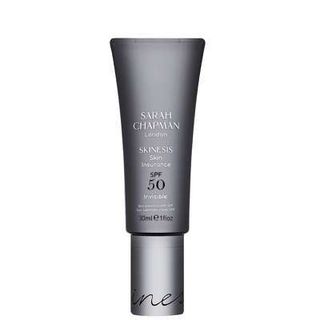
Sarah Chapman London Sun Protection Skinesis Skin Insurance SPF50 Invisible
Works for
1 of 1 advertised claim delivered
Sun protectionSPF 50 · 5 UV filtersBroad spectrum
This product offers a good level of protection against both UVB and UVA rays.
This sunscreen uses organic (so-called "chemical") sunscreen filters. Organic, or "chemical" filters usually provide reliable sun protection and rarely leave a white cast. Sunscreens with organic filters can sting eyes.
MoisturizingNot advertised by the brand · 29 ingredients credited for this claimStrong support
This product can help improve hydration of the skin with the two types of ingredients.
The first type is called “humectants”:
these ingredients help attract water.
When humectants are on the surface of the skin, they “pull in” the moisture from the outside environment, or from
within deeper layers of the skin. The following ingredients in this product do the job:
dextran, glycerin.
This product also contains ingredients called “occlusives”. They help reduce the speed with which our skin loses moisture to the outside environment. These ingredients also help soften the upper layer of the skin, so it feels less tight and nicer to the touch. The following ingredients in this product do the job: dimethicone, helianthus annuus seed oil.
The following ingredients in this product are especially good for supporting the skin barrier and helping with the hydration level: cyclotetrapeptide-24 aminocyclohexane carboxylate, nonapeptide-1
Anti-oxidationNot advertised by the brand · 8 ingredients credited for this claimStrong support
This product contains antioxidants (polygonum aviculare extract) that can help neutralize free radicals in skin. By doing so, they can lessen the damage the skin gets from the UV light (sun).
Anti-agingNot advertised by the brand · 7 ingredients credited for this claimStrong support
This product can help prevent early signs of skin aging because it offers a good level of broad spectrum sun protection. Sun damage is the main cause of premature skin aging, and protecting your skin from the sun is the best anti-aging strategy.
These ingredients in the product might also be helpful for reducing and preventing fine lines, wrinkles, and skin elasticity, even though there is no conclusive evidence for their effectiveness: cyclotetrapeptide-24 aminocyclohexane carboxylate, nonapeptide-1.
Evens skin toneNot advertised by the brand · 2 ingredients credited for this claimStrong support
This product offers broad spectrum sun protection. It means that it can prevent hyperpigmentation and help keep the skin tone even (sun damage is the main factor causing age spots, darkening of post-acne marks and other discolorations).
Anti-blemishNot advertised by the brand · 6 ingredients credited for this claimGood support
This product might be able to help reduce blemishes and clogged pores because it contains ethyl linoleate.
Can it cause trouble?
Irritancy12 strong irritants: Parfum, Jasminum officinale flower extract + 10 more — patch-test recommendedHigh risk
Comedogenic2 ingredients rated 2 or more on the 0–5 pore-clogging scale2 flagged


User reviews
Be the first — your take helps the next person decide.
Ingredients
Filter by role to see what each ingredient is doing.
Water~45–55%
Ethylhexyl methoxycinnamate~5.2–6.4%
- Irritation risk
- High
Octinoxate. When used in higher concentrations, works as a sunscreen protecting the skin from UVB rays. When used in lower concentration, helps to preserve the product formulation. Is shown to be harmful to coral reefs - consider avoiding bathing in coral reef areas when wearing a product with this ingredient. It can be irritating
More about Ethylhexyl methoxycinnamateBis-ethylhexyloxyphenol methoxyphenyl triazine~4.7–5.8%
- Irritation risk
- Medium
Tinosorb S. One of the most effective broad spectrum sunscreen ingredients. Protects from both UVA and UVB rays. It is photostable. Unfortunately, not approved by FDA (US) yet.
More about Bis-ethylhexyloxyphenol methoxyphenyl triazineCyclopentasiloxane~3.3–4%
- Irritation risk
- Low
A silicone that helps improve the product texture and spreadability. Can absorb oil creating a short-term mattifying effect on the skin
More about CyclopentasiloxaneDiethylamino hydroxybenzoyl hexyl benzoate~3.2–4%
- Irritation risk
- Medium
Uvinul A Plus. A new generation broad spectrum sunscreen that offers an effective protection especially in the UVA range. It is stable in formulations. Unfortunately, is not approved by the FDA (US) yet
More about Diethylamino hydroxybenzoyl hexyl benzoateEthylhexyl triazone~2.6–3.2%
- Irritation risk
- Medium
Uvinul T. A UV filter. Effective against UVB rays. It is photostable. Can increase water resistance properties of the sunscreen. Unfortunately, not approved by the FDA (US) yet
More about Ethylhexyl triazoneDicaprylyl ether~1.7–2.1%
- Irritation risk
- Low
Helps soften the upper layer of the skin while creating a non-greasy feel on the skin. Helps to dissolve other ingredients
More about Dicaprylyl etherDimethicone~1.5–1.9%
- Irritation risk
- Low
A silicone that helps to reduce water loss from the surface of the skin. Can temporarily "fill in" lines and wrinkles, absorb oil, and create a nice product finish
More about DimethiconePotassium cetyl phosphate~1.2–1.4%
- Irritation risk
- Medium
Helps oil and water mix together
More about Potassium cetyl phosphateButylene glycol~0.95–1.15%
- Irritation risk
- Low
Used to create a nice product texture and help delivery of other ingredients. Might be somewhat helpful in attracting water to the upper layer of the skin
More about Butylene glycolMethyl gluceth-20~0.65–1%
- Irritation risk
- Low
Helps attract water to the upper layer of the skin and soften it
More about Methyl gluceth-20Methylene bis-benzotriazolyl tetramethylbutylphenol~0.75–1.1%
- Irritation risk
- Medium
Tinosorb M. A UV filter. Is effective against both UVA and UVB rays. It also provides some protection against visible light. It is photostable and can also be used to improve photostability of other sunscreen ingredients. Its physical properties help to create lightweight sunscreen formulations. It can leave a slight white cast. Unfortunately, it is not approved by the FDA (US) yet
More about Methylene bis-benzotriazolyl tetramethylbutylphenolVinyl dimethicone/methicone silsesquioxane crosspolymer~0.5–0.75%
- Irritation risk
- Low
A type of silicone that create a smooth product finish and can create an optical soft-focus effect on the skin. Helps to thicken the product consistency
More about Vinyl dimethicone/methicone silsesquioxane crosspolymerNylon-12 fluorescent brightener 230 salt~0.5–0.8%
- Irritation risk
- Low
Isomalt~0.4–0.65%
- Irritation risk
- Low
Helps attract water to the upper layer of the skin
More about IsomaltPhenoxyethanol~0.45–0.65%
- Irritation risk
- Low
A preservative. It helps prevent bacterial growth in cosmetic products
More about PhenoxyethanolIsodecyl neopentanoate~0.45–0.65%
- Irritation risk
- Low
An emollient that helps soften the skin. It also forms a protective on its surface to reduce water loss.
More about Isodecyl neopentanoateDiisopropyl sebacate~0.35–0.65%
- Irritation risk
- Low
Helps soften the upper layer of the skin without creatng a greasy finish
More about Diisopropyl sebacateLauryl lactate~0.3–0.6%
- Irritation risk
- Low
Glycerin~0.3–0.6%
- Irritation risk
- Low
One of the best moisturizing ingredients. Naturally present in skin. It attracts water to the upper layer of the skin working as a humectant
More about GlycerinAmmonium acryloyldimethyltaurate/vp copolymer~0.25–0.5%
- Irritation risk
- Low
Increases thickness of a product. Texture enhancer for oil-in-water emulsions
More about Ammonium acryloyldimethyltaurate/vp copolymerOctadecenedioic acid~0.25–0.5%
- Irritation risk
- Low
Helps oil and water mix together. Might help suppress growth of acne-triggering bacteria in skin
More about Octadecenedioic acidHelianthus annuus seed oil~0.25–0.5%
- Irritation risk
- Low
A great emollient due to its high linoleic acid content. One of the most effective plant oils in helping skin hydration and repairing skin barrier function
More about Helianthus annuus seed oilSaccharide isomerate~0.25–0.45%
- Irritation risk
- Low
Helps attract water to the upper layer of the skin
More about Saccharide isomeratePanthenyl triacetate~0.25–0.45%
- Irritation risk
- Low
A stable oil-soluble derivative of vitamin B5. It can help support skin barrier and reduce inflammation in skin
More about Panthenyl triacetateXanthan gum~0.25–0.45%
- Irritation risk
- Low
Used to create a thicker product consistency
More about Xanthan gumSqualane~0.3–0.55%
- Irritation risk
- Low
An oil naturally present in skin. Works as an emollient to soften the skin and form a protective layer on its surface without a greasy feeling.
More about SqualaneAlcohol~0.25–0.45%
- Irritation risk
- High
Can be drying and contribute to skin irritation. Used in formulars to dissolve other ingredients, create a thinner product consistency or for its antibacterial properties
More about AlcoholEthyl linoleate~0.25–0.45%
- Irritation risk
- Medium
Helps reduce acne and blemishes. Helps to soften the upper layer of the skin and reduce inflammation. Might be helpful in reducing hyperpigmentation and evening out the skin tone, but evidence of effectiveness in skin are lacking
More about Ethyl linoleateDecyl glucoside~0.45–0.65%
- Irritation risk
- High
Helps oil and water mix together. Can be irritating
More about Decyl glucosideBenzoic acid~0.25–0.5%
Tocopheryl acetate~0.25–0.45%
- Irritation risk
- Medium
A more stable but less bio-available form of vitamin E compared to Tocopherol. Might help moisturize and protect the skin from free radicals, but mostly used in low concentrations to stabilize other ingredients.
More about Tocopheryl acetateHelianthus annuus hybrid oil~0.25–0.5%
- Irritation risk
- Low
Helps soften the upper layer of the skin
More about Helianthus annuus hybrid oilLimnanthes alba seed oil~0.3–0.55%
- Irritation risk
- Low
This oil's cmposition is closest to rapeseed oil. It is a very stable oil and serves as an emoillient
More about Limnanthes alba seed oilCitric acid~0.25–0.5%
- Irritation risk
- Medium
Can work as an exfoliant but is typically used to adjust the product pH
More about Citric acidDehydroacetic acid~0.25–0.5%
Lepidium meyenii root extract~0.25–0.5%
- Irritation risk
- Low
Oleyl alcohol~0.3–0.5%
Cedrus atlantica bark oil~0.25–0.45%
- Irritation risk
- Low
Parfum~0.25–0.45%
- Irritation risk
- High
An aromatic blend of unspecified and possibly irritating ingredients
More about ParfumLecithin~0.3–0.6%
- Irritation risk
- Low
Used mostly for creating emulsions - helping oil and water mix together. Helps soften the upper layer of the skin
More about LecithinCichorium intybus root extract~0.25–0.5%
- Irritation risk
- Low
Polyvinylalcohol crosspolymer~0.3–0.6%
- Irritation risk
- Low
Ectoin~0.25–0.5%
- Irritation risk
- Low
Softens the upper layer of the skin and can support skin barrier function
More about EctoinStearyl triethoxysilane~0.3–0.55%
- Irritation risk
- Low
Niacinamide~0.3–0.55%
- Irritation risk
- Low
Is proven to be effective in reducing blemishes, evening out skin tone and helping to improve lines and wrinkles. It helps the skin to repair sun damage, calm down inflammation and keep maintain good levels of moisture. The concentration of about 2% is effective for supporting the skin barrier and evening out the skin tone. Concentration of 4-6% is better for helping with acne and balancing the sebum production
More about NiacinamidePolygonum aviculare extract~0.35–0.6%
- Irritation risk
- Medium
A plant extract that contains a flavanol Juglanin. It can help neutralize free radicals in skin and reduce inflammation
More about Polygonum aviculare extractSodium starch octenylsuccinate~0.3–0.55%
- Irritation risk
- Low
Calcium pantothenate~0.3–0.55%
- Irritation risk
- Low
Helps support skin barrier function improving skin hydration and reducing sensitivity
More about Calcium pantothenateMaltodextrin~0.3–0.55%
- Irritation risk
- Low
Used to stabilize the product formulation and can help absorb oil
More about MaltodextrinBuddleja davidii extract~0.25–0.5%
- Irritation risk
- Low
Ethyl ferulate~0.3–0.5%
- Irritation risk
- Low
Jasminum officinale flower extract~0.25–0.5%
Pelargonium graveolens flower oil~0.3–0.55%
- Irritation risk
- High
An essential oil. Can be irritating. Can become an allergen with oxidation
More about Pelargonium graveolens flower oilPolyglyceryl-5 trioleate~0.35–0.65%
Santalum spicata wood oil~0.25–0.5%
- Irritation risk
- High
Sodium benzoate~0.25–0.5%
Potassium sorbate~0.3–0.55%
Allantoin~0.25–0.45%
- Irritation risk
- Low
Helps calm down inflammation in skin and can help reduce itching. Helps to repair the skin barrier and keep skin hydrated
More about AllantoinAloe barbadensis leaf juice powder~0.25–0.5%
- Irritation risk
- Medium
Traditionally used to treat sunburns, dermatitis and inflammation, but evidence for its effectiveness is lacking. The extract can contain humectants that help attract water into the skin
More about Aloe barbadensis leaf juice powderPlankton extract~0.3–0.55%
- Irritation risk
- Medium
- Comedogenicity
- 3/5
Can help attract water to the upper layer of the skin
More about Plankton extractPropylene glycol~0.25–0.5%
- Irritation risk
- High
Helps oil and water mix together and can enhance the penetration of other ingredients into the skin. It can be irritating
More about Propylene glycolVitis vinifera fruit cell extract~0.25–0.5%
- Irritation risk
- Low
Sodium ascorbyl phosphate~0.3–0.55%
- Irritation risk
- Medium
A stable derivative of vitamin C. It is oil-soluble which means it is more likely to penetrate the skin compared to the pure form of vitamin C (which is water-soluble), but it is less bio-available and is way less effective in stimulating collagen and reducing wrinkles compared to the pure form of vitamin C (L-ascorbic acid) and its other derivatives (for example, magnesium ascorbyl phosphate). At the same time, this vitamin C derivative has been shown in studies to be effective in reducing acne, blemishes and clogged pores. It is less irritating then the pure form of vitamin C
More about Sodium ascorbyl phosphateTocopherol~0.3–0.55%
- Irritation risk
- Low
Pure form of vitamin E. Can help moisturise and protect the skin from free radicals. Often used to help stabilise other ingredients or the formula itself
More about TocopherolRosa damascena flower oil~0.25–0.5%
- Irritation risk
- High
Used as a fragrance. Can be irritating
More about Rosa damascena flower oilSodium hydroxide~0.3–0.5%
Pyridoxine hcl~0.25–0.5%
- Irritation risk
- Medium
Might help neutralize free radicals in skin
More about Pyridoxine hclRosmarinus officinalis leaf extract~0.25–0.5%
- Irritation risk
- High
Can be helpful in reducing inflammation in skin, including inflamed acne. It can be irritating
More about Rosmarinus officinalis leaf extractSodium citrate~0.25–0.5%
- Irritation risk
- Medium
Helps to control the skin's pH level. Maintains the skin's natural film of amino-lactic acids and oils. Helps to preserve products
More about Sodium citrateEthylhexylglycerin~0.3–0.5%
Sorbic acid~0.25–0.5%
Hydrolyzed rna~0.25–0.5%
- Irritation risk
- Low
Silica~0.4–0.65%
Cyclotetrapeptide-24 aminocyclohexane carboxylate~0.25–0.45%
- Irritation risk
- Low
A type of peptide. Peptides are excellent moisturizers and might be able support collagen production reducing fine lines and wrinkles
More about Cyclotetrapeptide-24 aminocyclohexane carboxylateBht~0.25–0.45%
Dextran~0.2–0.4%
- Irritation risk
- Low
Helps attract water to the most upper layer of the skin. Derived from sugar
More about DextranNonapeptide-1~0.2–0.4%
- Irritation risk
- Low
A type of peptide. Peptides are excellent moisturizers and might be able support collagen production reducing fine lines and wrinkles
More about Nonapeptide-1Linalool~0.15–0.3%
Limonene~0.15–0.25%
- Irritation risk
- High
A common frangrance that can easily irritate skin, especially if exposed to air, light or heat
More about LimoneneBenzyl benzoate~0.15–0.3%
- Irritation risk
- High
Fragrance with sweet balsamic smell. Help to preserve products and dissolve other ingredients. Could trigger allergic reactions and be irritating
More about Benzyl benzoateCitronellol~0.15–0.25%
Geraniol~0.1–0.15%
Farnesol~0.1–0.15%
Ingredient list view
Water, Ethylhexyl methoxycinnamate, Bis-ethylhexyloxyphenol methoxyphenyl triazine, Cyclopentasiloxane, Diethylamino hydroxybenzoyl hexyl benzoate, Ethylhexyl triazone, Dicaprylyl ether, Dimethicone, Potassium cetyl phosphate, Butylene glycol, Methyl gluceth-20, Methylene bis-benzotriazolyl tetramethylbutylphenol, Vinyl dimethicone/methicone silsesquioxane crosspolymer, Nylon-12 fluorescent brightener 230 salt, Isomalt, Phenoxyethanol, Isodecyl neopentanoate, Diisopropyl sebacate, Lauryl lactate, Glycerin, Ammonium acryloyldimethyltaurate/vp copolymer, Octadecenedioic acid, Helianthus annuus seed oil, Saccharide isomerate, Panthenyl triacetate, Xanthan gum, Squalane, Alcohol, Ethyl linoleate, Decyl glucoside, Benzoic acid, Tocopheryl acetate, Helianthus annuus hybrid oil, Limnanthes alba seed oil, Citric acid, Dehydroacetic acid, Lepidium meyenii root extract, Oleyl alcohol, Cedrus atlantica bark oil, Parfum, Lecithin, Cichorium intybus root extract, Polyvinylalcohol crosspolymer, Ectoin, Stearyl triethoxysilane, Niacinamide, Polygonum aviculare extract, Sodium starch octenylsuccinate, Calcium pantothenate, Maltodextrin, Buddleja davidii extract, Ethyl ferulate, Jasminum officinale flower extract, Pelargonium graveolens flower oil, Polyglyceryl-5 trioleate, Santalum spicata wood oil, Sodium benzoate, Potassium sorbate, Allantoin, Aloe barbadensis leaf juice powder, Plankton extract, Propylene glycol, Vitis vinifera fruit cell extract, Sodium ascorbyl phosphate, Tocopherol, Rosa damascena flower oil, Sodium hydroxide, Pyridoxine hcl, Rosmarinus officinalis leaf extract, Sodium citrate, Ethylhexylglycerin, Sorbic acid, Hydrolyzed rna, Silica, Cyclotetrapeptide-24 aminocyclohexane carboxylate, Bht, Dextran, Nonapeptide-1, Linalool, Limonene, Benzyl benzoate, Citronellol, Geraniol, Farnesol
Compare prices
Retailers ranked by price — lowest first.
Worth comparing, line by line.
Match % combines shared ingredients, the first five ingredients, shared actives and hero ingredients, irritancy (lower counts in the alternative's favour), texture and body area. Only products in the same routine step are compared.
| Sarah Chapman LondonSun Protection Skinesis Skin Insurance SPF50 InvisibleYOUR PRODUCT | SkinMedicaTotal Defense and Repair SPF 50 | DRMTLGYBroad Spectrum SPF 45 | SVRSEBIACLEAR Crème SPF50 | |
|---|---|---|---|---|
| Match | — | 70% | 69% | 67% |
| Price | $69.94 | $61.20−$8.74 | $13.97−$55.97 | — |
| Shared key ingredients | — | 7 of 26 | 5 of 26 | 9 of 26 |
| Key difference | — | Panthenol | Octyldodecyl Neopentanoate | Salicylic Acid |
| Irritancy | High | Low | Low | Medium |
| SPF | SPF 50 | SPF 50 | SPF 45 | SPF 50 |
| Drying alcohol | Contains drying alcohol | — | — | — |
| View product | Shop | Shop | Shop |


Product summary
We assess that "Sarah Chapman London - Sun Protection Skinesis Skin Insurance SPF50 Invisible" can provide reliable sun protection based on the ingredient list. We love that it can protect from both UVA and UVB rays (not all sunscreens with SPF ratings give UVA protection. UVA rays do not cause sunburn, but still damage our skin and lead to early aging).
As a plus, this sunscreen uses some of the new generation UV filters (Tinosorb M). These filters are more stable and more gentle on the skin.
Because it includes good moisturizing ingredients, it can also work as a hydrating day cream. This product prevents early signs of aging by protecting against sun damage (all broad spectrum sunscreens do that).
Sunscreen filters
This sunscreen uses so-called "chemical", or organic UV filters (organic simply means that their molecules contain atoms of carbon). These filters typically give good sun protection and rarely leave a white cast, but they can be irritating for sensitive skin. Here are the exact UV filters in this sunscreen: tinosorb s 4.70% - 5.80%, uvinul a plus 3.20% - 4.00%, octinoxate 5.20% - 6.40%, uvinul t 2.60% - 3.20% and tinosorb m 0.75% - 1.10%.
Irritation risk
It contains a bunch of common irritants, including ingredients that do not provide any known benefit for the skin. It might not be the best choice if your skin is sensitive. We assess the overall irritancy of it to be high. For a detailed overview of all potential irritants: click here
You can see the detailed formula review with the breakdown of all actives in the product and the full ingredient list with estimated concentrations in the tables below.
Price
The product retails from 52.90£ up to 1465.00£ in the United Kingdom.
For a detailed price comparison: click here.
Sources cited in this review
Every concentration estimate and effectiveness label is anchored to one of these 36 studies and safety reviews.
- 1
- 2Final Report on the Safety Assessment of Dimethicone Copolyoljournals.sagepub.com
- 3
- 4
- 5
- 6Effect of topically applied lipids on surfactant-irritated skinonlinelibrary.wiley.com

Affiliate links · As an Amazon Associate, WIMJ earns from qualifying purchases.