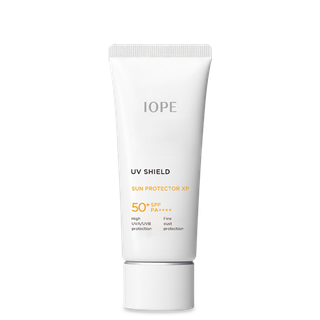
K-Beauty Blossom IOPE UV Shield Sun Protector XP SPF 50+ PA++++
Works for
2 of 2 advertised claims delivered
Sun protectionSPF 50 · 4 UV filtersBroad spectrum
This product offers a good level of protection against both UVB and UVA rays.
This sunscreen uses organic (so-called "chemical") sunscreen filters. Organic, or "chemical" filters usually provide reliable sun protection and rarely leave a white cast. Sunscreens with organic filters can sting eyes.
Anti-aging4 ingredients credited for this claimStrong support
“Protects skin from UV rays and fine dust The Micro-Filter SystemTM that protects skin from fine dust also protects from UV rays and harmful environments to help keep the skin in its healthiest state.”
This product can help reduce and prevent fine lines and wrinkles, improve skin elasticity and firmness because it contains adenosine, niacinamide.
Keep in mind that it typically takes at least 6 weeks to notice any results because the changes that are needed to improve fine lines and elasticity happen in the deeper layers of the skin. No topical anti-aging product can “erase” wrinkles or fully reverse signs of aging.
This product can also help prevent early signs of skin aging because it offers a good level of broad spectrum sun protection. Sun damage is the main cause of premature skin aging, and protecting your skin from the sun is the best anti-aging strategy.
MoisturizingNot advertised by the brand · 16 ingredients credited for this claimStrong support
This product can help soften the skin and reduce its moisture loss with emollients and occlusives: dimethicone, c12-15 alkyl benzoate.
Keep in mind that this product does not contain effective ingredients to attract water to the upper layer of the skin. This is why an additional product with humectants like glycerin or hyaluronic acid can be helpful (apply it before this product for the best results).
The following ingredients in this product are especially good for supporting the skin barrier and helping with the hydration level: niacinamide
Evens skin toneNot advertised by the brand · 3 ingredients credited for this claimStrong support
This product offers broad spectrum sun protection. It means that it can prevent hyperpigmentation and help keep the skin tone even (sun damage is the main factor causing age spots, darkening of post-acne marks and other discolorations).
Anti-blemishNot advertised by the brand · 1 ingredient credited for this claimGood support
This product might be able to help reduce blemishes and clogged pores because it contains niacinamide.
Can it cause trouble?
Irritancy1 strong irritant: ParfumMedium risk
Comedogenic2 ingredients rated 2 or more on the 0–5 pore-clogging scale2 flagged


User reviews
Be the first — your take helps the next person decide.
Ingredients
Filter by role to see what each ingredient is doing.
Water~45–55%
Butylene glycol~5.8–7.1%
- Irritation risk
- Low
Used to create a nice product texture and help delivery of other ingredients. Might be somewhat helpful in attracting water to the upper layer of the skin
More about Butylene glycolC12-15 alkyl benzoate~4.3–5.3%
- Irritation risk
- Low
Enhances the product texture and makes it more spreadable. Helps reduce water loss from the outer layer of skin. Extands the shelf life by preventing bacteria growth
More about C12-15 alkyl benzoateBis-ethylhexyloxyphenol methoxyphenyl triazine~3.5–4.2%
- Irritation risk
- Medium
Tinosorb S. One of the most effective broad spectrum sunscreen ingredients. Protects from both UVA and UVB rays. It is photostable. Unfortunately, not approved by FDA (US) yet.
More about Bis-ethylhexyloxyphenol methoxyphenyl triazineDiethylamino hydroxybenzoyl hexyl benzoate~3–3.7%
- Irritation risk
- Medium
Uvinul A Plus. A new generation broad spectrum sunscreen that offers an effective protection especially in the UVA range. It is stable in formulations. Unfortunately, is not approved by the FDA (US) yet
More about Diethylamino hydroxybenzoyl hexyl benzoateTitanium dioxide~2.3–2.9%
- Irritation risk
- Low
Works as a UV filter when used in high concentrations. It is photostable and is effective mostly against the UVB light, with some protection in the UVA range. In small concentrations, used for its ability to improve the color of cosmetic products. Is usually well tolerated by the skin
More about Titanium dioxideCyclopentasiloxane~1.6–1.9%
- Irritation risk
- Low
A silicone that helps improve the product texture and spreadability. Can absorb oil creating a short-term mattifying effect on the skin
More about CyclopentasiloxaneNiacinamide~1.3–1.6%
- Irritation risk
- Low
Is proven to be effective in reducing blemishes, evening out skin tone and helping to improve lines and wrinkles. It helps the skin to repair sun damage, calm down inflammation and keep maintain good levels of moisture. The concentration of about 2% is effective for supporting the skin barrier and evening out the skin tone. Concentration of 4-6% is better for helping with acne and balancing the sebum production
More about NiacinamideDimethicone~1.1–1.4%
- Irritation risk
- Low
A silicone that helps to reduce water loss from the surface of the skin. Can temporarily "fill in" lines and wrinkles, absorb oil, and create a nice product finish
More about DimethiconeSilica~1.1–1.3%
Cyclohexasiloxane~0.6–0.9%
- Irritation risk
- Low
A silicone that serves as an emollient. Helps create a nice non-greasy feels
More about CyclohexasiloxaneCetyl alcohol~0.55–0.85%
- Irritation risk
- Low
A non-drying alcohol that works to soften the skin and stabilize product formulations helping oil and water mix together
More about Cetyl alcoholGlyceryl stearate~0.45–0.7%
- Irritation risk
- Low
An emollient that softens the skin and forms a protective layer on its surface. Helps water and oil mix together
More about Glyceryl stearatePeg-100 stearate~0.45–0.7%
- Irritation risk
- Low
Helps oil and water mix togehter and creates a nice product texture
More about Peg-100 stearateTrisiloxane~0.3–0.55%
Nylon-12~0.35–0.6%
C14-22 alcohols~0.25–0.5%
- Irritation risk
- Low
A non-drying alcohol that helps stabilize product formulations
More about C14-22 alcoholsPolyacrylate-13~0.3–0.55%
- Irritation risk
- Low
Used to create a thicker product consistency and stabilize the product formulation
More about Polyacrylate-13Aluminum stearate~0.2–0.4%
- Irritation risk
- Medium
Used to help evenly disperse other ingredients (for example, pigment) in a formulation
More about Aluminum stearateParfum~0.2–0.35%
- Irritation risk
- High
An aromatic blend of unspecified and possibly irritating ingredients
More about ParfumPolyhydroxystearic acid~0.2–0.4%
- Irritation risk
- Medium
Used to create a thicker product consistency and stabilize the formulation
More about Polyhydroxystearic acidPolyisobutene~0.2–0.4%
Alumina~0.3–0.5%
- Irritation risk
- Low
The same compound that is used safely in dental implants and bone cements. In cosmetics, it is used to improve the consistency of products
More about AluminaStearic acid~0.25–0.5%
- Irritation risk
- Low
Helps oil and water mix together and works as an emollient
More about Stearic acidTocopheryl acetate~0.15–0.3%
- Irritation risk
- Medium
A more stable but less bio-available form of vitamin E compared to Tocopherol. Might help moisturize and protect the skin from free radicals, but mostly used in low concentrations to stabilize other ingredients.
More about Tocopheryl acetateC12-20 alkyl glucoside~0.2–0.35%
- Irritation risk
- Medium
Helps water and oil mix together
More about C12-20 alkyl glucosidePolysilicone-11~0.2–0.4%
- Irritation risk
- Low
A silicone that forms a light film on the skin surface helping to bind water and temporarily absorb oils creating a matt and powdery feel
More about Polysilicone-11C12-15 alcohols~0.2–0.35%
- Irritation risk
- Low
Methoxy peg-114/polyepsilon caprolactone~0.2–0.35%
- Irritation risk
- Low
Glyceryl caprylate~0.2–0.4%
- Irritation risk
- Low
An emollient that can also help water and oil mix together, as well as prevent bacteria growth in products
More about Glyceryl caprylateBifida ferment lysate~0.15–0.25%
- Irritation risk
- Low
Consists of remains of dead yeast bacteria cells. Helps to hydrate the skin and reduce irritation. Might has some anti-oxidant effect
More about Bifida ferment lysateCarbomer~0.15–0.3%
- Irritation risk
- Low
Helps create a thicker or gel-like product texture. It is not a surfactant but can be used in gentle cleansing formulations
More about CarbomerCichorium intybus root extract~0.15–0.25%
- Irritation risk
- Low
Ethylhexylglycerin~0.15–0.3%
Disodium edta~0.15–0.3%
Polysorbate 20~0.2–0.35%
Adenosine~0.15–0.25%
- Irritation risk
- Low
Might help improve cell turnover and reduce inflammation in skin. One study shows that the ingredients might be able to help reduce dynamic wrinkles (for example, in the corners of the eyes or on the forehead)
More about AdenosineSorbitan isostearate~0.15–0.3%
- Irritation risk
- Low
Helps oil and water mix together
More about Sorbitan isostearatePhenoxyethanol~0.15–0.3%
- Irritation risk
- Low
A preservative. It helps prevent bacterial growth in cosmetic products
More about PhenoxyethanolGossypium herbaceum extract~0.15–0.25%
- Irritation risk
- Low
- Comedogenicity
- 3/5
Glucose~0.15–0.3%
- Irritation risk
- Low
Helps attract water to the upper layer of the skin. Could be helpful in restoring the skin barrier function
More about GlucoseSodium benzoate~0.2–0.35%
Acetic acid~0.2–0.35%
- Irritation risk
- Low
Lactic acid~0.2–0.35%
- Irritation risk
- Medium
An exfoliating and moisturizing alpha-hydroxy acid (AHA). Typically causes less irritation than other AHAs, for example, glycolic acid. At high concentrations (about 15%), lactic acid can help reduce lines and wrinkles. Recent studies show that lactic acid can support the "good" bacteria living on skin's surface (healthy skin microbiome)
More about Lactic acidTocopherol~0.2–0.35%
- Irritation risk
- Low
Pure form of vitamin E. Can help moisturise and protect the skin from free radicals. Often used to help stabilise other ingredients or the formula itself
More about TocopherolWater~0.2–0.35%
Butylene glycol~0.2–0.35%
- Irritation risk
- Low
Used to create a nice product texture and help delivery of other ingredients. Might be somewhat helpful in attracting water to the upper layer of the skin
More about Butylene glycolEthylhexyl methoxycinnamate~0.35–0.65%
- Irritation risk
- High
Octinoxate. When used in higher concentrations, works as a sunscreen protecting the skin from UVB rays. When used in lower concentration, helps to preserve the product formulation. Is shown to be harmful to coral reefs - consider avoiding bathing in coral reef areas when wearing a product with this ingredient. It can be irritating
More about Ethylhexyl methoxycinnamateC12-15 alkyl benzoate~0.25–0.4%
- Irritation risk
- Low
Enhances the product texture and makes it more spreadable. Helps reduce water loss from the outer layer of skin. Extands the shelf life by preventing bacteria growth
More about C12-15 alkyl benzoateBis-ethylhexyloxyphenol methoxyphenyl triazine~0.35–0.65%
- Irritation risk
- Medium
Tinosorb S. One of the most effective broad spectrum sunscreen ingredients. Protects from both UVA and UVB rays. It is photostable. Unfortunately, not approved by FDA (US) yet.
More about Bis-ethylhexyloxyphenol methoxyphenyl triazineDiethylamino hydroxybenzoyl hexyl benzoate~0.4–0.6%
- Irritation risk
- Medium
Uvinul A Plus. A new generation broad spectrum sunscreen that offers an effective protection especially in the UVA range. It is stable in formulations. Unfortunately, is not approved by the FDA (US) yet
More about Diethylamino hydroxybenzoyl hexyl benzoateTitanium dioxide~0.3–0.55%
- Irritation risk
- Low
Works as a UV filter when used in high concentrations. It is photostable and is effective mostly against the UVB light, with some protection in the UVA range. In small concentrations, used for its ability to improve the color of cosmetic products. Is usually well tolerated by the skin
More about Titanium dioxideCyclopentasiloxane~0.25–0.45%
- Irritation risk
- Low
A silicone that helps improve the product texture and spreadability. Can absorb oil creating a short-term mattifying effect on the skin
More about CyclopentasiloxaneNiacinamide~0.2–0.4%
- Irritation risk
- Low
Is proven to be effective in reducing blemishes, evening out skin tone and helping to improve lines and wrinkles. It helps the skin to repair sun damage, calm down inflammation and keep maintain good levels of moisture. The concentration of about 2% is effective for supporting the skin barrier and evening out the skin tone. Concentration of 4-6% is better for helping with acne and balancing the sebum production
More about NiacinamideDimethicone~0.25–0.5%
- Irritation risk
- Low
A silicone that helps to reduce water loss from the surface of the skin. Can temporarily "fill in" lines and wrinkles, absorb oil, and create a nice product finish
More about DimethiconeSilica~0.3–0.6%
Cyclohexasiloxane~0.25–0.45%
- Irritation risk
- Low
A silicone that serves as an emollient. Helps create a nice non-greasy feels
More about CyclohexasiloxaneCetyl alcohol~0.25–0.5%
- Irritation risk
- Low
A non-drying alcohol that works to soften the skin and stabilize product formulations helping oil and water mix together
More about Cetyl alcoholGlyceryl stearate~0.25–0.5%
- Irritation risk
- Low
An emollient that softens the skin and forms a protective layer on its surface. Helps water and oil mix together
More about Glyceryl stearatePeg-100 stearate~0.3–0.55%
- Irritation risk
- Low
Helps oil and water mix togehter and creates a nice product texture
More about Peg-100 stearateTrisiloxane~0.2–0.4%
Nylon-12~0.25–0.5%
C14-22 alcohols~0.25–0.45%
- Irritation risk
- Low
A non-drying alcohol that helps stabilize product formulations
More about C14-22 alcoholsPolyacrylate-13~0.3–0.5%
- Irritation risk
- Low
Used to create a thicker product consistency and stabilize the product formulation
More about Polyacrylate-13Aluminum stearate~0.25–0.5%
- Irritation risk
- Medium
Used to help evenly disperse other ingredients (for example, pigment) in a formulation
More about Aluminum stearateParfum~0.25–0.45%
- Irritation risk
- High
An aromatic blend of unspecified and possibly irritating ingredients
More about ParfumPolyhydroxystearic acid~0.3–0.5%
- Irritation risk
- Medium
Used to create a thicker product consistency and stabilize the formulation
More about Polyhydroxystearic acidPolyisobutene~0.3–0.55%
Alumina~0.4–0.65%
- Irritation risk
- Low
The same compound that is used safely in dental implants and bone cements. In cosmetics, it is used to improve the consistency of products
More about AluminaStearic acid~0.4–0.65%
- Irritation risk
- Low
Helps oil and water mix together and works as an emollient
More about Stearic acidTocopheryl acetate~0.25–0.5%
- Irritation risk
- Medium
A more stable but less bio-available form of vitamin E compared to Tocopherol. Might help moisturize and protect the skin from free radicals, but mostly used in low concentrations to stabilize other ingredients.
More about Tocopheryl acetateC12-20 alkyl glucoside~0.25–0.5%
- Irritation risk
- Medium
Helps water and oil mix together
More about C12-20 alkyl glucosidePolysilicone-11~0.3–0.55%
- Irritation risk
- Low
A silicone that forms a light film on the skin surface helping to bind water and temporarily absorb oils creating a matt and powdery feel
More about Polysilicone-11C12-15 alcohols~0.3–0.55%
- Irritation risk
- Low
Methoxy peg-114/polyepsilon caprolactone~0.25–0.5%
- Irritation risk
- Low
Glyceryl caprylate~0.3–0.55%
- Irritation risk
- Low
An emollient that can also help water and oil mix together, as well as prevent bacteria growth in products
More about Glyceryl caprylateBifida ferment lysate~0.25–0.45%
- Irritation risk
- Low
Consists of remains of dead yeast bacteria cells. Helps to hydrate the skin and reduce irritation. Might has some anti-oxidant effect
More about Bifida ferment lysateCarbomer~0.25–0.5%
- Irritation risk
- Low
Helps create a thicker or gel-like product texture. It is not a surfactant but can be used in gentle cleansing formulations
More about CarbomerCichorium intybus root extract~0.25–0.45%
- Irritation risk
- Low
Ethylhexylglycerin~0.25–0.45%
Disodium edta~0.25–0.45%
Polysorbate 20~0.25–0.5%
Adenosine~0.25–0.45%
- Irritation risk
- Low
Might help improve cell turnover and reduce inflammation in skin. One study shows that the ingredients might be able to help reduce dynamic wrinkles (for example, in the corners of the eyes or on the forehead)
More about AdenosineSorbitan isostearate~0.25–0.45%
- Irritation risk
- Low
Helps oil and water mix together
More about Sorbitan isostearatePhenoxyethanol~0.2–0.35%
- Irritation risk
- Low
A preservative. It helps prevent bacterial growth in cosmetic products
More about PhenoxyethanolGossypium herbaceum extract~0.15–0.3%
- Irritation risk
- Low
- Comedogenicity
- 3/5
Glucose~0.15–0.3%
- Irritation risk
- Low
Helps attract water to the upper layer of the skin. Could be helpful in restoring the skin barrier function
More about GlucoseSodium benzoate~0.15–0.3%
Acetic acid~0.15–0.25%
- Irritation risk
- Low
Lactic acid~0.1–0.2%
- Irritation risk
- Medium
An exfoliating and moisturizing alpha-hydroxy acid (AHA). Typically causes less irritation than other AHAs, for example, glycolic acid. At high concentrations (about 15%), lactic acid can help reduce lines and wrinkles. Recent studies show that lactic acid can support the "good" bacteria living on skin's surface (healthy skin microbiome)
More about Lactic acidTocopherol~0.1–0.2%
- Irritation risk
- Low
Pure form of vitamin E. Can help moisturise and protect the skin from free radicals. Often used to help stabilise other ingredients or the formula itself
More about TocopherolIngredient list view
Water, Butylene glycol, C12-15 alkyl benzoate, Bis-ethylhexyloxyphenol methoxyphenyl triazine, Diethylamino hydroxybenzoyl hexyl benzoate, Titanium dioxide, Cyclopentasiloxane, Niacinamide, Dimethicone, Silica, Cyclohexasiloxane, Cetyl alcohol, Glyceryl stearate, Peg-100 stearate, Trisiloxane, Nylon-12, C14-22 alcohols, Polyacrylate-13, Aluminum stearate, Parfum, Polyhydroxystearic acid, Polyisobutene, Alumina, Stearic acid, Tocopheryl acetate, C12-20 alkyl glucoside, Polysilicone-11, C12-15 alcohols, Methoxy peg-114/polyepsilon caprolactone, Glyceryl caprylate, Bifida ferment lysate, Carbomer, Cichorium intybus root extract, Ethylhexylglycerin, Disodium edta, Polysorbate 20, Adenosine, Sorbitan isostearate, Phenoxyethanol, Gossypium herbaceum extract, Glucose, Sodium benzoate, Acetic acid, Lactic acid, Tocopherol, Water, Butylene glycol, Ethylhexyl methoxycinnamate, C12-15 alkyl benzoate, Bis-ethylhexyloxyphenol methoxyphenyl triazine, Diethylamino hydroxybenzoyl hexyl benzoate, Titanium dioxide, Cyclopentasiloxane, Niacinamide, Dimethicone, Silica, Cyclohexasiloxane, Cetyl alcohol, Glyceryl stearate, Peg-100 stearate, Trisiloxane, Nylon-12, C14-22 alcohols, Polyacrylate-13, Aluminum stearate, Parfum, Polyhydroxystearic acid, Polyisobutene, Alumina, Stearic acid, Tocopheryl acetate, C12-20 alkyl glucoside, Polysilicone-11, C12-15 alcohols, Methoxy peg-114/polyepsilon caprolactone, Glyceryl caprylate, Bifida ferment lysate, Carbomer, Cichorium intybus root extract, Ethylhexylglycerin, Disodium edta, Polysorbate 20, Adenosine, Sorbitan isostearate, Phenoxyethanol, Gossypium herbaceum extract, Glucose, Sodium benzoate, Acetic acid, Lactic acid, Tocopherol
Compare prices
Retailers ranked by price — lowest first.
Worth comparing, line by line.
Match % combines shared ingredients, the first five ingredients, shared actives and hero ingredients, irritancy (lower counts in the alternative's favour), texture and body area. Only products in the same routine step are compared.
| K-Beauty BlossomIOPE UV Shield Sun Protector XP SPF 50+ PA++++YOUR PRODUCT | Beauty of JoseonRelief Sun: Rice + Probiotic SPF50+ PA++++ | BellflowerWatermelon Fresh Sunscreen SPF50+ PA++++ | ISNTREEHyaluronic Acid Perfect Sun Block SPF50+ PA++++ | |
|---|---|---|---|---|
| Match | — | 86% | 85% | 84% |
| Price | $25.00 | $10.29−$14.71 | $8.00−$17.00 | — |
| Shared key ingredients | — | 3 of 11 | 4 of 11 | 4 of 11 |
| Key difference | — | Camellia Sinensis Leaf Extract | Centella Asiatica Extract | Ceramide Np |
| Irritancy | Medium | Low | Low | Low |
| SPF | SPF 50 | SPF 50 | SPF 50 | SPF 50 |
| Drying alcohol | — | — | — | — |
| View product | Shop | Shop | Shop |


Product summary
Based on the ingredient list, we assess that "K-Beauty Blossom - IOPE UV Shield Sun Protector XP SPF 50+ PA++++" can provide reliable sun protection. We love that it can protect from both UVA and UVB rays (not all sunscreens with SPF ratings give UVA protection. UVA rays do not cause sunburn, but still damage our skin and lead to early aging).
Because it includes good moisturizing ingredients, it can also work as a hydrating day cream. Like all broad-spectrum sunscreens, this product helps prevent early signs of aging.
Sunscreen filters
This sunscreen uses a mixture of both mineral and organic (so-called "chemical") UV filters. The organic filters in the product are: tinosorb s, uvinul a plus and octinoxate. As for the mineral filters, this sunscreen uses titanium dioxide.
Irritation risk
This formulation includes some common irritants, including ingredients that do not provide a benefit for the skin. We assess the overall irritancy of it to be medium. For a detailed overview of all potential irritants: click here
You can see the detailed formula review with the breakdown of all actives in the product and the full ingredient list with estimated concentrations in the tables below.
Sources cited in this review
Every concentration estimate and effectiveness label is anchored to one of these 16 studies and safety reviews.
- 1
- 2
- 3
- 4Final Report on the Safety Assessment of Dimethicone Copolyoljournals.sagepub.com
- 5
- 6

Affiliate links · As an Amazon Associate, WIMJ earns from qualifying purchases.