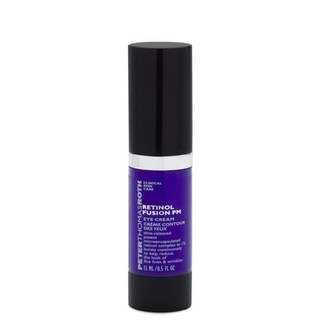
Peter Thomas Roth Retinol Fusion PM Eye Cream
Works for
3 of 3 advertised claims delivered
MoisturizingCeramide np, Dimethicone + 23 moreStrong evidence
“It also helps soften, moisturise ,and soothe the look of your skin to give a freshened, more youthful appearance.”
This product can help improve hydration of the skin with the two types of ingredients.
The first type is called “humectants”:
these ingredients help attract water.
When humectants are on the surface of the skin, they “pull in” the moisture from the outside environment, or from
within deeper layers of the skin. The following ingredients in this product do the job:
algae extract, sodium hyaluronate.
This product also contains ingredients called “occlusives”. They help reduce the speed with which our skin loses moisture to the outside environment. These ingredients also help soften the upper layer of the skin, so it feels less tight and nicer to the touch. The following ingredients in this product do the job: beeswax, butyrospermum parkii butter.
The following ingredients in this product are especially good for supporting the skin barrier and helping with the hydration level: ceramide np
Anti-agingRetinol, Retinyl palmitate + 5 moreStrong evidence
“This potent concentration includes a Microencapsulated Retinol Complex at 1% that helps to bring a more youthful appearance to your delicate eye area.”
This product can help reduce and prevent fine lines and wrinkles, improve skin elasticity and firmness because it contains retinol.
These ingredients in the product can also be helpful, even though there is less evidence for their effectiveness: retinyl palmitate.
Keep in mind that it typically takes at least 6 weeks to notice any results because the changes that are needed to improve fine lines and elasticity happen in the deeper layers of the skin. No topical anti-aging product can “erase” wrinkles or fully reverse signs of aging.
Evens skin toneRetinol, Retinyl palmitate + 2 moreStrong evidence
“It delivers a gentle and sustained release of potent retinol over the span of eight hours that works to help reduce darkness due to pigmentation, along with helping to diminish the look of fine lines and wrinkles, and increasing the look of skin smoothness.”
This product can help reduce hypepigmentation and even out the skin tone because it contains the following effective ingredients: retinol.
The following ingredient (ingredients) in this product might be helpful, but there is no evidence to confirm that it actually can help even out the skin tone: retinyl palmitate.
Keep in mind that you would need to apply any topical skincare targetted at hypigmentation consistently for a couple of months to get a result. No topical skincare product can help get rid of hyperpigmentation (including post-acne marks and age spots) instantly.
Anti-oxidationNot advertised by the brand · Superoxide dismutase, Retinol + 9 moreStrong evidence
This product contains antioxidants (retinol, superoxide dismutase) that can help neutralize free radicals in skin. By doing so, they can lessen the damage the skin gets from the UV light (sun).
ExfoliationNot advertised by the brand · Retinol, Retinyl palmitateStrong evidence
This product can help exfoliate the skin. In other words, it helps break down the bonds between dead cells on the surface of the skin and speed up the skin turnover. Skin often appears softer and brighter after exfoliation, but overdoing it can result in disrupted skin barrier. The following ingredient is doing the exfoliating job in this product: retinol.
Can it cause trouble?
Irritancy3 strong irritants: Retinol, Retinyl palmitate + 1 more — patch-test recommendedHigh risk
Comedogenic3 ingredients rated 2 or more on the 0–5 pore-clogging scale3 flagged

User reviews
Be the first — your take helps the next person decide.
Ingredients
Filter by role to see what each ingredient is doing.
Water~45–55%
Glyceryl stearate~4.5–5.4%
- Irritation risk
- Low
An emollient that softens the skin and forms a protective layer on its surface. Helps water and oil mix together
More about Glyceryl stearateCetyl alcohol~3.6–4.4%
- Irritation risk
- Low
A non-drying alcohol that works to soften the skin and stabilize product formulations helping oil and water mix together
More about Cetyl alcoholPropylene glycol stearate~3–3.7%
Cera alba~2.6–3.1%
- Irritation risk
- Medium
Forms a protective barrier that holds water and keeps dry skin hydrated. Keeps an emulsion from separating into its oil and liquid components, and increases the thickness of a product. Can be an allergen
More about Cera albaBeeswax~2–2.4%
- Irritation risk
- Low
Forms a protective barrier that holds water and keeps dry skin hydrated. Keeps an emulsion from separating into its oil and liquid components, and increases the thickness of a product. Can be an allergen
More about BeeswaxCaffeine~1.5–1.9%
- Irritation risk
- Medium
Might be helpful in neutralizing free radicals. Can have a dehydration effect that might somewhat decrease the look of puffy eyes
More about CaffeineRetinol~1.3–1.6%
- Irritation risk
- High
Two steps removed from the active form of vitamin A - retinoic acid. Once converted to the retinoic acid in the skin, retinol is proven to be effective against all signs of aging. It improves skin cell turnover, helps fight blemishes and clogged pores, can regulate excess oil production and even skin tone. It can, however, be quite irritating
More about RetinolButyrospermum parkii butter~1.2–1.5%
- Irritation risk
- Low
- Comedogenicity
- 3/5
A great moisturising ingredient that softens the skin and reduces water loss from its upper layer. It also can be helpful in protecting skin from free radicals
More about Butyrospermum parkii butterPersea gratissima oil~0.95–1.15%
- Irritation risk
- Medium
An emollient that helps soften the skin and could be helpful in repairing its barrier function
More about Persea gratissima oilAscorbic acid~0.65–0.95%
- Irritation risk
- High
The most well-researched antioxidant that works in skin. Helps neutralize free radicals supporting collagen production, helping to even out the skin tone and preventing early signs of aging
More about Ascorbic acidRetinyl palmitate~0.5–0.75%
- Irritation risk
- High
Three steps removed from the active form of vitamin A - retinoic acid. To have an effect in the skin, it first needs to be converted twice to become the retinoic acid. This means it is less potent than retinol, but could also be less irritating. Once converted to the retinoic acid in the skin, it helps against all signs of aging, improves skin cell turnover and helps fight blemishes and clogged pores. However, in many cosmetic formulations, it is used in a concentration that is too low to have the full effect
More about Retinyl palmitateTocopheryl acetate~0.5–0.7%
- Irritation risk
- Medium
A more stable but less bio-available form of vitamin E compared to Tocopherol. Might help moisturize and protect the skin from free radicals, but mostly used in low concentrations to stabilize other ingredients.
More about Tocopheryl acetateSodium hyaluronate~0.4–0.65%
- Irritation risk
- Low
One of the best moisturizing ingredients. Attracts water into the upper layer of the skin
More about Sodium hyaluronateSodium pca~0.35–0.65%
- Irritation risk
- Low
Naturally present in skin and helps to attract water to its upper layer
More about Sodium pcaBht~0.35–0.6%
Superoxide dismutase~0.3–0.6%
- Irritation risk
- Low
An antioxidant enzyme that is naturally present in skin. It can help support skin barrier function and reduce inflammation in skin. It is used in topical medications for inflammatory skin conditions including atopic dermatitis (eczema) and psoriasis. There are three types of natural Superoxide Dismutase in human skin. The compound used in topical treatments and cosmetics are mimics of typically one of these natural variants
More about Superoxide dismutaseSqualane~0.35–0.65%
- Irritation risk
- Low
An oil naturally present in skin. Works as an emollient to soften the skin and form a protective layer on its surface without a greasy feeling.
More about SqualaneAloe barbadensis leaf juice~0.25–0.5%
- Irritation risk
- Medium
Traditionally used to treat sunburns, dermatitis and inflammation, but evidence for its effectiveness is lacking. The extract can contain humectants that help attract water into the skin
More about Aloe barbadensis leaf juiceSoluble collagen~0.25–0.5%
- Irritation risk
- Low
A typically plant-derived compound that is supposed mimic human collagen. Cannot penetrate the skin barrier so is not particularly useful in skincare products beyond attracting water to the upper layer of the skin
More about Soluble collagenHydrolyzed elastin~0.25–0.5%
- Irritation risk
- Low
Lecithin~0.3–0.5%
- Irritation risk
- Low
Used mostly for creating emulsions - helping oil and water mix together. Helps soften the upper layer of the skin
More about LecithinAllantoin panthenol~0.2–0.4%
- Irritation risk
- Low
Ceramide np~0.25–0.45%
- Irritation risk
- Low
A type of lipid similar to ceramides naturally present in skin. Helps to soften the upper layer of the skin and supports the skin barrier function to keep it hydrated. Can help to prevent inflammation in skin
More about Ceramide npEchinacea purpurea extract~0.2–0.35%
- Irritation risk
- High
Plant extract that might have some anti-oxidant properties. Can be irritating
More about Echinacea purpurea extractAlgae extract~0.3–0.5%
- Irritation risk
- Low
- Comedogenicity
- 3/5
Plant extract that helps the skin to attract water and make it more smooth for touch. Also shows promise of anti-aging properties, but research is not extensive yet
More about Algae extractC13-14 isoparaffin~0.25–0.45%
- Irritation risk
- Low
Helps soften the upper layer of the skin, dissolve other ingredients and create a thicker product consistency
More about C13-14 isoparaffinFoeniculum vulgare seed extract~0.2–0.4%
- Irritation risk
- Low
Rosa canina fruit oil~0.25–0.45%
- Irritation risk
- Medium
A great emollient. Contains vitamin E (tocopherol) which may give it some anti-oxidant properties. Can contain volatile compounds and can be irritating
More about Rosa canina fruit oilViola tricolor extract~0.25–0.45%
- Irritation risk
- Medium
A plant extract that might have an anti-inflammatory effect in skin
More about Viola tricolor extractCamellia sinensis leaf extract~0.25–0.45%
- Irritation risk
- Low
Can contain potent anti-oxidant compounds (abbreviated ECG, GCG, EGC, and EGCG) that might help protect the skin from free radicals. Can help calm down inflammation and has some anti-bacterial properties. Unfortunately, these antioxidants are unstable and lose their effectiveness very quickly in products. The concentration of the antioxidant compounds in the extract also tends to be low to be effective in topical formulation
More about Camellia sinensis leaf extractDimethicone~0.25–0.5%
- Irritation risk
- Low
A silicone that helps to reduce water loss from the surface of the skin. Can temporarily "fill in" lines and wrinkles, absorb oil, and create a nice product finish
More about DimethiconeHelianthus annuus seed oil~0.25–0.45%
- Irritation risk
- Low
A great emollient due to its high linoleic acid content. One of the most effective plant oils in helping skin hydration and repairing skin barrier function
More about Helianthus annuus seed oilWheat amino acids~0.2–0.35%
- Irritation risk
- Low
Potassium phosphate~0.25–0.4%
Leuconostoc/radish root ferment filtrate~0.2–0.4%
- Irritation risk
- Medium
A preservative that comes from radishes fermented by a bacteria. New research suggests that the preservation properties in the ingredient come from an ammonium salt that is not present naturally in radish root but used in its cultivation. Is problematic because the exact amount of the preservative agents is difficult to determine
More about Leuconostoc/radish root ferment filtrateCitric acid~0.2–0.4%
- Irritation risk
- Medium
Can work as an exfoliant but is typically used to adjust the product pH
More about Citric acidDisodium edta~0.2–0.4%
Carbomer~0.2–0.4%
- Irritation risk
- Low
Helps create a thicker or gel-like product texture. It is not a surfactant but can be used in gentle cleansing formulations
More about CarbomerTriethanolamine~0.25–0.4%
- Irritation risk
- Medium
Used to adjust pH of the product and can help improve the product's smell
More about TriethanolamineSteapyrium chloride~0.2–0.4%
- Irritation risk
- Low
Polyacrylamide~0.25–0.45%
- Irritation risk
- Medium
Used to improve product texture and help oil and water mix together
More about PolyacrylamidePolysorbate 20~0.25–0.45%
Oleic acid~0.25–0.45%
- Irritation risk
- Medium
Helps soften the upper layer of the skin. At the same time, it can weaken the skin's barrier enhancing penetration of other ingredients and increasing the risk of skin dryness
More about Oleic acidSoy acid~0.25–0.45%
Laureth-7~0.25–0.45%
Ascorbyl methylsilanol pectinate~0.2–0.35%
- Irritation risk
- Medium
A stable derivative of pectin and vitamin C. It might help neutralize free radicals in skin, but evidence of effectiveness is lacking. Helps create a thicker product consistency and stabilize the product formulation
More about Ascorbyl methylsilanol pectinateEdta~0.2–0.35%
Methylpropanediol~0.2–0.35%
Butylene glycol~0.2–0.35%
- Irritation risk
- Low
Used to create a nice product texture and help delivery of other ingredients. Might be somewhat helpful in attracting water to the upper layer of the skin
More about Butylene glycolPropylene glycol~0.2–0.35%
- Irritation risk
- High
Helps oil and water mix together and can enhance the penetration of other ingredients into the skin. It can be irritating
More about Propylene glycolPotassium sorbate~0.15–0.25%
Sodium benzoate~0.15–0.25%
Pentylene glycol~0.2–0.35%
- Irritation risk
- Medium
Used to preserve products, dissolve other ingredients and create a nice product texture
More about Pentylene glycolAlcohol~0.1–0.15%
- Irritation risk
- High
Can be drying and contribute to skin irritation. Used in formulars to dissolve other ingredients, create a thinner product consistency or for its antibacterial properties
More about AlcoholPhenoxyethanol~0.15–0.25%
- Irritation risk
- Low
A preservative. It helps prevent bacterial growth in cosmetic products
More about PhenoxyethanolIngredient list view
Water, Glyceryl stearate, Unknown, Cetyl alcohol, Propylene glycol stearate, Cera alba, Beeswax, Caffeine, Retinol, Butyrospermum parkii butter, Persea gratissima oil, Ascorbic acid, Retinyl palmitate, Tocopheryl acetate, Sodium hyaluronate, Sodium pca, Bht, Superoxide dismutase, Squalane, Aloe barbadensis leaf juice, Soluble collagen, Hydrolyzed elastin, Lecithin, Allantoin panthenol, Ceramide np, Echinacea purpurea extract, Algae extract, C13-14 isoparaffin, Foeniculum vulgare seed extract, Rosa canina fruit oil, Viola tricolor extract, Camellia sinensis leaf extract, Dimethicone, Helianthus annuus seed oil, Wheat amino acids, Potassium phosphate, Leuconostoc/radish root ferment filtrate, Citric acid, Disodium edta, Carbomer, Triethanolamine, Steapyrium chloride, Polyacrylamide, Polysorbate 20, Oleic acid, Soy acid, Laureth-7, Ascorbyl methylsilanol pectinate, Edta, Methylpropanediol, Butylene glycol, Propylene glycol, Potassium sorbate, Sodium benzoate, Pentylene glycol, Alcohol, Phenoxyethanol
Compare prices
Retailers ranked by price — lowest first.

Worth comparing, line by line.
Match % combines shared ingredients, the first five ingredients, shared actives and hero ingredients, irritancy (lower counts in the alternative's favour), texture and body area. Only products in the same routine step are compared.
| Peter Thomas RothRetinol Fusion PM Eye CreamYOUR PRODUCT | DermalogicaAge Reversal Eye Complex | Reform SkincareEveryday Moisturiser | No7Pure Retinol Eye Cream | |
|---|---|---|---|---|
| Match | — | 67% | 63% | 61% |
| Price | $55.00 | $75.00+$20.00 | — | $16.98−$38.02 |
| Shared key ingredients | — | 8 of 19 | 1 of 19 | 4 of 19 |
| Key difference | — | Arginine/Lysine Polypeptide | Ferulic Acid | Acetyl Dipeptide-1 Cetyl Ester |
| Irritancy | High | Medium | Low | Medium |
| Drying alcohol | Contains drying alcohol | — | — | Contains drying alcohol |
| View product | Shop | Shop | Shop |


Product summary
Based on the ingredient list, "Peter Thomas Roth - Retinol Fusion PM Eye Cream" can work well for skin moisturization. This moisturizer uses a good combo of humectants and emollients. These both types of ingredients are essentials for improving the skin hydration and keeping the skin barrier healthy. Algae extract, sodium hyaluronate, sodium pca, soluble collagen and butylene glycol in this product (humectants) attract water molecules to the upper layer of the skin (the water comes from the outside air or from the deeper layers of the skin if the air is dry). Ceramide np, algae extract, persea gratissima oil, beeswax and butyrospermum parkii butter in this product help decrease the water evoporation from the skin, so that it stays hydrated for longer. These ingredients also soften the skin and take away the feeling of tightness and dryness.
Ingredient callouts
- This product also contains Vitamin C (Ascorbic Acid). It can be an effective active for anti-aging and evening out the skin tone, but in this moisturizer it is used for stabilizing other ingredients in the formulation. In this concentration (0.65% - 0.95%) it cannot have a noticeable benefit for the skin.
- This moisturizer contains an effective form of Retinoids (vitamin A): retinol 1.30% - 1.60%. Retinoids are potent multitasking actives. They work to improve and prevent early signs of aging, reduce hyperpigmentation (age spots and post-acne marks), and prevent inflamed blemishes and clogged pores. The downside of Retinoids is that they can be irritating. If you are not already using a Retinoid in your routine, it is best to start slowly and apply the Retinoid product only a few times per week. If your skin tolerates it well, you can gradually increase the frequency to daily. Because of the irritation risk of Retinoids, we recommend to have another, retinoid-free moisturizer in your routine to use on the alternate days or when your skin feels dry.
- As a plus, this moisturizer also contains Ceramides (ceramide np 0.25% - 0.45%). Ceramides are a type of lipids that our skin produces itself. They are a building block of the skin's barrier. Ceramides used in skincare are synthetic or extracted from plants. They work well for softening the skin surface and "patch holes" in the skin's barrier.
Irritation risk
This formulation includes some common irritants, including ingredients that do not provide a benefit for the skin. We assess the overall irritancy of this moisturizer to be high. For a detailed overview of all potential irritants: click here
You can see the detailed formula review with the breakdown of all actives in the product and the full ingredient list with estimated concentrations in the tables below.
Price
The product retails from 46.00£ up to 53.58£ in the United Kingdom, from 46.00$ up to 55.00$ in the United States, for 75.67A$ in Australia and for 69.30CA$ in Canada.
For a detailed price comparison: click here.
Sources cited in this review
Every concentration estimate and effectiveness label is anchored to one of these 29 studies and safety reviews.
- 1
- 2
- 3Improvement of naturally aged skin with vitamin A (retinol)ncbi.nlm.nih.gov
- 4
- 5Hyaluronic acid: A key molecule in skin agingncbi.nlm.nih.gov
- 6

Affiliate links · As an Amazon Associate, WIMJ earns from qualifying purchases.