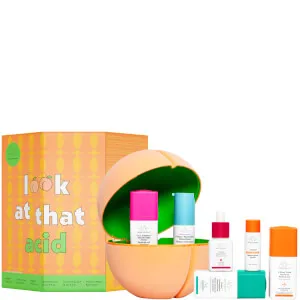
Works for
ExfoliationGlycolic acid, Salicylic acid + 8 moreWorks well
“A morning and evening serum combining signal peptides, plant-derived growth factors and amino acids with exfoliating 10% lactic acid to even the look of skin tone and textural irregularities.”
This product can help exfoliate the skin. In other words, it helps break down the bonds between dead cells on the surface of the skin and speed up the skin turnover. Skin often appears softer and brighter after exfoliation, but overdoing it can result in disrupted skin barrier. The following ingredient is doing the exfoliating job in this product: glycolic acid, salicylic acid.
Evens skin toneAscorbic acid, Glycolic acid + 16 moreWorks well
“A morning and evening serum combining signal peptides, plant-derived growth factors and amino acids with exfoliating 10% lactic acid to even the look of skin tone and textural irregularities.”
This product can help reduce hypepigmentation and even out the skin tone because it contains the following effective ingredients: ascorbic acid.
In addition, this product contains acetyl glucosamine, glycolic acid, salicylic acid. This ingredient (ingredients) might help reduce hyperpigmentation, but the effect, if any, is likely to be small.
The following ingredient (ingredients) in this product might be helpful, but there is no evidence to confirm that it actually can help even out the skin tone: alanine, dipotassium glycyrrhizate, ferulic acid, glycyrrhiza glabra root extract, lactobacillus/pumpkin ferment extract, tetrahydrobisdemethoxydiferuloylmethane, tetrahydrodemethoxydiferuloylmethane, tetrahydrodiferuloylmethane, vitis vinifera juice extract.
Keep in mind that you would need to apply any topical skincare targetted at hypigmentation consistently for a couple of months to get a result. No topical skincare product can help get rid of hyperpigmentation (including post-acne marks and age spots) instantly.
Anti-agingAscorbic acid, Heptapeptide-15 palmitate + 32 moreWorks well
“A resurfacing gel infused with a blend of glycolic, tartaric, lactic and citric acids (AHAs) and salicylic acid (BHA) to help visibly reduce fine lines and enlarged pores.”
This product can help reduce and prevent fine lines and wrinkles, improve skin elasticity and firmness because it contains ascorbic acid, acetyl glucosamine, adenosine, glycolic acid, heptapeptide-15 palmitate, palmitoyl hexapeptide-12.
These ingredients in the product can also be helpful, even though there is less evidence for their effectiveness: aspartic acid, copper palmitoyl heptapeptide-14, creatine, ferulic acid, palmitoyl tetrapeptide-7, palmitoyl tripeptide-1, palmitoyl tripeptide-38, serine, sh-oligopeptide-1, sh-oligopeptide-2, sh-polypeptide-1, sh-polypeptide-11, sh-polypeptide-9, threonine, tocotrienols, tripeptide-1.
Keep in mind that it typically takes at least 6 weeks to notice any results because the changes that are needed to improve fine lines and elasticity happen in the deeper layers of the skin. No topical anti-aging product can “erase” wrinkles or fully reverse signs of aging.
Anti-blemishSalicylic acid, Linoleic acid + 6 moreWorks well
“A blend of vegan retinol, virgin marula oil and ceramides to minimise the appearance of skin texture, fine lines, pigmentation and blemishes, while locking in moisture for a dewy glow.”
This product can help reduce breakouts and clogged pores because it contains the following ingredient: salicylic acid. This ingredient is used for treating acne and can have a noticeable effect.
The following ingredient (ingredients) in this product might be helpful, but there is no evidence to confirm that it actually works: glycolic acid, linoleic acid
MoisturizingLinoleic acid, Caprooyl sphingosine + 89 moreWorks well
“A quenching overnight mask formulated to plump the skin with moisture thanks to an electrolyte cocktail.”
This product can help improve hydration of the skin with the two types of ingredients.
The first type is called “humectants”:
these ingredients help attract water.
When humectants are on the surface of the skin, they “pull in” the moisture from the outside environment, or from
within deeper layers of the skin. The following ingredients in this product do the job:
alanine, arginine.
This product also contains ingredients called “occlusives”. They help reduce the speed with which our skin loses moisture to the outside environment. These ingredients also help soften the upper layer of the skin, so it feels less tight and nicer to the touch. The following ingredients in this product do the job: arginine, chondrus crispus extract.
The following ingredients in this product are especially good for supporting the skin barrier and helping with the hydration level: acetyl glucosamine, caprooyl phytosphingosine, caprooyl sphingosine, ceramide ap, ceramide eop, ceramide eos, ceramide np, ceramide ns, copper palmitoyl heptapeptide-14, heptapeptide-15 palmitate, linoleic acid, palmitoyl hexapeptide-12, palmitoyl tetrapeptide-7, palmitoyl tripeptide-1, palmitoyl tripeptide-38, panthenol, phytosphingosine, sh-oligopeptide-1, sh-oligopeptide-2, sh-polypeptide-1, sh-polypeptide-11, sh-polypeptide-9, tripeptide-1
Anti-oxidationSide benefit · Ascorbic acid, Ferulic acid + 20 moreWorks well
This product contains antioxidants (ascorbic acid, ferulic acid, tocopherol, tocotrienols) that can help neutralize free radicals in skin. By doing so, they can lessen the damage the skin gets from the UV light (sun).
The following ingredients - camellia sinensis leaf extract, creatine, quercetin, tartaric acid, tetrahydrobisdemethoxydiferuloylmethane, tetrahydrodemethoxydiferuloylmethane, tetrahydrodiferuloylmethane also can have an antioxidant effect, but there is less evidence to confirm their effectiveness in skin.
Can it cause trouble?
Irritancy51 flagged ingredients — patch-test recommendedHigh risk
Comedogenic7 ingredients rated 2 or more on the 0–5 pore-clogging scale7 flagged

User reviews
Be the first — your take helps the next person decide.
Ingredients
Filter by role to see what each ingredient is doing.
Water~40–60%
Dimethyl isosorbide~5.7–8.5%
- Irritation risk
- Low
Used to dissolve other ingredients in a product and can enhance their ability to penetrate the skin
More about Dimethyl isosorbideAscorbic acid~4.1–6.1%
- Irritation risk
- High
The most well-researched antioxidant that works in skin. Helps neutralize free radicals supporting collagen production, helping to even out the skin tone and preventing early signs of aging
More about Ascorbic acidLaureth-23~3.1–4.6%
- Irritation risk
- Medium
- Comedogenicity
- 2/5
Helps oil and water mix together
More about Laureth-23Glycerin~2.2–3.3%
- Irritation risk
- Low
One of the best moisturizing ingredients. Naturally present in skin. It attracts water to the upper layer of the skin working as a humectant
More about GlycerinTocopherol~1.7–2.6%
- Irritation risk
- Low
Pure form of vitamin E. Can help moisturise and protect the skin from free radicals. Often used to help stabilise other ingredients or the formula itself
More about TocopherolLactobacillus/pumpkin ferment extract~1.5–2.3%
- Irritation risk
- Medium
An enzyme-based exfoliant
More about Lactobacillus/pumpkin ferment extractSclerocarya birrea seed oil~1.3–1.9%
- Irritation risk
- Medium
An emollient that helps to soften the skin. It has a high contetn of oleic acid that might weaken the skin barrier. Might have some anti-oxidant properties. It might be somewhat helpful against hyperpigmentation.
More about Sclerocarya birrea seed oilDipotassium glycyrrhizate~1–1.5%
- Irritation risk
- Low
A salt derived from licorice. Works as an emollient to soften the upper layer of the skin and can help calm down inflammation. Might be helpful for skin lightening
More about Dipotassium glycyrrhizateGlycyrrhiza glabra root extract~0.5–1.2%
- Irritation risk
- Medium
A plant extract that can help lighten the skin and calm down inflammation. Might be helpful in neutralizing free radicals
More about Glycyrrhiza glabra root extractVitis vinifera juice extract~0.5–1.15%
- Irritation risk
- Medium
Contains AHAs that exfoliate the upper layer of the skin. Can help attract water to the upper layer of the skin due to the sugar content
More about Vitis vinifera juice extractPhyllanthus emblica fruit extract~0.4–0.95%
- Irritation risk
- Medium
A plant extract that might be helpful in neutralizing free radicals and have a skin lightening effect if used in high enough concentrations
More about Phyllanthus emblica fruit extractCamellia sinensis leaf extract~0.4–0.9%
- Irritation risk
- Low
Can contain potent anti-oxidant compounds (abbreviated ECG, GCG, EGC, and EGCG) that might help protect the skin from free radicals. Can help calm down inflammation and has some anti-bacterial properties. Unfortunately, these antioxidants are unstable and lose their effectiveness very quickly in products. The concentration of the antioxidant compounds in the extract also tends to be low to be effective in topical formulation
More about Camellia sinensis leaf extractLactobacillus/punica granatum fruit ferment extract~0.35–0.8%
- Irritation risk
- High
An enzyme-based exfoliant
More about Lactobacillus/punica granatum fruit ferment extractSodium hyaluronate crosspolymer~0.3–0.75%
- Irritation risk
- Medium
Attracts water into the upper layer of the skin
More about Sodium hyaluronate crosspolymerHydrolyzed quinoa~0.3–0.7%
- Irritation risk
- Low
Might help to attract water to the upper layer of the skin
More about Hydrolyzed quinoaPhytosterols~0.35–0.8%
- Irritation risk
- Medium
Lipids that work as an emollient and can be helpful in repairing skin barrier function
More about PhytosterolsGlutamylamidoethyl imidazole~0.2–0.75%
- Irritation risk
- Low
A peptide that is claimed to be helpful in supporting vitamin D production in skin but evidence is lacking
More about Glutamylamidoethyl imidazoleHydrolyzed wheat protein~0.15–0.65%
- Irritation risk
- Medium
Can help attract water to the upper layer of the skin. Avoid if sensitive to gluten
More about Hydrolyzed wheat proteinFerulic acid~0.15–0.65%
- Irritation risk
- Low
A potent anti-oxidant that has been shown to be effective in neutralizing free radicals in skin. There seem to have a synergetic effect of ferulic acid, vitamin E and C, meaning that when the ingredients are used together, they enhance each other's ability protect the skin against free radicals. Ferulic acid also helps to stabilize other ingredients - including vitamins C and E. It can help to even out the skin tone. Ferulic acid is approved for use as a sunscreen ingredient in Japan in concentrations up to 10%
More about Ferulic acidAcetyl glucosamine~0.15–0.6%
- Irritation risk
- Low
An effective moisturizing ingredient that also has been shown to be effective in evening out the skin tone and reducing hyperpigmentation. It can help somewhat reduce wrinkles in skin
More about Acetyl glucosamineSodium hyaluronate~0.15–0.6%
- Irritation risk
- Low
One of the best moisturizing ingredients. Attracts water into the upper layer of the skin
More about Sodium hyaluronateTetrahydrobisdemethoxydiferuloylmethane~0.15–0.55%
- Irritation risk
- High
An anti-oxidant derived from curcumin (naturally present in tumeric). It might be helpful in neutralizing free radicals in skin and possibly help even out the skin tone. Can be irritating
More about TetrahydrobisdemethoxydiferuloylmethaneTetrahydrodemethoxydiferuloylmethane~0.15–0.55%
- Irritation risk
- High
An anti-oxidant derived from curcumin (naturally present in tumeric). Is a part of the tetrahydrocurcuminoids complex (THC). The complex might be helpful in neutralizing free radicals in skin and possibly help even out the skin tone. Can be irritating
More about TetrahydrodemethoxydiferuloylmethaneTetrahydrodiferuloylmethane~0.15–0.55%
- Irritation risk
- High
An anti-oxidant derived from curcumin (naturally present in tumeric). Is a part of the tetrahydrocurcuminoids complex (THC). The complex might be helpful in neutralizing free radicals in skin and possibly help even out the skin tone. Can be irritating
More about TetrahydrodiferuloylmethaneGlycine~0.15–0.55%
- Irritation risk
- Low
Helps to attract water to the upper layer of the skin and can help restore the skin barrier function
More about GlycineLeuconostoc/radish root ferment filtrate~0.15–0.55%
- Irritation risk
- Medium
A preservative that comes from radishes fermented by a bacteria. New research suggests that the preservation properties in the ingredient come from an ammonium salt that is not present naturally in radish root but used in its cultivation. Is problematic because the exact amount of the preservative agents is difficult to determine
More about Leuconostoc/radish root ferment filtrateSucrose~0.1–0.5%
- Irritation risk
- Low
Can help attract water to the upper layer of the skin. In crystal form, it can work as a gentle exfoliant, gentler than the salt scrub. Helps stabilize the emulsion
More about SucroseMaltodextrin~0.15–0.55%
- Irritation risk
- Low
Used to stabilize the product formulation and can help absorb oil
More about MaltodextrinChondrus crispus extract~0.15–0.6%
- Irritation risk
- Low
- Comedogenicity
- 3/5
Red algae extract that helps attract water to the upper layer of the skin and create a nicer product consistency
More about Chondrus crispus extractHydroxyethyl acrylate/sodium acryloyldimethyl taurate copolymer~0.15–0.55%
- Irritation risk
- Medium
A gelling agent that thickens the product consistency and leaves the skin with a velvety finish
More about Hydroxyethyl acrylate/sodium acryloyldimethyl taurate copolymerIsohexadecane~0.35–0.85%
- Irritation risk
- Low
Improves the texture of the product and helps soften the skin. Helps oil and water mix together and can be used as a cleansing agent
More about IsohexadecanePhenoxyethanol~0.15–0.6%
- Irritation risk
- Low
A preservative. It helps prevent bacterial growth in cosmetic products
More about PhenoxyethanolCaprylhydroxamic acid~0.15–0.55%
Caprylyl glycol~0.15–0.6%
- Irritation risk
- Medium
Helps preserve products and creates a nice product texture
More about Caprylyl glycolSorbitan isostearate~0.15–0.6%
- Irritation risk
- Low
Helps oil and water mix together
More about Sorbitan isostearatePropanediol~0.15–0.6%
- Irritation risk
- Low
Acts as a solvent for other ingredients. Speeds up the absorption of other ingredients into the skin
More about PropanediolPentylene glycol~0.15–0.65%
- Irritation risk
- Medium
Used to preserve products, dissolve other ingredients and create a nice product texture
More about Pentylene glycolXanthan gum~0.15–0.6%
- Irritation risk
- Low
Used to create a thicker product consistency
More about Xanthan gumButylene glycol~0.15–0.55%
- Irritation risk
- Low
Used to create a nice product texture and help delivery of other ingredients. Might be somewhat helpful in attracting water to the upper layer of the skin
More about Butylene glycolSodium hydroxide~0.15–0.55%
Chlorphenesin~0.16–0.32%
Polysorbate 60~0.15–0.6%
Sodium dehydroacetate~0.15–0.55%
Potassium sorbate~0.15–0.55%
Sorbic acid~0.15–0.55%
Ethylhexylglycerin~0.15–0.55%
Water~0.15–0.55%
Glycerin~0.15–0.65%
- Irritation risk
- Low
One of the best moisturizing ingredients. Naturally present in skin. It attracts water to the upper layer of the skin working as a humectant
More about GlycerinLactic acid~0.15–0.55%
- Irritation risk
- Medium
An exfoliating and moisturizing alpha-hydroxy acid (AHA). Typically causes less irritation than other AHAs, for example, glycolic acid. At high concentrations (about 15%), lactic acid can help reduce lines and wrinkles. Recent studies show that lactic acid can support the "good" bacteria living on skin's surface (healthy skin microbiome)
More about Lactic acidDicaprylyl carbonate~0.15–0.6%
- Irritation risk
- Low
Helps products spread more easily and works as an emollient to soften skin
More about Dicaprylyl carbonateSqualane~0.15–0.65%
- Irritation risk
- Low
An oil naturally present in skin. Works as an emollient to soften the skin and form a protective layer on its surface without a greasy feeling.
More about SqualaneSodium hydroxide~0.15–0.55%
Glycine max seed extract~0.15–0.55%
- Irritation risk
- Low
Sclerocarya birrea seed oil~0.15–0.6%
- Irritation risk
- Medium
An emollient that helps to soften the skin. It has a high contetn of oleic acid that might weaken the skin barrier. Might have some anti-oxidant properties. It might be somewhat helpful against hyperpigmentation.
More about Sclerocarya birrea seed oilCamellia sinensis seed oil~0.15–0.6%
- Irritation risk
- Low
A plant oil that helps to soften the upper layer of the skin and can help restore the skin barrier. Might have some anti-oxidant effect
More about Camellia sinensis seed oilSodium pca~0.15–0.55%
- Irritation risk
- Low
Naturally present in skin and helps to attract water to its upper layer
More about Sodium pcaCaprylic/capric triglyceride~0.15–0.7%
- Irritation risk
- Medium
A good mix of fatty acids that forms a protective layer on the skin. Improves the shelf life of products. Derived from coconut and glycerin
More about Caprylic/capric triglycerideBorago officinalis seed oil~0.15–0.6%
- Irritation risk
- Low
A plant oil that is effective in reducing irritation in skin, restore the barrier function and support its hydration
More about Borago officinalis seed oilTremella fuciformis polysaccharide~0.15–0.55%
- Irritation risk
- Low
Tocotrienols~0.15–0.55%
- Irritation risk
- Low
A type of vitamin E that is more powerful in neutralizing free radicals compared to its other forms
More about TocotrienolsSh-oligopeptide-1~0.15–0.5%
- Irritation risk
- Low
A type of peptide. Peptides are excellent moisturizers and might be able support collagen production reducing fine lines and wrinkles
More about Sh-oligopeptide-1Sh-oligopeptide-2~0.15–0.5%
- Irritation risk
- Low
A type of peptide. Peptides are excellent moisturizers and might be able support collagen production reducing fine lines and wrinkles
More about Sh-oligopeptide-2Sh-polypeptide-1~0.15–0.5%
- Irritation risk
- Low
A type of peptide. Peptides are excellent moisturizers and might be able support collagen production reducing fine lines and wrinkles
More about Sh-polypeptide-1Sh-polypeptide-9~0.15–0.5%
- Irritation risk
- Low
A type of peptide. Peptides are excellent moisturizers and might be able support collagen production reducing fine lines and wrinkles
More about Sh-polypeptide-9Sh-polypeptide-11~0.15–0.55%
- Irritation risk
- Low
A type of peptide. Peptides are excellent moisturizers and might be able support collagen production reducing fine lines and wrinkles
More about Sh-polypeptide-11Copper palmitoyl heptapeptide-14~0.15–0.55%
- Irritation risk
- Low
The copper palmitoyl heptapeptide-14 is a synthetic peptide developed by ingredient supplier Infinitec, which claims that it can increase collagen production in skin when combined with Heptapeptide-15 Palmitate. The complex was tested in vitro (in a lab) and in a clinical test with 30 volunteers, but the latter wasn't placebo-controlled. The manufacturer reported wrinkle reduction after 28 days of use, but the details of the study aren't publicly available.
More about Copper palmitoyl heptapeptide-14Heptapeptide-15 palmitate~0.15–0.55%
- Irritation risk
- Low
A type of peptide. Peptides are excellent moisturizers and might be able support collagen production reducing fine lines and wrinkles
More about Heptapeptide-15 palmitatePalmitoyl tetrapeptide-7~0.15–0.65%
- Irritation risk
- Low
A type of peptide. Peptides are excellent moisturizers and might be able support collagen production reducing fine lines and wrinkles
More about Palmitoyl tetrapeptide-7Palmitoyl tripeptide-1~0.15–0.65%
- Irritation risk
- Low
A type of peptide. Peptides are excellent moisturizers and might be able support collagen production reducing fine lines and wrinkles
More about Palmitoyl tripeptide-1Palmitoyl tripeptide-38~0.15–0.55%
- Irritation risk
- Low
A type of peptide. Peptides are excellent moisturizers and might be able support collagen production reducing fine lines and wrinkles
More about Palmitoyl tripeptide-38Palmitoyl hexapeptide-12~0.15–0.55%
- Irritation risk
- Low
A type of peptide. Peptides are excellent moisturizers and might be able support collagen production reducing fine lines and wrinkles
More about Palmitoyl hexapeptide-12Tripeptide-1~0.15–0.6%
- Irritation risk
- Low
A type of peptide. Peptides are excellent moisturizers and might be able support collagen production reducing fine lines and wrinkles
More about Tripeptide-1Pyrus malus fruit extract~0.15–0.5%
- Irritation risk
- Medium
Can have some moisturizing properties due to its sugar content
More about Pyrus malus fruit extractPropanediol~0.15–0.6%
- Irritation risk
- Low
Acts as a solvent for other ingredients. Speeds up the absorption of other ingredients into the skin
More about PropanediolSodium hyaluronate~0.15–0.55%
- Irritation risk
- Low
One of the best moisturizing ingredients. Attracts water into the upper layer of the skin
More about Sodium hyaluronatePanthenol~0.15–0.55%
- Irritation risk
- Low
Helps attract water to the upper layer of the skin and can help improve skin barrier function
More about PanthenolSodium hyaluronate crosspolymer~0.15–0.55%
- Irritation risk
- Medium
Attracts water into the upper layer of the skin
More about Sodium hyaluronate crosspolymerSodium lactate~0.15–0.55%
- Irritation risk
- Medium
Helps attract water to the upper layer of the skin. Is often used to adjust the pH level of the product
More about Sodium lactatePca~0.15–0.55%
- Irritation risk
- Low
Naturally present in skin and helps to attract water to its upper layer
More about PcaAlanine~0.15–0.55%
- Irritation risk
- Low
An amino-acid that helps to attract water to the upper layer of the skin and might help to lighten the skin, but solid evidence is lacking
More about AlanineArginine~0.15–0.5%
- Irritation risk
- Low
An amino acid that is naturally present in skin and helps keep it hydrated. When used together with AHAs, it can reduce their irritating effect on the skin
More about ArginineGlycine~0.15–0.55%
- Irritation risk
- Low
Helps to attract water to the upper layer of the skin and can help restore the skin barrier function
More about GlycineHistidine~0.15–0.55%
Isoleucine~0.15–0.55%
- Irritation risk
- Low
An amino acid that can help attract water to the upper layer of the skin and support skin's barrier function
More about IsoleucinePhenylalanine~0.15–0.55%
- Irritation risk
- Low
Proline~0.15–0.55%
Serine~0.15–0.5%
- Irritation risk
- Low
An amino-acid that helps to attract water to the upper layer of the skin. In combination with other amino-acids, might help to reduce fine lines and wrinkles
More about SerineThreonine~0.15–0.55%
- Irritation risk
- Low
An amino-acid that helps to attract water to the upper layer of the skin. In combination with other amino-acids, might help to reduce fine lines and wrinkles
More about ThreonineValine~0.15–0.5%
- Irritation risk
- Low
Adenosine~0.15–0.55%
- Irritation risk
- Low
Might help improve cell turnover and reduce inflammation in skin. One study shows that the ingredients might be able to help reduce dynamic wrinkles (for example, in the corners of the eyes or on the forehead)
More about AdenosineNymphaea alba root extract~0.15–0.55%
- Irritation risk
- Medium
A plant root extract that might help neutralize free radicals in skin
More about Nymphaea alba root extractBacillus/folic acid ferment filtrate extract~0.15–0.5%
- Irritation risk
- Low
Symphytum officinale callus culture extract~0.15–0.5%
- Irritation risk
- Low
Dextran~0.15–0.55%
- Irritation risk
- Low
Helps attract water to the most upper layer of the skin. Derived from sugar
More about DextranOryza sativa bran oil~0.15–0.6%
- Irritation risk
- Low
Helps soften the upper layer of the skin and might have some anti-oxidant properties
More about Oryza sativa bran oilLinoleic acid~0.35–0.85%
- Irritation risk
- Low
An excellent emollient. Helps soften the skin, restore its barrier function, and can help to calm down inflammation. It can be helpful to prevent blemishes and clogged pores
More about Linoleic acidLinolenic acid~0.35–0.75%
- Irritation risk
- Medium
An emollient that helps soften the skin and calm down inflammation
More about Linolenic acidButylene glycol~0.15–0.55%
- Irritation risk
- Low
Used to create a nice product texture and help delivery of other ingredients. Might be somewhat helpful in attracting water to the upper layer of the skin
More about Butylene glycolAcetyl glutamine~0.15–0.55%
- Irritation risk
- Low
Coconut alkanes~0.15–0.65%
- Irritation risk
- Medium
- Comedogenicity
- 2/5
An emollient that helps soften the skin
More about Coconut alkanesCoco-caprylate/caprate~0.15–0.6%
- Irritation risk
- Low
Helps to soften the upper layer of the skin without creating a greasy texture
More about Coco-caprylate/capratePentylene glycol~0.15–0.65%
- Irritation risk
- Medium
Used to preserve products, dissolve other ingredients and create a nice product texture
More about Pentylene glycolIsomalt~0.15–0.55%
- Irritation risk
- Low
Helps attract water to the upper layer of the skin
More about IsomaltLecithin~0.15–0.65%
- Irritation risk
- Low
Used mostly for creating emulsions - helping oil and water mix together. Helps soften the upper layer of the skin
More about LecithinXanthan gum~0.15–0.6%
- Irritation risk
- Low
Used to create a thicker product consistency
More about Xanthan gumAspartic acid~0.15–0.55%
- Irritation risk
- Low
An amino-acid that helps increase skin hydration and might help to slightly improve skin firmness, potentially reducing lines and wrinkles
More about Aspartic acidPhytosphingosine~0.15–0.65%
- Irritation risk
- Low
A type of lipid that is naturally present in skin. It might help in repairing skin barrier function and has anti-bacterial effect
More about PhytosphingosinePhospholipids~0.15–0.55%
- Irritation risk
- Low
Emollients that are naturaly present in skin. In addition, they help water and oil mix together in the product
More about PhospholipidsGlycine soja sterols~0.15–0.65%
- Irritation risk
- Low
An emollient that helps soften the skin
More about Glycine soja sterolsTocopherol~0.15–0.55%
- Irritation risk
- Low
Pure form of vitamin E. Can help moisturise and protect the skin from free radicals. Often used to help stabilise other ingredients or the formula itself
More about TocopherolCitric acid~0.15–0.55%
- Irritation risk
- Medium
Can work as an exfoliant but is typically used to adjust the product pH
More about Citric acidLactic acid/glycolic acid copolymer~0.15–0.55%
- Irritation risk
- Low
Polyvinyl alcohol~0.15–0.6%
Phenoxyethanol~0.15–0.6%
- Irritation risk
- Low
A preservative. It helps prevent bacterial growth in cosmetic products
More about PhenoxyethanolSodium benzoate~0.25–0.5%
Hydroxypropyl cyclodextrin~0.15–0.65%
- Irritation risk
- Medium
Used to stabilize product formulations and help soften the upper layer of the skin
More about Hydroxypropyl cyclodextrinPolysorbate 20~0.15–0.6%
Caprylyl glycol~0.15–0.6%
- Irritation risk
- Medium
Helps preserve products and creates a nice product texture
More about Caprylyl glycolPhenylpropanol~0.15–0.5%
- Irritation risk
- High
Helps mask the smell of other ingredients and helps preserve the product formulation
More about PhenylpropanolChlorphenesin~0.16–0.32%
Carbomer~0.15–0.55%
- Irritation risk
- Low
Helps create a thicker or gel-like product texture. It is not a surfactant but can be used in gentle cleansing formulations
More about CarbomerGlyceryl caprylate~0.15–0.65%
- Irritation risk
- Low
An emollient that can also help water and oil mix together, as well as prevent bacteria growth in products
More about Glyceryl caprylateEthylhexylglycerin~0.15–0.55%
Water~0.15–0.55%
Glycolic acid~0.15–0.55%
- Irritation risk
- High
An alpha-hydroxy acid (AHA) that helps to remove the dead skin cells on the surface of the skin reveling a more even, smoother complexation. It is also able to stimulate collagen production with long-term use. Could help to reduce pore congestion. It can be irritating to the skin. Apply sunscreen daily if using products with glycolic acid
More about Glycolic acidButylene glycol~0.15–0.55%
- Irritation risk
- Low
Used to create a nice product texture and help delivery of other ingredients. Might be somewhat helpful in attracting water to the upper layer of the skin
More about Butylene glycolGlycerin~0.15–0.65%
- Irritation risk
- Low
One of the best moisturizing ingredients. Naturally present in skin. It attracts water to the upper layer of the skin working as a humectant
More about GlycerinSodium hydroxide~0.15–0.55%
Lactic acid~0.15–0.55%
- Irritation risk
- Medium
An exfoliating and moisturizing alpha-hydroxy acid (AHA). Typically causes less irritation than other AHAs, for example, glycolic acid. At high concentrations (about 15%), lactic acid can help reduce lines and wrinkles. Recent studies show that lactic acid can support the "good" bacteria living on skin's surface (healthy skin microbiome)
More about Lactic acidSalicylic acid~0.15–0.5%
- Irritation risk
- High
Used for skin exfoliation. It has an anti-inflammatory and anti-bacterial effect, helps to unclog pores, prevent blemishes and speed up healing of the existing ones. Sometimes referred to as a BHA (beta-hydroxy acid)
More about Salicylic acidTartaric acid~0.15–0.55%
- Irritation risk
- Medium
An AHA (alpha-hydroxy acid). It oxidizes quickly which makes it less effective in skincare formulations. It can support skin's barrier and moisture levels
More about Tartaric acidVitis vinifera juice extract~0.15–0.55%
- Irritation risk
- Medium
Contains AHAs that exfoliate the upper layer of the skin. Can help attract water to the upper layer of the skin due to the sugar content
More about Vitis vinifera juice extractAloe barbadensis leaf juice~0.15–0.55%
- Irritation risk
- Medium
Traditionally used to treat sunburns, dermatitis and inflammation, but evidence for its effectiveness is lacking. The extract can contain humectants that help attract water into the skin
More about Aloe barbadensis leaf juiceOpuntia ficus-indica extract~0.15–0.55%
- Irritation risk
- Low
Aesculus hippocastanum seed extract~0.15–0.55%
- Irritation risk
- High
Plant extract. Might have some anti-oxidant properties. Can be irritating
More about Aesculus hippocastanum seed extractCamellia sinensis leaf extract~0.15–0.6%
- Irritation risk
- Low
Can contain potent anti-oxidant compounds (abbreviated ECG, GCG, EGC, and EGCG) that might help protect the skin from free radicals. Can help calm down inflammation and has some anti-bacterial properties. Unfortunately, these antioxidants are unstable and lose their effectiveness very quickly in products. The concentration of the antioxidant compounds in the extract also tends to be low to be effective in topical formulation
More about Camellia sinensis leaf extractRubus idaeus fruit extract~0.1–0.5%
- Irritation risk
- Medium
A fruit extract that might have some anti-oxidant properties but evidence of effectiveness in skin is lacking
More about Rubus idaeus fruit extractSaccharomyces cerevisiae extract~0.15–0.5%
- Irritation risk
- Medium
A moisturizing ingredient that works as a humectant to attract water to the upper layer of the skin.
More about Saccharomyces cerevisiae extractBuddleja davidii meristem cell culture~0.15–0.55%
- Irritation risk
- Low
Sclerocarya birrea seed oil~0.15–0.6%
- Irritation risk
- Medium
An emollient that helps to soften the skin. It has a high contetn of oleic acid that might weaken the skin barrier. Might have some anti-oxidant properties. It might be somewhat helpful against hyperpigmentation.
More about Sclerocarya birrea seed oilSodium hyaluronate crosspolymer~0.15–0.55%
- Irritation risk
- Medium
Attracts water into the upper layer of the skin
More about Sodium hyaluronate crosspolymerAllantoin~0.1–0.5%
- Irritation risk
- Low
Helps calm down inflammation in skin and can help reduce itching. Helps to repair the skin barrier and keep skin hydrated
More about AllantoinHydroxyethylcellulose~0.15–0.6%
- Irritation risk
- Low
Used to thicken product formulations and create gel-like textures
More about HydroxyethylcelluloseGalactoarabinan~0.15–0.6%
- Irritation risk
- Medium
Helps attract water to the upper layer of the skin
More about GalactoarabinanPropanediol~0.15–0.6%
- Irritation risk
- Low
Acts as a solvent for other ingredients. Speeds up the absorption of other ingredients into the skin
More about PropanediolCitric acid~0.15–0.55%
- Irritation risk
- Medium
Can work as an exfoliant but is typically used to adjust the product pH
More about Citric acidTetrasodium glutamate diacetate~0.15–0.55%
- Irritation risk
- Low
Helps stabilize the product formulation
More about Tetrasodium glutamate diacetateXanthan gum~0.15–0.6%
- Irritation risk
- Low
Used to create a thicker product consistency
More about Xanthan gumHexylene glycol~0.15–0.55%
- Irritation risk
- Medium
Helps create a more spreadable product texture
More about Hexylene glycolPhenoxyethanol~0.15–0.6%
- Irritation risk
- Low
A preservative. It helps prevent bacterial growth in cosmetic products
More about PhenoxyethanolSodium benzoate~0.25–0.5%
Caprylyl glycol~0.15–0.6%
- Irritation risk
- Medium
Helps preserve products and creates a nice product texture
More about Caprylyl glycolPotassium sorbate~0.15–0.55%
Pentylene glycol~0.15–0.65%
- Irritation risk
- Medium
Used to preserve products, dissolve other ingredients and create a nice product texture
More about Pentylene glycolSodium carbonate~0.15–0.6%
Sodium chloride~0.15–0.65%
- Irritation risk
- Low
Used to stabilize mixtures of oil and water, and create thicker, gel-like product textures
More about Sodium chlorideDisodium phosphate~0.15–0.55%
- Irritation risk
- Low
Helps adjust the product pH and stabilize the formulation
More about Disodium phosphateSodium phosphate~0.15–0.55%
Ethylhexylglycerin~0.15–0.55%
Water~0.15–0.55%
Cellulose acetate~0.15–0.6%
- Irritation risk
- Low
Glycolic acid~0.15–0.55%
- Irritation risk
- High
An alpha-hydroxy acid (AHA) that helps to remove the dead skin cells on the surface of the skin reveling a more even, smoother complexation. It is also able to stimulate collagen production with long-term use. Could help to reduce pore congestion. It can be irritating to the skin. Apply sunscreen daily if using products with glycolic acid
More about Glycolic acidDicaprylyl carbonate~0.15–0.6%
- Irritation risk
- Low
Helps products spread more easily and works as an emollient to soften skin
More about Dicaprylyl carbonateGlycerin~0.15–0.65%
- Irritation risk
- Low
One of the best moisturizing ingredients. Naturally present in skin. It attracts water to the upper layer of the skin working as a humectant
More about GlycerinCetearyl alcohol~0.15–0.65%
- Irritation risk
- Low
- Comedogenicity
- 2/5
A non-drying alcohol. Works as an emollient. Helps water and oil mix together and creates a nice product texture
More about Cetearyl alcoholHydroxyethyl acrylate/sodium acryloyldimethyl taurate copolymer~0.15–0.55%
- Irritation risk
- Medium
A gelling agent that thickens the product consistency and leaves the skin with a velvety finish
More about Hydroxyethyl acrylate/sodium acryloyldimethyl taurate copolymerSodium hydroxide~0.15–0.55%
Coconut alkanes~0.15–0.65%
- Irritation risk
- Medium
- Comedogenicity
- 2/5
An emollient that helps soften the skin
More about Coconut alkanesCetearyl olivate~0.15–0.6%
Sorbitan olivate~0.15–0.6%
Lactic acid~0.15–0.55%
- Irritation risk
- Medium
An exfoliating and moisturizing alpha-hydroxy acid (AHA). Typically causes less irritation than other AHAs, for example, glycolic acid. At high concentrations (about 15%), lactic acid can help reduce lines and wrinkles. Recent studies show that lactic acid can support the "good" bacteria living on skin's surface (healthy skin microbiome)
More about Lactic acidSclerocarya birrea seed oil~0.15–0.6%
- Irritation risk
- Medium
An emollient that helps to soften the skin. It has a high contetn of oleic acid that might weaken the skin barrier. Might have some anti-oxidant properties. It might be somewhat helpful against hyperpigmentation.
More about Sclerocarya birrea seed oilSimmondsia chinensis seed oil~0.15–0.65%
- Irritation risk
- Medium
Softens the upper layer of skin and helps restore the healthy skin barrier. Has shown to help calm down inflammation in skin. It is a stable oil, meaning that it retains its properties even when exposed to air.
More about Simmondsia chinensis seed oilCitrullus lanatus seed oil~0.15–0.6%
- Irritation risk
- Low
Passiflora edulis seed oil~0.15–0.65%
- Irritation risk
- High
A good emollient helping to soften the skin. Might have some anti-oxidant properties. Adds a fragrance to the product
More about Passiflora edulis seed oilCaprylic/capric triglyceride~0.15–0.7%
- Irritation risk
- Medium
A good mix of fatty acids that forms a protective layer on the skin. Improves the shelf life of products. Derived from coconut and glycerin
More about Caprylic/capric triglycerideAdansonia digitata seed extract~0.15–0.55%
- Irritation risk
- Low
Salicylic acid~0.15–0.5%
- Irritation risk
- High
Used for skin exfoliation. It has an anti-inflammatory and anti-bacterial effect, helps to unclog pores, prevent blemishes and speed up healing of the existing ones. Sometimes referred to as a BHA (beta-hydroxy acid)
More about Salicylic acidSodium pca~0.15–0.55%
- Irritation risk
- Low
Naturally present in skin and helps to attract water to its upper layer
More about Sodium pcaPrunus amygdalus dulcis seed extract~0.15–0.5%
- Irritation risk
- Low
Almond extract (oil) - helps soften the upper layer of the skin
More about Prunus amygdalus dulcis seed extractVitis vinifera juice extract~0.15–0.55%
- Irritation risk
- Medium
Contains AHAs that exfoliate the upper layer of the skin. Can help attract water to the upper layer of the skin due to the sugar content
More about Vitis vinifera juice extractSodium lactate~0.15–0.55%
- Irritation risk
- Medium
Helps attract water to the upper layer of the skin. Is often used to adjust the pH level of the product
More about Sodium lactateSodium hyaluronate crosspolymer~0.15–0.55%
- Irritation risk
- Medium
Attracts water into the upper layer of the skin
More about Sodium hyaluronate crosspolymerCoco-caprylate/caprate~0.15–0.6%
- Irritation risk
- Low
Helps to soften the upper layer of the skin without creating a greasy texture
More about Coco-caprylate/capratePca~0.15–0.55%
- Irritation risk
- Low
Naturally present in skin and helps to attract water to its upper layer
More about PcaAlanine~0.15–0.55%
- Irritation risk
- Low
An amino-acid that helps to attract water to the upper layer of the skin and might help to lighten the skin, but solid evidence is lacking
More about AlanineArginine~0.15–0.5%
- Irritation risk
- Low
An amino acid that is naturally present in skin and helps keep it hydrated. When used together with AHAs, it can reduce their irritating effect on the skin
More about ArginineGlycine~0.15–0.55%
- Irritation risk
- Low
Helps to attract water to the upper layer of the skin and can help restore the skin barrier function
More about GlycineHistidine~0.15–0.55%
Isoleucine~0.15–0.55%
- Irritation risk
- Low
An amino acid that can help attract water to the upper layer of the skin and support skin's barrier function
More about IsoleucinePhenylalanine~0.15–0.55%
- Irritation risk
- Low
Proline~0.15–0.55%
Serine~0.15–0.5%
- Irritation risk
- Low
An amino-acid that helps to attract water to the upper layer of the skin. In combination with other amino-acids, might help to reduce fine lines and wrinkles
More about SerineThreonine~0.15–0.55%
- Irritation risk
- Low
An amino-acid that helps to attract water to the upper layer of the skin. In combination with other amino-acids, might help to reduce fine lines and wrinkles
More about ThreonineValine~0.15–0.5%
- Irritation risk
- Low
Citric acid~0.15–0.55%
- Irritation risk
- Medium
Can work as an exfoliant but is typically used to adjust the product pH
More about Citric acidAspartic acid~0.15–0.55%
- Irritation risk
- Low
An amino-acid that helps increase skin hydration and might help to slightly improve skin firmness, potentially reducing lines and wrinkles
More about Aspartic acidSorbitan isostearate~0.15–0.6%
- Irritation risk
- Low
Helps oil and water mix together
More about Sorbitan isostearatePropanediol~0.15–0.6%
- Irritation risk
- Low
Acts as a solvent for other ingredients. Speeds up the absorption of other ingredients into the skin
More about PropanediolZinc oxide~0.35–0.75%
- Irritation risk
- Low
A broad spectrum sunblock (protects from both UVA and UVB rays). Is suitable for most sensitive skins. In small concentrations, can be used as a colorant
More about Zinc oxidePolysorbate 60~0.15–0.6%
Phenoxyethanol~0.15–0.6%
- Irritation risk
- Low
A preservative. It helps prevent bacterial growth in cosmetic products
More about PhenoxyethanolCaprylyl glycol~0.15–0.6%
- Irritation risk
- Medium
Helps preserve products and creates a nice product texture
More about Caprylyl glycolTocopherol~0.15–0.55%
- Irritation risk
- Low
Pure form of vitamin E. Can help moisturise and protect the skin from free radicals. Often used to help stabilise other ingredients or the formula itself
More about TocopherolHexylene glycol~0.15–0.55%
- Irritation risk
- Medium
Helps create a more spreadable product texture
More about Hexylene glycolPentylene glycol~0.15–0.65%
- Irritation risk
- Medium
Used to preserve products, dissolve other ingredients and create a nice product texture
More about Pentylene glycolEthylhexylglycerin~0.15–0.55%
Water~0.15–0.55%
Squalane~0.15–0.65%
- Irritation risk
- Low
An oil naturally present in skin. Works as an emollient to soften the skin and form a protective layer on its surface without a greasy feeling.
More about SqualanePropanediol~0.15–0.6%
- Irritation risk
- Low
Acts as a solvent for other ingredients. Speeds up the absorption of other ingredients into the skin
More about PropanediolNiacinamide~0.15–0.55%
- Irritation risk
- Low
Is proven to be effective in reducing blemishes, evening out skin tone and helping to improve lines and wrinkles. It helps the skin to repair sun damage, calm down inflammation and keep maintain good levels of moisture. The concentration of about 2% is effective for supporting the skin barrier and evening out the skin tone. Concentration of 4-6% is better for helping with acne and balancing the sebum production
More about NiacinamideOlive oil glycereth-8 esters~0.15–0.65%
Coconut alkanes~0.15–0.65%
- Irritation risk
- Medium
- Comedogenicity
- 2/5
An emollient that helps soften the skin
More about Coconut alkanesCocos nucifera water~0.15–0.55%
- Irritation risk
- Low
Might help to attract water to the upper layer of the skin
More about Cocos nucifera waterSimmondsia chinensis seed oil~0.15–0.65%
- Irritation risk
- Medium
Softens the upper layer of skin and helps restore the healthy skin barrier. Has shown to help calm down inflammation in skin. It is a stable oil, meaning that it retains its properties even when exposed to air.
More about Simmondsia chinensis seed oilAmmonium acryloyldimethyltaurate/vp copolymer~0.15–0.55%
- Irritation risk
- Low
Increases thickness of a product. Texture enhancer for oil-in-water emulsions
More about Ammonium acryloyldimethyltaurate/vp copolymerGlycerin~0.15–0.65%
- Irritation risk
- Low
One of the best moisturizing ingredients. Naturally present in skin. It attracts water to the upper layer of the skin working as a humectant
More about GlycerinMannitol~0.15–0.55%
- Irritation risk
- Low
Helps to attract water to the upper layer of the skin
More about MannitolSclerocarya birrea seed butter~0.15–0.55%
- Irritation risk
- Low
Sclerocarya birrea seed oil~0.15–0.6%
- Irritation risk
- Medium
An emollient that helps to soften the skin. It has a high contetn of oleic acid that might weaken the skin barrier. Might have some anti-oxidant properties. It might be somewhat helpful against hyperpigmentation.
More about Sclerocarya birrea seed oilSodium pca~0.15–0.55%
- Irritation risk
- Low
Naturally present in skin and helps to attract water to its upper layer
More about Sodium pcaOpuntia tuna fruit extract~0.15–0.55%
- Irritation risk
- Low
Linum usitatissimum seed oil~0.15–0.5%
Sorbitol~0.15–0.55%
- Irritation risk
- Low
Helps attract water to the upper layer of the skin and improves the product texture
More about SorbitolQuercetin~0.15–0.55%
- Irritation risk
- Low
Might be able to help neutralize free radicals in skin
More about QuercetinTrehalose~0.15–0.55%
- Irritation risk
- Low
A sugar that attracts water to the upper layer of the skin
More about TrehaloseZea mays oil~0.15–0.5%
- Irritation risk
- Low
- Comedogenicity
- 3/5
A good moisturizing plant oil. Due to the high linoleic acid content, it helps soften the upper layer of the skin, reduce water loss and support skin barrier function
More about Zea mays oilCetyl alcohol~0.15–0.7%
- Irritation risk
- Low
A non-drying alcohol that works to soften the skin and stabilize product formulations helping oil and water mix together
More about Cetyl alcoholSucrose~0.15–0.5%
- Irritation risk
- Low
Can help attract water to the upper layer of the skin. In crystal form, it can work as a gentle exfoliant, gentler than the salt scrub. Helps stabilize the emulsion
More about SucroseCreatine~0.15–0.55%
- Irritation risk
- Low
Can support skin's ability to neutralize free radicals and produce collagen, though further research is needed to confirm effectiveness
More about CreatineInositol~0.15–0.6%
Pentylene glycol~0.15–0.7%
- Irritation risk
- Medium
Used to preserve products, dissolve other ingredients and create a nice product texture
More about Pentylene glycolFerulic acid~0.15–0.6%
- Irritation risk
- Low
A potent anti-oxidant that has been shown to be effective in neutralizing free radicals in skin. There seem to have a synergetic effect of ferulic acid, vitamin E and C, meaning that when the ingredients are used together, they enhance each other's ability protect the skin against free radicals. Ferulic acid also helps to stabilize other ingredients - including vitamins C and E. It can help to even out the skin tone. Ferulic acid is approved for use as a sunscreen ingredient in Japan in concentrations up to 10%
More about Ferulic acidHydroxytyrosol~0.15–0.55%
- Irritation risk
- Low
Behenic acid~0.3–0.75%
Linoleic acid~0.35–0.85%
- Irritation risk
- Low
An excellent emollient. Helps soften the skin, restore its barrier function, and can help to calm down inflammation. It can be helpful to prevent blemishes and clogged pores
More about Linoleic acidCholesterol~0.15–0.7%
- Irritation risk
- Low
An emollient that is naturally found in skin
More about CholesterolCeramide ns~0.15–0.65%
- Irritation risk
- Low
A type of lipid similar to ceramides naturally present in skin. Helps to soften the upper layer of the skin and supports the skin barrier function to keep it hydrated. Can help to prevent inflammation in skin
More about Ceramide nsCeramide ap~0.15–0.65%
- Irritation risk
- Low
A type of lipid similar to ceramides naturally present in skin. Helps to soften the upper layer of the skin and supports the skin barrier function to keep it hydrated. Can help to prevent inflammation in skin
More about Ceramide apCeramide eos~0.15–0.55%
- Irritation risk
- Low
A type of lipid similar to ceramides naturally present in skin. Helps to soften the upper layer of the skin and supports the skin barrier function to keep it hydrated. Can help to prevent inflammation in skin
More about Ceramide eosCeramide np~0.15–0.65%
- Irritation risk
- Low
A type of lipid similar to ceramides naturally present in skin. Helps to soften the upper layer of the skin and supports the skin barrier function to keep it hydrated. Can help to prevent inflammation in skin
More about Ceramide npCeramide eop~0.15–0.65%
- Irritation risk
- Low
A type of lipid similar to ceramides naturally present in skin. Helps to soften the upper layer of the skin and supports the skin barrier function to keep it hydrated. Can help to prevent inflammation in skin
More about Ceramide eopPhospholipids~0.15–0.6%
- Irritation risk
- Low
Emollients that are naturaly present in skin. In addition, they help water and oil mix together in the product
More about PhospholipidsSodium hyaluronate crosspolymer~0.15–0.55%
- Irritation risk
- Medium
Attracts water into the upper layer of the skin
More about Sodium hyaluronate crosspolymerMagnesium pca~0.15–0.55%
- Irritation risk
- Low
Helps attract water to the upper layer of the skin
More about Magnesium pcaMicrocrystalline cellulose~0.15–0.65%
Adenosine~0.15–0.55%
- Irritation risk
- Low
Might help improve cell turnover and reduce inflammation in skin. One study shows that the ingredients might be able to help reduce dynamic wrinkles (for example, in the corners of the eyes or on the forehead)
More about AdenosineSodium hyaluronate~0.15–0.55%
- Irritation risk
- Low
One of the best moisturizing ingredients. Attracts water into the upper layer of the skin
More about Sodium hyaluronateXanthan gum~0.15–0.6%
- Irritation risk
- Low
Used to create a thicker product consistency
More about Xanthan gumCaprooyl phytosphingosine~0.15–0.65%
- Irritation risk
- Low
A component of ceramides. Helps to soften the upper layer of the skin and supports the skin barrier function to keep it hydrated. Can help to prevent inflammation in skin
More about Caprooyl phytosphingosineAscorbyl palmitate~0.15–0.55%
- Irritation risk
- Medium
Being a lipid soluble form of vitamin C, it is more stable and can penetrate the skin better than L-Ascorbic acid. It is effective in protecting the skin from free radicals, as well as evening the skin tone, but is less effective in stimulating collagen production compared to L-Ascorbic acid.
More about Ascorbyl palmitateHydroxypropyl methylcellulose~0.15–0.6%
- Irritation risk
- Medium
Used to create a thicker product consistency and stabilize the formulation
More about Hydroxypropyl methylcelluloseCaprooyl sphingosine~0.15–0.55%
- Irritation risk
- Low
A component of ceramides. Helps to soften the upper layer of the skin and supports the skin barrier function to keep it hydrated. Can help to prevent inflammation in skin
More about Caprooyl sphingosineCoco-caprylate/caprate~0.15–0.6%
- Irritation risk
- Low
Helps to soften the upper layer of the skin without creating a greasy texture
More about Coco-caprylate/caprateCeteareth-25~0.2–0.75%
Citric acid~0.1–0.5%
- Irritation risk
- Medium
Can work as an exfoliant but is typically used to adjust the product pH
More about Citric acidGlyceryl caprylate~0.15–0.6%
- Irritation risk
- Low
An emollient that can also help water and oil mix together, as well as prevent bacteria growth in products
More about Glyceryl caprylatePhenoxyethanol~0.1–0.45%
- Irritation risk
- Low
A preservative. It helps prevent bacterial growth in cosmetic products
More about PhenoxyethanolCaprylyl glycol~0.1–0.45%
- Irritation risk
- Medium
Helps preserve products and creates a nice product texture
More about Caprylyl glycolSodium benzoate~0.05–0.3%
Tocopherol~0.1–0.4%
- Irritation risk
- Low
Pure form of vitamin E. Can help moisturise and protect the skin from free radicals. Often used to help stabilise other ingredients or the formula itself
More about TocopherolChlorphenesin~0.16–0.32%
Potassium sorbate~0.1–0.35%
Ethylhexylglycerin~0.05–0.2%
Ingredient list view
Water, Dimethyl isosorbide, Ascorbic acid, Laureth-23, Glycerin, Tocopherol, Lactobacillus/pumpkin ferment extract, Sclerocarya birrea seed oil, Dipotassium glycyrrhizate, Glycyrrhiza glabra root extract, Vitis vinifera juice extract, Phyllanthus emblica fruit extract, Camellia sinensis leaf extract, Lactobacillus/punica granatum fruit ferment extract, Sodium hyaluronate crosspolymer, Hydrolyzed quinoa, Phytosterols, Glutamylamidoethyl imidazole, Hydrolyzed wheat protein, Ferulic acid, Acetyl glucosamine, Sodium hyaluronate, Tetrahydrobisdemethoxydiferuloylmethane, Tetrahydrodemethoxydiferuloylmethane, Tetrahydrodiferuloylmethane, Glycine, Leuconostoc/radish root ferment filtrate, Sucrose, Maltodextrin, Chondrus crispus extract, Hydroxyethyl acrylate/sodium acryloyldimethyl taurate copolymer, Isohexadecane, Phenoxyethanol, Caprylhydroxamic acid, Caprylyl glycol, Sorbitan isostearate, Propanediol, Pentylene glycol, Xanthan gum, Butylene glycol, Sodium hydroxide, Chlorphenesin, Polysorbate 60, Sodium dehydroacetate, Potassium sorbate, Sorbic acid, Ethylhexylglycerin, Water, Glycerin, Lactic acid, Dicaprylyl carbonate, Squalane, Sodium hydroxide, Glycine max seed extract, Sclerocarya birrea seed oil, Camellia sinensis seed oil, Sodium pca, Caprylic/capric triglyceride, Borago officinalis seed oil, Tremella fuciformis polysaccharide, Tocotrienols, Sh-oligopeptide-1, Sh-oligopeptide-2, Sh-polypeptide-1, Sh-polypeptide-9, Sh-polypeptide-11, Copper palmitoyl heptapeptide-14, Heptapeptide-15 palmitate, Palmitoyl tetrapeptide-7, Palmitoyl tripeptide-1, Palmitoyl tripeptide-38, Palmitoyl hexapeptide-12, Tripeptide-1, Pyrus malus fruit extract, Propanediol, Sodium hyaluronate, Panthenol, Sodium hyaluronate crosspolymer, Sodium lactate, Pca, Alanine, Arginine, Glycine, Histidine, Isoleucine, Phenylalanine, Proline, Serine, Threonine, Valine, Adenosine, Nymphaea alba root extract, Bacillus/folic acid ferment filtrate extract, Symphytum officinale callus culture extract, Dextran, Oryza sativa bran oil, Linoleic acid, Linolenic acid, Butylene glycol, Acetyl glutamine, Coconut alkanes, Coco-caprylate/caprate, Pentylene glycol, Isomalt, Lecithin, Xanthan gum, Aspartic acid, Phytosphingosine, Phospholipids, Glycine soja sterols, Tocopherol, Citric acid, Lactic acid/glycolic acid copolymer, Polyvinyl alcohol, Phenoxyethanol, Sodium benzoate, Hydroxypropyl cyclodextrin, Polysorbate 20, Caprylyl glycol, Phenylpropanol, Chlorphenesin, Carbomer, Glyceryl caprylate, Ethylhexylglycerin, Water, Glycolic acid, Butylene glycol, Glycerin, Sodium hydroxide, Lactic acid, Salicylic acid, Tartaric acid, Vitis vinifera juice extract, Aloe barbadensis leaf juice, Opuntia ficus-indica extract, Aesculus hippocastanum seed extract, Camellia sinensis leaf extract, Rubus idaeus fruit extract, Saccharomyces cerevisiae extract, Buddleja davidii meristem cell culture, Sclerocarya birrea seed oil, Sodium hyaluronate crosspolymer, Allantoin, Hydroxyethylcellulose, Galactoarabinan, Propanediol, Citric acid, Tetrasodium glutamate diacetate, Xanthan gum, Hexylene glycol, Phenoxyethanol, Sodium benzoate, Caprylyl glycol, Potassium sorbate, Pentylene glycol, Sodium carbonate, Sodium chloride, Disodium phosphate, Sodium phosphate, Ethylhexylglycerin, Water, Cellulose acetate, Glycolic acid, Dicaprylyl carbonate, Glycerin, Cetearyl alcohol, Hydroxyethyl acrylate/sodium acryloyldimethyl taurate copolymer, Sodium hydroxide, Coconut alkanes, Cetearyl olivate, Sorbitan olivate, Lactic acid, Sclerocarya birrea seed oil, Simmondsia chinensis seed oil, Citrullus lanatus seed oil, Passiflora edulis seed oil, Caprylic/capric triglyceride, Adansonia digitata seed extract, Salicylic acid, Sodium pca, Prunus amygdalus dulcis seed extract, Vitis vinifera juice extract, Sodium lactate, Sodium hyaluronate crosspolymer, Coco-caprylate/caprate, Pca, Alanine, Arginine, Glycine, Histidine, Isoleucine, Phenylalanine, Proline, Serine, Threonine, Valine, Citric acid, Aspartic acid, Sorbitan isostearate, Propanediol, Zinc oxide, Polysorbate 60, Phenoxyethanol, Caprylyl glycol, Tocopherol, Hexylene glycol, Pentylene glycol, Ethylhexylglycerin, Water, Squalane, Propanediol, Niacinamide, Olive oil glycereth-8 esters, Coconut alkanes, Cocos nucifera water, Simmondsia chinensis seed oil, Ammonium acryloyldimethyltaurate/vp copolymer, Glycerin, Mannitol, Sclerocarya birrea seed butter, Sclerocarya birrea seed oil, Sodium pca, Opuntia tuna fruit extract, Linum usitatissimum seed oil, Sorbitol, Quercetin, Trehalose, Zea mays oil, Cetyl alcohol, Sucrose, Creatine, Inositol, Pentylene glycol, Ferulic acid, Hydroxytyrosol, Behenic acid, Linoleic acid, Cholesterol, Ceramide ns, Ceramide ap, Ceramide eos, Ceramide np, Ceramide eop, Phospholipids, Sodium hyaluronate crosspolymer, Magnesium pca, Microcrystalline cellulose, Adenosine, Sodium hyaluronate, Xanthan gum, Caprooyl phytosphingosine, Ascorbyl palmitate, Hydroxypropyl methylcellulose, Caprooyl sphingosine, Coco-caprylate/caprate, Ceteareth-25, Citric acid, Glyceryl caprylate, Phenoxyethanol, Caprylyl glycol, Sodium benzoate, Tocopherol, Chlorphenesin, Potassium sorbate, Ethylhexylglycerin
Compare prices
Retailers ranked by price — lowest first.

Worth comparing, line by line.
Match % combines shared ingredients, the first five ingredients, shared actives and hero ingredients, irritancy (lower counts in the alternative's favour), texture and body area. Only products in the same routine step are compared.
| Drunk ElephantLook At That AcidYOUR PRODUCT | CeraVeSalicylic Acid Acne Control Gel, Acne Treatment for Face | skintific2% SALICYLIC ACID ANTI ACNE SERUM | BiobareVitamin C, B, E & Ferulic Serum | |
|---|---|---|---|---|
| Match | — | 57% | 57% | 56% |
| Price | — | $15.79 | — | — |
| Shared key ingredients | — | 10 of 78 | 12 of 78 | 7 of 78 |
| Key difference | — | Lactic Acid | Oligopeptide-1 | — |
| Irritancy | High | Low | Medium | Medium |
| Drying alcohol | — | — | — | — |
| View product | Shop | Shop | Shop |


More alternatives: Face facts Ceramide Blemish Gel MoisturiserSome By Mi AHA 10% Amino Peeling Ampoule
Sources cited in this review
Every concentration estimate and effectiveness label is anchored to one of these 85 studies and safety reviews.
- 1
- 2
- 3Vitamin E in dermatologyncbi.nlm.nih.gov
- 4Vitamin E and Skin Healthlpi.oregonstate.edu
- 5
- 6

Affiliate links · As an Amazon Associate, WIMJ earns from qualifying purchases.