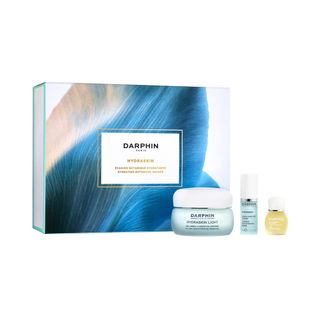
Darphin Hydraskin Hydrating Botanical Escape
Works for
1 of 1 advertised claim delivered
Moisturizing36 ingredients credited for this claimStrong support
“Hydraskin Hydrating Botanical Escape”
This product can help improve hydration of the skin with the two types of ingredients.
The first type is called “humectants”:
these ingredients help attract water.
When humectants are on the surface of the skin, they “pull in” the moisture from the outside environment, or from
within deeper layers of the skin. The following ingredients in this product do the job:
glycerin, hyaluronic acid.
This product also contains ingredients called “occlusives”. They help reduce the speed with which our skin loses moisture to the outside environment. These ingredients also help soften the upper layer of the skin, so it feels less tight and nicer to the touch. The following ingredients in this product do the job: dimethicone, dimethiconol.
The following ingredients in this product are especially good for supporting the skin barrier and helping with the hydration level: panthenol, urea
Anti-oxidationNot advertised by the brand · 7 ingredients credited for this claimModerate support
This product contains antioxidants (imperata cylindrica root extract, punica granatum extract) that might be able to help neutralize free radicals in skin to lessen the damage it gets from the UV light (sun). There is not enough evidence to confirm their effectiveness in skin though.
Can it cause trouble?
Irritancy25 strong irritants: Lavandula stoechas extract, Parfum + 23 more — patch-test recommendedHigh risk
Comedogenic3 ingredients rated 2 or more on the 0–5 pore-clogging scale3 flagged
User reviews
Be the first — your take helps the next person decide.
Ingredients
Filter by role to see what each ingredient is doing.
Cream~25–30%
- Irritation risk
- Low
Water~12–15%
Glycerin~5.2–6.3%
- Irritation risk
- Low
One of the best moisturizing ingredients. Naturally present in skin. It attracts water to the upper layer of the skin working as a humectant
More about GlycerinDimethicone~4.2–5.1%
- Irritation risk
- Low
A silicone that helps to reduce water loss from the surface of the skin. Can temporarily "fill in" lines and wrinkles, absorb oil, and create a nice product finish
More about DimethiconePolysorbate 60~2.7–3.3%
Cetyl palmitate~2.1–2.6%
- Irritation risk
- Low
An emollient that helps soften the skin and is used to improve product texture and stability
More about Cetyl palmitatePropanediol~1.7–2.1%
- Irritation risk
- Low
Acts as a solvent for other ingredients. Speeds up the absorption of other ingredients into the skin
More about PropanediolHydrogenated polydecene~1.4–1.7%
- Irritation risk
- Low
Helps to soften the upper layer of the skin and create a nice product texture
More about Hydrogenated polydeceneSorbitan stearate~1.2–1.5%
Squalane~1.1–1.3%
- Irritation risk
- Low
An oil naturally present in skin. Works as an emollient to soften the skin and form a protective layer on its surface without a greasy feeling.
More about SqualaneImperata cylindrica root extract~0.7–1.05%
- Irritation risk
- Medium
A plat extract that might help neutralize free radicals in skin and attract water to its upper layer
More about Imperata cylindrica root extractTridecyl stearate~0.65–0.95%
- Irritation risk
- Medium
Used to create a thicker product consistency and soften the upper layer of the skin
More about Tridecyl stearateCucumis sativus fruit extract~0.55–0.8%
- Irritation risk
- Medium
Might be somewhat helpful in reducing hyperpigmentation and neutralizing free radicals but its typical concentration in a product is too low for having an effect
More about Cucumis sativus fruit extractActinidia chinensis fruit extract~0.55–0.85%
- Irritation risk
- High
A plant extract that might have some anti-oxidant properties, but evidence of effectiveness in skin is lacking
More about Actinidia chinensis fruit extractSalicornia herbacea extract~0.5–0.7%
- Irritation risk
- Low
Lavandula stoechas extract~0.5–0.7%
Tridecyl trimellitate~0.5–0.75%
- Irritation risk
- Medium
Used to create a thicker product consistency and soften the upper layer of the skin
More about Tridecyl trimellitateButylene glycol~0.45–0.65%
- Irritation risk
- Low
Used to create a nice product texture and help delivery of other ingredients. Might be somewhat helpful in attracting water to the upper layer of the skin
More about Butylene glycolTocopheryl acetate~0.5–0.75%
- Irritation risk
- Medium
A more stable but less bio-available form of vitamin E compared to Tocopherol. Might help moisturize and protect the skin from free radicals, but mostly used in low concentrations to stabilize other ingredients.
More about Tocopheryl acetateDipentaerythrityl hexacaprylate/hexacaprate~0.4–0.6%
- Irritation risk
- Low
Panthenol~0.3–0.6%
- Irritation risk
- Low
Helps attract water to the upper layer of the skin and can help improve skin barrier function
More about PanthenolAcrylates/c10-30 alkyl acrylate crosspolymer~0.45–0.65%
- Irritation risk
- Medium
Maintains the texture of skincare products. Allows the product to spread evenly. Helps oil and water mix together
More about Acrylates/c10-30 alkyl acrylate crosspolymerCaprylic/capric triglyceride~0.4–0.6%
- Irritation risk
- Medium
A good mix of fatty acids that forms a protective layer on the skin. Improves the shelf life of products. Derived from coconut and glycerin
More about Caprylic/capric triglycerideEthylhexylglycerin~0.3–0.55%
Dimethiconol~0.35–0.65%
- Irritation risk
- Low
A silicone that makes products more spreadable and keeps skin smooth. Helps to add gloss to skin and may visually fill in fine lines/wrinkles for short time
More about DimethiconolHydrogenated vegetable oil~0.3–0.6%
- Irritation risk
- Low
- Comedogenicity
- 2/5
An oil from a mixture of different vegetables. Helps soften the upper layer of the skin
More about Hydrogenated vegetable oilHydroxyethyl acrylate/sodium acryloyldimethyl taurate copolymer~0.3–0.55%
- Irritation risk
- Medium
A gelling agent that thickens the product consistency and leaves the skin with a velvety finish
More about Hydroxyethyl acrylate/sodium acryloyldimethyl taurate copolymerIsohexadecane~0.45–0.65%
- Irritation risk
- Low
Improves the texture of the product and helps soften the skin. Helps oil and water mix together and can be used as a cleansing agent
More about IsohexadecaneSodium hyaluronate~0.3–0.55%
- Irritation risk
- Low
One of the best moisturizing ingredients. Attracts water into the upper layer of the skin
More about Sodium hyaluronateCaprylyl glycol~0.3–0.6%
- Irritation risk
- Medium
Helps preserve products and creates a nice product texture
More about Caprylyl glycolSodium hydroxide~0.3–0.55%
Carbomer~0.3–0.55%
- Irritation risk
- Low
Helps create a thicker or gel-like product texture. It is not a surfactant but can be used in gentle cleansing formulations
More about CarbomerTetrasodium edta~0.3–0.55%
Sodium benzoate~0.25–0.5%
Chlorphenesin~0.16–0.32%
Parfum~0.25–0.5%
- Irritation risk
- High
An aromatic blend of unspecified and possibly irritating ingredients
More about ParfumAlpha-isomethyl ionone~0.25–0.5%
- Irritation risk
- High
A fragrance. Potential allergen and can be irritating
More about Alpha-isomethyl iononeLimonene~0.25–0.5%
- Irritation risk
- High
A common frangrance that can easily irritate skin, especially if exposed to air, light or heat
More about LimoneneButylphenyl methylpropional~0.25–0.5%
- Irritation risk
- High
A fragrance. Can trigger allergic reactions and be irritating
More about Butylphenyl methylpropionalHexyl cinnamal~0.25–0.5%
Linalool~0.25–0.5%
Hydroxyisohexyl 3-cyclohexene carboxaldehyde~0.25–0.5%
- Irritation risk
- High
A fragrance. Can be irritating
More about Hydroxyisohexyl 3-cyclohexene carboxaldehydeHydroxycitronellal~0.25–0.5%
- Irritation risk
- High
A fragrance. A likely allergen and can be irritating
More about HydroxycitronellalCitronellol~0.25–0.5%
Benzyl benzoate~0.25–0.5%
- Irritation risk
- High
Fragrance with sweet balsamic smell. Help to preserve products and dissolve other ingredients. Could trigger allergic reactions and be irritating
More about Benzyl benzoateCitral~0.25–0.5%
Geraniol~0.25–0.5%
Ci 19140~0.3–0.55%
Ci 42090~0.3–0.55%
Water~0.3–0.55%
Propanediol~0.3–0.55%
- Irritation risk
- Low
Acts as a solvent for other ingredients. Speeds up the absorption of other ingredients into the skin
More about PropanediolGlycerin~0.35–0.6%
- Irritation risk
- Low
One of the best moisturizing ingredients. Naturally present in skin. It attracts water to the upper layer of the skin working as a humectant
More about GlycerinButylene glycol~0.3–0.55%
- Irritation risk
- Low
Used to create a nice product texture and help delivery of other ingredients. Might be somewhat helpful in attracting water to the upper layer of the skin
More about Butylene glycolMethyl gluceth-20~0.3–0.55%
- Irritation risk
- Low
Helps attract water to the upper layer of the skin and soften it
More about Methyl gluceth-20Peg-40 hydrogenated castor oil~0.3–0.6%
- Irritation risk
- Medium
Helps oil and water mix together
More about Peg-40 hydrogenated castor oilImperata cylindrica root extract~0.3–0.5%
- Irritation risk
- Medium
A plat extract that might help neutralize free radicals in skin and attract water to its upper layer
More about Imperata cylindrica root extractPunica granatum extract~0.3–0.55%
- Irritation risk
- Medium
A plant extract that can help neutralize free radicals in skin and even out the skin tone, but is typically used in products in a concentration that is too low to be effective
More about Punica granatum extractMalachite extract~0.45–0.65%
- Irritation risk
- Low
A mineral that is claimed to be able to support collagen product in skin, but evidence of effectiveness is missing
More about Malachite extractSodium hyaluronate~0.3–0.55%
- Irritation risk
- Low
One of the best moisturizing ingredients. Attracts water into the upper layer of the skin
More about Sodium hyaluronateTocopherol~0.45–0.65%
- Irritation risk
- Low
Pure form of vitamin E. Can help moisturise and protect the skin from free radicals. Often used to help stabilise other ingredients or the formula itself
More about TocopherolEthylhexylglycerin~0.3–0.55%
Hyaluronic acid~0.3–0.55%
- Irritation risk
- Low
One of the best moisturizing ingredients. Attracts water into the upper layer of the skin. Naturally present in skin. Typically has large molecule size unless advertised otherwise on the product label. Helps support skin's barrier function and may help to reduce inflammation
More about Hyaluronic acidTrehalose~0.3–0.55%
- Irritation risk
- Low
A sugar that attracts water to the upper layer of the skin
More about TrehaloseCaprylyl glycol~0.3–0.6%
- Irritation risk
- Medium
Helps preserve products and creates a nice product texture
More about Caprylyl glycolSodium pca~0.3–0.55%
- Irritation risk
- Low
Naturally present in skin and helps to attract water to its upper layer
More about Sodium pcaSodium polyacrylate~0.4–0.65%
- Irritation risk
- Low
Used to create a gel-like product texture, as well as to stabilize emulsions
More about Sodium polyacrylate1,2-hexanediol~0.3–0.55%
Polyquaternium-51~0.45–0.65%
- Irritation risk
- Low
An emollient that helps create a nice silky finish on the skin
More about Polyquaternium-51Urea~0.3–0.55%
- Irritation risk
- Low
Naturally present in skin (urea makes up about 7% of natural moisturizing factors in skin). Attracts water to the upper layer of the skin. Also has a positive effect on the skin barrier beyond the humectant action. Can enhance penetration of other ingredients. Is an exfoliating ingredient when used in high concentrations
More about UreaCarbomer~0.3–0.55%
- Irritation risk
- Low
Helps create a thicker or gel-like product texture. It is not a surfactant but can be used in gentle cleansing formulations
More about CarbomerSodium carbomer~0.45–0.65%
Parfum~0.25–0.5%
- Irritation risk
- High
An aromatic blend of unspecified and possibly irritating ingredients
More about ParfumButylphenyl methylpropional~0.25–0.5%
- Irritation risk
- High
A fragrance. Can trigger allergic reactions and be irritating
More about Butylphenyl methylpropionalHydroxyisohexyl 3-cyclohexene carboxaldehyde~0.25–0.5%
- Irritation risk
- High
A fragrance. Can be irritating
More about Hydroxyisohexyl 3-cyclohexene carboxaldehydeHexyl cinnamal~0.25–0.5%
Alpha-isomethyl ionone~0.25–0.5%
- Irritation risk
- High
A fragrance. Potential allergen and can be irritating
More about Alpha-isomethyl iononeLimonene~0.25–0.5%
- Irritation risk
- High
A common frangrance that can easily irritate skin, especially if exposed to air, light or heat
More about LimoneneLinalool~0.25–0.5%
Hydroxycitronellal~0.25–0.5%
- Irritation risk
- High
A fragrance. A likely allergen and can be irritating
More about HydroxycitronellalTetrasodium edta~0.3–0.55%
Phenoxyethanol~0.3–0.55%
- Irritation risk
- Low
A preservative. It helps prevent bacterial growth in cosmetic products
More about PhenoxyethanolChlorphenesin~0.16–0.32%
Potassium sorbate~0.3–0.6%
Ci 42090~0.35–0.6%
Rosa damascena extract~0.3–0.6%
- Irritation risk
- High
Oil of a very fragrant pink rose used as fragrance in cosmetics. Extensive research has shown it has mixed benefits. In the pro column, inhaling this flower’s scent seems to have relaxing properties and the plant’s petals contain skin-soothing and antioxidant compounds that can benefit skin. On the flipside, the numerous chemicals that create this rose’s distinctive fragrance pose a risk of causing skin aggravation.
More about Rosa damascena extractAroma~0.35–0.6%
Sesamum indicum seed oil~0.4–0.6%
- Irritation risk
- Low
A good moisturizing plant oil. Due to the high linoleic acid content, it helps soften the upper layer of the skin, reduce water loss and support skin barrier function
More about Sesamum indicum seed oilHelianthus annuus seed oil~0.4–0.6%
- Irritation risk
- Low
A great emollient due to its high linoleic acid content. One of the most effective plant oils in helping skin hydration and repairing skin barrier function
More about Helianthus annuus seed oilMacadamia ternifolia seed oil~0.4–0.65%
- Irritation risk
- Medium
Plant oil from nuts that helps soften the upper layer of the skin. Contains a high concentration of oleic acid that can weaken skin's barrier function and increase water-loss while enhancing penetration of other ingredients
More about Macadamia ternifolia seed oilPrunus amygdalus dulcis seed~0.3–0.6%
- Irritation risk
- Low
Helps soften the upper layer of the skin
More about Prunus amygdalus dulcis seedJojoba alcohol~0.4–0.6%
Isopropyl jojobate~0.4–0.6%
- Irritation risk
- Low
Jojoba esters~0.4–0.65%
- Irritation risk
- Medium
An emollient made of jojoba oil. Helps soften the skin and support its barrier function
More about Jojoba estersOenothera biennis extract~0.45–0.7%
- Irritation risk
- Low
Oenothera biennis oil~0.4–0.65%
- Irritation risk
- Medium
Helps soften the upper layer of the skin and can support skin barrier function
More about Oenothera biennis oilRosa rubiginosa seed oil~0.4–0.65%
- Irritation risk
- High
Plant oil that due to the high content of linoleic acid can support skin's barrier function and reduce moisture loss
More about Rosa rubiginosa seed oilRosa damascena flower wax~0.35–0.6%
- Irritation risk
- High
Is likely to contain rose essential oil that can be irritating. Typically used for its fragrance and to create a thicker product consistency
More about Rosa damascena flower waxCaprylic/capric triglyceride~0.45–0.65%
- Irritation risk
- Medium
A good mix of fatty acids that forms a protective layer on the skin. Improves the shelf life of products. Derived from coconut and glycerin
More about Caprylic/capric triglycerideRosa centifolia flower wax~0.3–0.6%
- Irritation risk
- High
Is likely to contain an essential oil that can be irritating. Typically used for its fragrance and to create a thicker product consistency
More about Rosa centifolia flower waxCitrus aurantium amara flower oil~0.3–0.6%
- Irritation risk
- High
Used as a fragrance. Can be irritating
More about Citrus aurantium amara flower oilPogostemon cablin leaf oil~0.35–0.65%
Pogostemon cablin oil~0.3–0.55%
- Irritation risk
- Low
Ferula galbaniflua gum~0.3–0.55%
- Irritation risk
- Low
Cymbopogon nardus oil~0.3–0.6%
- Irritation risk
- High
Dipteryx odorata seed extract~0.35–0.6%
- Irritation risk
- Low
Vaccinium myrtillus seed oil~0.3–0.6%
- Irritation risk
- Low
Zea mays oil~0.3–0.55%
- Irritation risk
- Low
- Comedogenicity
- 3/5
A good moisturizing plant oil. Due to the high linoleic acid content, it helps soften the upper layer of the skin, reduce water loss and support skin barrier function
More about Zea mays oilHydrogenated vegetable oil~0.35–0.65%
- Irritation risk
- Low
- Comedogenicity
- 2/5
An oil from a mixture of different vegetables. Helps soften the upper layer of the skin
More about Hydrogenated vegetable oilCananga odorata flower oil~0.25–0.5%
Argon~0.35–0.65%
- Irritation risk
- Low
Geranium maculatum extract~0.25–0.5%
- Irritation risk
- High
Contains an essential oil. Can be irritating
More about Geranium maculatum extractRosa damascena extract~0.25–0.45%
- Irritation risk
- High
Oil of a very fragrant pink rose used as fragrance in cosmetics. Extensive research has shown it has mixed benefits. In the pro column, inhaling this flower’s scent seems to have relaxing properties and the plant’s petals contain skin-soothing and antioxidant compounds that can benefit skin. On the flipside, the numerous chemicals that create this rose’s distinctive fragrance pose a risk of causing skin aggravation.
More about Rosa damascena extractSalicornia herbacea extract~0.3–0.6%
- Irritation risk
- Low
Tocopherol~0.35–0.65%
- Irritation risk
- Low
Pure form of vitamin E. Can help moisturise and protect the skin from free radicals. Often used to help stabilise other ingredients or the formula itself
More about TocopherolLavandula stoechas extract~0.3–0.55%
Hibiscus abelmoschus extract~0.3–0.55%
- Irritation risk
- Low
Coumarin~0.25–0.45%
Geraniol~0.2–0.4%
Citral~0.15–0.3%
Citronellol~0.15–0.25%
Benzyl benzoate~0.15–0.3%
- Irritation risk
- High
Fragrance with sweet balsamic smell. Help to preserve products and dissolve other ingredients. Could trigger allergic reactions and be irritating
More about Benzyl benzoateLinalool~0.15–0.25%
Farnesol~0.1–0.2%
Ingredient list view
Cream, Unknown, Water, Glycerin, Dimethicone, Polysorbate 60, Cetyl palmitate, Propanediol, Hydrogenated polydecene, Sorbitan stearate, Squalane, Imperata cylindrica root extract, Tridecyl stearate, Cucumis sativus fruit extract, Actinidia chinensis fruit extract, Salicornia herbacea extract, Lavandula stoechas extract, Tridecyl trimellitate, Butylene glycol, Tocopheryl acetate, Dipentaerythrityl hexacaprylate/hexacaprate, Panthenol, Acrylates/c10-30 alkyl acrylate crosspolymer, Caprylic/capric triglyceride, Ethylhexylglycerin, Dimethiconol, Hydrogenated vegetable oil, Hydroxyethyl acrylate/sodium acryloyldimethyl taurate copolymer, Isohexadecane, Sodium hyaluronate, Caprylyl glycol, Sodium hydroxide, Carbomer, Tetrasodium edta, Sodium benzoate, Chlorphenesin, Parfum, Alpha-isomethyl ionone, Limonene, Butylphenyl methylpropional, Hexyl cinnamal, Linalool, Hydroxyisohexyl 3-cyclohexene carboxaldehyde, Hydroxycitronellal, Citronellol, Benzyl benzoate, Citral, Geraniol, Ci 19140, Ci 42090, Water, Propanediol, Glycerin, Butylene glycol, Methyl gluceth-20, Peg-40 hydrogenated castor oil, Imperata cylindrica root extract, Punica granatum extract, Malachite extract, Sodium hyaluronate, Tocopherol, Ethylhexylglycerin, Hyaluronic acid, Trehalose, Caprylyl glycol, Sodium pca, Sodium polyacrylate, 1,2-hexanediol, Polyquaternium-51, Urea, Carbomer, Sodium carbomer, Parfum, Butylphenyl methylpropional, Hydroxyisohexyl 3-cyclohexene carboxaldehyde, Hexyl cinnamal, Alpha-isomethyl ionone, Limonene, Linalool, Hydroxycitronellal, Tetrasodium edta, Phenoxyethanol, Chlorphenesin, Potassium sorbate, Ci 42090, Rosa damascena extract, Aroma, Sesamum indicum seed oil, Helianthus annuus seed oil, Macadamia ternifolia seed oil, Prunus amygdalus dulcis seed, Jojoba alcohol, Isopropyl jojobate, Jojoba esters, Oenothera biennis extract, Oenothera biennis oil, Rosa rubiginosa seed oil, Rosa damascena flower wax, Caprylic/capric triglyceride, Rosa centifolia flower wax, Citrus aurantium amara flower oil, Pogostemon cablin leaf oil, Pogostemon cablin oil, Ferula galbaniflua gum, Cymbopogon nardus oil, Dipteryx odorata seed extract, Vaccinium myrtillus seed oil, Zea mays oil, Hydrogenated vegetable oil, Cananga odorata flower oil, Argon, Geranium maculatum extract, Rosa damascena extract, Salicornia herbacea extract, Tocopherol, Lavandula stoechas extract, Hibiscus abelmoschus extract, Coumarin, Geraniol, Citral, Citronellol, Benzyl benzoate, Linalool, Farnesol
Compare prices
Retailers ranked by price — lowest first.
Affiliate links · prices updated regularly · As an Amazon Associate, WIMJ earns from qualifying purchases.
Product summary
Judging from the ingredient list, "Darphin - Hydraskin Hydrating Botanical Escape" works well for improving skin hydration This moisturizer uses a good combo of humectants and emollients. These both types of ingredients are essentials for improving the skin hydration and keeping the skin barrier healthy. Panthenol, urea, glycerin, hyaluronic acid and imperata cylindrica root extract in this product (humectants) attract water molecules to the upper layer of the skin (the water comes from the outside air or from the deeper layers of the skin if the air is dry). Emollients in this formulation (jojoba alcohol, jojoba esters, oenothera biennis oil, rosa rubiginosa seed oil and sesamum indicum seed oil) help to reduce the moisture loss from the skin. They also soften the skin surface and relieve the feeling of dryness and tightness.
Irritation risk
This moisturizer contains a bunch of common irritants, including ingredients that do not provide any known benefit for the skin. It might not be the best choice if your skin is sensitive. We assess the overall irritancy of this moisturizer to be high. For a detailed overview of all potential irritants: click here
You can see the detailed formula review with the breakdown of all actives in the product and the full ingredient list with estimated concentrations in the tables below.
Price
The product retails for 33.49$ in the United States.
For a detailed price comparison: click here.
Sources cited in this review
Every concentration estimate and effectiveness label is anchored to one of these 34 studies and safety reviews.
- 1
- 2
- 3Final Report on the Safety Assessment of Dimethicone Copolyoljournals.sagepub.com
- 4Safety Assessment of Polyene Group as Used in Cosmeticscir-safety.org
- 5Allergic contact dermatitis from grassespubmed.ncbi.nlm.nih.gov
- 6

Affiliate links · As an Amazon Associate, WIMJ earns from qualifying purchases.