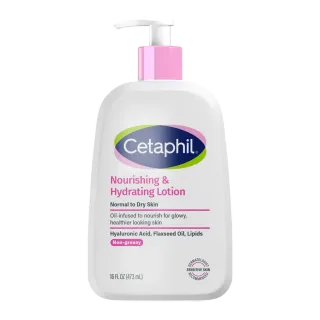
Works for
MoisturizingPanthenol, Urea + 25 moreWorks well
“Nourishing & Hydrating Lotion”
This product can help improve hydration of the skin with the two types of ingredients.
The first type is called “humectants”:
these ingredients help attract water.
When humectants are on the surface of the skin, they “pull in” the moisture from the outside environment, or from
within deeper layers of the skin. The following ingredients in this product do the job:
fructose, glycerin.
This product also contains ingredients called “occlusives”. They help reduce the speed with which our skin loses moisture to the outside environment. These ingredients also help soften the upper layer of the skin, so it feels less tight and nicer to the touch. The following ingredients in this product do the job: butyrospermum parkii butter, caprylic/capric triglyceride.
The following ingredients in this product are especially good for supporting the skin barrier and helping with the hydration level: panthenol, urea
Can it cause trouble?
Irritancy10 flagged ingredientsMedium risk
Comedogenic3 ingredients rated 2 or more on the 0–5 pore-clogging scale3 flagged

User reviews
Be the first — your take helps the next person decide.
Ingredients
Filter by role to see what each ingredient is doing.
Hyaluronic acid~22–33%
- Irritation risk
- Low
One of the best moisturizing ingredients. Attracts water into the upper layer of the skin. Naturally present in skin. Typically has large molecule size unless advertised otherwise on the product label. Helps support skin's barrier function and may help to reduce inflammation
More about Hyaluronic acidLinum usitatissimum seed oil~3.6–5.3%
Water~4.7–7.1%
Glycerin~3.5–5.3%
- Irritation risk
- Low
One of the best moisturizing ingredients. Naturally present in skin. It attracts water to the upper layer of the skin working as a humectant
More about GlycerinButyrospermum parkii butter~3.3–4.9%
- Irritation risk
- Low
- Comedogenicity
- 3/5
A great moisturising ingredient that softens the skin and reduces water loss from its upper layer. It also can be helpful in protecting skin from free radicals
More about Butyrospermum parkii butterIsopropyl palmitate~2.2–3.3%
- Irritation risk
- Medium
- Comedogenicity
- 3/5
Helps soften the upper layer of the skin and create a thicker product consistency
More about Isopropyl palmitateCetearyl alcohol~1.8–2.7%
- Irritation risk
- Low
- Comedogenicity
- 2/5
A non-drying alcohol. Works as an emollient. Helps water and oil mix together and creates a nice product texture
More about Cetearyl alcoholGlyceryl stearate citrate~1.5–2.3%
- Irritation risk
- Low
Helps oil and water mix together while softening the upper layer of the skin
More about Glyceryl stearate citrateDimethicone~1.4–2.2%
- Irritation risk
- Low
A silicone that helps to reduce water loss from the surface of the skin. Can temporarily "fill in" lines and wrinkles, absorb oil, and create a nice product finish
More about DimethiconeHexyldecanol~1.1–1.7%
- Irritation risk
- Low
Helps soften the upper layer of the skin
More about HexyldecanolDistarch phosphate~0.9–1.3%
- Irritation risk
- Low
Glyceryl stearate~0.9–1.35%
- Irritation risk
- Low
An emollient that softens the skin and forms a protective layer on its surface. Helps water and oil mix together
More about Glyceryl stearatePanthenol~0.6–1.35%
- Irritation risk
- Low
Helps attract water to the upper layer of the skin and can help improve skin barrier function
More about PanthenolCaprylic/capric triglyceride~0.8–1.25%
- Irritation risk
- Medium
A good mix of fatty acids that forms a protective layer on the skin. Improves the shelf life of products. Derived from coconut and glycerin
More about Caprylic/capric triglyceridePhenoxyethanol~0.5–1%
- Irritation risk
- Low
A preservative. It helps prevent bacterial growth in cosmetic products
More about PhenoxyethanolPeg-100 stearate~0.55–1.35%
- Irritation risk
- Low
Helps oil and water mix togehter and creates a nice product texture
More about Peg-100 stearateSodium stearoyl glutamate~0.5–1.2%
- Irritation risk
- Medium
Helps oil and water mix together
More about Sodium stearoyl glutamateEthylhexylglycerin~0.45–1.1%
Tocopherol~0.45–1.05%
- Irritation risk
- Low
Pure form of vitamin E. Can help moisturise and protect the skin from free radicals. Often used to help stabilise other ingredients or the formula itself
More about TocopherolTocopheryl acetate~0.4–0.95%
- Irritation risk
- Medium
A more stable but less bio-available form of vitamin E compared to Tocopherol. Might help moisturize and protect the skin from free radicals, but mostly used in low concentrations to stabilize other ingredients.
More about Tocopheryl acetateAcrylates/c10-30 alkyl acrylate crosspolymer~0.5–1.15%
- Irritation risk
- Medium
Maintains the texture of skincare products. Allows the product to spread evenly. Helps oil and water mix together
More about Acrylates/c10-30 alkyl acrylate crosspolymerPentylene glycol~0.45–1.05%
- Irritation risk
- Medium
Used to preserve products, dissolve other ingredients and create a nice product texture
More about Pentylene glycolSodium hydroxide~0.35–0.85%
Citric acid~0.35–0.85%
- Irritation risk
- Medium
Can work as an exfoliant but is typically used to adjust the product pH
More about Citric acidDisodium edta~0.35–0.85%
Linum usitatissimum seed oil~0.3–0.75%
Niacinamide~0.2–0.75%
- Irritation risk
- Low
Is proven to be effective in reducing blemishes, evening out skin tone and helping to improve lines and wrinkles. It helps the skin to repair sun damage, calm down inflammation and keep maintain good levels of moisture. The concentration of about 2% is effective for supporting the skin barrier and evening out the skin tone. Concentration of 4-6% is better for helping with acne and balancing the sebum production
More about NiacinamideFructose~0.2–0.75%
- Irritation risk
- Low
Helps attract water to the upper layer of the skin
More about FructoseUrea~0.2–0.75%
- Irritation risk
- Low
Naturally present in skin (urea makes up about 7% of natural moisturizing factors in skin). Attracts water to the upper layer of the skin. Also has a positive effect on the skin barrier beyond the humectant action. Can enhance penetration of other ingredients. Is an exfoliating ingredient when used in high concentrations
More about UreaBisabolol~0.2–0.75%
- Irritation risk
- Low
An active component of chamomile plant that historically has been used to calm down irritated skin. A recent study shows that bisabolol indeed can have some anti-inflammatory effect on skin, even though conclusive data is lacking. Bisabolol has a sweet floral scent and can be added to products for its aromatic properties
More about BisabololCetylhydroxyproline palmitamide~0.35–0.8%
- Irritation risk
- Low
A type of lipid similar to ceramides naturally present in skin. Helps to soften the upper layer of the skin and supports the skin barrier function to keep it hydrated. Can help to prevent inflammation in skin
More about Cetylhydroxyproline palmitamideStearic acid~0.35–0.85%
- Irritation risk
- Low
Helps oil and water mix together and works as an emollient
More about Stearic acidAllantoin~0.15–0.6%
- Irritation risk
- Low
Helps calm down inflammation in skin and can help reduce itching. Helps to repair the skin barrier and keep skin hydrated
More about AllantoinMaltose~0.15–0.6%
- Irritation risk
- Low
Sodium chloride~0.15–0.6%
- Irritation risk
- Low
Used to stabilize mixtures of oil and water, and create thicker, gel-like product textures
More about Sodium chlorideSodium lactate~0.1–0.5%
- Irritation risk
- Medium
Helps attract water to the upper layer of the skin. Is often used to adjust the pH level of the product
More about Sodium lactateSodium pca~0.1–0.45%
- Irritation risk
- Low
Naturally present in skin and helps to attract water to its upper layer
More about Sodium pcaTrehalose~0.1–0.45%
- Irritation risk
- Low
A sugar that attracts water to the upper layer of the skin
More about TrehaloseBrassica campestris sterols~0.15–0.6%
- Irritation risk
- Low
Help soften the upper layer of the skin
More about Brassica campestris sterolsPantolactone~0.1–0.35%
- Irritation risk
- Low
Helps attract water to the upper layer of the skin
More about PantolactoneGlucose~0.05–0.25%
- Irritation risk
- Low
Helps attract water to the upper layer of the skin. Could be helpful in restoring the skin barrier function
More about GlucoseSodium hyaluronate~0.05–0.3%
- Irritation risk
- Low
One of the best moisturizing ingredients. Attracts water into the upper layer of the skin
More about Sodium hyaluronateIngredient list view
Hyaluronic acid, Linum usitatissimum seed oil, Unknown, Water, Glycerin, Butyrospermum parkii butter, Isopropyl palmitate, Cetearyl alcohol, Glyceryl stearate citrate, Dimethicone, Hexyldecanol, Distarch phosphate, Glyceryl stearate, Panthenol, Caprylic/capric triglyceride, Phenoxyethanol, Peg-100 stearate, Sodium stearoyl glutamate, Ethylhexylglycerin, Tocopherol, Tocopheryl acetate, Acrylates/c10-30 alkyl acrylate crosspolymer, Pentylene glycol, Sodium hydroxide, Citric acid, Disodium edta, Linum usitatissimum seed oil, Niacinamide, Fructose, Urea, Bisabolol, Cetylhydroxyproline palmitamide, Stearic acid, Allantoin, Maltose, Sodium chloride, Sodium lactate, Sodium pca, Trehalose, Brassica campestris sterols, Pantolactone, Glucose, Sodium hyaluronate
Compare prices
Retailers ranked by price — lowest first.

Worth comparing, line by line.
Match % combines shared ingredients, the first five ingredients, shared actives and hero ingredients, irritancy (lower counts in the alternative's favour), texture and body area. Only products in the same routine step are compared.
| CetaphilNourishing & Hydrating LotionYOUR PRODUCT | MarudermHyaluronic Acid Moisturizer Face & Body Cream | SimpleX Kindness Hydrating Light Facial Moisturiser | AtwaterHeavy Armor Facial Moisturizer | |
|---|---|---|---|---|
| Match | — | 91% | 89% | 87% |
| Price | $16.97 | $18.49+$1.52 | $2.61−$14.36 | $29.60+$12.63 |
| Shared key ingredients | — | 12 of 18 | 8 of 18 | 10 of 18 |
| Key difference | — | Glycine | Mineral Oil | Glucosamine Hcl |
| Irritancy | Medium | Low | Low | Medium |
| Drying alcohol | — | — | — | — |
| View product | Shop | Shop | Shop |

More alternatives: Dr Sam's Flawless MoisturiserBoots Skin Clear Lotion with niacinamide
Sources cited in this review
Every concentration estimate and effectiveness label is anchored to one of these 19 studies and safety reviews.
- 1Efficacy of a New Topical Nano-hyaluronic Acid in Humansncbi.nlm.nih.gov
- 2Physiochemical properties and application of hyaluronic acid: a systematic reviewonlinelibrary.wiley.com
- 3
- 4Final Report on the Safety Assessment of Isopropyl Isostearatejournals.sagepub.com
- 5
- 6Final Report on the Safety Assessment of Dimethicone Copolyoljournals.sagepub.com

Affiliate links · As an Amazon Associate, WIMJ earns from qualifying purchases.