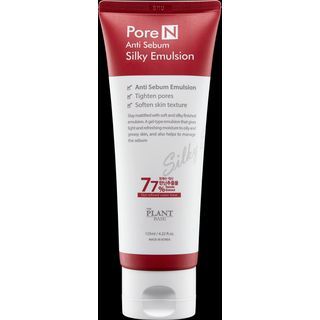
THE PLANT BASE Pore N Anti Sebum Silky Emulsion
Works for
1 of 1 advertised claim delivered
Moisturizing17 ingredients credited for this claimStrong support
“Benefits Contains V7 Complex which consists of 7 kinds of vitamins for skin moisturising and soothing.”
This product can help improve hydration of the skin with the two types of ingredients.
The first type is called “humectants”:
these ingredients help attract water.
When humectants are on the surface of the skin, they “pull in” the moisture from the outside environment, or from
within deeper layers of the skin. The following ingredients in this product do the job:
glycerin, bis-peg-18 methyl ether dimethyl silane.
This product also contains ingredients called “occlusives”. They help reduce the speed with which our skin loses moisture to the outside environment. These ingredients also help soften the upper layer of the skin, so it feels less tight and nicer to the touch. The following ingredients in this product do the job: dimethicone, argania spinosa kernel oil.
The following ingredients in this product are especially good for supporting the skin barrier and helping with the hydration level: panthenol
Anti-oxidationNot advertised by the brand · 14 ingredients credited for this claimStrong support
This product contains antioxidants (resveratrol, retinol) that can help neutralize free radicals in skin. By doing so, they can lessen the damage the skin gets from the UV light (sun).
Anti-agingNot advertised by the brand · 9 ingredients credited for this claimStrong support
This product can help reduce and prevent fine lines and wrinkles, improve skin elasticity and firmness because it contains retinol, adenosine.
These ingredients in the product can also be helpful, even though there is less evidence for their effectiveness: resveratrol.
Keep in mind that it typically takes at least 6 weeks to notice any results because the changes that are needed to improve fine lines and elasticity happen in the deeper layers of the skin. No topical anti-aging product can “erase” wrinkles or fully reverse signs of aging.
ExfoliationNot advertised by the brand · 2 ingredients credited for this claimStrong support
This product can help exfoliate the skin. In other words, it helps break down the bonds between dead cells on the surface of the skin and speed up the skin turnover. Skin often appears softer and brighter after exfoliation, but overdoing it can result in disrupted skin barrier. The following ingredient is doing the exfoliating job in this product: retinol.
Evens skin toneNot advertised by the brand · 8 ingredients credited for this claimStrong support
This product can help reduce hypepigmentation and even out the skin tone because it contains the following effective ingredients: retinol.
The following ingredient (ingredients) in this product might be helpful, but there is no evidence to confirm that it actually can help even out the skin tone: glycyrrhiza glabra root extract, morus alba bark extract, resveratrol.
Keep in mind that you would need to apply any topical skincare targetted at hypigmentation consistently for a couple of months to get a result. No topical skincare product can help get rid of hyperpigmentation (including post-acne marks and age spots) instantly.
Anti-blemishNot advertised by the brand · 3 ingredients credited for this claimStrong support
This product can help reduce breakouts and clogged pores because it contains the following ingredient: retinol. This ingredient is used for treating acne and can have a noticeable effect.
Can it cause trouble?
Irritancy10 strong irritants: Lavandula angustifolia flower/leaf/stem extract, Santalum album oil + 8 more — patch-test recommendedHigh risk
Comedogenic1 ingredient rated 2 or more on the 0–5 pore-clogging scale1 flagged


User reviews
Be the first — your take helps the next person decide.
Ingredients
Filter by role to see what each ingredient is doing.
Water~45–55%
Opuntia coccinellifera fruit extract~4.3–5.2%
- Irritation risk
- High
A plant extract that might help neutralize free radicals in skin
More about Opuntia coccinellifera fruit extractLavandula angustifolia flower/leaf/stem extract~4.1–5%
Glyceryl linoleate~2.8–3.4%
- Irritation risk
- Medium
Helps oil and water mix together
More about Glyceryl linoleateElettaria cardamomum seed oil~2.2–2.6%
- Irritation risk
- Low
Santalum album oil~1.9–2.4%
Argania spinosa kernel oil~1.7–2.1%
- Irritation risk
- Medium
An emollient that helps soften the upper layer of the skin. Might have some weak anti-oxidant properties
More about Argania spinosa kernel oilPanthenol~1.4–1.8%
- Irritation risk
- Low
Helps attract water to the upper layer of the skin and can help improve skin barrier function
More about PanthenolResveratrol3.56%
- Irritation risk
- Medium
Helps neutralize free radicals in skin and might help reduce fine lines and wrinkles, as well as even out the skin tone
More about ResveratrolCyclopentasiloxane~1.3–1.5%
- Irritation risk
- Low
A silicone that helps improve the product texture and spreadability. Can absorb oil creating a short-term mattifying effect on the skin
More about CyclopentasiloxaneCitric acid~1–1.2%
- Irritation risk
- Medium
Can work as an exfoliant but is typically used to adjust the product pH
More about Citric acidDiospyros kaki leaf extract38.05%
- Irritation risk
- Low
Glyceryl linolenate~0.8–1.15%
- Irritation risk
- Low
Helps soften the upper layer of the skin
More about Glyceryl linolenateAscorbyl palmitate~0.6–0.95%
- Irritation risk
- Medium
Being a lipid soluble form of vitamin C, it is more stable and can penetrate the skin better than L-Ascorbic acid. It is effective in protecting the skin from free radicals, as well as evening the skin tone, but is less effective in stimulating collagen production compared to L-Ascorbic acid.
More about Ascorbyl palmitateGlycine soja oil~0.6–0.9%
- Irritation risk
- Medium
- Comedogenicity
- 2/5
A good emollient that helps soften the skin and helps repair its barrier function. It can clog pores if used in high concentrations.
More about Glycine soja oilBiotin~0.55–0.8%
- Irritation risk
- Low
Might have some moisturising properties. Is not effective when applied topically beyond some moisturizing effect
More about BiotinBis-peg-18 methyl ether dimethyl silane~0.55–0.8%
- Irritation risk
- Low
A type of silicone that helps soften the upper layer of the skin and create a nice product texture
More about Bis-peg-18 methyl ether dimethyl silaneAcrylates/c10-30 alkyl acrylate crosspolymer~0.5–0.8%
- Irritation risk
- Medium
Maintains the texture of skincare products. Allows the product to spread evenly. Helps oil and water mix together
More about Acrylates/c10-30 alkyl acrylate crosspolymerC12-14 pareth-12~0.5–0.75%
Ascorbic acid~0.45–0.7%
- Irritation risk
- High
The most well-researched antioxidant that works in skin. Helps neutralize free radicals supporting collagen production, helping to even out the skin tone and preventing early signs of aging
More about Ascorbic acidMorus alba bark extract~0.4–0.6%
- Irritation risk
- High
A plant extract that might have anti-oxidant properties and help even out skin tone, but solid evidence is lacking
More about Morus alba bark extractCitrus aurantium bergamia fruit extract~0.35–0.65%
- Irritation risk
- High
Cyclohexasiloxane~0.45–0.65%
- Irritation risk
- Low
A silicone that serves as an emollient. Helps create a nice non-greasy feels
More about CyclohexasiloxaneCitrus paradisi peel oil~0.3–0.55%
Enantia chlorantha bark extract~0.3–0.55%
- Irritation risk
- High
A bark extract that might help clam down inflammation and neutralize free radicals , but evidence of effectiveness in skin is lacking
More about Enantia chlorantha bark extractDipropylene glycol~0.3–0.55%
- Irritation risk
- Low
Helps to dissolve other ingredients in a formulation. Slows down the rate of product drying
More about Dipropylene glycolDimethicone/vinyl dimethicone crosspolymer~0.3–0.6%
- Irritation risk
- Low
Used to stabilize product formulations and create a nice product texture
More about Dimethicone/vinyl dimethicone crosspolymerTocopheryl acetate~0.3–0.6%
- Irritation risk
- Medium
A more stable but less bio-available form of vitamin E compared to Tocopherol. Might help moisturize and protect the skin from free radicals, but mostly used in low concentrations to stabilize other ingredients.
More about Tocopheryl acetateCitrus tangerina extract~0.3–0.55%
- Irritation risk
- High
Glyceryl arachidonate~0.4–0.6%
- Irritation risk
- Medium
Helps water and oil mix together
More about Glyceryl arachidonateCitrus aurantium dulcis oil~0.3–0.6%
- Irritation risk
- High
Used as a fragrance. It can be irritating and cause photosensitivity
More about Citrus aurantium dulcis oilGlycerin~0.35–0.65%
- Irritation risk
- Low
One of the best moisturizing ingredients. Naturally present in skin. It attracts water to the upper layer of the skin working as a humectant
More about GlycerinPolysilicone-11~0.35–0.65%
- Irritation risk
- Low
A silicone that forms a light film on the skin surface helping to bind water and temporarily absorb oils creating a matt and powdery feel
More about Polysilicone-11Phenoxyethanol~0.3–0.6%
- Irritation risk
- Low
A preservative. It helps prevent bacterial growth in cosmetic products
More about PhenoxyethanolGlycyrrhiza glabra root extract~0.3–0.55%
- Irritation risk
- Medium
A plant extract that can help lighten the skin and calm down inflammation. Might be helpful in neutralizing free radicals
More about Glycyrrhiza glabra root extractCastanea crenata shell extract37.18%
- Irritation risk
- Low
Dimethicone~0.4–0.6%
- Irritation risk
- Low
A silicone that helps to reduce water loss from the surface of the skin. Can temporarily "fill in" lines and wrinkles, absorb oil, and create a nice product finish
More about DimethiconeNiacinamide~0.3–0.6%
- Irritation risk
- Low
Is proven to be effective in reducing blemishes, evening out skin tone and helping to improve lines and wrinkles. It helps the skin to repair sun damage, calm down inflammation and keep maintain good levels of moisture. The concentration of about 2% is effective for supporting the skin barrier and evening out the skin tone. Concentration of 4-6% is better for helping with acne and balancing the sebum production
More about NiacinamideAdenosine~0.3–0.55%
- Irritation risk
- Low
Might help improve cell turnover and reduce inflammation in skin. One study shows that the ingredients might be able to help reduce dynamic wrinkles (for example, in the corners of the eyes or on the forehead)
More about AdenosineCedrus atlantica bark oil~0.3–0.5%
- Irritation risk
- Low
Lactic acid~0.3–0.55%
- Irritation risk
- Medium
An exfoliating and moisturizing alpha-hydroxy acid (AHA). Typically causes less irritation than other AHAs, for example, glycolic acid. At high concentrations (about 15%), lactic acid can help reduce lines and wrinkles. Recent studies show that lactic acid can support the "good" bacteria living on skin's surface (healthy skin microbiome)
More about Lactic acidAscorbyl tetraisopalmitate~0.3–0.6%
- Irritation risk
- Medium
A vitamin C derivative. Studies show that is might be effective in reducing hyperpigmentation, but there are no studies confirming that it is effectively converted into the bioavailable form of Vitamin C in skin. It is not clear how this derivative compares in effectiveness to the topical application of bioavailable form of vitamin C (L-ascorbic acid)
More about Ascorbyl tetraisopalmitateLavandula angustifolia oil~0.3–0.5%
- Irritation risk
- High
An essential oil. Potential allergen and can be irritating. It has some anti-bacterial properties
More about Lavandula angustifolia oilRetinol~0.25–0.5%
- Irritation risk
- High
Two steps removed from the active form of vitamin A - retinoic acid. Once converted to the retinoic acid in the skin, retinol is proven to be effective against all signs of aging. It improves skin cell turnover, helps fight blemishes and clogged pores, can regulate excess oil production and even skin tone. It can, however, be quite irritating
More about RetinolCarbomer~0.25–0.5%
- Irritation risk
- Low
Helps create a thicker or gel-like product texture. It is not a surfactant but can be used in gentle cleansing formulations
More about CarbomerButylene glycol~0.25–0.45%
- Irritation risk
- Low
Used to create a nice product texture and help delivery of other ingredients. Might be somewhat helpful in attracting water to the upper layer of the skin
More about Butylene glycol1,2-hexanediol~0.15–0.3%
Citrus aurantium dulcis fruit extract~0.15–0.3%
- Irritation risk
- High
A plant extract that is used as a fragrance. Can be irritating and lead to photosensitivity
More about Citrus aurantium dulcis fruit extractDisodium edta~0.15–0.25%
Pelargonium graveolens flower oil~0.15–0.3%
- Irritation risk
- High
An essential oil. Can be irritating. Can become an allergen with oxidation
More about Pelargonium graveolens flower oilOleanolic acid~0.15–0.3%
- Irritation risk
- Low
Might be helpful against blemishes, work as an anti-oxidant, reduce inflammation and improve skin's ability to hold on to moisture, but more research is needed to confirm its effectiveness when applied topically to human skin
More about Oleanolic acidTromethamine~0.1–0.2%
Ammonium acryloyldimethyltaurate/vp copolymer~0.1–0.2%
- Irritation risk
- Low
Increases thickness of a product. Texture enhancer for oil-in-water emulsions
More about Ammonium acryloyldimethyltaurate/vp copolymerIngredient list view
Water, Opuntia coccinellifera fruit extract, Lavandula angustifolia flower/leaf/stem extract, Glyceryl linoleate, Elettaria cardamomum seed oil, Santalum album oil, Argania spinosa kernel oil, Panthenol, Resveratrol, Cyclopentasiloxane, Citric acid, Diospyros kaki leaf extract, Glyceryl linolenate, Ascorbyl palmitate, Glycine soja oil, Biotin, Bis-peg-18 methyl ether dimethyl silane, Acrylates/c10-30 alkyl acrylate crosspolymer, C12-14 pareth-12, Ascorbic acid, Morus alba bark extract, Citrus aurantium bergamia fruit extract, Cyclohexasiloxane, Citrus paradisi peel oil, Enantia chlorantha bark extract, Dipropylene glycol, Dimethicone/vinyl dimethicone crosspolymer, Tocopheryl acetate, Citrus tangerina extract, Glyceryl arachidonate, Citrus aurantium dulcis oil, Glycerin, Polysilicone-11, Phenoxyethanol, Glycyrrhiza glabra root extract, Castanea crenata shell extract, Dimethicone, Niacinamide, Adenosine, Cedrus atlantica bark oil, Lactic acid, Ascorbyl tetraisopalmitate, Lavandula angustifolia oil, Retinol, Carbomer, Butylene glycol, Unknown, 1,2-hexanediol, Citrus aurantium dulcis fruit extract, Disodium edta, Pelargonium graveolens flower oil, Oleanolic acid, Tromethamine, Ammonium acryloyldimethyltaurate/vp copolymer
Compare prices
Retailers ranked by price — lowest first.

Affiliate links · prices updated regularly
Worth comparing, line by line.
Match % combines shared ingredients, the first five ingredients, shared actives and hero ingredients, irritancy (lower counts in the alternative's favour), texture and body area. Only products in the same routine step are compared.
| THE PLANT BASEPore N Anti Sebum Silky EmulsionYOUR PRODUCT | AHCEye Cream For Face | NATUREKINDWhitening Mega Vitamin Cream | TONYMOLYRetinol Red Radiance Cream | |
|---|---|---|---|---|
| Match | — | 61% | 59% | 57% |
| Price | $14.40 | $14.75 | $37.60+$23.20 | $49.00+$34.60 |
| Shared key ingredients | — | 7 of 14 | 3 of 14 | 6 of 14 |
| Key difference | — | Copper Tripeptide-1 | Polyglutamic Acid | Hexapeptide-2 |
| Irritancy | High | High | Medium | High |
| Drying alcohol | — | Contains drying alcohol | — | — |
| View product | Shop | Shop | Shop |


Product summary
Based on the ingredients included, "THE PLANT BASE - Pore N Anti Sebum Silky Emulsion" works well for moisturizing the skin. The formulation is based on a combination of good humectants and emollients. Both are needed to increase the skin hydration level. Humectants in this product (panthenol, glycerin, bis-peg-18 methyl ether dimethyl silane and butylene glycol) help to increase the water content in the upper layer of the skin. (These ingredients do so by "capturing" water molecules from the outside air or from within the deeper layers of the skin). Emollients in this formulation (argania spinosa kernel oil, glycine soja oil, dimethicone, cyclopentasiloxane and glyceryl linolenate) help to reduce the moisture loss from the skin. They also soften the skin surface and relieve the feeling of dryness and tightness.
Ingredient callouts
- This product also contains Vitamin C (Ascorbic Acid). It can be an effective active for anti-aging and evening out the skin tone, but in this moisturizer it is used for stabilizing other ingredients in the formulation. In this concentration (0.45% - 0.70%) it cannot have a noticeable benefit for the skin.
- This moisturizer contains an effective form of Retinoids (vitamin A): retinol 0.25% - 0.50%. Retinoids are potent multitasking actives. They work to improve and prevent early signs of aging, reduce hyperpigmentation (age spots and post-acne marks), and prevent inflamed blemishes and clogged pores. The downside of Retinoids is that they can be irritating. If you are not already using a Retinoid in your routine, it is best to start slowly and apply the Retinoid product only a few times per week. If your skin tolerates it well, you can gradually increase the frequency to daily. Because of the irritation risk of Retinoids, we recommend to have another, retinoid-free moisturizer in your routine to use on the alternate days or when your skin feels dry.
- Adenosine 0.30% - 0.55%. It is a compound that in involved in many biological processes inside the skin cells. According one high-quality clinical trial, topical Adenosine in low concentrations can somewhat help improve "deep wrinkles" - the wrinkles that appear with age in places where our faces are most dynamic (for example, on the forehead or in the corners of the eyes).
- Panthenol (pro-vitamin B5) at about 1.40% - 1.80% concentration. In this concentration, Panthenol works effectively to improve the skin barrier and reduce inflammation.
Irritation risk
There are quite a few common irritants in this product, including ingredients without particular skin benefits. We would not recommend it for sensitive skin. We assess the overall irritancy of this moisturizer to be high. For a detailed overview of all potential irritants: click here
You can see the detailed formula review with the breakdown of all actives in the product and the full ingredient list with estimated concentrations in the tables below.
Price
The product retails for 23.50A$ in Australia and for 14.40$ in the United States.
For a detailed price comparison: click here.
Sources cited in this review
Every concentration estimate and effectiveness label is anchored to one of these 37 studies and safety reviews.
- 1
- 2Skin moisturizing effects of panthenol-based formulationspdfs.semanticscholar.org
- 3
- 4
- 5
- 6

Affiliate links · As an Amazon Associate, WIMJ earns from qualifying purchases.