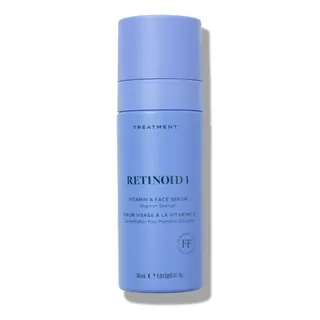
Skin Rocks Retinoid 1 - Vitamin A Face Serum
Works for
Anti-blemishHydroxypinacolone retinoate, BakuchiolWorks well
“Formulated with 0.2% hydroxypinacolone retinoate, the serum helps tackle fine lines, breakouts and dark spots.”
This product can help reduce breakouts and clogged pores because it contains the following ingredient: hydroxypinacolone retinoate. This ingredient is used for treating acne and can have a noticeable effect.
In addition, this product contains bakuchiol. It can help in reducing blemishes, even though it is less effective.
Anti-agingHydroxypinacolone retinoate, Bakuchiol + 2 moreWorks well
“Working to minimise the look of fine lines and wrinkles, it helps to leave the skin with a more even-looking tone.”
This product can help reduce and prevent fine lines and wrinkles, improve skin elasticity and firmness because it contains hydroxypinacolone retinoate, bakuchiol.
Keep in mind that it typically takes at least 6 weeks to notice any results because the changes that are needed to improve fine lines and elasticity happen in the deeper layers of the skin. No topical anti-aging product can “erase” wrinkles or fully reverse signs of aging.
Evens skin toneHydroxypinacolone retinoate, BakuchiolWorks well
“Targets the appearance of fine lines, dullness, uneven skin tone and texture”
This product can help reduce hypepigmentation and even out the skin tone because it contains the following effective ingredients: hydroxypinacolone retinoate.
In addition, this product contains bakuchiol. This ingredient (ingredients) might help reduce hyperpigmentation, but the effect, if any, is likely to be small.
Keep in mind that you would need to apply any topical skincare targetted at hypigmentation consistently for a couple of months to get a result. No topical skincare product can help get rid of hyperpigmentation (including post-acne marks and age spots) instantly.
MoisturizingGlycerin, Squalane + 15 moreWorks
“Fortified with squalane and vitamin E, it also works to moisturise the skin.”
This product can help improve hydration of the skin with the two types of ingredients.
The first type is called “humectants”:
these ingredients help attract water.
When humectants are on the surface of the skin, they “pull in” the moisture from the outside environment, or from
within deeper layers of the skin. The following ingredients in this product do the job:
glycerin.
This product also contains ingredients called “occlusives”. They help reduce the speed with which our skin loses moisture to the outside environment. These ingredients also help soften the upper layer of the skin, so it feels less tight and nicer to the touch. The following ingredients in this product do the job: caprylic/capric triglyceride, dimethicone.
Anti-oxidationSide benefit · Bakuchiol, Zingiber officinale root extract + 5 moreWorks well
This product contains antioxidants (bakuchiol) that can help neutralize free radicals in skin. By doing so, they can lessen the damage the skin gets from the UV light (sun).
Can it cause trouble?
Irritancy16 flagged ingredients — patch-test recommendedHigh risk
Comedogenic2 ingredients rated 2 or more on the 0–5 pore-clogging scale2 flagged


User reviews
Be the first — your take helps the next person decide.
Ingredients
Filter by role to see what each ingredient is doing.
Water~45–55%
Isononyl isononanoate~5.2–6.4%
- Irritation risk
- Low
Forms a protective film on the surface of the skin to prevent moisture loss. Gives a velvety feel to products while reducing tackiness
More about Isononyl isononanoateDiisopropyl dimer dilinoleate~4.2–5.2%
- Irritation risk
- Low
Glycerin~3–3.7%
- Irritation risk
- Low
One of the best moisturizing ingredients. Naturally present in skin. It attracts water to the upper layer of the skin working as a humectant
More about GlycerinSqualane~2.4–3%
- Irritation risk
- Low
An oil naturally present in skin. Works as an emollient to soften the skin and form a protective layer on its surface without a greasy feeling.
More about SqualaneDimethicone~2–2.4%
- Irritation risk
- Low
A silicone that helps to reduce water loss from the surface of the skin. Can temporarily "fill in" lines and wrinkles, absorb oil, and create a nice product finish
More about DimethiconeCaprylic/capric triglyceride~1.7–2.1%
- Irritation risk
- Medium
A good mix of fatty acids that forms a protective layer on the skin. Improves the shelf life of products. Derived from coconut and glycerin
More about Caprylic/capric triglycerideEthylhexyl isononanoate~1.5–1.8%
- Irritation risk
- Low
Helps soften the upper layer of the skin and improve the product consistency
More about Ethylhexyl isononanoateDimethyl isosorbide~1.2–1.4%
- Irritation risk
- Low
Used to dissolve other ingredients in a product and can enhance their ability to penetrate the skin
More about Dimethyl isosorbidePotassium cetyl phosphate~0.95–1.15%
- Irritation risk
- Medium
Helps oil and water mix together
More about Potassium cetyl phosphateBakuchiol~0.7–1.05%
- Irritation risk
- Medium
A plant extract that is, though different in chemical structure, acts similar to retinoids. First studies show that it can help reduce fine lines and wrinkles, improve skin tone, reduce clogged pores and blemishes, and reduce inflammation. There is no conclusive evidence that bakuchiol is as effective as retinol however. The study that directly compared retinol with bakuchiol used bakuchiol applied twice daily compared to once per day for the retinol. According to this study, bakuchiol is less irritating than retinol. Bakuchiol is extracted from seeds of Babchi plant. Other parts of the plant contain coumarins that could cause allergic and irritant reactions. These compounds should be removed in the extraction process when bakuchiol is produced, but it is a good idea to be cautious and stay away from products that include the Babchi plant extracts other than purified bakuchiol to avoid irritation
More about BakuchiolCetyl alcohol~0.65–1%
- Irritation risk
- Low
A non-drying alcohol that works to soften the skin and stabilize product formulations helping oil and water mix together
More about Cetyl alcoholGlycine soja extract~0.5–0.75%
- Irritation risk
- Low
Hydroxyethyl acrylate/sodium acryloyldimethyl taurate copolymer~0.45–0.7%
- Irritation risk
- Medium
A gelling agent that thickens the product consistency and leaves the skin with a velvety finish
More about Hydroxyethyl acrylate/sodium acryloyldimethyl taurate copolymerBenzyl alcohol~0.35–0.65%
- Irritation risk
- High
A preservative. Can be used to mask unpleasant smell. Can be irritating
More about Benzyl alcoholHydroxypinacolone retinoate~0.1–0.15%
- Irritation risk
- High
A derivative of the most potent form of vitamin A, retinoic acid. The ingredient can be sold under name Granactive Retinoid. Note that if a skincare brand discloses the concentration of Granactive Retinoid in a product, the concentration refers to a diluted form of Hydroxypinacolone Retinoate: 1% of Granactive Retinoid corresponds to 0.1% of Hydroxypinacolone Retinoate. Hydroxypinacolone Retinoate (HPR) is a unique derivative of retinoic acid because it can directly work in the skin and does not require additional conversion steps. According to studies done by the manufacturer on models of human skin (not real people), this derivative is more effective than other cosmetic versions of retinoids (such as retinol, retinaldehyde, and retinyl palmitate), and, at the same time, causes less irritation. It has been also demonstrated to be more stable than retinol which makes formulating with easier and increases the chances that a product with it will maintain its effectiveness after opening. The packaging should still ideally be air-tight. HPR is available over the counter in the EU, UK, Asia, Australia and New Zealand, but is only with a prescription in Canada.
More about Hydroxypinacolone retinoateAstrocaryum murumuru seed butter~0.45–0.65%
- Irritation risk
- Medium
Helps soften the upper layer of the skin. Could be comedogenic due to the myrisic acid content
More about Astrocaryum murumuru seed butterGossypium herbaceum seed oil~0.3–0.6%
- Irritation risk
- Low
- Comedogenicity
- 3/5
Cottonseed oil. It is used as an emollient and occlusive in products. It is rich palmitic, oleic acid, and linoleic fatty acids.
More about Gossypium herbaceum seed oilPolymethylsilsesquioxane~0.35–0.6%
- Irritation risk
- Low
A silicone that improves product texture and helps dissolve other ingredients. Can form a non-greasy film on the skin to prevent moisture loss
More about PolymethylsilsesquioxaneGlyceryl stearate~0.35–0.6%
- Irritation risk
- Low
An emollient that softens the skin and forms a protective layer on its surface. Helps water and oil mix together
More about Glyceryl stearatePolysilicone-11~0.3–0.55%
- Irritation risk
- Low
A silicone that forms a light film on the skin surface helping to bind water and temporarily absorb oils creating a matt and powdery feel
More about Polysilicone-11Hdi/trimethylol hexyllactone crosspolymer~0.25–0.5%
- Irritation risk
- Low
Used to create a silky product texture and add volume to products
More about Hdi/trimethylol hexyllactone crosspolymerBidens pilosa extract~0.25–0.45%
- Irritation risk
- Low
Polyisobutene~0.25–0.5%
Butyrospermum parkii butter~0.3–0.55%
- Irritation risk
- Low
- Comedogenicity
- 3/5
A great moisturising ingredient that softens the skin and reduces water loss from its upper layer. It also can be helpful in protecting skin from free radicals
More about Butyrospermum parkii butterWithania somnifera root extract~0.25–0.45%
- Irritation risk
- High
Trisodium ethylenediamine disuccinate~0.25–0.45%
- Irritation risk
- Medium
Used to improve stability of the formulation
More about Trisodium ethylenediamine disuccinateHelianthus annuus seed oil~0.25–0.5%
- Irritation risk
- Low
A great emollient due to its high linoleic acid content. One of the most effective plant oils in helping skin hydration and repairing skin barrier function
More about Helianthus annuus seed oilHordeum vulgare extract~0.25–0.5%
- Irritation risk
- Medium
A plant extract that might have some anti-oxidant properties. Avoid if you are sensitive to gluten
More about Hordeum vulgare extractZingiber officinale root extract~0.15–0.3%
- Irritation risk
- High
A plant extract that can contain an irritating essential oil. Might have some anti-oxidant effect, but evidence is lacking
More about Zingiber officinale root extractCucumis sativus seed extract~0.2–0.4%
- Irritation risk
- Low
Tocopheryl acetate~0.25–0.45%
- Irritation risk
- Medium
A more stable but less bio-available form of vitamin E compared to Tocopherol. Might help moisturize and protect the skin from free radicals, but mostly used in low concentrations to stabilize other ingredients.
More about Tocopheryl acetateTocopherol~0.2–0.4%
- Irritation risk
- Low
Pure form of vitamin E. Can help moisturise and protect the skin from free radicals. Often used to help stabilise other ingredients or the formula itself
More about TocopherolLinum usitatissimum seed oil~0.2–0.35%
Bisabolol~0.15–0.3%
- Irritation risk
- Low
An active component of chamomile plant that historically has been used to calm down irritated skin. A recent study shows that bisabolol indeed can have some anti-inflammatory effect on skin, even though conclusive data is lacking. Bisabolol has a sweet floral scent and can be added to products for its aromatic properties
More about BisabololCaprylhydroxamic acid~0.2–0.35%
Xanthan gum~0.15–0.3%
- Irritation risk
- Low
Used to create a thicker product consistency
More about Xanthan gumPhytosterols~0.2–0.35%
- Irritation risk
- Medium
Lipids that work as an emollient and can be helpful in repairing skin barrier function
More about PhytosterolsCitric acid~0.1–0.2%
- Irritation risk
- Medium
Can work as an exfoliant but is typically used to adjust the product pH
More about Citric acidPeg-7 trimethylolpropane coconut ether~0.15–0.25%
Sorbitan isostearate~0.1–0.15%
- Irritation risk
- Low
Helps oil and water mix together
More about Sorbitan isostearatePhenethyl alcohol~0.1–0.15%
Ingredient list view
Water, Isononyl isononanoate, Diisopropyl dimer dilinoleate, Glycerin, Squalane, Dimethicone, Caprylic/capric triglyceride, Ethylhexyl isononanoate, Dimethyl isosorbide, Potassium cetyl phosphate, Bakuchiol, Cetyl alcohol, Glycine soja extract, Hydroxyethyl acrylate/sodium acryloyldimethyl taurate copolymer, Benzyl alcohol, Hydroxypinacolone retinoate, Astrocaryum murumuru seed butter, Gossypium herbaceum seed oil, Polymethylsilsesquioxane, Glyceryl stearate, Polysilicone-11, Hdi/trimethylol hexyllactone crosspolymer, Bidens pilosa extract, Polyisobutene, Butyrospermum parkii butter, Withania somnifera root extract, Trisodium ethylenediamine disuccinate, Helianthus annuus seed oil, Hordeum vulgare extract, Zingiber officinale root extract, Cucumis sativus seed extract, Tocopheryl acetate, Tocopherol, Linum usitatissimum seed oil, Bisabolol, Caprylhydroxamic acid, Xanthan gum, Phytosterols, Citric acid, Peg-7 trimethylolpropane coconut ether, Sorbitan isostearate, Phenethyl alcohol
Compare prices
Retailers ranked by price — lowest first.

Worth comparing, line by line.
Match % combines shared ingredients, the first five ingredients, shared actives and hero ingredients, irritancy (lower counts in the alternative's favour), texture and body area. Only products in the same routine step are compared.
| Skin RocksRetinoid 1 - Vitamin A Face SerumYOUR PRODUCT | Lancer SkincareYounger Pure Youth Serum with MIMIXYL | Mad HippieSuper A Serum | StackedSkincareAdvanced Retinol Serum | |
|---|---|---|---|---|
| Match | — | 88% | 85% | 84% |
| Price | $80.00 | — | $28.99−$51.01 | $29.99−$50.01 |
| Shared key ingredients | — | 6 of 14 | 5 of 14 | 5 of 14 |
| Key difference | — | Glycolic Acid | Retinol | Niacinamide |
| Irritancy | High | Medium | High | Medium |
| Drying alcohol | — | — | — | — |
| View product | Shop | Shop | Shop |


More alternatives: Dr Sam's Flawless Nightly SerumMedicube Deep Reviving Bakuchiol Retinol Serum
Product summary
"Skin Rocks - Retinoid 1 - Vitamin A Face Serum" is effective for: Evens skin tone, Anti-blemish and Anti-aging
This product could be helpful for: Moisturizing, but its actives are not the most effective or are not well-studied.
Ingredient callouts
- Bakuchiol in this product (the concentration is about 0.70% - 1.05%). Helps fight photodamage (wrinkles, elasticity loss and pigmentation) and can reduce clogged pores and blemishes. Bakuchiol is a compound extracted from a plant Babchi. It acts similar to retinoids, but with less irritation risk.
- This product contains an effective form of Retinoids (vitamin A): hydroxypinacolone retinoate 0.10% - 0.15%. Retinoids are potent multitasking actives. They work to improve and prevent early signs of aging, reduce hyperpigmentation (age spots and post-acne marks), and prevent inflamed blemishes and clogged pores. The downside of Retinoids is that they can be irritating. If you are not already using a Retinoid in your routine, it is best to start slowly and apply the Retinoid product only a few times per week. If your skin tolerates it well, you can gradually increase the frequency to daily.
- Humectants (glycerin 3.00% - 3.70%). These ingredients help attract water to the upper layer of the skin and improve the skin hydration.
Price
The product retails from 65.00£ up to 466.00£ in the United Kingdom and for 80.00$ in the United States.
For a detailed price comparison: click here.
Sources cited in this review
Every concentration estimate and effectiveness label is anchored to one of these 24 studies and safety reviews.
- 1
- 2
- 3Final Report on the Safety Assessment of Dimethicone Copolyoljournals.sagepub.com
- 4
- 5
- 6Bakuchiol in the Management of Acne-affected Skinresearchgate.net

Affiliate links · As an Amazon Associate, WIMJ earns from qualifying purchases.