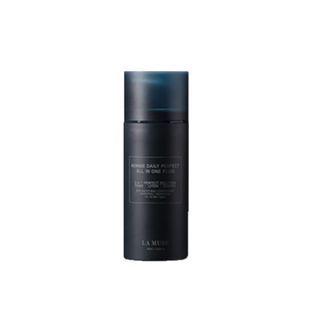
La Muse Homme Daily Perfect All In One Fulid
Works for
1 of 1 advertised claim delivered
Moisturizing32 ingredients credited for this claimStrong support
“Extracts from Fig and Algae offer deep hydration and improve skin elasticity.”
This product can help improve hydration of the skin with the two types of ingredients.
The first type is called “humectants”:
these ingredients help attract water.
When humectants are on the surface of the skin, they “pull in” the moisture from the outside environment, or from
within deeper layers of the skin. The following ingredients in this product do the job:
algae extract, betaine.
This product also contains ingredients called “occlusives”. They help reduce the speed with which our skin loses moisture to the outside environment. These ingredients also help soften the upper layer of the skin, so it feels less tight and nicer to the touch. The following ingredients in this product do the job: dimethicone, peg-10 dimethicone.
The following ingredients in this product are especially good for supporting the skin barrier and helping with the hydration level: ceramide np, niacinamide
Evens skin toneNot advertised by the brand · 2 ingredients credited for this claimStrong support
This product can help reduce hypepigmentation and even out the skin tone because it contains the following effective ingredients: niacinamide
Keep in mind that you would need to apply any topical skincare targetted at hypigmentation consistently for a couple of months to get a result. No topical skincare product can help get rid of hyperpigmentation (including post-acne marks and age spots) instantly.
Anti-agingNot advertised by the brand · 6 ingredients credited for this claimStrong support
This product can help reduce and prevent fine lines and wrinkles, improve skin elasticity and firmness because it contains adenosine, niacinamide.
These ingredients in the product can also be helpful, even though there is less evidence for their effectiveness: centella asiatica extract.
Keep in mind that it typically takes at least 6 weeks to notice any results because the changes that are needed to improve fine lines and elasticity happen in the deeper layers of the skin. No topical anti-aging product can “erase” wrinkles or fully reverse signs of aging.
Anti-blemishNot advertised by the brand · 4 ingredients credited for this claimStrong support
This product can help reduce breakouts and clogged pores because it contains the following ingredient: niacinamide. This ingredient is used for treating acne and can have a noticeable effect.
Anti-oxidationNot advertised by the brand · 8 ingredients credited for this claimModerate support
This product contains antioxidants (centella asiatica extract, ficus carica fruit extract) that might be able to help neutralize free radicals in skin to lessen the damage it gets from the UV light (sun). There is not enough evidence to confirm their effectiveness in skin though.
Can it cause trouble?
Irritancy3 strong irritants: Eclipta prostrata leaf extract, Alcohol + 1 more — patch-test recommendedHigh risk
Comedogenic3 ingredients rated 2 or more on the 0–5 pore-clogging scale3 flagged


User reviews
Be the first — your take helps the next person decide.
Ingredients
Filter by role to see what each ingredient is doing.
Water~45–55%
Glycerin~4.6–5.7%
- Irritation risk
- Low
One of the best moisturizing ingredients. Naturally present in skin. It attracts water to the upper layer of the skin working as a humectant
More about GlycerinDimethicone~4.2–5.1%
- Irritation risk
- Low
A silicone that helps to reduce water loss from the surface of the skin. Can temporarily "fill in" lines and wrinkles, absorb oil, and create a nice product finish
More about DimethiconeNiacinamide~3.1–3.7%
- Irritation risk
- Low
Is proven to be effective in reducing blemishes, evening out skin tone and helping to improve lines and wrinkles. It helps the skin to repair sun damage, calm down inflammation and keep maintain good levels of moisture. The concentration of about 2% is effective for supporting the skin barrier and evening out the skin tone. Concentration of 4-6% is better for helping with acne and balancing the sebum production
More about NiacinamideMethylpropanediol~2.3–2.8%
Cyclopentasiloxane~1.9–2.4%
- Irritation risk
- Low
A silicone that helps improve the product texture and spreadability. Can absorb oil creating a short-term mattifying effect on the skin
More about CyclopentasiloxaneCetyl alcohol~1.6–2%
- Irritation risk
- Low
A non-drying alcohol that works to soften the skin and stabilize product formulations helping oil and water mix together
More about Cetyl alcoholCentella asiatica extract~1.3–1.5%
- Irritation risk
- Medium
A plant extract that has been shown to be able to reduce inflammation in skin, support restoration of skin barrier function, as well as support collagen production. Contains active compounds called centelloids: asiaticoside, madecasosside, asiatic acid and madecassic acid. Might be helpful in preventing stretch marks. It can be itself be irritating though.
More about Centella asiatica extractFicus carica fruit extract~1.1–1.4%
- Irritation risk
- Medium
A plant extract that can help neutralize free radicals. The concentrations typically used in cosmetics are too small to have an effect
More about Ficus carica fruit extractAlgae extract~1–1.3%
- Irritation risk
- Low
- Comedogenicity
- 3/5
Plant extract that helps the skin to attract water and make it more smooth for touch. Also shows promise of anti-aging properties, but research is not extensive yet
More about Algae extractEclipta prostrata leaf extract~0.65–1%
- Irritation risk
- High
A plant extract that is mostly used as a fragrance. Might have some anti-oxidant effect
More about Eclipta prostrata leaf extractUlmus davidiana root extract~0.55–0.8%
- Irritation risk
- High
A plant root extract that helps attract water to the upper layer of the skin. It might have an anti-inflammatory effect and could help neturalize free radicals in skin
More about Ulmus davidiana root extractAmaranthus caudatus seed extract~0.5–0.75%
- Irritation risk
- Low
Hydrogenated argania spinosa kernel oil~0.5–0.75%
- Irritation risk
- Low
Cyclomethicone~0.45–0.7%
- Irritation risk
- Low
A type of silicone that leaves a nice silky finish on the skin and can help soften its upper layer
More about CyclomethiconeSaccharomyces ferment filtrate~0.4–0.65%
- Irritation risk
- Low
A product of yeast fermentation. Helps attract water to the upper layer of the skin
More about Saccharomyces ferment filtrateGlyceryl stearate~0.45–0.7%
- Irritation risk
- Low
An emollient that softens the skin and forms a protective layer on its surface. Helps water and oil mix together
More about Glyceryl stearateDimethicone/vinyl dimethicone crosspolymer~0.35–0.6%
- Irritation risk
- Low
Used to stabilize product formulations and create a nice product texture
More about Dimethicone/vinyl dimethicone crosspolymerCetyl ethylhexanoate~0.35–0.65%
- Irritation risk
- Medium
An emollient that helps soften the skin and creates a thicker product texture
More about Cetyl ethylhexanoateCaprylic/capric/myristic/stearic triglyceride~0.3–0.55%
- Irritation risk
- Low
Helps to soften the upper layer of the skin
More about Caprylic/capric/myristic/stearic triglycerideHydrogenated poly(c6-14 olefin)~0.3–0.55%
- Irritation risk
- Low
Helps soften the upper layer of the skin and create a nice product texture
More about Hydrogenated poly(c6-14 olefin)Squalane~0.3–0.55%
- Irritation risk
- Low
An oil naturally present in skin. Works as an emollient to soften the skin and form a protective layer on its surface without a greasy feeling.
More about SqualaneHydroxyethyl acrylate/sodium acryloyldimethyl taurate copolymer~0.25–0.45%
- Irritation risk
- Medium
A gelling agent that thickens the product consistency and leaves the skin with a velvety finish
More about Hydroxyethyl acrylate/sodium acryloyldimethyl taurate copolymerSteareth-2~0.25–0.5%
Carbomer~0.25–0.45%
- Irritation risk
- Low
Helps create a thicker or gel-like product texture. It is not a surfactant but can be used in gentle cleansing formulations
More about CarbomerTromethamine~0.25–0.45%
Dipropylene glycol~0.2–0.4%
- Irritation risk
- Low
Helps to dissolve other ingredients in a formulation. Slows down the rate of product drying
More about Dipropylene glycolSodium stearoyl glutamate~0.3–0.55%
- Irritation risk
- Medium
Helps oil and water mix together
More about Sodium stearoyl glutamateBetaine~0.25–0.45%
- Irritation risk
- Low
Helps attract water to the upper layer of the skin and improves the product texture
More about BetaineButylene glycol~0.25–0.45%
- Irritation risk
- Low
Used to create a nice product texture and help delivery of other ingredients. Might be somewhat helpful in attracting water to the upper layer of the skin
More about Butylene glycolHydrogenated polyisobutene~0.25–0.5%
- Irritation risk
- Low
Used to improve the product consistency and soften the upper layer of the skin
More about Hydrogenated polyisobuteneAlcohol~0.25–0.45%
- Irritation risk
- High
Can be drying and contribute to skin irritation. Used in formulars to dissolve other ingredients, create a thinner product consistency or for its antibacterial properties
More about AlcoholDipotassium glycyrrhizate~0.25–0.45%
- Irritation risk
- Low
A salt derived from licorice. Works as an emollient to soften the upper layer of the skin and can help calm down inflammation. Might be helpful for skin lightening
More about Dipotassium glycyrrhizateAdenosine~0.25–0.45%
- Irritation risk
- Low
Might help improve cell turnover and reduce inflammation in skin. One study shows that the ingredients might be able to help reduce dynamic wrinkles (for example, in the corners of the eyes or on the forehead)
More about AdenosineIsononyl isononanoate~0.25–0.5%
- Irritation risk
- Low
Forms a protective film on the surface of the skin to prevent moisture loss. Gives a velvety feel to products while reducing tackiness
More about Isononyl isononanoatePolyglyceryl-10 stearate~0.25–0.45%
- Irritation risk
- Medium
Helps water and oil mix together and softens the upper layer of the skin
More about Polyglyceryl-10 stearateDisodium edta~0.25–0.45%
Cetearyl alcohol~0.3–0.55%
- Irritation risk
- Low
- Comedogenicity
- 2/5
A non-drying alcohol. Works as an emollient. Helps water and oil mix together and creates a nice product texture
More about Cetearyl alcoholStearic acid~0.35–0.65%
- Irritation risk
- Low
Helps oil and water mix together and works as an emollient
More about Stearic acidButyrospermum parkii butter~0.3–0.55%
- Irritation risk
- Low
- Comedogenicity
- 3/5
A great moisturising ingredient that softens the skin and reduces water loss from its upper layer. It also can be helpful in protecting skin from free radicals
More about Butyrospermum parkii butterPolyglyceryl-2 dipolyhydroxystearate~0.25–0.45%
- Irritation risk
- Low
Helps to soften the upper layer of the skin
More about Polyglyceryl-2 dipolyhydroxystearateFructooligosaccharides~0.25–0.4%
- Irritation risk
- Low
Help attract water to the upper layer of the skin
More about FructooligosaccharidesLecithin~0.3–0.55%
- Irritation risk
- Low
Used mostly for creating emulsions - helping oil and water mix together. Helps soften the upper layer of the skin
More about LecithinBeta-glucan~0.2–0.4%
- Irritation risk
- Low
Helps attract water to the upper layer of the skin, calm down inflammation and irritation, restore the barrier function and support wound healing. It can be helpful in reducing fine lines and wrinkles
More about Beta-glucanTocopheryl acetate~0.25–0.45%
- Irritation risk
- Medium
A more stable but less bio-available form of vitamin E compared to Tocopherol. Might help moisturize and protect the skin from free radicals, but mostly used in low concentrations to stabilize other ingredients.
More about Tocopheryl acetateInulin lauryl carbamate~0.2–0.4%
Hydrolyzed hyaluronic acid~0.2–0.4%
- Irritation risk
- Low
One of the best moisturizing ingredients. Attracts water into the upper layer of the skin. A version of it is naturally present in skin
More about Hydrolyzed hyaluronic acidPistacia lentiscus gum~0.25–0.45%
- Irritation risk
- High
A tree rasin that could temporarily tighten the skin and might help regulate sebum production, but the research on its effectiveness in skin is lacking
More about Pistacia lentiscus gumCeramide np~0.25–0.45%
- Irritation risk
- Low
A type of lipid similar to ceramides naturally present in skin. Helps to soften the upper layer of the skin and supports the skin barrier function to keep it hydrated. Can help to prevent inflammation in skin
More about Ceramide npDisodium stearoyl glutamate~0.25–0.5%
- Irritation risk
- Medium
Helps oil and water mix together and workd as a cleanser
More about Disodium stearoyl glutamatePeg-10 dimethicone~0.2–0.4%
- Irritation risk
- Low
A silicone that works to soften the upper layer of the skin and reduce its water loss
More about Peg-10 dimethiconePolysorbate 60~0.15–0.3%
Parfum~0.15–0.25%
- Irritation risk
- High
An aromatic blend of unspecified and possibly irritating ingredients
More about Parfum1,2-hexanediol~0.15–0.25%
Phenoxyethanol~0.15–0.25%
- Irritation risk
- Low
A preservative. It helps prevent bacterial growth in cosmetic products
More about PhenoxyethanolEthylhexylglycerin~0.1–0.15%
Ingredient list view
Water, Glycerin, Dimethicone, Niacinamide, Methylpropanediol, Cyclopentasiloxane, Cetyl alcohol, Centella asiatica extract, Ficus carica fruit extract, Algae extract, Eclipta prostrata leaf extract, Ulmus davidiana root extract, Amaranthus caudatus seed extract, Hydrogenated argania spinosa kernel oil, Cyclomethicone, Saccharomyces ferment filtrate, Glyceryl stearate, Dimethicone/vinyl dimethicone crosspolymer, Cetyl ethylhexanoate, Caprylic/capric/myristic/stearic triglyceride, Hydrogenated poly(c6-14 olefin), Squalane, Hydroxyethyl acrylate/sodium acryloyldimethyl taurate copolymer, Steareth-2, Carbomer, Tromethamine, Dipropylene glycol, Sodium stearoyl glutamate, Betaine, Butylene glycol, Hydrogenated polyisobutene, Alcohol, Dipotassium glycyrrhizate, Adenosine, Isononyl isononanoate, Polyglyceryl-10 stearate, Disodium edta, Cetearyl alcohol, Stearic acid, Butyrospermum parkii butter, Polyglyceryl-2 dipolyhydroxystearate, Fructooligosaccharides, Lecithin, Beta-glucan, Tocopheryl acetate, Inulin lauryl carbamate, Hydrolyzed hyaluronic acid, Pistacia lentiscus gum, Ceramide np, Disodium stearoyl glutamate, Peg-10 dimethicone, Polysorbate 60, Parfum, 1,2-hexanediol, Phenoxyethanol, Ethylhexylglycerin
Compare prices
Retailers ranked by price — lowest first.

Affiliate links · prices updated regularly
Worth comparing, line by line.
Match % combines shared ingredients, the first five ingredients, shared actives and hero ingredients, irritancy (lower counts in the alternative's favour), texture and body area. Only products in the same routine step are compared.
| La MuseHomme Daily Perfect All In One FulidYOUR PRODUCT | celimaxThe Real Noni Energy Repair Cream | LABIOTTEPremium Collagen Full Up Eye Cream | KLAVUUWhite Pearlsation Enriched Divine Pearl Cream | |
|---|---|---|---|---|
| Match | — | 78% | 78% | 77% |
| Price | $26.00 | $13.62−$12.38 | $30.72+$4.72 | $37.90+$11.90 |
| Shared key ingredients | — | 10 of 20 | 11 of 20 | 10 of 20 |
| Key difference | — | Caprylic/Capric Triglyceride | Copper Tripeptide-1 | Panthenol |
| Irritancy | High | Medium | Medium | Medium |
| Drying alcohol | Contains drying alcohol | — | — | Contains drying alcohol |
| View product | Shop | Shop | Shop |


Product summary
Based on the ingredient list, "La Muse - Homme Daily Perfect All In One Fulid" can work well for skin moisturization. To work well, any moisturizer needs to include a combination of water-binding and emollient ingredients. La Muse - Homme Daily Perfect All In One Fulid ticks this box. Algae extract, betaine, cyclomethicone, fructooligosaccharides and glycerin in this product (humectants) attract water molecules to the upper layer of the skin (the water comes from the outside air or from the deeper layers of the skin if the air is dry). Ceramide np, algae extract, cyclomethicone, dimethicone and peg-10 dimethicone in this product help decrease the water evoporation from the skin, so that it stays hydrated for longer. These ingredients also soften the skin and take away the feeling of tightness and dryness.
Ingredient callouts
- We love that this moisturizer contains a good concentration of niacinamide 3.10% - 3.70%. Niacinamide is a perfect active in a moistruizer because it helps calm down inflamation in skin and support the skin barrier. More than that, it is helpful for most common skin concerns: it helps regulat oil production, help reduce acne and clogged pores, improve skin tone and prevent pigmentation marks. It also helps fight photodamage.
- As a plus, this moisturizer also contains Ceramides (ceramide np 0.25% - 0.45%). Ceramides are a type of lipids that our skin produces itself. They are a building block of the skin's barrier. Ceramides used in skincare are synthetic or extracted from plants. They work well for softening the skin surface and "patch holes" in the skin's barrier.
- Adenosine 0.25% - 0.45%. It is a compound that in involved in many biological processes inside the skin cells. According one high-quality clinical trial, topical Adenosine in low concentrations can somewhat help improve "deep wrinkles" - the wrinkles that appear with age in places where our faces are most dynamic (for example, on the forehead or in the corners of the eyes).
Irritation risk
We assess the overall irritancy of this moisturizer to be high. For a detailed overview of all potential irritants: click here
You can see the detailed formula review with the breakdown of all actives in the product and the full ingredient list with estimated concentrations in the tables below.
Price
The product retails for 26.00$ in the United States.
For a detailed price comparison: click here.
Sources cited in this review
Every concentration estimate and effectiveness label is anchored to one of these 38 studies and safety reviews.
- 1
- 2
- 3Final Report on the Safety Assessment of Dimethicone Copolyoljournals.sagepub.com
- 4
- 5
- 6

Affiliate links · As an Amazon Associate, WIMJ earns from qualifying purchases.