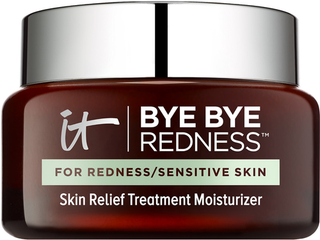
It Cosmetics Bye Bye Redness Sensitive Skin Moisturizer
Works for
2 of 2 advertised claims delivered
MoisturizingCeramide np, Palmitoyl oligopeptide + 53 moreStrong evidence
“Developed with plastic surgeons, Bye Bye Redness Moisturizer helps neutralize and soothe the look of redness while providing deep hydration and is gentle enough for even the most sensitive and dry skin.”
This product can help improve hydration of the skin with the two types of ingredients.
The first type is called “humectants”:
these ingredients help attract water.
When humectants are on the surface of the skin, they “pull in” the moisture from the outside environment, or from
within deeper layers of the skin. The following ingredients in this product do the job:
biosaccharide gum-1, glycerin.
This product also contains ingredients called “occlusives”. They help reduce the speed with which our skin loses moisture to the outside environment. These ingredients also help soften the upper layer of the skin, so it feels less tight and nicer to the touch. The following ingredients in this product do the job: dimethicone, squalane.
The following ingredients in this product are especially good for supporting the skin barrier and helping with the hydration level: acetyl hexapeptide-8, acetyl octapeptide-3, ceramide ap, ceramide np, palmitoyl oligopeptide, palmitoyl tetrapeptide-7
Anti-agingRetinyl retinoate, Palmitoyl tetrapeptide-7 + 10 moreStrong evidence
“Perfect for a.m. and p.m., your redness-relieving moisturizer also smooths the look of lines and wrinkles and is infused with anti-aging, skin-soothing colloidal oatmeal, aloe, cucumber, chamomile extract, avocado, chrysin, turmeric, collagen, and peptides.”
This product can help reduce and prevent fine lines and wrinkles, improve skin elasticity and firmness because it contains retinyl retinoate.
These ingredients in the product can also be helpful, even though there is less evidence for their effectiveness: acetyl hexapeptide-8, acetyl octapeptide-3, palmitoyl oligopeptide, palmitoyl tetrapeptide-7.
Keep in mind that it typically takes at least 6 weeks to notice any results because the changes that are needed to improve fine lines and elasticity happen in the deeper layers of the skin. No topical anti-aging product can “erase” wrinkles or fully reverse signs of aging.
ExfoliationNot advertised by the brand · Retinyl retinoate, Polylactic acid + 1 moreStrong evidence
This product can help exfoliate the skin. In other words, it helps break down the bonds between dead cells on the surface of the skin and speed up the skin turnover. Skin often appears softer and brighter after exfoliation, but overdoing it can result in disrupted skin barrier. The following ingredient is doing the exfoliating job in this product: retinyl retinoate.
Anti-blemishNot advertised by the brand · Retinyl retinoate, Zinc pca + 4 moreStrong evidence
This product can help reduce breakouts and clogged pores because it contains the following ingredient: retinyl retinoate. This ingredient is used for treating acne and can have a noticeable effect.
The following ingredient (ingredients) in this product might be helpful, but there is no evidence to confirm that it actually works: zinc pca
Evens skin toneNot advertised by the brand · Retinyl retinoate, Chrysin + 6 moreModerate evidence
The following ingredient (ingredients) in this product might be helpful, but there is no evidence to confirm that it actually works: chrysin, glycyrrhiza glabra root extract, retinyl retinoate.
Anti-oxidationNot advertised by the brand · Chrysin, Glycyrrhiza glabra root extract + 12 moreModerate evidence
This product contains antioxidants (chrysin) that might be able to help neutralize free radicals in skin to lessen the damage it gets from the UV light (sun). There is not enough evidence to confirm their effectiveness in skin though.
Can it cause trouble?
Irritancy2 strong irritants: Retinyl retinoate, Chrysanthemum parthenium extract — patch-test recommendedHigh risk
Comedogenic4 ingredients rated 2 or more on the 0–5 pore-clogging scale4 flagged

User reviews
Be the first — your take helps the next person decide.
Ingredients
Filter by role to see what each ingredient is doing.
Water~45–55%
Butylene glycol~5.6–6.9%
- Irritation risk
- Low
Used to create a nice product texture and help delivery of other ingredients. Might be somewhat helpful in attracting water to the upper layer of the skin
More about Butylene glycolCyclopentasiloxane~4–4.9%
- Irritation risk
- Low
A silicone that helps improve the product texture and spreadability. Can absorb oil creating a short-term mattifying effect on the skin
More about CyclopentasiloxaneGlycerin~2.9–3.6%
- Irritation risk
- Low
One of the best moisturizing ingredients. Naturally present in skin. It attracts water to the upper layer of the skin working as a humectant
More about GlycerinButylene glycol dicaprylate/dicaprate~2.2–2.7%
- Irritation risk
- Low
Helps soften the upper layer of the skin
More about Butylene glycol dicaprylate/dicaprateEthylhexyl isononanoate~1.8–2.2%
- Irritation risk
- Low
Helps soften the upper layer of the skin and improve the product consistency
More about Ethylhexyl isononanoateHydrogenated polyisobutene~1.5–1.9%
- Irritation risk
- Low
Used to improve the product consistency and soften the upper layer of the skin
More about Hydrogenated polyisobuteneGlyceryl stearate~1.3–1.5%
- Irritation risk
- Low
An emollient that softens the skin and forms a protective layer on its surface. Helps water and oil mix together
More about Glyceryl stearateDimethicone~1.1–1.3%
- Irritation risk
- Low
A silicone that helps to reduce water loss from the surface of the skin. Can temporarily "fill in" lines and wrinkles, absorb oil, and create a nice product finish
More about DimethiconeCaprylic/capric/myristic/stearic triglyceride~0.65–1%
- Irritation risk
- Low
Helps to soften the upper layer of the skin
More about Caprylic/capric/myristic/stearic triglyceridePeg-100 stearate~0.55–0.8%
- Irritation risk
- Low
Helps oil and water mix togehter and creates a nice product texture
More about Peg-100 stearatePolyglyceryl-3 methylglucose distearate~0.35–0.65%
- Irritation risk
- Medium
Helps water and oil mix together
More about Polyglyceryl-3 methylglucose distearateStearyl behenate~0.3–0.5%
- Irritation risk
- Low
Helps soften the upper layer of the skin
More about Stearyl behenatePentaerythrityl tetraethylhexanoate~0.25–0.5%
- Irritation risk
- Low
Used to create a nice product consistency while softening the upper layer of the skin
More about Pentaerythrityl tetraethylhexanoateBiosaccharide gum-1~0.2–0.35%
- Irritation risk
- Low
Helps attract water to the upper layer of the skin and is claimed to provide a longer-lasting hydration because of its ability to create a water-binding film on the surface of the skin
More about Biosaccharide gum-1Cetearyl alcohol~0.25–0.45%
- Irritation risk
- Low
- Comedogenicity
- 2/5
A non-drying alcohol. Works as an emollient. Helps water and oil mix together and creates a nice product texture
More about Cetearyl alcoholHydrogenated lecithin~0.2–0.35%
- Irritation risk
- Low
Helps to retain moisture by creating a protective barrier on the skin. Rich in fatty acids. Improves product texture and helps with the penetration of other ingredients.
More about Hydrogenated lecithinPolyethylene~0.25–0.5%
Peg/ppg-20/15 dimethicone~0.15–0.25%
- Irritation risk
- Medium
Helps oil and water mix together
More about Peg/ppg-20/15 dimethiconePhenyl methicone~0.15–0.25%
- Irritation risk
- Low
Dimethicone/vinyl dimethicone crosspolymer~0.05–0.15%
- Irritation risk
- Low
Used to stabilize product formulations and create a nice product texture
More about Dimethicone/vinyl dimethicone crosspolymerStearyl stearate~0.1–0.15%
- Irritation risk
- Low
Peg-150 distearate~0.05–0.1%
- Irritation risk
- Medium
Helps oil and water mix together
More about Peg-150 distearateStearic acid~0.15–0.25%
- Irritation risk
- Low
Helps oil and water mix together and works as an emollient
More about Stearic acidPalmitic acid~0.1–0.15%
- Irritation risk
- Low
An emollient that is naturally present in skin and helps soften it
More about Palmitic acidCocos nucifera oil~0.01–0.05%
- Irritation risk
- Low
- Comedogenicity
- 3/5
An emollient. Found to be as effective as a moisturizer for dry skin as mineral oil. Could be comedogenic
More about Cocos nucifera oilAloe barbadensis leaf extract~0.1–0.15%
- Irritation risk
- Medium
Traditionally used to treat sunburns, dermatitis and inflammation, but evidence for its effectiveness is lacking. The extract can contain humectants that help attract water into the skin
More about Aloe barbadensis leaf extractButyrospermum parkii butter~0.05–0.15%
- Irritation risk
- Low
- Comedogenicity
- 3/5
A great moisturising ingredient that softens the skin and reduces water loss from its upper layer. It also can be helpful in protecting skin from free radicals
More about Butyrospermum parkii butterPhytosteryl/isostearyl/cetyl/stearyl/behenyl dimer dilinoleate~0.05–0.1%
- Irritation risk
- Low
Helps soften the upper layer of the skin and create a nice product consistency
More about Phytosteryl/isostearyl/cetyl/stearyl/behenyl dimer dilinoleateCeramide np~0.05–0.15%
- Irritation risk
- Low
A type of lipid similar to ceramides naturally present in skin. Helps to soften the upper layer of the skin and supports the skin barrier function to keep it hydrated. Can help to prevent inflammation in skin
More about Ceramide npHydrogenated polydecene~0.05%
- Irritation risk
- Low
Helps to soften the upper layer of the skin and create a nice product texture
More about Hydrogenated polydeceneCeteareth-20~0.1–0.2%
- Irritation risk
- Medium
- Comedogenicity
- 2/5
Helps oil and water mix together. Has some emollient properties
More about Ceteareth-20Glyceryl citrate/lactate/linoleate/oleate~0.05–0.1%
Hydroxypropyl bispalmitamide mea~0.05–0.15%
Glycosphingolipids~0.05–0.1%
- Irritation risk
- Low
A type of lipids naturally present in skin. They can be converted to ceramides in skin
More about GlycosphingolipidsCeramide ap~0.05–0.1%
- Irritation risk
- Low
A type of lipid similar to ceramides naturally present in skin. Helps to soften the upper layer of the skin and supports the skin barrier function to keep it hydrated. Can help to prevent inflammation in skin
More about Ceramide apMeadowfoam estolide~0.01–0.05%
- Irritation risk
- Medium
Helps soften the upper layer of the skin and create a more even product formulation
More about Meadowfoam estolideGlycine soja sterols~0.05–0.15%
- Irritation risk
- Low
An emollient that helps soften the skin
More about Glycine soja sterolsCetearyl glucoside~0.05–0.1%
- Irritation risk
- Medium
Helps water and oil in the product mix well together and improves product texture
More about Cetearyl glucosideBetaine~0.01–0.05%
- Irritation risk
- Low
Helps attract water to the upper layer of the skin and improves the product texture
More about BetaineSodium hyaluronate~0.05%
- Irritation risk
- Low
One of the best moisturizing ingredients. Attracts water into the upper layer of the skin
More about Sodium hyaluronatePolyquaternium-51~0.05–0.15%
- Irritation risk
- Low
An emollient that helps create a nice silky finish on the skin
More about Polyquaternium-51Glyceryl polymethacrylate~0.05–0.1%
- Irritation risk
- Low
Used to create a nice product texture
More about Glyceryl polymethacrylateAleuritic acid~0.01–0.05%
- Irritation risk
- Low
Yeast extract~0.05%
- Irritation risk
- Low
Helps attract water to the upper layer of the skin and might have some anti-oxidant and skin lightening properties. It can help calm down inflammation in skin
More about Yeast extractGlycoproteins~0.01–0.05%
Hydroxyethyl acrylate/sodium acryloyldimethyl taurate copolymer~0.05%
- Irritation risk
- Medium
A gelling agent that thickens the product consistency and leaves the skin with a velvety finish
More about Hydroxyethyl acrylate/sodium acryloyldimethyl taurate copolymerSqualane~0.1–0.15%
- Irritation risk
- Low
An oil naturally present in skin. Works as an emollient to soften the skin and form a protective layer on its surface without a greasy feeling.
More about SqualanePolysorbate 60~0.05–0.1%
Sorbitan isostearate~0.05–0.1%
- Irritation risk
- Low
Helps oil and water mix together
More about Sorbitan isostearatePortulaca oleracea extract~0.05%
- Irritation risk
- Medium
A plant extract that has some anti-oxidant activity, but solid research is lacking. Can help attract water to the upper layer of the skin
More about Portulaca oleracea extractTocopheryl acetate~0.05–0.1%
- Irritation risk
- Medium
A more stable but less bio-available form of vitamin E compared to Tocopherol. Might help moisturize and protect the skin from free radicals, but mostly used in low concentrations to stabilize other ingredients.
More about Tocopheryl acetateAllantoin~0.01–0.05%
- Irritation risk
- Low
Helps calm down inflammation in skin and can help reduce itching. Helps to repair the skin barrier and keep skin hydrated
More about AllantoinCarbomer~0.05%
- Irritation risk
- Low
Helps create a thicker or gel-like product texture. It is not a surfactant but can be used in gentle cleansing formulations
More about CarbomerGlucose~0.05%
- Irritation risk
- Low
Helps attract water to the upper layer of the skin. Could be helpful in restoring the skin barrier function
More about GlucoseTromethamine~0.05%
Eruca sativa leaf extract~0.01–0.05%
- Irritation risk
- Low
Sodium benzotriazolyl butylphenol sulfonate~0.05%
- Irritation risk
- Medium
Helps protect the ingredients in the formulation against UV light
More about Sodium benzotriazolyl butylphenol sulfonateButeth-3~0.05%
- Irritation risk
- Low
Tributyl citrate~0.1–0.2%
Hydrolyzed collagen~0.1–0.2%
- Irritation risk
- Low
A typically plant-derived compound that is supposed mimic human collagen. Cannot penetrate the skin barrier so is not particularly useful in skincare products beyond attracting water to the upper layer of the skin
More about Hydrolyzed collagenEthylhexylglycerin~0.05–0.15%
Niacinamide~0.05–0.15%
- Irritation risk
- Low
Is proven to be effective in reducing blemishes, evening out skin tone and helping to improve lines and wrinkles. It helps the skin to repair sun damage, calm down inflammation and keep maintain good levels of moisture. The concentration of about 2% is effective for supporting the skin barrier and evening out the skin tone. Concentration of 4-6% is better for helping with acne and balancing the sebum production
More about NiacinamideCamellia sinensis leaf extract~0.1–0.15%
- Irritation risk
- Low
Can contain potent anti-oxidant compounds (abbreviated ECG, GCG, EGC, and EGCG) that might help protect the skin from free radicals. Can help calm down inflammation and has some anti-bacterial properties. Unfortunately, these antioxidants are unstable and lose their effectiveness very quickly in products. The concentration of the antioxidant compounds in the extract also tends to be low to be effective in topical formulation
More about Camellia sinensis leaf extractCitric acid~0.05–0.1%
- Irritation risk
- Medium
Can work as an exfoliant but is typically used to adjust the product pH
More about Citric acidRetinyl retinoate~0.05–0.1%
- Irritation risk
- High
A "hybrid" of retinol and retinoic acid. It is more stable than retinol and is likely to be more effective based on the early research data available. Is as irritating as retinol
More about Retinyl retinoatePolylactic acid~0.15–0.3%
- Irritation risk
- Medium
Used as an abrasive ingredient for physical (mechanical) exfoliation
More about Polylactic acidCanola oil~0.1–0.2%
- Irritation risk
- Medium
A plant oil that can help soften the upper layer of the skin
More about Canola oilCholesteryl nonanoate~0.1–0.2%
- Irritation risk
- Low
Ascorbyl tetraisopalmitate~0.1–0.2%
- Irritation risk
- Medium
A vitamin C derivative. Studies show that is might be effective in reducing hyperpigmentation, but there are no studies confirming that it is effectively converted into the bioavailable form of Vitamin C in skin. It is not clear how this derivative compares in effectiveness to the topical application of bioavailable form of vitamin C (L-ascorbic acid)
More about Ascorbyl tetraisopalmitateGlycyrrhiza glabra root extract~0.05–0.1%
- Irritation risk
- Medium
A plant extract that can help lighten the skin and calm down inflammation. Might be helpful in neutralizing free radicals
More about Glycyrrhiza glabra root extractChamomilla recutita flower water~0.1–0.15%
- Irritation risk
- Low
Curcuma longa root extract~0.05–0.1%
- Irritation risk
- High
A plant extract that can contain an active compound curcumin, that may have some anti-inflammatory properties when applied to the skin, but solid research is lacking and the typical concentration used in skincare products is too low. Can be an irritant
More about Curcuma longa root extractColloidal oatmeal~0.15–0.3%
- Irritation risk
- Low
Helps to restore skin barrier function, soften the upper layer of the skin and calm down inflammation
More about Colloidal oatmealLeuconostoc/radish root ferment filtrate~0.1–0.15%
- Irritation risk
- Medium
A preservative that comes from radishes fermented by a bacteria. New research suggests that the preservation properties in the ingredient come from an ammonium salt that is not present naturally in radish root but used in its cultivation. Is problematic because the exact amount of the preservative agents is difficult to determine
More about Leuconostoc/radish root ferment filtrateSteareth-20~0.15–0.3%
N-hydroxysuccinimide~0.1–0.2%
- Irritation risk
- High
Is claimed to be able to brighten skin tone by removing some blood-related pigmented compounds in skin (hemoglobin and related elements) but solid research is missing. Can be irritating
More about N-hydroxysuccinimideChrysin~0.1–0.2%
- Irritation risk
- Medium
Might be helpful in reducing fine lines and wrinkles, as well as lightening the skin, but solid evidence is missing. Could somewhat help in reducing the darkness of the under-eye area. Helps to neutralise free radicals in skin
More about ChrysinPalmitoyl oligopeptide~0.2–0.35%
- Irritation risk
- Low
A type of peptide. Peptides are excellent moisturizers and might be able support collagen production reducing fine lines and wrinkles
More about Palmitoyl oligopeptidePalmitoyl tetrapeptide-7~0.15–0.3%
- Irritation risk
- Low
A type of peptide. Peptides are excellent moisturizers and might be able support collagen production reducing fine lines and wrinkles
More about Palmitoyl tetrapeptide-7Chlorhexidine digluconate~0.15–0.3%
Potassium sorbate~0.15–0.3%
Panthenol~0.15–0.25%
- Irritation risk
- Low
Helps attract water to the upper layer of the skin and can help improve skin barrier function
More about PanthenolPersea gratissima oil~0.2–0.35%
- Irritation risk
- Medium
An emollient that helps soften the skin and could be helpful in repairing its barrier function
More about Persea gratissima oilVitis vinifera seed oil~0.2–0.35%
- Irritation risk
- Medium
A great emollient that can also have anti-oxidant properties
More about Vitis vinifera seed oilBeta-glucan~0.15–0.25%
- Irritation risk
- Low
Helps attract water to the upper layer of the skin, calm down inflammation and irritation, restore the barrier function and support wound healing. It can be helpful in reducing fine lines and wrinkles
More about Beta-glucanAcetyl hexapeptide-8~0.15–0.25%
- Irritation risk
- Low
A type of peptide. Peptides are excellent moisturizers and might be able support collagen production reducing fine lines and wrinkles
More about Acetyl hexapeptide-8Acetyl octapeptide-3~0.15–0.25%
- Irritation risk
- Low
A type of peptide. Peptides are excellent moisturizers and might be able support collagen production reducing fine lines and wrinkles
More about Acetyl octapeptide-3Caprylyl glycol~0.15–0.3%
- Irritation risk
- Medium
Helps preserve products and creates a nice product texture
More about Caprylyl glycolOlea europaea fruit oil~0.15–0.3%
- Irritation risk
- Medium
An emollient that helps soften the skin but is not effective for restoring its barrier function. Might be helpful to calm down inflammation
More about Olea europaea fruit oilCholesteryl isostearate~0.15–0.3%
- Irritation risk
- Low
Cholesteryl chloride~0.15–0.25%
- Irritation risk
- Low
Bht~0.15–0.25%
Silica~0.25–0.45%
Dipropylene glycol~0.1–0.25%
- Irritation risk
- Low
Helps to dissolve other ingredients in a formulation. Slows down the rate of product drying
More about Dipropylene glycolMagnolia acuminata bark extract~0.15–0.25%
- Irritation risk
- Low
Chrysanthemum parthenium extract~0.15–0.25%
- Irritation risk
- High
Could have anti-inflammatory effect on skin, but can be irritating as well. Can be added to products for its smell
More about Chrysanthemum parthenium extractLithospermum officinale extract~0.15–0.3%
- Irritation risk
- Low
Agaricus bisporus extract~0.15–0.3%
- Irritation risk
- Low
Saccharum officinarum extract~0.15–0.3%
- Irritation risk
- Low
Sugar extract that helps attract water to the upper layer of the skin
More about Saccharum officinarum extractCucumis sativus fruit extract~0.15–0.3%
- Irritation risk
- Medium
Might be somewhat helpful in reducing hyperpigmentation and neutralizing free radicals but its typical concentration in a product is too low for having an effect
More about Cucumis sativus fruit extractZinc pca~0.15–0.3%
- Irritation risk
- Low
A compound that combines zinc with a hydrating ingredient PCA. Might to be helpful against acne and clogged pores. Can help calm down inflammation in skin. Could be helpful in reducing the formation of free radicals in skin. Might help to reduce fine lines in wrinkles, but solid evidence is missing
More about Zinc pcaHippophae rhamnoides fruit extract~0.2–0.35%
- Irritation risk
- Medium
A plant extract that might help neutralize free radicals in skin, but research on its effectiveness is lacking
More about Hippophae rhamnoides fruit extractHydrolyzed silk~0.15–0.3%
- Irritation risk
- Medium
Can help attract water to the upper layer of the skin
More about Hydrolyzed silkPhenoxyethanol~0.15–0.25%
- Irritation risk
- Low
A preservative. It helps prevent bacterial growth in cosmetic products
More about PhenoxyethanolCaprylhydroxamic acid~0.15–0.25%
Disodium edta~0.15–0.3%
1,2-hexanediol~0.15–0.25%
Ci 42090~0.1–0.2%
Ci 19140~0.1–0.15%
Ingredient list view
Water, Butylene glycol, Cyclopentasiloxane, Glycerin, Butylene glycol dicaprylate/dicaprate, Ethylhexyl isononanoate, Hydrogenated polyisobutene, Glyceryl stearate, Dimethicone, Caprylic/capric/myristic/stearic triglyceride, Peg-100 stearate, Polyglyceryl-3 methylglucose distearate, Stearyl behenate, Pentaerythrityl tetraethylhexanoate, Biosaccharide gum-1, Cetearyl alcohol, Hydrogenated lecithin, Polyethylene, Peg/ppg-20/15 dimethicone, Phenyl methicone, Dimethicone/vinyl dimethicone crosspolymer, Stearyl stearate, Peg-150 distearate, Stearic acid, Palmitic acid, Cocos nucifera oil, Aloe barbadensis leaf extract, Butyrospermum parkii butter, Phytosteryl/isostearyl/cetyl/stearyl/behenyl dimer dilinoleate, Ceramide np, Hydrogenated polydecene, Ceteareth-20, Glyceryl citrate/lactate/linoleate/oleate, Hydroxypropyl bispalmitamide mea, Glycosphingolipids, Ceramide ap, Meadowfoam estolide, Glycine soja sterols, Cetearyl glucoside, Betaine, Sodium hyaluronate, Polyquaternium-51, Glyceryl polymethacrylate, Aleuritic acid, Yeast extract, Glycoproteins, Hydroxyethyl acrylate/sodium acryloyldimethyl taurate copolymer, Squalane, Polysorbate 60, Sorbitan isostearate, Portulaca oleracea extract, Tocopheryl acetate, Allantoin, Carbomer, Glucose, Tromethamine, Eruca sativa leaf extract, Sodium benzotriazolyl butylphenol sulfonate, Buteth-3, Tributyl citrate, Hydrolyzed collagen, Ethylhexylglycerin, Niacinamide, Camellia sinensis leaf extract, Citric acid, Retinyl retinoate, Polylactic acid, Canola oil, Cholesteryl nonanoate, Ascorbyl tetraisopalmitate, Glycyrrhiza glabra root extract, Chamomilla recutita flower water, Curcuma longa root extract, Colloidal oatmeal, Leuconostoc/radish root ferment filtrate, Steareth-20, N-hydroxysuccinimide, Chrysin, Palmitoyl oligopeptide, Palmitoyl tetrapeptide-7, Chlorhexidine digluconate, Potassium sorbate, Panthenol, Persea gratissima oil, Vitis vinifera seed oil, Beta-glucan, Acetyl hexapeptide-8, Acetyl octapeptide-3, Caprylyl glycol, Olea europaea fruit oil, Cholesteryl isostearate, Cholesteryl chloride, Bht, Silica, Dipropylene glycol, Magnolia acuminata bark extract, Chrysanthemum parthenium extract, Lithospermum officinale extract, Agaricus bisporus extract, Saccharum officinarum extract, Cucumis sativus fruit extract, Zinc pca, Hippophae rhamnoides fruit extract, Hydrolyzed silk, Phenoxyethanol, Caprylhydroxamic acid, Disodium edta, 1,2-hexanediol, Ci 42090, Ci 19140
Compare prices
Retailers ranked by price — lowest first.

Worth comparing, line by line.
Match % combines shared ingredients, the first five ingredients, shared actives and hero ingredients, irritancy (lower counts in the alternative's favour), texture and body area. Only products in the same routine step are compared.
| It CosmeticsBye Bye Redness Sensitive Skin MoisturizerYOUR PRODUCT | Medik8r-Retinoate Youth Activating Cream Intense | |
|---|---|---|
| Match | — | 64% |
| Price | $28.00 | $220.13+$192.13 |
| Shared key ingredients | — | 7 of 27 |
| Key difference | — | Copper Heptapeptide-14 Pantothenate |
| Irritancy | High | High |
| Drying alcohol | — | — |
| View product | Shop |
Product summary
"It Cosmetics - Bye Bye Redness Sensitive Skin Moisturizer" is effective for: Anti-inflammatory, Moisturizing, Exfoliation, Anti-blemish and Anti-aging
This product could be helpful for: Evens skin tone, but its actives are not the most effective or are not well-studied.
Ingredient callouts
- this product contains an effective form of Retinoids (vitamin A): retinyl retinoate 0.05% - 0.10%. Retinoids are potent multitasking actives. They work to improve and prevent early signs of aging, reduce hyperpigmentation (age spots and post-acne marks), and prevent inflamed blemishes and clogged pores. The downside of Retinoids is that they can be irritating. If you are not already using a Retinoid in your routine, it is best to start slowly and apply the Retinoid product only a few times per week. If your skin tolerates it well, you can gradually increase the frequency to daily.
- Ceramides (ceramide np 0.05% - 0.15% and ceramide ap 0.01% - 0.05%). Ceramides are a type of lipids that our skin produces itself. They are a building block of the skin's barrier. Ceramides used in skincare are synthetic or extracted from plants. They work well for softening the skin surface and "patch holes" in the skin's barrier.
- Peptides (palmitoyl tetrapeptide-7 0.15% - 0.25%, palmitoyl oligopeptide 0.20% - 0.35%, acetyl octapeptide-3 0.15% - 0.25% and acetyl hexapeptide-8 0.15% - 0.25%). There are many different kind of Peptides and they are naturally present in our skin. They all are a combination of aminoacids. Some of them work as natural antibiotics, promote wound-healing and production of collagen. The science is still not settled on how effective Peptides are in skincare, but it is very likely that they have a benefit. They might help restore the skin barrier and fight the signs of aging. At the very least, Peptides work as humectants: they attract water to the upper layer of the skin and improve its hydration.
- Humectants (sodium hyaluronate 0.05% - 0.05%, hydrolyzed collagen 0.10% - 0.15%, glycerin 2.90% - 3.60%, acetyl octapeptide-3 0.15% - 0.25%, acetyl hexapeptide-8 0.15% - 0.25%, biosaccharide gum-1 0.20% - 0.35% and zinc pca 0.15% - 0.25%). These ingredients help attract water to the upper layer of the skin and improve the skin hydration.
About the brand
According to Cruelty-Free Kitty "It Cosmetics" is cruelty free, but its parent company is not.
Price
The product retails for 49.50$ in the United States.
For a detailed price comparison: click here.
Sources cited in this review
Every concentration estimate and effectiveness label is anchored to one of these 49 studies and safety reviews.
- 1
- 2
- 3
- 4
- 5Final Report on the Safety Assessment of Dimethicone Copolyoljournals.sagepub.com
- 6

Affiliate links · As an Amazon Associate, WIMJ earns from qualifying purchases.