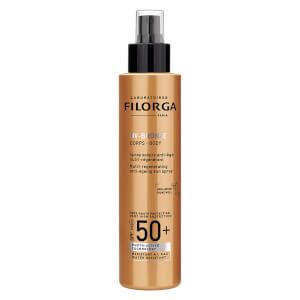
Filorga UV Bronze SPF50 Body Oil

Filorga UV Bronze SPF50 Body Oil

SPF 50Efficacy90/100IrritancyHigh·6 UV filters
Edit

Works for

2 of 2 advertised claims delivered

Sun protection
SPF 50 · 6 UV filters
Broad spectrum
SPF 50Broad spectrumChemical filtersNo white cast

This product offers a good level of protection against both UVB and UVA rays.

This sunscreen uses organic (so-called "chemical") sunscreen filters. Organic, or "chemical" filters usually provide reliable sun protection and rarely leave a white cast. Sunscreens with organic filters can sting eyes.

UV spectrum
UVB290–320 nmUVA II320–340 nmUVA I340–400 nm
Homosalate
Octinoxate
Octisalate
Uvinul T
Tinosorb S
Uvinul A Plus
FilterCoverageWhat it doesEst. amount
HomosalateUVB Photo-stable A weak sunscreen that offers some protection against the sun rays that cause sunburn (UVB), but does not offer meaningful protection against protect against the most aging sun rays (UVA). It loses its effectiveness quickly when exposed to sunlight. It is an organic, or so called "chemical" sunscreen. When used in low concentrations, helps to stabilize the product formulation~4.4–5.4%
OctinoxateEthylhexyl MethoxycinnamateUVBOctinoxate. When used in higher concentrations, works as a sunscreen protecting the skin from UVB rays. When used in lower concentration, helps to preserve the product formulation. Is shown to be harmful to coral reefs - consider avoiding bathing in coral reef areas when wearing a product with this ingredient. It can be irritating~2.8–3.4%
OctisalateEthylhexyl SalicylateUVBOctisalate. A UV filter. It offers some protection against the sun rays that cause sunburn (UVB), but does not protect against the most aging sun rays (UVA). It loses its effectiveness quickly when exposed to sunlight. It is an organic, or so called "chemical" sunscreen~2–2.4%
Uvinul TEthylhexyl TriazoneUVB Photo-stable Uvinul T. A UV filter. Effective against UVB rays. It is photostable. Can increase water resistance properties of the sunscreen. Unfortunately, not approved by the FDA (US) yet~1.6–2%
Tinosorb SBis-ethylhexyloxyphenol Methoxyphenyl TriazineUVBUVA Photo-stable Tinosorb S. One of the most effective broad spectrum sunscreen ingredients. Protects from both UVA and UVB rays. It is photostable. Unfortunately, not approved by FDA (US) yet.~0.65–1%
Uvinul A PlusDiethylamino Hydroxybenzoyl Hexyl BenzoateUVA1 Photo-stable Uvinul A Plus. A new generation broad spectrum sunscreen that offers an effective protection especially in the UVA range. It is stable in formulations. Unfortunately, is not approved by the FDA (US) yet~5.1–6.3%
~ marks concentrations estimated from label position and typical use levels
Anti-aging
13 ingredients credited for this claim
Strong support
What the product description says
“Protect skin from harmful sun exposure with the Filorga UV Bronze SPF50 Body Oil ; a nutri-regenerating, anti-ageing sun spray that offers very high protection and enhances your sunkissed glow.”
Source: Mankind

This product can help prevent early signs of skin aging because it offers a good level of broad spectrum sun protection. Sun damage is the main cause of premature skin aging, and protecting your skin from the sun is the best anti-aging strategy.

These ingredients in the product might also be helpful for reducing and preventing fine lines, wrinkles, and skin elasticity, even though there is no conclusive evidence for their effectiveness: aspartic acid, folic acid, retinyl acetate, serine, threonine.

SerineKey activeEffect: MediumAn amino-acid that helps to attract water to the upper layer of the skin. In combination with other amino-acids, might help to reduce fine lines and wrinkles~0.3–0.5%
Retinyl acetateKey activeEffect: Medium~0.3–0.5%
Aspartic acidKey activeEffect: MediumAn amino-acid that helps increase skin hydration and might help to slightly improve skin firmness, potentially reducing lines and wrinkles~0.25–0.5%
Folic acidKey activeEffect: MediumCan help stimulate collagen production in skin. While available studies are promising, more research is needed to confirm the efficacy in skin~0.3–0.55%
ThreonineKey activeEffect: MediumAn amino-acid that helps to attract water to the upper layer of the skin. In combination with other amino-acids, might help to reduce fine lines and wrinkles~0.25–0.45%
Thermus thermophillus fermentEffect: LowMight be helpful in neutralising free radicals in skin and have some hydration properties~0.55–0.85%
Aminobutyric acidEffect: LowHas been shown to support wound healing and skin barrier function when used topically in rats. Is likely to be effective in supporting skin's hydration and barrier function, but research for human skin is missing. Might have some anti-aging properties but the research is missing~0.3–0.5%
HydroxyprolineEffect: LowIs helpful in restoring skin barrier function supporting its moisture levels. Is claimed to stimulte collagen production in skin but evidence is lacking~0.3–0.55%
Prunus amygdalus dulcis oilEffect: LowAn emollient that softens the skin~0.3–0.6%
NiacinamideUnder-dosedEffect: HighIs proven to be effective in reducing blemishes, evening out skin tone and helping to improve lines and wrinkles. It helps the skin to repair sun damage, calm down inflammation and keep maintain good levels of moisture. The concentration of about 2% is effective for supporting the skin barrier and evening out the skin tone. Concentration of 4-6% is better for helping with acne and balancing the sebum production~0.3–0.55%
Ascorbic acidUnder-dosedEffect: HighThe most well-researched antioxidant that works in skin. Helps neutralize free radicals supporting collagen production, helping to even out the skin tone and preventing early signs of aging~0.25–0.45%
NiacinUnder-dosedEffect: MediumA form of vitamin B3. It is similar in action to niacinamide, but is more likely to cause red flashes in skin as the side effect~0.3–0.55%
TocopherolEffect: Low, below effective dosePure form of vitamin E. Can help moisturise and protect the skin from free radicals. Often used to help stabilise other ingredients or the formula itself~0.25–0.5%
Anti-oxidation
Not advertised by the brand · 8 ingredients credited for this claim
Strong support

This product contains antioxidants (glutathione) that can help neutralize free radicals in skin. By doing so, they can lessen the damage the skin gets from the UV light (sun).

GlutathioneKey activeEffect: HighA peptide that can help neutralize free radicals in skin and reduce melanin production resulting in skin lightening effect and reduction in hyperpigmentation. It can also help attract moisture to the upper layer of the skin~0.3–0.55%
Thermus thermophillus fermentEffect: LowMight be helpful in neutralising free radicals in skin and have some hydration properties~0.55–0.85%
Pyridoxine hclEffect: LowMight help neutralize free radicals in skin~0.3–0.5%
TaurineEffect: LowCould be helpful in reducing inflammation in skin, evening out the skin tone and neutralizing free radicals, but more research is needed to confirm its effectiveness~0.3–0.55%
Prunus amygdalus dulcis oilEffect: LowAn emollient that softens the skin~0.3–0.6%
TocopherolUnder-dosedEffect: HighPure form of vitamin E. Can help moisturise and protect the skin from free radicals. Often used to help stabilise other ingredients or the formula itself~0.25–0.5%
Ascorbic acidUnder-dosedEffect: HighThe most well-researched antioxidant that works in skin. Helps neutralize free radicals supporting collagen production, helping to even out the skin tone and preventing early signs of aging~0.25–0.45%
Tocopheryl acetateEffect: Low, below effective doseA more stable but less bio-available form of vitamin E compared to Tocopherol. Might help moisturize and protect the skin from free radicals, but mostly used in low concentrations to stabilize other ingredients.~0.35–0.65%
Evens skin tone
Not advertised by the brand · 6 ingredients credited for this claim
Strong support

This product offers broad spectrum sun protection. It means that it can prevent hyperpigmentation and help keep the skin tone even (sun damage is the main factor causing age spots, darkening of post-acne marks and other discolorations).

GlutathioneKey activeEffect: HighA peptide that can help neutralize free radicals in skin and reduce melanin production resulting in skin lightening effect and reduction in hyperpigmentation. It can also help attract moisture to the upper layer of the skin~0.3–0.55%
AlanineEffect: LowAn amino-acid that helps to attract water to the upper layer of the skin and might help to lighten the skin, but solid evidence is lacking~0.25–0.45%
TaurineEffect: LowCould be helpful in reducing inflammation in skin, evening out the skin tone and neutralizing free radicals, but more research is needed to confirm its effectiveness~0.3–0.55%
NiacinamideUnder-dosedEffect: HighIs proven to be effective in reducing blemishes, evening out skin tone and helping to improve lines and wrinkles. It helps the skin to repair sun damage, calm down inflammation and keep maintain good levels of moisture. The concentration of about 2% is effective for supporting the skin barrier and evening out the skin tone. Concentration of 4-6% is better for helping with acne and balancing the sebum production~0.3–0.55%
Ascorbic acidUnder-dosedEffect: HighThe most well-researched antioxidant that works in skin. Helps neutralize free radicals supporting collagen production, helping to even out the skin tone and preventing early signs of aging~0.25–0.45%
NiacinUnder-dosedEffect: MediumA form of vitamin B3. It is similar in action to niacinamide, but is more likely to cause red flashes in skin as the side effect~0.3–0.55%
Moisturizing
Not advertised by the brand · 34 ingredients credited for this claim
Good support

This product can help improve hydration of the skin with the two types of ingredients.

The first type is called “humectants”:
these ingredients help attract water. When humectants are on the surface of the skin, they “pull in” the moisture from the outside environment, or from within deeper layers of the skin. The following ingredients in this product do the job: alanine, aminobutyric acid.

This product also contains ingredients called “occlusives”. They help reduce the speed with which our skin loses moisture to the outside environment. These ingredients also help soften the upper layer of the skin, so it feels less tight and nicer to the touch. The following ingredients in this product do the job: arginine, cocos nucifera oil.

InositolKey active· HumectantEffect: High~0.3–0.5%
IsoleucineKey activeEffect: HighAn amino acid that can help attract water to the upper layer of the skin and support skin's barrier function~0.25–0.45%
Lysine hclKey activeEffect: High~0.25–0.45%
Aminobutyric acidKey active· HumectantEffect: HighHas been shown to support wound healing and skin barrier function when used topically in rats. Is likely to be effective in supporting skin's hydration and barrier function, but research for human skin is missing. Might have some anti-aging properties but the research is missing~0.3–0.5%
ArginineKey active· Humectant, OcclusiveEffect: HighAn amino acid that is naturally present in skin and helps keep it hydrated. When used together with AHAs, it can reduce their irritating effect on the skin~0.25–0.45%
Aspartic acidKey active· HumectantEffect: HighAn amino-acid that helps increase skin hydration and might help to slightly improve skin firmness, potentially reducing lines and wrinkles~0.25–0.5%
Calcium pantothenateKey activeEffect: HighHelps support skin barrier function improving skin hydration and reducing sensitivity~0.25–0.5%
Cocos nucifera oilKey active· Emollient, OcclusiveEffect: HighAn emollient. Found to be as effective as a moisturizer for dry skin as mineral oil. Could be comedogenic~0.45–0.7%
CyanocobalaminKey activeEffect: HighCan support skin barrier function and reduce inflammation in skin~0.3–0.55%
Glutamic acidKey active· HumectantEffect: HighAn amino-acid that helps attract water to the upper layer of the skin~0.3–0.5%
GlutathioneKey activeEffect: HighA peptide that can help neutralize free radicals in skin and reduce melanin production resulting in skin lightening effect and reduction in hyperpigmentation. It can also help attract moisture to the upper layer of the skin~0.3–0.55%
GlycerinKey active· HumectantEffect: HighOne of the best moisturizing ingredients. Naturally present in skin. It attracts water to the upper layer of the skin working as a humectant~0.3–0.6%
GlycineKey active· HumectantEffect: HighHelps to attract water to the upper layer of the skin and can help restore the skin barrier function~0.25–0.5%
HistidineKey active· HumectantEffect: High~0.25–0.45%
HydroxyprolineKey activeEffect: HighIs helpful in restoring skin barrier function supporting its moisture levels. Is claimed to stimulte collagen production in skin but evidence is lacking~0.3–0.55%
OrnithineKey activeEffect: HighAn amino-acid. Helps attract water to the upper layer of the skin~0.3–0.55%
SerineKey activeEffect: HighAn amino-acid that helps to attract water to the upper layer of the skin. In combination with other amino-acids, might help to reduce fine lines and wrinkles~0.3–0.5%
Sodium hyaluronateKey active· HumectantEffect: HighOne of the best moisturizing ingredients. Attracts water into the upper layer of the skin~0.25–0.45%
Thermus thermophillus fermentKey active· HumectantEffect: HighMight be helpful in neutralising free radicals in skin and have some hydration properties~0.55–0.85%
ThreonineKey activeEffect: HighAn amino-acid that helps to attract water to the upper layer of the skin. In combination with other amino-acids, might help to reduce fine lines and wrinkles~0.25–0.45%
TyrosineKey activeEffect: High~0.3–0.5%
AlanineKey active· HumectantEffect: HighAn amino-acid that helps to attract water to the upper layer of the skin and might help to lighten the skin, but solid evidence is lacking~0.25–0.45%
CyclopentasiloxaneKey active· EmollientEffect: MediumA silicone that helps improve the product texture and spreadability. Can absorb oil creating a short-term mattifying effect on the skin~3.1–3.8%
GlucoseKey active· HumectantEffect: MediumHelps attract water to the upper layer of the skin. Could be helpful in restoring the skin barrier function~0.25–0.45%
C12-15 alkyl benzoateKey active· EmollientEffect: MediumEnhances the product texture and makes it more spreadable. Helps reduce water loss from the outer layer of skin. Extands the shelf life by preventing bacteria growth~25–31%
ProlineKey activeEffect: Medium~0.3–0.55%
Prunus amygdalus dulcis oilKey active· EmollientEffect: MediumAn emollient that softens the skin~0.3–0.6%
IsododecaneKey active· Emollient, OcclusiveEffect: MediumAn emollient that helps soften the skin and can decrease moisture loss. Helps create a nice product texture~5.8–7.1%
Cyclohexasiloxane· EmollientEffect: LowA silicone that serves as an emollient. Helps create a nice non-greasy feels~1.7–2.1%
Coenzyme aEffect: LowHelps soften the upper layer of the skin and dissolve other ingredients in a product~0.3–0.55%
BiotinEffect: LowMight have some moisturising properties. Is not effective when applied topically beyond some moisturizing effect~0.3–0.55%
NiacinUnder-dosedEffect: HighA form of vitamin B3. It is similar in action to niacinamide, but is more likely to cause red flashes in skin as the side effect~0.3–0.55%
NiacinamideUnder-dosedEffect: HighIs proven to be effective in reducing blemishes, evening out skin tone and helping to improve lines and wrinkles. It helps the skin to repair sun damage, calm down inflammation and keep maintain good levels of moisture. The concentration of about 2% is effective for supporting the skin barrier and evening out the skin tone. Concentration of 4-6% is better for helping with acne and balancing the sebum production~0.3–0.55%
TocopherolEffect: Low, below effective dosePure form of vitamin E. Can help moisturise and protect the skin from free radicals. Often used to help stabilise other ingredients or the formula itself~0.25–0.5%

Can it cause trouble?

Irritancy
11 strong irritants: Parfum, Retinyl acetate + 9 more — patch-test recommended
High risk
We flagged 29 ingredients with irritancy potential. Severity depends on your sensitivity threshold; the table lists the worst offenders first.
IngredientFunctionIrritationEst. amount
Ethylhexyl methoxycinnamateOctinoxate. When used in higher concentrations, works as a sunscreen protecting the skin from UVB rays. When used in lower concentration, helps to preserve the product formulation. Is shown to be harmful to coral reefs - consider avoiding bathing in coral reef areas when wearing a product with this ingredient. It can be irritatingHigh~2.8–3.4%est.
Alcohol denat.Produces temporary toning effect. Can help dissolve other ingredients or preserve productsHigh~0.45–0.7%est.
ParfumAn aromatic blend of unspecified and possibly irritating ingredientsHigh~0.35–0.65%est.
Ascorbic acidThe most well-researched antioxidant that works in skin. Helps neutralize free radicals supporting collagen production, helping to even out the skin tone and preventing early signs of agingHigh~0.25–0.45%est.
Retinyl acetate—High~0.3–0.5%est.
NiacinA form of vitamin B3. It is similar in action to niacinamide, but is more likely to cause red flashes in skin as the side effectHigh~0.3–0.55%est.
Alpha-isomethyl iononeA fragrance. Potential allergen and can be irritatingHigh~0.25–0.45%est.
Benzyl benzoateFragrance with sweet balsamic smell. Help to preserve products and dissolve other ingredients. Could trigger allergic reactions and be irritatingHigh~0.25–0.4%est.
Benzyl salicylateA fragrance. Is a likely irritantHigh~0.2–0.4%est.
CitronellolA fragrance. Can be irritatingHigh~0.2–0.35%est.
EugenolA fragrance. Is a likely irritantHigh~0.15–0.3%est.
GeraniolA fragrance. Can be irritatingHigh~0.2–0.35%est.
Hexyl cinnamalA fragrance with jasmine smell. A likely irritantHigh~0.2–0.35%est.
LimoneneA common frangrance that can easily irritate skin, especially if exposed to air, light or heatHigh~0.15–0.3%est.
LinaloolA fragrance. Can be irritatingHigh~0.15–0.3%est.
Diethylamino hydroxybenzoyl hexyl benzoateUvinul A Plus. A new generation broad spectrum sunscreen that offers an effective protection especially in the UVA range. It is stable in formulations. Unfortunately, is not approved by the FDA (US) yetMedium~5.1–6.3%est.
HomosalateA weak sunscreen that offers some protection against the sun rays that cause sunburn (UVB), but does not offer meaningful protection against protect against the most aging sun rays (UVA). It loses its effectiveness quickly when exposed to sunlight. It is an organic, or so called "chemical" sunscreen. When used in low concentrations, helps to stabilize the product formulationMedium~4.4–5.4%est.
Ethylhexyl triazoneUvinul T. A UV filter. Effective against UVB rays. It is photostable. Can increase water resistance properties of the sunscreen. Unfortunately, not approved by the FDA (US) yetMedium~1.6–2%est.
Thermus thermophillus fermentMight be helpful in neutralising free radicals in skin and have some hydration propertiesMedium~0.55–0.85%est.
Bis-ethylhexyloxyphenol methoxyphenyl triazineTinosorb S. One of the most effective broad spectrum sunscreen ingredients. Protects from both UVA and UVB rays. It is photostable. Unfortunately, not approved by FDA (US) yet.Medium~0.65–1%est.
Tocopheryl acetateA more stable but less bio-available form of vitamin E compared to Tocopherol. Might help moisturize and protect the skin from free radicals, but mostly used in low concentrations to stabilize other ingredients.Medium~0.35–0.65%est.
Glyceryl linoleateHelps oil and water mix togetherMedium~0.35–0.65%est.
Potassium sorbateA preservativeMedium~0.25–0.5%est.
BhtA preservativeMedium~0.25–0.45%est.
Citric acidCan work as an exfoliant but is typically used to adjust the product pHMedium~0.25–0.45%est.
Calcium chlorideHelps create a thicker product consistency. Might be irritatingMedium~0.25–0.45%est.
GlutathioneA peptide that can help neutralize free radicals in skin and reduce melanin production resulting in skin lightening effect and reduction in hyperpigmentation. It can also help attract moisture to the upper layer of the skinMedium~0.3–0.55%est.
TaurineCould be helpful in reducing inflammation in skin, evening out the skin tone and neutralizing free radicals, but more research is needed to confirm its effectivenessMedium~0.3–0.55%est.
Pyridoxine hclMight help neutralize free radicals in skinMedium~0.3–0.5%est.
Comedogenic
1 ingredient rated 2 or more on the 0–5 pore-clogging scale
1 flagged
These ingredients have a comedogenic rating of 2 or more on a 0–5 scale; the table shows each one's rating. In leave-on products they can clog pores in acne-prone skin.
IngredientFunctionRatingEst. amount
Cocos nucifera oilAn emollient. Found to be as effective as a moisturizer for dry skin as mineral oil. Could be comedogenic3/5~0.45–0.7%est.
Edit

User reviews

Would you recommend?
No community reviews yet.

Be the first — your take helps the next person decide.

Write a review · ~30s

Ingredients

Filter by role to see what each ingredient is doing.

C12-15 alkyl benzoate~25–31%
Key active
Irritation risk
Low
Works for
Moisturizing

Enhances the product texture and makes it more spreadable. Helps reduce water loss from the outer layer of skin. Extands the shelf life by preventing bacteria growth

More about C12-15 alkyl benzoate
Isododecane~5.8–7.1%
Key active
Irritation risk
Low
Works for
Moisturizing

An emollient that helps soften the skin and can decrease moisture loss. Helps create a nice product texture

More about Isododecane
Diethylamino hydroxybenzoyl hexyl benzoate~5.1–6.3%
UV filterKey activeIrritant · medium
Irritation risk
Medium
Works for
Sun protection

Uvinul A Plus. A new generation broad spectrum sunscreen that offers an effective protection especially in the UVA range. It is stable in formulations. Unfortunately, is not approved by the FDA (US) yet

More about Diethylamino hydroxybenzoyl hexyl benzoate
Homosalate~4.4–5.4%
UV filterKey activeIrritant · medium
Irritation risk
Medium
Works for
Sun protection

A weak sunscreen that offers some protection against the sun rays that cause sunburn (UVB), but does not offer meaningful protection against protect against the most aging sun rays (UVA). It loses its effectiveness quickly when exposed to sunlight. It is an organic, or so called "chemical" sunscreen. When used in low concentrations, helps to stabilize the product formulation

More about Homosalate
Cyclopentasiloxane~3.1–3.8%
Key active
Irritation risk
Low
Works for
MattifyingMoisturizing

A silicone that helps improve the product texture and spreadability. Can absorb oil creating a short-term mattifying effect on the skin

More about Cyclopentasiloxane
Ethylhexyl methoxycinnamate~2.8–3.4%
UV filterKey activeIrritant · high
Irritation risk
High
Works for
Sun protection

Octinoxate. When used in higher concentrations, works as a sunscreen protecting the skin from UVB rays. When used in lower concentration, helps to preserve the product formulation. Is shown to be harmful to coral reefs - consider avoiding bathing in coral reef areas when wearing a product with this ingredient. It can be irritating

More about Ethylhexyl methoxycinnamate
Cyclohexasiloxane~1.7–2.1%
Formula
Irritation risk
Low
Works for
Moisturizing

A silicone that serves as an emollient. Helps create a nice non-greasy feels

More about Cyclohexasiloxane
Ethylhexyl salicylate~2–2.4%
UV filter
Irritation risk
Low
Works for
Sun protection

Octisalate. A UV filter. It offers some protection against the sun rays that cause sunburn (UVB), but does not protect against the most aging sun rays (UVA). It loses its effectiveness quickly when exposed to sunlight. It is an organic, or so called "chemical" sunscreen

More about Ethylhexyl salicylate
Ethylhexyl triazone~1.6–2%
UV filterKey activeIrritant · medium
Irritation risk
Medium
Works for
Sun protection

Uvinul T. A UV filter. Effective against UVB rays. It is photostable. Can increase water resistance properties of the sunscreen. Unfortunately, not approved by the FDA (US) yet

More about Ethylhexyl triazone
Water~0.95–1.15%
Formula
Irritation risk
Low

Plain old water

More about Water
Trimethylsiloxysilicate~0.75–1.15%
Formula
Irritation risk
Low

A type of silicone that helps create a nice product consistency and support the delivery of other ingredients

More about Trimethylsiloxysilicate
Thermus thermophillus ferment~0.55–0.85%
Key activeIrritant · medium
Irritation risk
Medium
Works for
MoisturizingAnti-oxidationAnti-aging

Might be helpful in neutralising free radicals in skin and have some hydration properties

More about Thermus thermophillus ferment
Bis-ethylhexyloxyphenol methoxyphenyl triazine~0.65–1%
UV filterKey activeIrritant · medium
Irritation risk
Medium
Works for
Sun protection

Tinosorb S. One of the most effective broad spectrum sunscreen ingredients. Protects from both UVA and UVB rays. It is photostable. Unfortunately, not approved by FDA (US) yet.

More about Bis-ethylhexyloxyphenol methoxyphenyl triazine
Alcohol denat.~0.45–0.7%
Irritant · high
Irritation risk
High

Produces temporary toning effect. Can help dissolve other ingredients or preserve products

More about Alcohol denat.
Cocos nucifera oil~0.45–0.7%
Key activeComedogenic 3/5
Irritation risk
Low
Comedogenicity
3/5
Works for
Moisturizing

An emollient. Found to be as effective as a moisturizer for dry skin as mineral oil. Could be comedogenic

More about Cocos nucifera oil
Phenoxyethanol~0.45–0.65%
Formula
Irritation risk
Low

A preservative. It helps prevent bacterial growth in cosmetic products

More about Phenoxyethanol
Parfum~0.35–0.65%
Irritant · high
Irritation risk
High

An aromatic blend of unspecified and possibly irritating ingredients

More about Parfum
Tocopheryl acetate~0.35–0.65%
Irritant · medium
Irritation risk
Medium
Works for
Anti-oxidation

A more stable but less bio-available form of vitamin E compared to Tocopherol. Might help moisturize and protect the skin from free radicals, but mostly used in low concentrations to stabilize other ingredients.

More about Tocopheryl acetate
Sucrose palmitate~0.45–0.65%
Formula
Irritation risk
Low
Works for
Cleansing
More about Sucrose palmitate
Glycerin~0.3–0.6%
Key active
Irritation risk
Low
Works for
Moisturizing

One of the best moisturizing ingredients. Naturally present in skin. It attracts water to the upper layer of the skin working as a humectant

More about Glycerin
Triethylene glycol~0.25–0.45%
Formula
Glyceryl linoleate~0.35–0.65%
Irritant · medium
Irritation risk
Medium
Works for
Cleansing

Helps oil and water mix together

More about Glyceryl linoleate
Prunus amygdalus dulcis oil~0.3–0.6%
Key active
Irritation risk
Low
Works for
MoisturizingAnti-oxidationAnti-aging

An emollient that softens the skin

More about Prunus amygdalus dulcis oil
Potassium sorbate~0.25–0.5%
Irritant · medium
Irritation risk
Medium

A preservative

More about Potassium sorbate
Hydrolyzed soy flour~0.25–0.45%
Formula
Sodium chloride~0.3–0.55%
Formula
Irritation risk
Low

Used to stabilize mixtures of oil and water, and create thicker, gel-like product textures

More about Sodium chloride
Bht~0.25–0.45%
Irritant · medium
Irritation risk
Medium

A preservative

More about Bht
Glucose~0.25–0.45%
Key active
Irritation risk
Low
Works for
Moisturizing

Helps attract water to the upper layer of the skin. Could be helpful in restoring the skin barrier function

More about Glucose
Sodium hyaluronate~0.25–0.45%
Key active
Irritation risk
Low
Works for
Moisturizing

One of the best moisturizing ingredients. Attracts water into the upper layer of the skin

More about Sodium hyaluronate
Sodium hydroxide~0.25–0.45%
Formula
Irritation risk
Low

Used to adjust the product's pH

More about Sodium hydroxide
Citric acid~0.25–0.45%
Irritant · medium
Irritation risk
Medium

Can work as an exfoliant but is typically used to adjust the product pH

More about Citric acid
Potassium chloride~0.25–0.5%
Formula
Calcium chloride~0.25–0.45%
Irritant · medium
Irritation risk
Medium

Helps create a thicker product consistency. Might be irritating

More about Calcium chloride
Magnesium sulfate~0.3–0.55%
Formula
Irritation risk
Low

Used to create a thicker product consistency

More about Magnesium sulfate
Glutamine~0.25–0.45%
Formula
Irritation risk
Low
More about Glutamine
Sodium phosphate~0.25–0.45%
Formula
Irritation risk
Low

Helps stabilize the product formulation

More about Sodium phosphate
Ascorbic acid~0.25–0.45%
Under-dosedIrritant · high
Irritation risk
High
Works for
Anti-oxidationEvens skin toneAnti-aging

The most well-researched antioxidant that works in skin. Helps neutralize free radicals supporting collagen production, helping to even out the skin tone and preventing early signs of aging

More about Ascorbic acid
Sodium acetate~0.25–0.45%
Formula
Irritation risk
Low
More about Sodium acetate
Tocopherol~0.25–0.5%
Under-dosed
Irritation risk
Low
Works for
Anti-oxidationAnti-agingAnti-inflammatoryMoisturizing

Pure form of vitamin E. Can help moisturise and protect the skin from free radicals. Often used to help stabilise other ingredients or the formula itself

More about Tocopherol
Lysine hcl~0.25–0.45%
Key active
Irritation risk
Low
Works for
Moisturizing
More about Lysine hcl
Arginine~0.25–0.45%
Key active
Irritation risk
Low
Works for
Moisturizing

An amino acid that is naturally present in skin and helps keep it hydrated. When used together with AHAs, it can reduce their irritating effect on the skin

More about Arginine
Alanine~0.25–0.45%
Key active
Irritation risk
Low
Works for
MoisturizingEvens skin tone

An amino-acid that helps to attract water to the upper layer of the skin and might help to lighten the skin, but solid evidence is lacking

More about Alanine
Histidine~0.25–0.45%
Key active
Irritation risk
Low
Works for
Moisturizing
More about Histidine
Valine~0.25–0.45%
Formula
Irritation risk
Low
More about Valine
Leucine~0.25–0.45%
Formula
Irritation risk
Low
More about Leucine
Threonine~0.25–0.45%
Key active
Irritation risk
Low
Works for
MoisturizingAnti-aging

An amino-acid that helps to attract water to the upper layer of the skin. In combination with other amino-acids, might help to reduce fine lines and wrinkles

More about Threonine
Isoleucine~0.25–0.45%
Key active
Irritation risk
Low
Works for
Moisturizing

An amino acid that can help attract water to the upper layer of the skin and support skin's barrier function

More about Isoleucine
Tryptophan~0.3–0.55%
Formula
Irritation risk
Low
More about Tryptophan
Phenylalanine~0.3–0.55%
Formula
Irritation risk
Low
More about Phenylalanine
Tyrosine~0.3–0.5%
Key active
Irritation risk
Low
Works for
Moisturizing
More about Tyrosine
Glycine~0.25–0.5%
Key active
Irritation risk
Low
Works for
Moisturizing

Helps to attract water to the upper layer of the skin and can help restore the skin barrier function

More about Glycine
Polysorbate 80~0.3–0.6%
Formula
Irritation risk
Low
Works for
Cleansing

Helps water and oil mix together

More about Polysorbate 80
Serine~0.3–0.5%
Key active
Irritation risk
Low
Works for
MoisturizingAnti-aging

An amino-acid that helps to attract water to the upper layer of the skin. In combination with other amino-acids, might help to reduce fine lines and wrinkles

More about Serine
2'-deoxyadenosine~0.25–0.5%
Formula
Cystine~0.3–0.55%
Formula
Irritation risk
Low
More about Cystine
Cyanocobalamin~0.3–0.55%
Key active
Irritation risk
Low
Works for
Anti-inflammatoryMoisturizing

Can support skin barrier function and reduce inflammation in skin

More about Cyanocobalamin
Deoxycytidine~0.25–0.5%
Formula
Irritation risk
Low
More about Deoxycytidine
Deoxyguanosine~0.25–0.5%
Formula
Irritation risk
Low
More about Deoxyguanosine
Deoxythymidine
Not recognized
Glutathione~0.3–0.55%
Key activeIrritant · medium
Irritation risk
Medium
Works for
Evens skin toneMoisturizingAnti-oxidation

A peptide that can help neutralize free radicals in skin and reduce melanin production resulting in skin lightening effect and reduction in hyperpigmentation. It can also help attract moisture to the upper layer of the skin

More about Glutathione
Asparagine~0.3–0.55%
Formula
Irritation risk
Low
More about Asparagine
Aspartic acid~0.25–0.5%
Key active
Irritation risk
Low
Works for
MoisturizingAnti-aging

An amino-acid that helps increase skin hydration and might help to slightly improve skin firmness, potentially reducing lines and wrinkles

More about Aspartic acid
Ornithine~0.3–0.55%
Key active
Irritation risk
Low
Works for
Moisturizing

An amino-acid. Helps attract water to the upper layer of the skin

More about Ornithine
Glutamic acid~0.3–0.5%
Key active
Irritation risk
Low
Works for
Moisturizing

An amino-acid that helps attract water to the upper layer of the skin

More about Glutamic acid
Nicotinamide adenine dinucleotide~0.3–0.55%
Formula
Proline~0.3–0.55%
Key active
Irritation risk
Low
Works for
Moisturizing
More about Proline
Aminobutyric acid~0.3–0.5%
Key active
Irritation risk
Low
Works for
MoisturizingAnti-agingAnti-inflammatory

Has been shown to support wound healing and skin barrier function when used topically in rats. Is likely to be effective in supporting skin's hydration and barrier function, but research for human skin is missing. Might have some anti-aging properties but the research is missing

More about Aminobutyric acid
Methionine~0.3–0.55%
Formula
Irritation risk
Low
More about Methionine
Taurine~0.3–0.55%
Irritant · medium
Irritation risk
Medium
Works for
Anti-inflammatoryAnti-oxidationAnti-blemishEvens skin tone

Could be helpful in reducing inflammation in skin, evening out the skin tone and neutralizing free radicals, but more research is needed to confirm its effectiveness

More about Taurine
Hydroxyproline~0.3–0.55%
Key active
Irritation risk
Low
Works for
MoisturizingCleansingAnti-aging

Is helpful in restoring skin barrier function supporting its moisture levels. Is claimed to stimulte collagen production in skin but evidence is lacking

More about Hydroxyproline
Glucosamine~0.3–0.55%
Formula
Irritation risk
Low
More about Glucosamine
Coenzyme a~0.3–0.55%
Formula
Irritation risk
Low
Works for
Moisturizing

Helps soften the upper layer of the skin and dissolve other ingredients in a product

More about Coenzyme a
Glucuronolactone~0.3–0.55%
Formula
Sodium glucuronate~0.25–0.5%
Formula
Thiamine diphosphate~0.3–0.5%
Formula
Disodium flavine adenine dinucleotide~0.3–0.55%
Formula
Sodium uridine triphosphate
Not recognized
Retinyl acetate~0.3–0.5%
Key activeIrritant · high
Irritation risk
High
Works for
Anti-aging
More about Retinyl acetate
Inositol~0.3–0.5%
Key active
Irritation risk
Low
Works for
Moisturizing
More about Inositol
Methyl deoxycytidine
Not recognized
Niacin~0.3–0.55%
Under-dosedIrritant · high
Irritation risk
High
Works for
MoisturizingEvens skin toneAnti-agingAnti-blemish

A form of vitamin B3. It is similar in action to niacinamide, but is more likely to cause red flashes in skin as the side effect

More about Niacin
Niacinamide~0.3–0.55%
Under-dosed
Irritation risk
Low
Works for
Anti-agingEvens skin toneMoisturizingAnti-blemishReduces irritationAntibacterialReduces rednessAnti-inflammatory

Is proven to be effective in reducing blemishes, evening out skin tone and helping to improve lines and wrinkles. It helps the skin to repair sun damage, calm down inflammation and keep maintain good levels of moisture. The concentration of about 2% is effective for supporting the skin barrier and evening out the skin tone. Concentration of 4-6% is better for helping with acne and balancing the sebum production

More about Niacinamide
Pyridoxal 5-phosphate~0.3–0.5%
Formula
Pyridoxine hcl~0.3–0.5%
Irritant · medium
Irritation risk
Medium
Works for
Anti-oxidation

Might help neutralize free radicals in skin

More about Pyridoxine hcl
Biotin~0.3–0.55%
Formula
Irritation risk
Low
Works for
Moisturizing

Might have some moisturising properties. Is not effective when applied topically beyond some moisturizing effect

More about Biotin
Calcium pantothenate~0.25–0.5%
Key active
Irritation risk
Low
Works for
Reduces irritationMoisturizing

Helps support skin barrier function improving skin hydration and reducing sensitivity

More about Calcium pantothenate
Folic acid~0.3–0.55%
Key active
Irritation risk
Low
Works for
Anti-aging

Can help stimulate collagen production in skin. While available studies are promising, more research is needed to confirm the efficacy in skin

More about Folic acid
Riboflavin~0.3–0.5%
Formula
Irritation risk
Low
More about Riboflavin
Tocopheryl phosphate~0.35–0.65%
Formula
Irritation risk
Low
Works for
Cleansing
More about Tocopheryl phosphate
Alpha-isomethyl ionone~0.25–0.45%
Irritant · high
Irritation risk
High

A fragrance. Potential allergen and can be irritating

More about Alpha-isomethyl ionone
Benzyl benzoate~0.25–0.4%
Irritant · high
Irritation risk
High

Fragrance with sweet balsamic smell. Help to preserve products and dissolve other ingredients. Could trigger allergic reactions and be irritating

More about Benzyl benzoate
Benzyl salicylate~0.2–0.4%
Irritant · high
Irritation risk
High

A fragrance. Is a likely irritant

More about Benzyl salicylate
Citronellol~0.2–0.35%
Irritant · high
Irritation risk
High

A fragrance. Can be irritating

More about Citronellol
Eugenol~0.15–0.3%
Irritant · high
Irritation risk
High

A fragrance. Is a likely irritant

More about Eugenol
Geraniol~0.2–0.35%
Irritant · high
Irritation risk
High

A fragrance. Can be irritating

More about Geraniol
Hexyl cinnamal~0.2–0.35%
Irritant · high
Irritation risk
High

A fragrance with jasmine smell. A likely irritant

More about Hexyl cinnamal
Limonene~0.15–0.3%
Irritant · high
Irritation risk
High

A common frangrance that can easily irritate skin, especially if exposed to air, light or heat

More about Limonene
Linalool~0.15–0.3%
Irritant · high
Irritation risk
High

A fragrance. Can be irritating

More about Linalool
Ingredient list view

C12-15 alkyl benzoate, Isododecane, Diethylamino hydroxybenzoyl hexyl benzoate, Homosalate, Cyclopentasiloxane, Ethylhexyl methoxycinnamate, Cyclohexasiloxane, Ethylhexyl salicylate, Ethylhexyl triazone, Water, Trimethylsiloxysilicate, Thermus thermophillus ferment, Bis-ethylhexyloxyphenol methoxyphenyl triazine, Alcohol denat., Cocos nucifera oil, Phenoxyethanol, Parfum, Tocopheryl acetate, Sucrose palmitate, Glycerin, Triethylene glycol, Glyceryl linoleate, Prunus amygdalus dulcis oil, Potassium sorbate, Hydrolyzed soy flour, Sodium chloride, Bht, Glucose, Sodium hyaluronate, Sodium hydroxide, Citric acid, Potassium chloride, Calcium chloride, Magnesium sulfate, Glutamine, Sodium phosphate, Ascorbic acid, Sodium acetate, Tocopherol, Lysine hcl, Arginine, Alanine, Histidine, Valine, Leucine, Threonine, Isoleucine, Tryptophan, Phenylalanine, Tyrosine, Glycine, Polysorbate 80, Serine, 2'-deoxyadenosine, Cystine, Cyanocobalamin, Deoxycytidine, Deoxyguanosine, Unknown, Glutathione, Asparagine, Aspartic acid, Ornithine, Glutamic acid, Nicotinamide adenine dinucleotide, Proline, Aminobutyric acid, Methionine, Taurine, Hydroxyproline, Glucosamine, Coenzyme a, Glucuronolactone, Sodium glucuronate, Thiamine diphosphate, Disodium flavine adenine dinucleotide, Unknown, Retinyl acetate, Inositol, Unknown, Niacin, Niacinamide, Pyridoxal 5-phosphate, Pyridoxine hcl, Biotin, Calcium pantothenate, Folic acid, Riboflavin, Tocopheryl phosphate, Alpha-isomethyl ionone, Benzyl benzoate, Benzyl salicylate, Citronellol, Eugenol, Geraniol, Hexyl cinnamal, Limonene, Linalool

Compare prices

Retailers ranked by price — lowest first.

Lookfantastic
≈ $40.01
Buy
Mankind
≈ $40.01
Buy
Amazon UK
Price unavailable
Check

Affiliate links · prices updated regularly · As an Amazon Associate, WIMJ earns from qualifying purchases.

Worth comparing, line by line.

Match % combines shared ingredients, the first five ingredients, shared actives and hero ingredients, irritancy (lower counts in the alternative's favour), texture and body area. Only products in the same routine step are compared.

Side-by-side comparison of this product against its closest alternatives
FilorgaUV Bronze SPF50 Body OilYOUR PRODUCTUltra VioletteMini Preen Screen™ SPF 50OttieWater Barrier SunscreeninnisfreeHyaluron Moist Sunscreen Mini
Match—78%76%75%
Price$39.66$26.44−$13.22$14.89−$24.77$12.98−$26.68
Shared key ingredients—6 of 337 of 336 of 33
Key difference—Mineral OilMadecassosideMadecassoside
Irritancy High Medium Medium Medium
SPFSPF 50SPF 50SPF 50SPF 50
Drying alcohol Contains drying alcohol Contains drying alcohol ——
View product Shop Shop Shop
Cheaper alternatives? See how this stacks up against similar formulas.
We compare ingredient profiles across our catalog — pick the closest match for your budget.
Open dupe finder

Product summary

Based on the ingredient list, we assess that "Filorga - UV Bronze SPF50 Body Oil" can provide reliable sun protection. It can protect from both UVA and UVB rays. This is great news because not all sunscreens with SPF ratings give UVA protection. (UVA rays do not cause sunburn, but still damage our skin and lead to early aging).

It also works as a moisturizer, so you do not have to use an additional hydrating product. Like all broad-spectrum sunscreens, this product helps prevent early signs of aging.

Sunscreen filters

This is a so-called "chemical" sunscreen. It means that it uses organic UV filters. They typically offer good sun protection and rarely leave a white cast, but they can be irritating for some people with sensitive skin. These are the sun protection ingredients in this sunscreen: tinosorb s 0.65% - 1.00%, uvinul a plus 5.10% - 6.30%, octinoxate 2.80% - 3.40%, octisalate 2.00% - 2.40%, uvinul t 1.60% - 2.00% and homosalate 4.40% - 5.40%.

Irritation risk

There are quite a few common irritants in this product, including ingredients without particular skin benefits. We would not recommend it for sensitive skin. We assess the overall irritancy of it to be high. For a detailed overview of all potential irritants: click here

You can see the detailed formula review with the breakdown of all actives in the product and the full ingredient list with estimated concentrations in the tables below.

Price

The product retails for 30.00£ in the United Kingdom.

For a detailed price comparison: click here.

Sources cited in this review

Every concentration estimate and effectiveness label is anchored to one of these 36 studies and safety reviews.

  1. 1
  2. 2
  3. 3
  4. 4
  5. 5
  6. 6
Filorga UV Bronze SPF50 Body Oil
FilorgaUV Bronze SPF50 Body Oil

Affiliate links · As an Amazon Associate, WIMJ earns from qualifying purchases.

As an Amazon Associate, WIMJ earns from qualifying purchases.