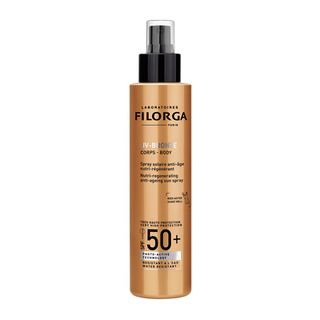
Filorga UV-Bronze Body SPF50+
Works for
2 of 2 advertised claims delivered
Sun protectionSPF 50 · 6 UV filtersBroad spectrum
This product offers a good level of protection against both UVB and UVA rays.
This sunscreen uses organic (so-called "chemical") sunscreen filters. Organic, or "chemical" filters usually provide reliable sun protection and rarely leave a white cast. Sunscreens with organic filters can sting eyes.
Anti-aging13 ingredients credited for this claimStrong support
“a powerful antioxidant activated by the sun's rays brings the skin high UV + IR protection and combats signs of ageing.”
This product can help prevent early signs of skin aging because it offers a good level of broad spectrum sun protection. Sun damage is the main cause of premature skin aging, and protecting your skin from the sun is the best anti-aging strategy.
These ingredients in the product might also be helpful for reducing and preventing fine lines, wrinkles, and skin elasticity, even though there is no conclusive evidence for their effectiveness: aspartic acid, folic acid, retinyl acetate, serine, threonine.
Anti-oxidationNot advertised by the brand · 9 ingredients credited for this claimStrong support
This product contains antioxidants (glutathione) that can help neutralize free radicals in skin. By doing so, they can lessen the damage the skin gets from the UV light (sun).
Evens skin toneNot advertised by the brand · 7 ingredients credited for this claimStrong support
This product offers broad spectrum sun protection. It means that it can prevent hyperpigmentation and help keep the skin tone even (sun damage is the main factor causing age spots, darkening of post-acne marks and other discolorations).
MoisturizingNot advertised by the brand · 32 ingredients credited for this claimGood support
This product can help improve hydration of the skin with the two types of ingredients.
The first type is called “humectants”:
these ingredients help attract water.
When humectants are on the surface of the skin, they “pull in” the moisture from the outside environment, or from
within deeper layers of the skin. The following ingredients in this product do the job:
alanine, aspartic acid.
This product also contains ingredients called “occlusives”. They help reduce the speed with which our skin loses moisture to the outside environment. These ingredients also help soften the upper layer of the skin, so it feels less tight and nicer to the touch. The following ingredients in this product do the job: cocos nucifera oil, isododecane.
Can it cause trouble?
Irritancy11 strong irritants: Parfum, Retinyl acetate + 9 more — patch-test recommendedHigh risk
Comedogenic1 ingredient rated 2 or more on the 0–5 pore-clogging scale1 flagged


User reviews
Be the first — your take helps the next person decide.
Ingredients
Filter by role to see what each ingredient is doing.
C12-15 alkyl benzoate~25–31%
- Irritation risk
- Low
Enhances the product texture and makes it more spreadable. Helps reduce water loss from the outer layer of skin. Extands the shelf life by preventing bacteria growth
More about C12-15 alkyl benzoateIsododecane~5.8–7%
- Irritation risk
- Low
An emollient that helps soften the skin and can decrease moisture loss. Helps create a nice product texture
More about IsododecaneCyclohexasiloxane~5–6.1%
- Irritation risk
- Low
A silicone that serves as an emollient. Helps create a nice non-greasy feels
More about CyclohexasiloxaneDiethylamino hydroxybenzoyl hexyl benzoate~4.3–5.3%
- Irritation risk
- Medium
Uvinul A Plus. A new generation broad spectrum sunscreen that offers an effective protection especially in the UVA range. It is stable in formulations. Unfortunately, is not approved by the FDA (US) yet
More about Diethylamino hydroxybenzoyl hexyl benzoateHomosalate~3.8–4.6%
- Irritation risk
- Medium
A weak sunscreen that offers some protection against the sun rays that cause sunburn (UVB), but does not offer meaningful protection against protect against the most aging sun rays (UVA). It loses its effectiveness quickly when exposed to sunlight. It is an organic, or so called "chemical" sunscreen. When used in low concentrations, helps to stabilize the product formulation
More about HomosalateEthylhexyl methoxycinnamate~2.7–3.3%
- Irritation risk
- High
Octinoxate. When used in higher concentrations, works as a sunscreen protecting the skin from UVB rays. When used in lower concentration, helps to preserve the product formulation. Is shown to be harmful to coral reefs - consider avoiding bathing in coral reef areas when wearing a product with this ingredient. It can be irritating
More about Ethylhexyl methoxycinnamateEthylhexyl salicylate~2.1–2.5%
- Irritation risk
- Low
Octisalate. A UV filter. It offers some protection against the sun rays that cause sunburn (UVB), but does not protect against the most aging sun rays (UVA). It loses its effectiveness quickly when exposed to sunlight. It is an organic, or so called "chemical" sunscreen
More about Ethylhexyl salicylateEthylhexyl triazone~1.9–2.3%
- Irritation risk
- Medium
Uvinul T. A UV filter. Effective against UVB rays. It is photostable. Can increase water resistance properties of the sunscreen. Unfortunately, not approved by the FDA (US) yet
More about Ethylhexyl triazoneWater~1.1–1.3%
Trimethylsiloxysilicate~1–1.3%
- Irritation risk
- Low
A type of silicone that helps create a nice product consistency and support the delivery of other ingredients
More about TrimethylsiloxysilicateThermus thermophillus ferment~0.7–1%
- Irritation risk
- Medium
Might be helpful in neutralising free radicals in skin and have some hydration properties
More about Thermus thermophillus fermentBis-ethylhexyloxyphenol methoxyphenyl triazine~0.75–1.1%
- Irritation risk
- Medium
Tinosorb S. One of the most effective broad spectrum sunscreen ingredients. Protects from both UVA and UVB rays. It is photostable. Unfortunately, not approved by FDA (US) yet.
More about Bis-ethylhexyloxyphenol methoxyphenyl triazineAlcohol denat.~0.5–0.8%
- Irritation risk
- High
Produces temporary toning effect. Can help dissolve other ingredients or preserve products
More about Alcohol denat.Cocos nucifera oil~0.5–0.75%
- Irritation risk
- Low
- Comedogenicity
- 3/5
An emollient. Found to be as effective as a moisturizer for dry skin as mineral oil. Could be comedogenic
More about Cocos nucifera oilPhenoxyethanol~0.45–0.65%
- Irritation risk
- Low
A preservative. It helps prevent bacterial growth in cosmetic products
More about PhenoxyethanolParfum~0.4–0.6%
- Irritation risk
- High
An aromatic blend of unspecified and possibly irritating ingredients
More about ParfumTocopheryl acetate~0.45–0.65%
- Irritation risk
- Medium
A more stable but less bio-available form of vitamin E compared to Tocopherol. Might help moisturize and protect the skin from free radicals, but mostly used in low concentrations to stabilize other ingredients.
More about Tocopheryl acetateSucrose palmitate~0.45–0.7%
Glycerin~0.35–0.65%
- Irritation risk
- Low
One of the best moisturizing ingredients. Naturally present in skin. It attracts water to the upper layer of the skin working as a humectant
More about GlycerinTriethylene glycol~0.25–0.5%
- Irritation risk
- Low
Glyceryl linoleate~0.4–0.6%
- Irritation risk
- Medium
Helps oil and water mix together
More about Glyceryl linoleatePrunus amygdalus dulcis oil~0.35–0.6%
- Irritation risk
- Low
An emollient that softens the skin
More about Prunus amygdalus dulcis oilPotassium sorbate~0.25–0.5%
Hydrolyzed soy flour~0.25–0.45%
- Irritation risk
- Low
Sea salt~0.25–0.45%
- Irritation risk
- Medium
Used to thicken the product formulation and might help to add minerals to the surface of the skin. It is used in scrubs as a physical exfoliant. Can increase sensitivity to other ingredients if left on the skin or used in high concentration
More about Sea saltBht~0.25–0.45%
Glucose~0.25–0.45%
- Irritation risk
- Low
Helps attract water to the upper layer of the skin. Could be helpful in restoring the skin barrier function
More about GlucoseSodium hyaluronate~0.25–0.45%
- Irritation risk
- Low
One of the best moisturizing ingredients. Attracts water into the upper layer of the skin
More about Sodium hyaluronateSodium hydroxide~0.25–0.45%
Citric acid~0.25–0.45%
- Irritation risk
- Medium
Can work as an exfoliant but is typically used to adjust the product pH
More about Citric acidPotassium chloride~0.25–0.5%
- Irritation risk
- Low
Calcium chloride~0.25–0.45%
- Irritation risk
- Medium
Helps create a thicker product consistency. Might be irritating
More about Calcium chlorideMagnesium sulfate~0.3–0.55%
Glutamine~0.25–0.45%
- Irritation risk
- Low
Sodium phosphate~0.25–0.45%
Ascorbic acid~0.25–0.45%
- Irritation risk
- High
The most well-researched antioxidant that works in skin. Helps neutralize free radicals supporting collagen production, helping to even out the skin tone and preventing early signs of aging
More about Ascorbic acidSodium acetate~0.25–0.45%
- Irritation risk
- Low
Tocopherol~0.3–0.55%
- Irritation risk
- Low
Pure form of vitamin E. Can help moisturise and protect the skin from free radicals. Often used to help stabilise other ingredients or the formula itself
More about TocopherolLysine hcl~0.3–0.55%
Arginine hcl~0.3–0.55%
- Irritation risk
- Low
An amino acid that is naturally present in skin and helps keep it hydrated. When used together with AHAs, it can reduce their irritating effect on the skin
More about Arginine hclAlanine~0.3–0.5%
- Irritation risk
- Low
An amino-acid that helps to attract water to the upper layer of the skin and might help to lighten the skin, but solid evidence is lacking
More about AlanineHistidine hcl~0.3–0.55%
- Irritation risk
- Low
A salt of an amino-acid that helps attract water to the upper layer of the skin. Might be helpful in restoring the skin barrier function
More about Histidine hclValine~0.3–0.5%
- Irritation risk
- Low
Leucine~0.3–0.55%
- Irritation risk
- Low
Threonine~0.3–0.55%
- Irritation risk
- Low
An amino-acid that helps to attract water to the upper layer of the skin. In combination with other amino-acids, might help to reduce fine lines and wrinkles
More about ThreonineIsoleucine~0.3–0.55%
- Irritation risk
- Low
An amino acid that can help attract water to the upper layer of the skin and support skin's barrier function
More about IsoleucineTryptophan~0.3–0.55%
- Irritation risk
- Low
Phenylalanine~0.3–0.55%
- Irritation risk
- Low
Tyrosine~0.3–0.5%
Glycine~0.3–0.5%
- Irritation risk
- Low
Helps to attract water to the upper layer of the skin and can help restore the skin barrier function
More about GlycinePolysorbate 80~0.3–0.6%
Serine~0.3–0.5%
- Irritation risk
- Low
An amino-acid that helps to attract water to the upper layer of the skin. In combination with other amino-acids, might help to reduce fine lines and wrinkles
More about SerineCystine~0.3–0.55%
- Irritation risk
- Low
Cyanocobalamin~0.3–0.55%
- Irritation risk
- Low
Can support skin barrier function and reduce inflammation in skin
More about CyanocobalaminGlutathione~0.3–0.55%
- Irritation risk
- Medium
A peptide that can help neutralize free radicals in skin and reduce melanin production resulting in skin lightening effect and reduction in hyperpigmentation. It can also help attract moisture to the upper layer of the skin
More about GlutathioneAsparagine~0.3–0.55%
- Irritation risk
- Low
Aspartic acid~0.3–0.5%
- Irritation risk
- Low
An amino-acid that helps increase skin hydration and might help to slightly improve skin firmness, potentially reducing lines and wrinkles
More about Aspartic acidOrnithine hcl~0.3–0.55%
- Irritation risk
- Low
Glutamic acid~0.3–0.5%
- Irritation risk
- Low
An amino-acid that helps attract water to the upper layer of the skin
More about Glutamic acidNicotinamide adenine dinucleotide~0.3–0.55%
- Irritation risk
- Low
Proline~0.3–0.55%
Methionine~0.3–0.55%
- Irritation risk
- Low
Taurine~0.3–0.55%
- Irritation risk
- Medium
Could be helpful in reducing inflammation in skin, evening out the skin tone and neutralizing free radicals, but more research is needed to confirm its effectiveness
More about TaurineHydroxyproline~0.3–0.55%
- Irritation risk
- Low
Is helpful in restoring skin barrier function supporting its moisture levels. Is claimed to stimulte collagen production in skin but evidence is lacking
More about HydroxyprolineGlucosamine hcl~0.3–0.5%
- Irritation risk
- Low
Might be able to stimulate production of skin's natural moisturizing compounds such as hyaluronic acid. Could be helpful for evening the skin tone.
More about Glucosamine hclCoenzyme a~0.3–0.55%
- Irritation risk
- Low
Helps soften the upper layer of the skin and dissolve other ingredients in a product
More about Coenzyme aSodium glucuronate~0.25–0.5%
- Irritation risk
- Low
Thiamine diphosphate~0.3–0.5%
- Irritation risk
- Low
Retinyl acetate~0.3–0.5%
Inositol~0.3–0.5%
Niacin~0.3–0.55%
- Irritation risk
- High
A form of vitamin B3. It is similar in action to niacinamide, but is more likely to cause red flashes in skin as the side effect
More about NiacinNiacinamide~0.3–0.55%
- Irritation risk
- Low
Is proven to be effective in reducing blemishes, evening out skin tone and helping to improve lines and wrinkles. It helps the skin to repair sun damage, calm down inflammation and keep maintain good levels of moisture. The concentration of about 2% is effective for supporting the skin barrier and evening out the skin tone. Concentration of 4-6% is better for helping with acne and balancing the sebum production
More about NiacinamidePyridoxine hcl~0.3–0.5%
- Irritation risk
- Medium
Might help neutralize free radicals in skin
More about Pyridoxine hclBiotin~0.3–0.5%
- Irritation risk
- Low
Might have some moisturising properties. Is not effective when applied topically beyond some moisturizing effect
More about BiotinCalcium pantothenate~0.3–0.5%
- Irritation risk
- Low
Helps support skin barrier function improving skin hydration and reducing sensitivity
More about Calcium pantothenateRiboflavin~0.25–0.5%
- Irritation risk
- Low
Sodium tocopheryl phosphate~0.3–0.55%
Thiamine hcl~0.25–0.5%
- Irritation risk
- Medium
Can help attract water to the upper layer of the skin. Is studied as a mosquito repellent
More about Thiamine hclFolic acid~0.25–0.5%
- Irritation risk
- Low
Can help stimulate collagen production in skin. While available studies are promising, more research is needed to confirm the efficacy in skin
More about Folic acidAlpha-isomethyl ionone~0.25–0.45%
- Irritation risk
- High
A fragrance. Potential allergen and can be irritating
More about Alpha-isomethyl iononeBenzyl benzoate~0.2–0.4%
- Irritation risk
- High
Fragrance with sweet balsamic smell. Help to preserve products and dissolve other ingredients. Could trigger allergic reactions and be irritating
More about Benzyl benzoateBenzyl salicylate~0.2–0.4%
Citronellol~0.2–0.35%
Eugenol~0.15–0.3%
Geraniol~0.2–0.35%
Hexyl cinnamal~0.15–0.3%
Limonene~0.15–0.25%
- Irritation risk
- High
A common frangrance that can easily irritate skin, especially if exposed to air, light or heat
More about LimoneneLinalool~0.15–0.25%
Ingredient list view
C12-15 alkyl benzoate, Isododecane, Cyclohexasiloxane, Diethylamino hydroxybenzoyl hexyl benzoate, Homosalate, Ethylhexyl methoxycinnamate, Ethylhexyl salicylate, Ethylhexyl triazone, Water, Trimethylsiloxysilicate, Thermus thermophillus ferment, Bis-ethylhexyloxyphenol methoxyphenyl triazine, Alcohol denat., Cocos nucifera oil, Phenoxyethanol, Parfum, Tocopheryl acetate, Sucrose palmitate, Glycerin, Triethylene glycol, Glyceryl linoleate, Prunus amygdalus dulcis oil, Potassium sorbate, Hydrolyzed soy flour, Sea salt, Bht, Glucose, Sodium hyaluronate, Sodium hydroxide, Citric acid, Potassium chloride, Calcium chloride, Magnesium sulfate, Glutamine, Sodium phosphate, Ascorbic acid, Sodium acetate, Tocopherol, Lysine hcl, Arginine hcl, Alanine, Histidine hcl, Valine, Leucine, Threonine, Isoleucine, Tryptophan, Phenylalanine, Tyrosine, Glycine, Polysorbate 80, Serine, Cystine, Cyanocobalamin, Glutathione, Asparagine, Aspartic acid, Ornithine hcl, Glutamic acid, Nicotinamide adenine dinucleotide, Proline, Methionine, Taurine, Hydroxyproline, Glucosamine hcl, Coenzyme a, Sodium glucuronate, Thiamine diphosphate, Retinyl acetate, Inositol, Niacin, Niacinamide, Pyridoxine hcl, Biotin, Calcium pantothenate, Riboflavin, Sodium tocopheryl phosphate, Thiamine hcl, Folic acid, Alpha-isomethyl ionone, Benzyl benzoate, Benzyl salicylate, Citronellol, Eugenol, Geraniol, Hexyl cinnamal, Limonene, Linalool
Compare prices
Retailers ranked by price — lowest first.
Affiliate links · prices updated regularly · As an Amazon Associate, WIMJ earns from qualifying purchases.
Worth comparing, line by line.
Match % combines shared ingredients, the first five ingredients, shared actives and hero ingredients, irritancy (lower counts in the alternative's favour), texture and body area. Only products in the same routine step are compared.
| FilorgaUV-Bronze Body SPF50+YOUR PRODUCT | SVRSEBIACLEAR Crème SPF50 | Make P:remUV Defense Me. Blue Ray Sun Gel SPF50+ PA++++ | La Roche-PosayAnthelios Anti-Imperfections Sun Lotion SPF 50+ | |
|---|---|---|---|---|
| Match | — | 69% | 69% | 66% |
| Price | $31.73 | — | $31.90 | $26.44−$5.29 |
| Shared key ingredients | — | 8 of 31 | 7 of 31 | 6 of 31 |
| Key difference | — | Salicylic Acid | Anhydroxylitol | Salicylic Acid |
| Irritancy | High | Medium | Medium | Low |
| SPF | SPF 50 | SPF 50 | SPF 50 | SPF 50 |
| Drying alcohol | Contains drying alcohol | — | Contains drying alcohol | — |
| View product | Shop | Shop | Shop |


Product summary
We believe that this product can provide reliable sun protection based on the ingredients listed. It can protect from both UVA and UVB rays. This is great news because not all sunscreens with SPF ratings give UVA protection. (UVA rays do not cause sunburn, but still damage our skin and lead to early aging).
It contains good moisturizing ingredients and can double as a hydrating day cream. This product prevents early signs of aging by protecting against sun damage (all broad spectrum sunscreens do that).
Sunscreen filters
This sunscreen uses so-called "chemical", or organic UV filters (organic simply means that their molecules contain atoms of carbon). These filters typically give good sun protection and rarely leave a white cast, but they can be irritating for sensitive skin. The UV filters in this sunscreen are: tinosorb s 0.75% - 1.10%, uvinul a plus 4.30% - 5.30%, octinoxate 2.70% - 3.30%, octisalate 2.10% - 2.50%, uvinul t 1.90% - 2.30% and homosalate 3.80% - 4.60%.
Irritation risk
This product contains a bunch of common irritants, including ingredients that do not provide any known benefit for the skin. It might not be the best choice if your skin is sensitive. We assess the overall irritancy of this sunscreen to be high. For a detailed overview of all potential irritants: click here
You can see the detailed formula review with the breakdown of all actives in the product and the full ingredient list with estimated concentrations in the tables below.
Price
The product retails for 61.84A$ in Australia and from 15.00£ up to 24.00£ in the United Kingdom.
For a detailed price comparison: click here.
Sources cited in this review
Every concentration estimate and effectiveness label is anchored to one of these 33 studies and safety reviews.
- 1
- 2
- 3
- 4
- 5Hyaluronic acid: A key molecule in skin agingncbi.nlm.nih.gov
- 6

Affiliate links · As an Amazon Associate, WIMJ earns from qualifying purchases.