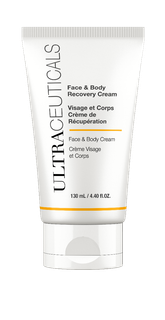
Ultraceuticals Face & Body Recovery Cream
Works for
1 of 1 advertised claim delivered
MoisturizingUrea, Niacinamide + 11 moreStrong evidence
“Face & Body Recovery Cream”
This product can help improve hydration of the skin with the two types of ingredients.
The first type is called “humectants”:
these ingredients help attract water.
When humectants are on the surface of the skin, they “pull in” the moisture from the outside environment, or from
within deeper layers of the skin. The following ingredients in this product do the job:
glycerin, sodium hyaluronate.
This product also contains ingredients called “occlusives”. They help reduce the speed with which our skin loses moisture to the outside environment. These ingredients also help soften the upper layer of the skin, so it feels less tight and nicer to the touch. The following ingredients in this product do the job: butyrospermum parkii butter, dimethicone.
The following ingredients in this product are especially good for supporting the skin barrier and helping with the hydration level: niacinamide, urea
Anti-agingNot advertised by the brand · Niacinamide, Butyrospermum parkii butter + 2 moreStrong evidence
This product can help reduce and prevent fine lines and wrinkles, improve skin elasticity and firmness because it contains niacinamide.
Keep in mind that it typically takes at least 6 weeks to notice any results because the changes that are needed to improve fine lines and elasticity happen in the deeper layers of the skin. No topical anti-aging product can “erase” wrinkles or fully reverse signs of aging.
Evens skin toneNot advertised by the brand · Niacinamide, Glycine soja seed extract + 2 moreStrong evidence
This product can help reduce hypepigmentation and even out the skin tone because it contains the following effective ingredients: niacinamide
The following ingredient (ingredients) in this product might be helpful, but there is no evidence to confirm that it actually can help even out the skin tone: glycine soja seed extract.
Keep in mind that you would need to apply any topical skincare targetted at hypigmentation consistently for a couple of months to get a result. No topical skincare product can help get rid of hyperpigmentation (including post-acne marks and age spots) instantly.
Anti-blemishNot advertised by the brand · Niacinamide, Allantoin + 1 moreGood evidence
This product might be able to help reduce blemishes and clogged pores because it contains niacinamide.
Can it cause trouble?
Irritancy1 strong irritant: Alcohol denat.Medium risk
Comedogenic4 ingredients rated 2 or more on the 0–5 pore-clogging scale4 flagged


User reviews
Be the first — your take helps the next person decide.
Ingredients
Filter by role to see what each ingredient is doing.
Water~45–55%
Glycerin~4.7–5.7%
- Irritation risk
- Low
One of the best moisturizing ingredients. Naturally present in skin. It attracts water to the upper layer of the skin working as a humectant
More about GlycerinDicaprylyl ether~4.2–5.2%
- Irritation risk
- Low
Helps soften the upper layer of the skin while creating a non-greasy feel on the skin. Helps to dissolve other ingredients
More about Dicaprylyl etherUrea~3.2–3.9%
- Irritation risk
- Low
Naturally present in skin (urea makes up about 7% of natural moisturizing factors in skin). Attracts water to the upper layer of the skin. Also has a positive effect on the skin barrier beyond the humectant action. Can enhance penetration of other ingredients. Is an exfoliating ingredient when used in high concentrations
More about UreaCetearyl alcohol~2.5–3.1%
- Irritation risk
- Low
- Comedogenicity
- 2/5
A non-drying alcohol. Works as an emollient. Helps water and oil mix together and creates a nice product texture
More about Cetearyl alcoholDimethicone~2.2–2.7%
- Irritation risk
- Low
A silicone that helps to reduce water loss from the surface of the skin. Can temporarily "fill in" lines and wrinkles, absorb oil, and create a nice product finish
More about DimethiconeSilica~2–2.4%
Niacinamide~1.5–1.9%
- Irritation risk
- Low
Is proven to be effective in reducing blemishes, evening out skin tone and helping to improve lines and wrinkles. It helps the skin to repair sun damage, calm down inflammation and keep maintain good levels of moisture. The concentration of about 2% is effective for supporting the skin barrier and evening out the skin tone. Concentration of 4-6% is better for helping with acne and balancing the sebum production
More about NiacinamideButyrospermum parkii butter~1.3–1.6%
- Irritation risk
- Low
- Comedogenicity
- 3/5
A great moisturising ingredient that softens the skin and reduces water loss from its upper layer. It also can be helpful in protecting skin from free radicals
More about Butyrospermum parkii butterDna~1–1.2%
- Irritation risk
- Low
Disodium lauriminodipropionate tocopheryl phosphates~0.7–1.1%
- Irritation risk
- Low
A form of Vitamin E. In concentrations 1-3%, it can help neutralize free radicals in skin and support photodamage repair
More about Disodium lauriminodipropionate tocopheryl phosphatesGlycine soja seed extract~0.6–0.9%
- Irritation risk
- Medium
An emollient that helps soften the skin. Might be somewhat helpful in evening the skin tone.
More about Glycine soja seed extractBisabolol~0.45–0.7%
- Irritation risk
- Low
An active component of chamomile plant that historically has been used to calm down irritated skin. A recent study shows that bisabolol indeed can have some anti-inflammatory effect on skin, even though conclusive data is lacking. Bisabolol has a sweet floral scent and can be added to products for its aromatic properties
More about BisabololTasmannia lanceolata fruit extract~0.45–0.65%
- Irritation risk
- High
Sodium hyaluronate~0.45–0.65%
- Irritation risk
- Low
One of the best moisturizing ingredients. Attracts water into the upper layer of the skin
More about Sodium hyaluronateAllantoin~0.45–0.65%
- Irritation risk
- Low
Helps calm down inflammation in skin and can help reduce itching. Helps to repair the skin barrier and keep skin hydrated
More about AllantoinCaffeine~0.4–0.6%
- Irritation risk
- Medium
Might be helpful in neutralizing free radicals. Can have a dehydration effect that might somewhat decrease the look of puffy eyes
More about CaffeinePterocarpus marsupium bark extract~0.35–0.6%
- Irritation risk
- Low
Sodium pca~0.3–0.55%
- Irritation risk
- Low
Naturally present in skin and helps to attract water to its upper layer
More about Sodium pcaTocopheryl acetate~0.3–0.55%
- Irritation risk
- Medium
A more stable but less bio-available form of vitamin E compared to Tocopherol. Might help moisturize and protect the skin from free radicals, but mostly used in low concentrations to stabilize other ingredients.
More about Tocopheryl acetateSodium lactate~0.3–0.5%
- Irritation risk
- Medium
Helps attract water to the upper layer of the skin. Is often used to adjust the pH level of the product
More about Sodium lactateAcrylates/c10-30 alkyl acrylate crosspolymer~0.35–0.6%
- Irritation risk
- Medium
Maintains the texture of skincare products. Allows the product to spread evenly. Helps oil and water mix together
More about Acrylates/c10-30 alkyl acrylate crosspolymerPeg-20 stearate~0.3–0.5%
Polyacrylate crosspolymer-6~0.25–0.5%
- Irritation risk
- Low
Disodium edta~0.25–0.45%
Bht~0.25–0.45%
Carbomer~0.25–0.45%
- Irritation risk
- Low
Helps create a thicker or gel-like product texture. It is not a surfactant but can be used in gentle cleansing formulations
More about CarbomerSalicylic acid~0.25–0.45%
- Irritation risk
- High
Used for skin exfoliation. It has an anti-inflammatory and anti-bacterial effect, helps to unclog pores, prevent blemishes and speed up healing of the existing ones. Sometimes referred to as a BHA (beta-hydroxy acid)
More about Salicylic acidPotassium sorbate~0.25–0.5%
Water~0.25–0.45%
Glycerin~0.3–0.55%
- Irritation risk
- Low
One of the best moisturizing ingredients. Naturally present in skin. It attracts water to the upper layer of the skin working as a humectant
More about GlycerinDicaprylyl ether~0.3–0.5%
- Irritation risk
- Low
Helps soften the upper layer of the skin while creating a non-greasy feel on the skin. Helps to dissolve other ingredients
More about Dicaprylyl etherUrea~0.25–0.45%
- Irritation risk
- Low
Naturally present in skin (urea makes up about 7% of natural moisturizing factors in skin). Attracts water to the upper layer of the skin. Also has a positive effect on the skin barrier beyond the humectant action. Can enhance penetration of other ingredients. Is an exfoliating ingredient when used in high concentrations
More about UreaCetearyl alcohol~0.3–0.55%
- Irritation risk
- Low
- Comedogenicity
- 2/5
A non-drying alcohol. Works as an emollient. Helps water and oil mix together and creates a nice product texture
More about Cetearyl alcoholDimethicone~0.3–0.55%
- Irritation risk
- Low
A silicone that helps to reduce water loss from the surface of the skin. Can temporarily "fill in" lines and wrinkles, absorb oil, and create a nice product finish
More about DimethiconeSilica~0.4–0.6%
Niacinamide~0.25–0.5%
- Irritation risk
- Low
Is proven to be effective in reducing blemishes, evening out skin tone and helping to improve lines and wrinkles. It helps the skin to repair sun damage, calm down inflammation and keep maintain good levels of moisture. The concentration of about 2% is effective for supporting the skin barrier and evening out the skin tone. Concentration of 4-6% is better for helping with acne and balancing the sebum production
More about NiacinamideButyrospermum parkii butter~0.3–0.55%
- Irritation risk
- Low
- Comedogenicity
- 3/5
A great moisturising ingredient that softens the skin and reduces water loss from its upper layer. It also can be helpful in protecting skin from free radicals
More about Butyrospermum parkii butterDna~0.25–0.45%
- Irritation risk
- Low
Disodium lauriminodipropionate tocopheryl phosphates~0.3–0.55%
- Irritation risk
- Low
A form of Vitamin E. In concentrations 1-3%, it can help neutralize free radicals in skin and support photodamage repair
More about Disodium lauriminodipropionate tocopheryl phosphatesGlycine soja seed extract~0.3–0.55%
- Irritation risk
- Medium
An emollient that helps soften the skin. Might be somewhat helpful in evening the skin tone.
More about Glycine soja seed extractBisabolol~0.2–0.4%
- Irritation risk
- Low
An active component of chamomile plant that historically has been used to calm down irritated skin. A recent study shows that bisabolol indeed can have some anti-inflammatory effect on skin, even though conclusive data is lacking. Bisabolol has a sweet floral scent and can be added to products for its aromatic properties
More about BisabololTasmannia lanceolata fruit extract~0.25–0.45%
- Irritation risk
- High
Sodium hyaluronate~0.25–0.45%
- Irritation risk
- Low
One of the best moisturizing ingredients. Attracts water into the upper layer of the skin
More about Sodium hyaluronateAllantoin~0.25–0.45%
- Irritation risk
- Low
Helps calm down inflammation in skin and can help reduce itching. Helps to repair the skin barrier and keep skin hydrated
More about AllantoinCaffeine~0.25–0.45%
- Irritation risk
- Medium
Might be helpful in neutralizing free radicals. Can have a dehydration effect that might somewhat decrease the look of puffy eyes
More about CaffeinePterocarpus marsupium bark extract~0.25–0.45%
- Irritation risk
- Low
Sodium pca~0.25–0.45%
- Irritation risk
- Low
Naturally present in skin and helps to attract water to its upper layer
More about Sodium pcaTocopheryl acetate~0.25–0.5%
- Irritation risk
- Medium
A more stable but less bio-available form of vitamin E compared to Tocopherol. Might help moisturize and protect the skin from free radicals, but mostly used in low concentrations to stabilize other ingredients.
More about Tocopheryl acetateSodium lactate~0.25–0.45%
- Irritation risk
- Medium
Helps attract water to the upper layer of the skin. Is often used to adjust the pH level of the product
More about Sodium lactateAcrylates/c10-30 alkyl acrylate crosspolymer~0.3–0.55%
- Irritation risk
- Medium
Maintains the texture of skincare products. Allows the product to spread evenly. Helps oil and water mix together
More about Acrylates/c10-30 alkyl acrylate crosspolymerPeg-20 stearate~0.25–0.5%
Polyacrylate crosspolymer-6~0.25–0.5%
- Irritation risk
- Low
Disodium edta~0.25–0.45%
Bht~0.25–0.45%
Carbomer~0.25–0.45%
- Irritation risk
- Low
Helps create a thicker or gel-like product texture. It is not a surfactant but can be used in gentle cleansing formulations
More about CarbomerSalicylic acid~0.25–0.45%
- Irritation risk
- High
Used for skin exfoliation. It has an anti-inflammatory and anti-bacterial effect, helps to unclog pores, prevent blemishes and speed up healing of the existing ones. Sometimes referred to as a BHA (beta-hydroxy acid)
More about Salicylic acidPotassium sorbate~0.25–0.45%
T-butyl alcohol~0.2–0.35%
- Irritation risk
- Medium
Used to dissolve other ingredients and to improve smell of products. It could be irritating
More about T-butyl alcoholBenzyl alcohol~0.15–0.3%
- Irritation risk
- High
A preservative. Can be used to mask unpleasant smell. Can be irritating
More about Benzyl alcoholSodium hydroxide~0.2–0.4%
Alcohol denat.~0.2–0.4%
- Irritation risk
- High
Produces temporary toning effect. Can help dissolve other ingredients or preserve products
More about Alcohol denat.Lactic acid~0.15–0.3%
- Irritation risk
- Medium
An exfoliating and moisturizing alpha-hydroxy acid (AHA). Typically causes less irritation than other AHAs, for example, glycolic acid. At high concentrations (about 15%), lactic acid can help reduce lines and wrinkles. Recent studies show that lactic acid can support the "good" bacteria living on skin's surface (healthy skin microbiome)
More about Lactic acidPhenoxyethanol~0.15–0.3%
- Irritation risk
- Low
A preservative. It helps prevent bacterial growth in cosmetic products
More about PhenoxyethanolSorbic acid~0.15–0.3%
Benzoic acid~0.15–0.25%
Dehydroacetic acid~0.1–0.2%
Ingredient list view
Water, Glycerin, Dicaprylyl ether, Urea, Cetearyl alcohol, Dimethicone, Silica, Niacinamide, Butyrospermum parkii butter, Unknown, Dna, Disodium lauriminodipropionate tocopheryl phosphates, Unknown, Glycine soja seed extract, Bisabolol, Tasmannia lanceolata fruit extract, Sodium hyaluronate, Allantoin, Caffeine, Pterocarpus marsupium bark extract, Sodium pca, Tocopheryl acetate, Sodium lactate, Acrylates/c10-30 alkyl acrylate crosspolymer, Peg-20 stearate, Polyacrylate crosspolymer-6, Disodium edta, Bht, Carbomer, Salicylic acid, Potassium sorbate, Water, Glycerin, Dicaprylyl ether, Urea, Cetearyl alcohol, Dimethicone, Silica, Niacinamide, Butyrospermum parkii butter, Unknown, Dna, Disodium lauriminodipropionate tocopheryl phosphates, Unknown, Glycine soja seed extract, Bisabolol, Tasmannia lanceolata fruit extract, Sodium hyaluronate, Allantoin, Caffeine, Pterocarpus marsupium bark extract, Sodium pca, Tocopheryl acetate, Sodium lactate, Acrylates/c10-30 alkyl acrylate crosspolymer, Peg-20 stearate, Polyacrylate crosspolymer-6, Disodium edta, Bht, Carbomer, Salicylic acid, Potassium sorbate, T-butyl alcohol, Benzyl alcohol, Sodium hydroxide, Alcohol denat., Lactic acid, Phenoxyethanol, Sorbic acid, Benzoic acid, Dehydroacetic acid
Compare prices
Retailers ranked by price — lowest first.

Affiliate links · prices updated regularly
Worth comparing, line by line.
Match % combines shared ingredients, the first five ingredients, shared actives and hero ingredients, irritancy (lower counts in the alternative's favour), texture and body area. Only products in the same routine step are compared.
| UltraceuticalsFace & Body Recovery CreamYOUR PRODUCT | e.l.f. CosmeticsBlemish Breakthrough Blemish Calming Water Cream | AtwaterOil Regulator Facial Moisturizer | TulaOil-Free Acne Moisturizer | |
|---|---|---|---|---|
| Match | — | 79% | 78% | 78% |
| Price | $55.00 | — | $35.00−$20.00 | — |
| Shared key ingredients | — | 4 of 13 | 6 of 13 | 7 of 13 |
| Key difference | — | Acetyl Glucosamine | Panthenol | Azelaic Acid |
| Irritancy | Medium | Low | Medium | Medium |
| Drying alcohol | Contains drying alcohol | — | — | — |
| View product | Shop | Shop | Shop |


Product summary
"Ultraceuticals - Face & Body Recovery Cream" has a good moisturizing formula. To work well, any moisturizer needs to include a combination of water-binding and emollient ingredients. Ultraceuticals - Face & Body Recovery Cream ticks this box. Urea, glycerin, sodium hyaluronate, sodium lactate and sodium pca in this product (humectants) attract water molecules to the upper layer of the skin (the water comes from the outside air or from the deeper layers of the skin if the air is dry). Butyrospermum parkii butter, dimethicone, cetearyl alcohol, glycine soja seed extract and dicaprylyl ether in this product help decrease the water evoporation from the skin, so that it stays hydrated for longer. These ingredients also soften the skin and take away the feeling of tightness and dryness.
Irritation risk
We assess the overall irritancy of this moisturizer to be medium. For a detailed overview of all potential irritants: click here
You can see the detailed formula review with the breakdown of all actives in the product and the full ingredient list with estimated concentrations in the tables below.
Price
The product retails for 55.00$ in the United States.
For a detailed price comparison: click here.
Sources cited in this review
Every concentration estimate and effectiveness label is anchored to one of these 18 studies and safety reviews.
- 1
- 2Topical urea in skincare: A reviewpubmed.ncbi.nlm.nih.gov
- 3
- 4Final Report on the Safety Assessment of Dimethicone Copolyoljournals.sagepub.com
- 5
- 6

Affiliate links · As an Amazon Associate, WIMJ earns from qualifying purchases.