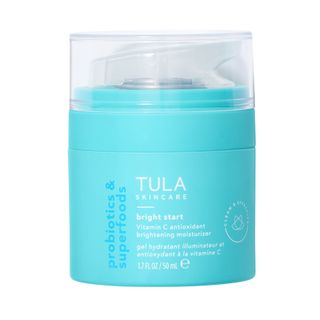
Tula Bright Start Vitamin C Antioxidant Brightening Moisturizer
Works for
3 of 3 advertised claims delivered
Evens skin tone5 ingredients credited for this claimStrong support
“What Else You Need to Know Bright Start is a vitamin C moisturizer that hydrates, brightens, and improves the appearance of uneven skin tone and texture.”
This product can help reduce hypepigmentation and even out the skin tone because it contains the following effective ingredients: tranexamic acid
The following ingredient (ingredients) in this product might be helpful, but there is no evidence to confirm that it actually can help even out the skin tone: 3-o-ethyl ascorbic acid, ferulic acid.
Keep in mind that you would need to apply any topical skincare targetted at hypigmentation consistently for a couple of months to get a result. No topical skincare product can help get rid of hyperpigmentation (including post-acne marks and age spots) instantly.
Moisturizing22 ingredients credited for this claimStrong support
“Bright Start Vitamin C Antioxidant Brightening Moisturizer”
This product can help improve hydration of the skin with the two types of ingredients.
The first type is called “humectants”:
these ingredients help attract water.
When humectants are on the surface of the skin, they “pull in” the moisture from the outside environment, or from
within deeper layers of the skin. The following ingredients in this product do the job:
glycerin, lactobacillus ferment.
This product also contains ingredients called “occlusives”. They help reduce the speed with which our skin loses moisture to the outside environment. These ingredients also help soften the upper layer of the skin, so it feels less tight and nicer to the touch. The following ingredients in this product do the job: helianthus annuus seed oil, octyldodecyl neopentanoate.
The following ingredients in this product are especially good for supporting the skin barrier and helping with the hydration level: acetyl tetrapeptide-2
Anti-aging8 ingredients credited for this claimModerate support
“, Vitamin C, Ferulic Acid, and Tranexamic Acid Brighten the appearance of skin and help improve the look of dark spots.”
This product contains acetyl tetrapeptide-2, ferulic acid. These ingredients might be able to help reduce and prevent fine lines and wrinkles, improve skin elasticity and firmness, but there is not enough evidence that it actually works.
Anti-oxidationNot advertised by the brand · 14 ingredients credited for this claimStrong support
This product contains antioxidants (ferulic acid) that can help neutralize free radicals in skin. By doing so, they can lessen the damage the skin gets from the UV light (sun).
The following ingredients - 3-o-ethyl ascorbic acid also can have an antioxidant effect, but there is less evidence to confirm their effectiveness in skin.
Can it cause trouble?
Irritancy9 strong irritants: Citrus junos seed extract, Citrus unshiu peel extract + 7 more — patch-test recommendedHigh risk
Comedogenic1 ingredient rated 2 or more on the 0–5 pore-clogging scale1 flagged
User reviews
Be the first — your take helps the next person decide.
Ingredients
Filter by role to see what each ingredient is doing.
Water~45–55%
Octyldodecyl neopentanoate~4.7–5.7%
- Irritation risk
- Low
An emollient that helps soften the skin. Often used to stabilize other ingredients, for example, sunscreen
More about Octyldodecyl neopentanoate3-o-ethyl ascorbic acid~4.5–5.4%
- Irritation risk
- High
A vitamin C derivative that is more stable but less potent than pure form of vitamin C. Can help neutralize free radicals and help reduce hyperpigmentation, but the required concentration is likely to be much higher than for the pure form of vitamin C, limiting the ingredient's effectiveness in products
More about 3-o-ethyl ascorbic acidTetrahexyldecyl ascorbate~3.2–3.9%
- Irritation risk
- Medium
Being a lipid soluble form of vitamin C, it is more stable than ascorbic acid, but still degrades quickly and needs to be stabilized in a formulation with another ingredient. It is claimed to penetrate skin better than pure vitamin C and have the the similar benefits, but solid studies of its effectiveness are lacking. Is likely to require a higher concentration in a product than pure vitamin C to be effective. It might be able to help reduce pore clogging.
More about Tetrahexyldecyl ascorbateGlyceryl stearate~2.5–3.1%
- Irritation risk
- Low
An emollient that softens the skin and forms a protective layer on its surface. Helps water and oil mix together
More about Glyceryl stearateCetyl alcohol~2.2–2.6%
- Irritation risk
- Low
A non-drying alcohol that works to soften the skin and stabilize product formulations helping oil and water mix together
More about Cetyl alcoholLactococcus ferment lysate~1.7–2.1%
- Irritation risk
- Low
Consists of remains of dead bacteria cells. Is likely helpful in attracting water to the upper layer of the skin. Might be helpful in reducing inflammation and neutralizing free radicals in skin
More about Lactococcus ferment lysateTranexamic acid~1.4–1.8%
- Irritation risk
- Low
An amino acid that is effective in reducing hyperpigmentation and evening out the skin tone. It can also help in skin barrier recovery. It is used to treat melasma, especially with injections and when taken orally
More about Tranexamic acidFerulic acid~1.2–1.4%
- Irritation risk
- Low
A potent anti-oxidant that has been shown to be effective in neutralizing free radicals in skin. There seem to have a synergetic effect of ferulic acid, vitamin E and C, meaning that when the ingredients are used together, they enhance each other's ability protect the skin against free radicals. Ferulic acid also helps to stabilize other ingredients - including vitamins C and E. It can help to even out the skin tone. Ferulic acid is approved for use as a sunscreen ingredient in Japan in concentrations up to 10%
More about Ferulic acidLactobacillus ferment~0.95–1.15%
- Irritation risk
- Low
A fermentation product created by bacteria Lactobacillus. The fermented product has anti-bacterial properties and might be helpful in calming down inflammation, but studies are lacking. Helps attract water to the upper layer of the skin. Can be used as a preservative
More about Lactobacillus fermentInulin~0.7–1.05%
- Irritation risk
- Low
Helps attract water to the upper layer of the skin. Is claimed to support the growth of "good" bacteria in skin (as a "prebiotic"), but the research is lacking
More about InulinCitrus junos seed extract~0.6–0.95%
- Irritation risk
- High
Citrus unshiu peel extract~0.6–0.85%
- Irritation risk
- High
Acetyl tetrapeptide-2~0.55–0.8%
- Irritation risk
- Low
A type of peptide. Peptides are excellent moisturizers and might be able support collagen production reducing fine lines and wrinkles
More about Acetyl tetrapeptide-2Sodium hyaluronate~0.5–0.75%
- Irritation risk
- Low
One of the best moisturizing ingredients. Attracts water into the upper layer of the skin
More about Sodium hyaluronateBeta vulgaris root extract~0.5–0.75%
- Irritation risk
- Medium
A plant extract that might have some antioxidant properties, but mostly used in cosmetics for its color
More about Beta vulgaris root extractBeta vulgaris~0.5–0.75%
- Irritation risk
- Low
Lactobacillus~0.45–0.65%
- Irritation risk
- Low
A non-living ingredient made by fermentation with the bacteria Lactobacillus. It can help attract water to the upper layer of the skin and might help reduce inflammation
More about LactobacillusLactic acid~0.4–0.65%
- Irritation risk
- Medium
An exfoliating and moisturizing alpha-hydroxy acid (AHA). Typically causes less irritation than other AHAs, for example, glycolic acid. At high concentrations (about 15%), lactic acid can help reduce lines and wrinkles. Recent studies show that lactic acid can support the "good" bacteria living on skin's surface (healthy skin microbiome)
More about Lactic acidCurcuma longa root extract~0.35–0.65%
- Irritation risk
- High
A plant extract that can contain an active compound curcumin, that may have some anti-inflammatory properties when applied to the skin, but solid research is lacking and the typical concentration used in skincare products is too low. Can be an irritant
More about Curcuma longa root extractAlpha-glucan oligosaccharide~0.5–0.75%
- Irritation risk
- Low
Helps attract water to the upper layer of the skin
More about Alpha-glucan oligosaccharideHelianthus annuus seed oil~0.4–0.65%
- Irritation risk
- Low
A great emollient due to its high linoleic acid content. One of the most effective plant oils in helping skin hydration and repairing skin barrier function
More about Helianthus annuus seed oilHedychium coronarium root extract~0.3–0.6%
- Irritation risk
- Low
Citrus aurantium dulcis peel oil~0.3–0.6%
- Irritation risk
- High
An essentil oil from orange peel. Potential allergen and can be irritating
More about Citrus aurantium dulcis peel oilCitrus reticulata peel oil~0.3–0.6%
- Irritation risk
- High
An essential oil used for fragrance. Can be an allergen and irritant
More about Citrus reticulata peel oilDaucus carota sativa seed oil~0.4–0.6%
- Irritation risk
- Low
A plant oil that might help neutralize free radicals and have an anti-bacterial effect
More about Daucus carota sativa seed oilDicaprylyl carbonate~0.4–0.6%
- Irritation risk
- Low
Helps products spread more easily and works as an emollient to soften skin
More about Dicaprylyl carbonatePolymnia sonchifolia root juice~0.35–0.6%
- Irritation risk
- High
A plant extract that helps attract water to the upper layer of the skin and might have some anti-oxidant properties
More about Polymnia sonchifolia root juiceMaltodextrin~0.35–0.65%
- Irritation risk
- Low
Used to stabilize the product formulation and can help absorb oil
More about MaltodextrinVanilla planifolia fruit extract~0.3–0.6%
- Irritation risk
- High
A plant extract used as a fragrance. Can be irritating
More about Vanilla planifolia fruit extractCaesalpinia spinosa fruit extract~0.35–0.6%
- Irritation risk
- Low
Melia azadirachta leaf extract~0.3–0.6%
- Irritation risk
- High
A plant extract that has anti-bacterial properties. Can be used to preserve the product. Can be irritating
More about Melia azadirachta leaf extractMelia azadirachta flower extract~0.3–0.6%
- Irritation risk
- Medium
A plant extract that might be helpful to neutralize free radicals in skin
More about Melia azadirachta flower extractKappaphycus alvarezii extract~0.3–0.6%
- Irritation risk
- Low
A red algae extract that can help attract water to the upper layer of the skin and might have some antioxidant properties
More about Kappaphycus alvarezii extractCorallina officinalis extract~0.3–0.6%
- Irritation risk
- Low
- Comedogenicity
- 3/5
Red algae extract that helps attract water to the upper layer of the skin and might contain antioxidants
More about Corallina officinalis extractOcimum basilicum flower/leaf extract~0.35–0.6%
- Irritation risk
- High
Used as a fragrance. Canbe irritating
More about Ocimum basilicum flower/leaf extractEugenia caryophyllus flower extract~0.4–0.6%
- Irritation risk
- High
A plant extract that is used as a fragrance. Can be irritating
More about Eugenia caryophyllus flower extractOcimum sanctum leaf extract~0.3–0.6%
- Irritation risk
- High
A plant extract that is rich in a fragrance compound eugenol that is a frequent allergen and can be irritating. It might also contain anti-oxidants to help neutralize free radicals
More about Ocimum sanctum leaf extractDaucus carota sativa root extract~0.3–0.6%
- Irritation risk
- Low
Carrot extract. Might have anti-oxidant properties and be used to add orange color
More about Daucus carota sativa root extractBiotin~0.3–0.6%
- Irritation risk
- Low
Might have some moisturising properties. Is not effective when applied topically beyond some moisturizing effect
More about BiotinStearyl alcohol~0.45–0.65%
- Irritation risk
- Low
An emollient that helps soften the skin
More about Stearyl alcoholPropanediol~0.4–0.6%
- Irritation risk
- Low
Acts as a solvent for other ingredients. Speeds up the absorption of other ingredients into the skin
More about PropanediolHydroxyacetophenone~0.35–0.6%
Glycerin~0.4–0.65%
- Irritation risk
- Low
One of the best moisturizing ingredients. Naturally present in skin. It attracts water to the upper layer of the skin working as a humectant
More about GlycerinCarbomer~0.35–0.6%
- Irritation risk
- Low
Helps create a thicker or gel-like product texture. It is not a surfactant but can be used in gentle cleansing formulations
More about CarbomerTriethyl citrate~0.3–0.6%
Cetearyl olivate~0.35–0.65%
Sorbitan olivate~0.35–0.65%
Potassium stearate~0.55–0.85%
Trisodium ethylenediamine disuccinate~0.3–0.6%
- Irritation risk
- Medium
Used to improve stability of the formulation
More about Trisodium ethylenediamine disuccinateOctyldodecanol~0.35–0.6%
- Irritation risk
- Low
An emollient that helps to soften the skin and create a pleasant product texture and stabilize the formulation
More about OctyldodecanolSodium chloride~0.35–0.6%
- Irritation risk
- Low
Used to stabilize mixtures of oil and water, and create thicker, gel-like product textures
More about Sodium chlorideBeta-carotene~0.3–0.55%
Tocopherol~0.3–0.55%
- Irritation risk
- Low
Pure form of vitamin E. Can help moisturise and protect the skin from free radicals. Often used to help stabilise other ingredients or the formula itself
More about TocopherolAscorbyl palmitate~0.3–0.5%
- Irritation risk
- Medium
Being a lipid soluble form of vitamin C, it is more stable and can penetrate the skin better than L-Ascorbic acid. It is effective in protecting the skin from free radicals, as well as evening the skin tone, but is less effective in stimulating collagen production compared to L-Ascorbic acid.
More about Ascorbyl palmitateSodium citrate~0.25–0.5%
- Irritation risk
- Medium
Helps to control the skin's pH level. Maintains the skin's natural film of amino-lactic acids and oils. Helps to preserve products
More about Sodium citrateSodium hydroxide~0.25–0.45%
Butylene glycol~0.2–0.4%
- Irritation risk
- Low
Used to create a nice product texture and help delivery of other ingredients. Might be somewhat helpful in attracting water to the upper layer of the skin
More about Butylene glycolCitric acid~0.2–0.35%
- Irritation risk
- Medium
Can work as an exfoliant but is typically used to adjust the product pH
More about Citric acid1,2-hexanediol~0.15–0.25%
Phenoxyethanol~0.2–0.35%
- Irritation risk
- Low
A preservative. It helps prevent bacterial growth in cosmetic products
More about PhenoxyethanolSodium benzoate~0.15–0.3%
Potassium sorbate~0.15–0.25%
Limonene~0.1–0.15%
- Irritation risk
- High
A common frangrance that can easily irritate skin, especially if exposed to air, light or heat
More about LimoneneIngredient list view
Water, Octyldodecyl neopentanoate, 3-o-ethyl ascorbic acid, Tetrahexyldecyl ascorbate, Glyceryl stearate, Cetyl alcohol, Lactococcus ferment lysate, Tranexamic acid, Ferulic acid, Lactobacillus ferment, Inulin, Citrus junos seed extract, Citrus unshiu peel extract, Acetyl tetrapeptide-2, Sodium hyaluronate, Beta vulgaris root extract, Beta vulgaris, Lactobacillus, Lactic acid, Curcuma longa root extract, Alpha-glucan oligosaccharide, Helianthus annuus seed oil, Hedychium coronarium root extract, Citrus aurantium dulcis peel oil, Citrus reticulata peel oil, Daucus carota sativa seed oil, Dicaprylyl carbonate, Polymnia sonchifolia root juice, Maltodextrin, Vanilla planifolia fruit extract, Caesalpinia spinosa fruit extract, Melia azadirachta leaf extract, Melia azadirachta flower extract, Kappaphycus alvarezii extract, Corallina officinalis extract, Ocimum basilicum flower/leaf extract, Eugenia caryophyllus flower extract, Ocimum sanctum leaf extract, Daucus carota sativa root extract, Biotin, Stearyl alcohol, Propanediol, Hydroxyacetophenone, Glycerin, Carbomer, Triethyl citrate, Cetearyl olivate, Sorbitan olivate, Potassium stearate, Trisodium ethylenediamine disuccinate, Octyldodecanol, Sodium chloride, Beta-carotene, Tocopherol, Ascorbyl palmitate, Sodium citrate, Sodium hydroxide, Butylene glycol, Citric acid, 1,2-hexanediol, Phenoxyethanol, Sodium benzoate, Potassium sorbate, Limonene
Compare prices
Retailers ranked by price — lowest first.

Worth comparing, line by line.
Match % combines shared ingredients, the first five ingredients, shared actives and hero ingredients, irritancy (lower counts in the alternative's favour), texture and body area. Only products in the same routine step are compared.
| TulaBright Start Vitamin C Antioxidant Brightening MoisturizerYOUR PRODUCT | skinmadeVitamin C E + Alpha Arbutin serum | |
|---|---|---|
| Match | — | 50% |
| Price | $56.00 | — |
| Shared key ingredients | — | 6 of 19 |
| Key difference | — | Hexanoyl Dipeptide-3 Norleucine Acetate |
| Irritancy | High | Low |
| Drying alcohol | — | — |
| View product | Shop |


Product summary
"Tula - Bright Start Vitamin C Antioxidant Brightening Moisturizer" is effective for: Evens skin tone and Moisturizing
This moisturizer could be helpful for: Anti-aging, but its actives are not the most effective or are not well-studied.
Ingredient callouts
- We like that this moisturizer contains peptides (acetyl tetrapeptide-2 0.55% - 0.80%). There are many different kind of Peptides and they are naturally present in our skin. They all are a combination of aminoacids. Some of them work as natural antibiotics, promote wound-healing and production of collagen. The science is still not settled on how effective Peptides are in skincare, but it is very likely that they have a benefit. Peptides might help restore the skin barrier and fight the signs of aging. At the very least, Peptides work as humectants: they attract water to the upper layer of the skin and improve its hydration.
About the brand
According to Cruelty-Free Kitty "Tula" is cruelty free, but its parent company is not.
Price
The product retails from 50.30$ up to 56.00$ in the United States, for 73.00CA$ in Canada and from 49.00£ up to 380.00£ in the United Kingdom.
For a detailed price comparison: click here.
Sources cited in this review
Every concentration estimate and effectiveness label is anchored to one of these 32 studies and safety reviews.
- 1
- 2
- 3
- 4
- 5Effect of tranexamic acid on melasma: a clinical trial with histological evaluationonlinelibrary.wiley.com
- 6Tranexamic acid accelerates skin barrier recovery and upregulates occludin in damaged skinonlinelibrary.wiley.com

Affiliate links · As an Amazon Associate, WIMJ earns from qualifying purchases.