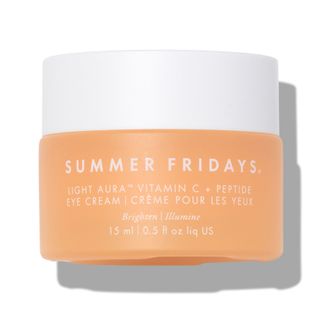
Summer Fridays Light Aura Vitamin C + Peptide Eye Cream
Works for
3 of 3 advertised claims delivered
Moisturizing27 ingredients credited for this claimStrong support
“moisturising formula”
This product can help improve hydration of the skin with the two types of ingredients.
The first type is called “humectants”:
these ingredients help attract water.
When humectants are on the surface of the skin, they “pull in” the moisture from the outside environment, or from
within deeper layers of the skin. The following ingredients in this product do the job:
glucosamine hcl, glycerin.
This product also contains ingredients called “occlusives”. They help reduce the speed with which our skin loses moisture to the outside environment. These ingredients also help soften the upper layer of the skin, so it feels less tight and nicer to the touch. The following ingredients in this product do the job: butyrospermum parkii butter, caprylic/capric triglyceride.
The following ingredients in this product are especially good for supporting the skin barrier and helping with the hydration level: acetyl hexapeptide-8, niacinamide
Anti-aging7 ingredients credited for this claimStrong support
“more youthful appearance”
This product can help reduce and prevent fine lines and wrinkles, improve skin elasticity and firmness because it contains niacinamide.
These ingredients in the product can also be helpful, even though there is less evidence for their effectiveness: acetyl hexapeptide-8.
Keep in mind that it typically takes at least 6 weeks to notice any results because the changes that are needed to improve fine lines and elasticity happen in the deeper layers of the skin. No topical anti-aging product can “erase” wrinkles or fully reverse signs of aging.
Evens skin tone4 ingredients credited for this claimStrong support
“brighten”
This product can help reduce hypepigmentation and even out the skin tone because it contains the following effective ingredients: niacinamide
The following ingredient (ingredients) in this product might be helpful, but there is no evidence to confirm that it actually can help even out the skin tone: glucosamine hcl.
Keep in mind that you would need to apply any topical skincare targetted at hypigmentation consistently for a couple of months to get a result. No topical skincare product can help get rid of hyperpigmentation (including post-acne marks and age spots) instantly.
Can it cause trouble?
Irritancy3 strong irritants: Carica papaya leaf extract, Ocimum sanctum leaf extract + 1 more — patch-test recommendedHigh risk
Comedogenic4 ingredients rated 2 or more on the 0–5 pore-clogging scale4 flagged


User reviews
Be the first — your take helps the next person decide.
Ingredients
Filter by role to see what each ingredient is doing.
Water~45–55%
Behenyl alcohol~6–7.3%
- Irritation risk
- Low
Non-drying alcohol that helps water and oil mix together. Also serves as an emollient
More about Behenyl alcoholGlycerin~4–4.9%
- Irritation risk
- Low
One of the best moisturizing ingredients. Naturally present in skin. It attracts water to the upper layer of the skin working as a humectant
More about GlycerinButyrospermum parkii butter~3.1–3.8%
- Irritation risk
- Low
- Comedogenicity
- 3/5
A great moisturising ingredient that softens the skin and reduces water loss from its upper layer. It also can be helpful in protecting skin from free radicals
More about Butyrospermum parkii butterPentylene glycol~2.2–2.7%
- Irritation risk
- Medium
Used to preserve products, dissolve other ingredients and create a nice product texture
More about Pentylene glycolCoco-caprylate~1.8–2.2%
- Irritation risk
- Medium
An emollient that softens skin and creates a nice product texture
More about Coco-caprylateCetearyl alcohol~1.5–1.9%
- Irritation risk
- Low
- Comedogenicity
- 2/5
A non-drying alcohol. Works as an emollient. Helps water and oil mix together and creates a nice product texture
More about Cetearyl alcoholCaprylic/capric triglyceride~1.4–1.7%
- Irritation risk
- Medium
A good mix of fatty acids that forms a protective layer on the skin. Improves the shelf life of products. Derived from coconut and glycerin
More about Caprylic/capric triglycerideNiacinamide~1–1.2%
- Irritation risk
- Low
Is proven to be effective in reducing blemishes, evening out skin tone and helping to improve lines and wrinkles. It helps the skin to repair sun damage, calm down inflammation and keep maintain good levels of moisture. The concentration of about 2% is effective for supporting the skin barrier and evening out the skin tone. Concentration of 4-6% is better for helping with acne and balancing the sebum production
More about NiacinamideHydroxyethyl acrylate/sodium acryloyldimethyl taurate copolymer~0.7–1.05%
- Irritation risk
- Medium
A gelling agent that thickens the product consistency and leaves the skin with a velvety finish
More about Hydroxyethyl acrylate/sodium acryloyldimethyl taurate copolymerGlyceryl stearate~0.6–0.9%
- Irritation risk
- Low
An emollient that softens the skin and forms a protective layer on its surface. Helps water and oil mix together
More about Glyceryl stearateJojoba esters~0.5–0.75%
- Irritation risk
- Medium
An emollient made of jojoba oil. Helps soften the skin and support its barrier function
More about Jojoba estersTetrahexyldecyl ascorbate~0.45–0.65%
- Irritation risk
- Medium
Being a lipid soluble form of vitamin C, it is more stable than ascorbic acid, but still degrades quickly and needs to be stabilized in a formulation with another ingredient. It is claimed to penetrate skin better than pure vitamin C and have the the similar benefits, but solid studies of its effectiveness are lacking. Is likely to require a higher concentration in a product than pure vitamin C to be effective. It might be able to help reduce pore clogging.
More about Tetrahexyldecyl ascorbateIsostearyl isostearate~0.4–0.6%
- Irritation risk
- Medium
- Comedogenicity
- 3/5
Helps soften the upper layer of the skin and improve the product texture. It can be comedogenic
More about Isostearyl isostearateSodium hyaluronate~0.3–0.55%
- Irritation risk
- Low
One of the best moisturizing ingredients. Attracts water into the upper layer of the skin
More about Sodium hyaluronateAcetyl hexapeptide-8~0.3–0.55%
- Irritation risk
- Low
A type of peptide. Peptides are excellent moisturizers and might be able support collagen production reducing fine lines and wrinkles
More about Acetyl hexapeptide-8Persea gratissima oil~0.35–0.6%
- Irritation risk
- Medium
An emollient that helps soften the skin and could be helpful in repairing its barrier function
More about Persea gratissima oilRosa canina seed oil~0.3–0.55%
- Irritation risk
- Medium
A plant oil that helps soften the upper layer of the skin. It might have anti-oxidant properties. Might help reduce inflammation in skin and help against blemishes
More about Rosa canina seed oilCaffeine~0.25–0.4%
- Irritation risk
- Medium
Might be helpful in neutralizing free radicals. Can have a dehydration effect that might somewhat decrease the look of puffy eyes
More about CaffeineAllantoin~0.2–0.35%
- Irritation risk
- Low
Helps calm down inflammation in skin and can help reduce itching. Helps to repair the skin barrier and keep skin hydrated
More about AllantoinPropanediol~0.2–0.4%
- Irritation risk
- Low
Acts as a solvent for other ingredients. Speeds up the absorption of other ingredients into the skin
More about PropanediolPhospholipids~0.2–0.35%
- Irritation risk
- Low
Emollients that are naturaly present in skin. In addition, they help water and oil mix together in the product
More about PhospholipidsPrunus amygdalus dulcis oil~0.2–0.4%
- Irritation risk
- Low
An emollient that softens the skin
More about Prunus amygdalus dulcis oilPapaver rhoeas extract~0.2–0.4%
- Irritation risk
- Low
Tocopherol~0.2–0.35%
- Irritation risk
- Low
Pure form of vitamin E. Can help moisturise and protect the skin from free radicals. Often used to help stabilise other ingredients or the formula itself
More about TocopherolCarica papaya leaf extract~0.2–0.35%
- Irritation risk
- High
Curcuma longa root extract~0.2–0.35%
- Irritation risk
- High
A plant extract that can contain an active compound curcumin, that may have some anti-inflammatory properties when applied to the skin, but solid research is lacking and the typical concentration used in skincare products is too low. Can be an irritant
More about Curcuma longa root extractCorallina officinalis extract~0.2–0.4%
- Irritation risk
- Low
- Comedogenicity
- 3/5
Red algae extract that helps attract water to the upper layer of the skin and might contain antioxidants
More about Corallina officinalis extractCoccinia indica fruit extract~0.2–0.4%
- Irritation risk
- Medium
A plant extract that might have some anti-oxidant effect helping neutralize free radicals in skin
More about Coccinia indica fruit extractOcimum sanctum leaf extract~0.2–0.4%
- Irritation risk
- High
A plant extract that is rich in a fragrance compound eugenol that is a frequent allergen and can be irritating. It might also contain anti-oxidants to help neutralize free radicals
More about Ocimum sanctum leaf extractOcimum basilicum flower/leaf extract~0.2–0.4%
- Irritation risk
- High
Used as a fragrance. Canbe irritating
More about Ocimum basilicum flower/leaf extractSimmondsia chinensis seed oil~0.25–0.5%
- Irritation risk
- Medium
Softens the upper layer of skin and helps restore the healthy skin barrier. Has shown to help calm down inflammation in skin. It is a stable oil, meaning that it retains its properties even when exposed to air.
More about Simmondsia chinensis seed oilBambusa vulgaris leaf/stem extract~0.25–0.45%
- Irritation risk
- Medium
The extract can contain up to 70% of silica. In cosmetics, silica helps absorb oil and creates a thicker product texture
More about Bambusa vulgaris leaf/stem extractPisum sativum extract~0.2–0.4%
- Irritation risk
- Medium
Might be helpful in protecting skin collagen and elastin from breaking down but solid research is lacking
More about Pisum sativum extractGlucosamine hcl~0.2–0.4%
- Irritation risk
- Low
Might be able to stimulate production of skin's natural moisturizing compounds such as hyaluronic acid. Could be helpful for evening the skin tone.
More about Glucosamine hclSilica~0.3–0.6%
Melia azadirachta flower extract~0.2–0.4%
- Irritation risk
- Medium
A plant extract that might be helpful to neutralize free radicals in skin
More about Melia azadirachta flower extractMelia azadirachta leaf extract~0.2–0.4%
- Irritation risk
- High
A plant extract that has anti-bacterial properties. Can be used to preserve the product. Can be irritating
More about Melia azadirachta leaf extractSodium stearoyl glutamate~0.25–0.5%
- Irritation risk
- Medium
Helps oil and water mix together
More about Sodium stearoyl glutamatePolyglycerin-3~0.2–0.4%
- Irritation risk
- Low
Helps to attract water to the upper layer of the skin
More about Polyglycerin-3Diheptyl succinate~0.25–0.45%
- Irritation risk
- Low
Helps to soften the upper layer of the skin and creates a nice product finish on the skin
More about Diheptyl succinateCapryloyl glycerin/sebacic acid copolymer~0.2–0.4%
- Irritation risk
- Low
Helps soften the upper layer of the skin
More about Capryloyl glycerin/sebacic acid copolymerSorbitan isostearate~0.25–0.45%
- Irritation risk
- Low
Helps oil and water mix together
More about Sorbitan isostearateSodium phytate~0.2–0.4%
Glyceryl caprylate~0.25–0.5%
- Irritation risk
- Low
An emollient that can also help water and oil mix together, as well as prevent bacteria growth in products
More about Glyceryl caprylateGlyceryl undecylenate~0.25–0.5%
- Irritation risk
- Medium
Helps oil and water mix together and helps preserve the product formulation
More about Glyceryl undecylenateXanthan gum~0.2–0.4%
- Irritation risk
- Low
Used to create a thicker product consistency
More about Xanthan gum1,2-hexanediol~0.15–0.25%
Caprylyl glycol~0.2–0.35%
- Irritation risk
- Medium
Helps preserve products and creates a nice product texture
More about Caprylyl glycolSodium benzoate~0.1–0.2%
Phenethyl alcohol~0.15–0.3%
Polysorbate 60~0.15–0.3%
Mica~0.1–0.2%
- Irritation risk
- Low
Creates an illusion of smoother and more radiant skin tone. Adds shimmer to the skin by reflecting light
More about MicaTitanium dioxide~0.1–0.15%
- Irritation risk
- Low
Works as a UV filter when used in high concentrations. It is photostable and is effective mostly against the UVB light, with some protection in the UVA range. In small concentrations, used for its ability to improve the color of cosmetic products. Is usually well tolerated by the skin
More about Titanium dioxideIngredient list view
Water, Behenyl alcohol, Glycerin, Butyrospermum parkii butter, Pentylene glycol, Coco-caprylate, Cetearyl alcohol, Caprylic/capric triglyceride, Niacinamide, Hydroxyethyl acrylate/sodium acryloyldimethyl taurate copolymer, Glyceryl stearate, Jojoba esters, Tetrahexyldecyl ascorbate, Isostearyl isostearate, Sodium hyaluronate, Acetyl hexapeptide-8, Persea gratissima oil, Rosa canina seed oil, Caffeine, Allantoin, Propanediol, Phospholipids, Prunus amygdalus dulcis oil, Papaver rhoeas extract, Tocopherol, Carica papaya leaf extract, Curcuma longa root extract, Corallina officinalis extract, Coccinia indica fruit extract, Unknown, Unknown, Ocimum sanctum leaf extract, Ocimum basilicum flower/leaf extract, Simmondsia chinensis seed oil, Bambusa vulgaris leaf/stem extract, Pisum sativum extract, Glucosamine hcl, Silica, Melia azadirachta flower extract, Melia azadirachta leaf extract, Sodium stearoyl glutamate, Polyglycerin-3, Diheptyl succinate, Capryloyl glycerin/sebacic acid copolymer, Sorbitan isostearate, Sodium phytate, Glyceryl caprylate, Glyceryl undecylenate, Xanthan gum, 1,2-hexanediol, Caprylyl glycol, Sodium benzoate, Phenethyl alcohol, Polysorbate 60, Mica, Titanium dioxide
Compare prices
Retailers ranked by price — lowest first.


Worth comparing, line by line.
Match % combines shared ingredients, the first five ingredients, shared actives and hero ingredients, irritancy (lower counts in the alternative's favour), texture and body area. Only products in the same routine step are compared.
| Summer FridaysLight Aura Vitamin C + Peptide Eye CreamYOUR PRODUCT | KnoursOne Perfect Revival Eye Cream | GeologieAnti Aging Eye Cream | Bubble SkincareStar Dew | |
|---|---|---|---|---|
| Match | — | 82% | 81% | 81% |
| Price | $42.00 | $36.00−$6.00 | $45.00+$3.00 | $18.51−$23.49 |
| Shared key ingredients | — | 6 of 18 | 6 of 18 | 6 of 18 |
| Key difference | — | Adenosine | Retinol | Anhydroxylitol |
| Irritancy | High | Medium | Medium | Medium |
| Drying alcohol | — | — | — | — |
| View product | Shop | Shop | Shop |


Product summary
"Summer Fridays - Light Aura Vitamin C + Peptide Eye Cream" is a well-rounded moisturizing product. This moisturizer uses a good combo of humectants and emollients. These both types of ingredients are essentials for improving the skin hydration and keeping the skin barrier healthy. Acetyl hexapeptide-8, glucosamine hcl, glycerin, polyglycerin-3 and sodium hyaluronate in this product (humectants) attract water molecules to the upper layer of the skin (the water comes from the outside air or from the deeper layers of the skin if the air is dry). Helianthus annuus seed wax, jojoba esters, butyrospermum parkii butter, caprylic/capric triglyceride and cetearyl alcohol in this product help decrease the water evoporation from the skin, so that it stays hydrated for longer. These ingredients also soften the skin and take away the feeling of tightness and dryness.
Ingredient callouts
- This moistruizer also contains peptides (acetyl hexapeptide-8 0.30% - 0.55%). Peptides is a very big group of ingredients. They all consist of a different combination of amino-acids. Our skin produces peptides naturally. Some of them work as natural anti-biotics, promote wound-healing and production of collagen. The scientists are still studying how effective the topical application of peptides is, but it is very likely that peptides in skincare are helpful. They might be able to support skin barrier restoration and even have an anti-aging benefit. At the very least, they certainly help attract water to the skin and support the hydration in this way.
Irritation risk
There are some common irritants in this product, including ingredients that do not have benefits for the skin. We assess the overall irritancy of this moisturizer to be high. For a detailed overview of all potential irritants: click here
You can see the detailed formula review with the breakdown of all actives in the product and the full ingredient list with estimated concentrations in the tables below.
About the brand
According to Cruelty-Free Kitty "Summer Fridays" is cruelty free and so is its parent company.
Price
The product retails for 42.00$ in the United States, from 40.00£ up to 43.00£ in the United Kingdom and for 55.00CA$ in Canada.
For a detailed price comparison: click here.
Sources cited in this review
Every concentration estimate and effectiveness label is anchored to one of these 20 studies and safety reviews.
- 1
- 2
- 3
- 4
- 5
- 6Hyaluronic acid: A key molecule in skin agingncbi.nlm.nih.gov

Affiliate links · As an Amazon Associate, WIMJ earns from qualifying purchases.