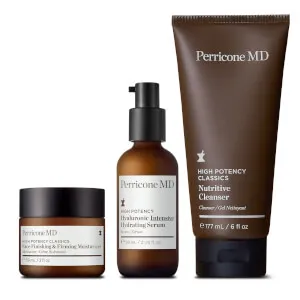
Perricone MD Cleanse & Firm Intensive Hydration Regimen
Works for
CleansingSodium laureth sulfate, Cocamidopropyl betaine + 14 moreCan be harsh
“Cleanse, nourish and hydrate with this High Potency trio featuring a gentle gel cleanser, deeply nourishing hyaluronic acid serum and indulgent, rose-scented moisturizer.”
This product works by removing dirt and oil from the surface of the skin.
It contains the following cleansing agents that tend to be harsh on the skin: sodium laureth sulfate.
The following cleansing agents are typically mild, but still can cause an irritation or allergy for some people cocamidopropyl betaine.
Keep in mind that cleansing can disrupt the skin barrier, and most people do not need to cleanse their skin more than once per day.
ExfoliationAcetyl glucosamine, Zinc gluconate + 1 moreNot delivered
“One of our best face wash products features exfoliating alpha lipoic acid to soften, smooth and reduce the appearance of excess oil and enlarged pores.”
This product might help exfoliate the skin with acetyl glucosamine, zinc gluconate, but These ingredients is not the most effective.
Can it cause trouble?
Irritancy27 flagged ingredients — patch-test recommendedHigh risk
Comedogenic4 ingredients rated 2 or more on the 0–5 pore-clogging scale4 flagged

User reviews
Be the first — your take helps the next person decide.
Ingredients
Filter by role to see what each ingredient is doing.
Water~45–55%
Sodium laureth sulfate~10–12%
- Irritation risk
- High
- Comedogenicity
- 2/5
Works as a foaming cleansing agent
More about Sodium laureth sulfateCocamidopropyl betaine~6.1–7.4%
- Irritation risk
- High
Helps water and oil mix together. Used as a cleansing ingredient. Could be an allergen
More about Cocamidopropyl betaineLauryl glucoside~3.8–4.7%
Ppg-2 hydroxyethyl coco/isostearamide~2.3–2.8%
Dimethyl mea~1.9–2.3%
- Irritation risk
- Low
Thioctic acid~1.5–1.9%
Magnesium aspartate~1.3–1.6%
- Irritation risk
- Low
Might be helpful in restoring skin barrier function and calm down inflammation in skin
More about Magnesium aspartateZinc gluconate~1.1–1.3%
- Irritation risk
- Medium
Typically used to stabilize the product formulations. It is a salt of a polyhydroxy acid (PHA) and in larger concentrations, can help shed the dead cells from the skin surface revealing smoother skin. It can help attract water to the upper layer of the skin. Might to be helpful against acne and clogged pores. Could be helpful in neutralizing free radicals, but solid research is missing. Due to the zinc content, might help calm down inflammation in skin
More about Zinc gluconateEthylhexylglycerin~0.8–1.2%
Copper gluconate~0.65–0.95%
- Irritation risk
- Medium
Typically used to stabilize the product formulations. It is a salt of polyhydroxy acid (PHA) and in larger concentrations, can help shed the dead cells from the skin surface revealing smoother skin. It can help attract water to the upper layer of the skin. Might to be helpful against acne and clogged pores. Could be helpful in neutralizing free radicals, but solid research is missing
More about Copper gluconateDisodium edta~0.55–0.8%
Sodium chloride~0.55–0.85%
- Irritation risk
- Low
Used to stabilize mixtures of oil and water, and create thicker, gel-like product textures
More about Sodium chlorideCitric acid~0.45–0.7%
- Irritation risk
- Medium
Can work as an exfoliant but is typically used to adjust the product pH
More about Citric acidPhenoxyethanol~0.45–0.65%
- Irritation risk
- Low
A preservative. It helps prevent bacterial growth in cosmetic products
More about PhenoxyethanolWater~0.45–0.65%
Dimethicone~0.5–0.75%
- Irritation risk
- Low
A silicone that helps to reduce water loss from the surface of the skin. Can temporarily "fill in" lines and wrinkles, absorb oil, and create a nice product finish
More about DimethiconeButylene glycol~0.35–0.65%
- Irritation risk
- Low
Used to create a nice product texture and help delivery of other ingredients. Might be somewhat helpful in attracting water to the upper layer of the skin
More about Butylene glycolNiacinamide~0.3–0.6%
- Irritation risk
- Low
Is proven to be effective in reducing blemishes, evening out skin tone and helping to improve lines and wrinkles. It helps the skin to repair sun damage, calm down inflammation and keep maintain good levels of moisture. The concentration of about 2% is effective for supporting the skin barrier and evening out the skin tone. Concentration of 4-6% is better for helping with acne and balancing the sebum production
More about NiacinamideAcetyl glucosamine~0.3–0.55%
- Irritation risk
- Low
An effective moisturizing ingredient that also has been shown to be effective in evening out the skin tone and reducing hyperpigmentation. It can help somewhat reduce wrinkles in skin
More about Acetyl glucosamineSqualane~0.35–0.6%
- Irritation risk
- Low
An oil naturally present in skin. Works as an emollient to soften the skin and form a protective layer on its surface without a greasy feeling.
More about SqualaneSodium acrylate/sodium acryloyldimethyl taurate copolymer~0.25–0.5%
- Irritation risk
- Low
Used to create a thicker product consistency
More about Sodium acrylate/sodium acryloyldimethyl taurate copolymerPolysilicone-11~0.3–0.55%
- Irritation risk
- Low
A silicone that forms a light film on the skin surface helping to bind water and temporarily absorb oils creating a matt and powdery feel
More about Polysilicone-11Cetearyl olivate~0.25–0.5%
Hdi/trimethylol hexyllactone crosspolymer~0.25–0.5%
- Irritation risk
- Low
Used to create a silky product texture and add volume to products
More about Hdi/trimethylol hexyllactone crosspolymerPolyisobutene~0.3–0.55%
Sorbitan olivate~0.25–0.5%
Dimethyl isosorbide~0.25–0.5%
- Irritation risk
- Low
Used to dissolve other ingredients in a product and can enhance their ability to penetrate the skin
More about Dimethyl isosorbidePolysorbate 20~0.3–0.5%
1,2-hexanediol~0.25–0.45%
Caprylyl glycol~0.3–0.5%
- Irritation risk
- Medium
Helps preserve products and creates a nice product texture
More about Caprylyl glycolDimethyl mea~0.25–0.5%
- Irritation risk
- Low
Hydroxyacetophenone~0.25–0.5%
Citric acid~0.25–0.45%
- Irritation risk
- Medium
Can work as an exfoliant but is typically used to adjust the product pH
More about Citric acidCeramide np~0.3–0.55%
- Irritation risk
- Low
A type of lipid similar to ceramides naturally present in skin. Helps to soften the upper layer of the skin and supports the skin barrier function to keep it hydrated. Can help to prevent inflammation in skin
More about Ceramide npCaprylyl/capryl glucoside~0.4–0.6%
- Irritation risk
- Medium
Helps oil and water mix together. Can be used as a cleansing agent
More about Caprylyl/capryl glucosideSorbitan oleate~0.25–0.5%
- Irritation risk
- Medium
- Comedogenicity
- 2/5
Helps oil and water mix together
More about Sorbitan oleateSodium gluconate~0.25–0.45%
Spermidine~0.25–0.5%
- Irritation risk
- Low
Silica~0.4–0.6%
Sodium acetylated hyaluronate~0.25–0.45%
- Irritation risk
- Low
A type of hyaluronic acid that works as an excellent moisturizer by attracting water into the upper layer of the skin. Is typically feels less sticky on the skin compared to the usual hyaluronic acid
More about Sodium acetylated hyaluronateSodium hyaluronate~0.25–0.45%
- Irritation risk
- Low
One of the best moisturizing ingredients. Attracts water into the upper layer of the skin
More about Sodium hyaluronatePhenoxyethanol~0.25–0.5%
- Irritation risk
- Low
A preservative. It helps prevent bacterial growth in cosmetic products
More about PhenoxyethanolPhytosphingosine~0.3–0.55%
- Irritation risk
- Low
A type of lipid that is naturally present in skin. It might help in repairing skin barrier function and has anti-bacterial effect
More about PhytosphingosineSodium hyaluronate crosspolymer~0.25–0.45%
- Irritation risk
- Medium
Attracts water into the upper layer of the skin
More about Sodium hyaluronate crosspolymerHyaluronic acid~0.25–0.45%
- Irritation risk
- Low
One of the best moisturizing ingredients. Attracts water into the upper layer of the skin. Naturally present in skin. Typically has large molecule size unless advertised otherwise on the product label. Helps support skin's barrier function and may help to reduce inflammation
More about Hyaluronic acidEthylhexylglycerin~0.25–0.5%
Acetyl tetrapeptide-11~0.25–0.45%
- Irritation risk
- Low
A type of peptide. Peptides are excellent moisturizers and might be able support collagen production reducing fine lines and wrinkles
More about Acetyl tetrapeptide-11Acetyl tetrapeptide-9~0.25–0.45%
- Irritation risk
- Low
A type of peptide. Peptides are excellent moisturizers and might be able support collagen production reducing fine lines and wrinkles
More about Acetyl tetrapeptide-9Glycerin~0.3–0.55%
- Irritation risk
- Low
One of the best moisturizing ingredients. Naturally present in skin. It attracts water to the upper layer of the skin working as a humectant
More about GlycerinDisodium acetyl glucosamine phosphate~0.25–0.45%
- Irritation risk
- Low
Sodium glucuronate~0.25–0.45%
- Irritation risk
- Low
Magnesium sulfate~0.3–0.55%
Water~0.25–0.45%
Ethylhexyl palmitate~0.3–0.55%
- Irritation risk
- Low
- Comedogenicity
- 3/5
An emollient that helps soften the skin and create a nice product texture
More about Ethylhexyl palmitateGlycerin~0.3–0.55%
- Irritation risk
- Low
One of the best moisturizing ingredients. Naturally present in skin. It attracts water to the upper layer of the skin working as a humectant
More about GlycerinAleurites moluccanus seed oil~0.25–0.45%
- Irritation risk
- Low
Helps soften the upper layer of the skin
More about Aleurites moluccanus seed oilPolyacrylamide~0.3–0.55%
- Irritation risk
- Medium
Used to improve product texture and help oil and water mix together
More about PolyacrylamideCetearyl alcohol~0.3–0.55%
- Irritation risk
- Low
- Comedogenicity
- 2/5
A non-drying alcohol. Works as an emollient. Helps water and oil mix together and creates a nice product texture
More about Cetearyl alcoholC13-14 isoparaffin~0.3–0.55%
- Irritation risk
- Low
Helps soften the upper layer of the skin, dissolve other ingredients and create a thicker product consistency
More about C13-14 isoparaffinPolysorbate 60~0.3–0.5%
Glyceryl stearate~0.3–0.55%
- Irritation risk
- Low
An emollient that softens the skin and forms a protective layer on its surface. Helps water and oil mix together
More about Glyceryl stearatePeg-100 stearate~0.35–0.6%
- Irritation risk
- Low
Helps oil and water mix togehter and creates a nice product texture
More about Peg-100 stearateDimethyl mea~0.25–0.5%
- Irritation risk
- Low
Tetrahexyldecyl ascorbate~0.25–0.5%
- Irritation risk
- Medium
Being a lipid soluble form of vitamin C, it is more stable than ascorbic acid, but still degrades quickly and needs to be stabilized in a formulation with another ingredient. It is claimed to penetrate skin better than pure vitamin C and have the the similar benefits, but solid studies of its effectiveness are lacking. Is likely to require a higher concentration in a product than pure vitamin C to be effective. It might be able to help reduce pore clogging.
More about Tetrahexyldecyl ascorbateTyrosine~0.25–0.45%
Hydrolyzed wheat protein~0.25–0.45%
- Irritation risk
- Medium
Can help attract water to the upper layer of the skin. Avoid if sensitive to gluten
More about Hydrolyzed wheat proteinTocopheryl acetate~0.25–0.5%
- Irritation risk
- Medium
A more stable but less bio-available form of vitamin E compared to Tocopherol. Might help moisturize and protect the skin from free radicals, but mostly used in low concentrations to stabilize other ingredients.
More about Tocopheryl acetateHydrolyzed wheat starch~0.25–0.45%
- Irritation risk
- Low
Citric acid~0.25–0.45%
- Irritation risk
- Medium
Can work as an exfoliant but is typically used to adjust the product pH
More about Citric acidPeg/ppg-18/18 dimethicone~0.25–0.5%
- Irritation risk
- Low
A silicone that mixes with water creating nice light-weight product texture
More about Peg/ppg-18/18 dimethiconeDimethicone~0.3–0.55%
- Irritation risk
- Low
A silicone that helps to reduce water loss from the surface of the skin. Can temporarily "fill in" lines and wrinkles, absorb oil, and create a nice product finish
More about DimethiconeCaprylyl glycol~0.25–0.5%
- Irritation risk
- Medium
Helps preserve products and creates a nice product texture
More about Caprylyl glycolLaureth-7~0.25–0.45%
Hexylene glycol~0.2–0.35%
- Irritation risk
- Medium
Helps create a more spreadable product texture
More about Hexylene glycolPhenoxyethanol~0.2–0.35%
- Irritation risk
- Low
A preservative. It helps prevent bacterial growth in cosmetic products
More about PhenoxyethanolCitronellol~0.1–0.2%
Geraniol~0.1–0.2%
Hydroxycitronellal~0.1–0.2%
- Irritation risk
- High
A fragrance. A likely allergen and can be irritating
More about HydroxycitronellalButylphenyl methylpropional~0.1–0.2%
- Irritation risk
- High
A fragrance. Can trigger allergic reactions and be irritating
More about Butylphenyl methylpropionalBenzyl benzoate~0.05–0.1%
- Irritation risk
- High
Fragrance with sweet balsamic smell. Help to preserve products and dissolve other ingredients. Could trigger allergic reactions and be irritating
More about Benzyl benzoateEugenol~0.05–0.1%
Ingredient list view
Water, Sodium laureth sulfate, Cocamidopropyl betaine, Lauryl glucoside, Ppg-2 hydroxyethyl coco/isostearamide, Dimethyl mea, Thioctic acid, Unknown, Magnesium aspartate, Zinc gluconate, Ethylhexylglycerin, Copper gluconate, Disodium edta, Sodium chloride, Citric acid, Phenoxyethanol, Water, Dimethicone, Butylene glycol, Niacinamide, Acetyl glucosamine, Squalane, Sodium acrylate/sodium acryloyldimethyl taurate copolymer, Polysilicone-11, Cetearyl olivate, Hdi/trimethylol hexyllactone crosspolymer, Polyisobutene, Sorbitan olivate, Dimethyl isosorbide, Polysorbate 20, 1,2-hexanediol, Caprylyl glycol, Dimethyl mea, Hydroxyacetophenone, Citric acid, Ceramide np, Caprylyl/capryl glucoside, Sorbitan oleate, Sodium gluconate, Spermidine, Silica, Sodium acetylated hyaluronate, Sodium hyaluronate, Phenoxyethanol, Phytosphingosine, Sodium hyaluronate crosspolymer, Hyaluronic acid, Ethylhexylglycerin, Acetyl tetrapeptide-11, Acetyl tetrapeptide-9, Glycerin, Disodium acetyl glucosamine phosphate, Sodium glucuronate, Magnesium sulfate, Water, Ethylhexyl palmitate, Glycerin, Aleurites moluccanus seed oil, Polyacrylamide, Cetearyl alcohol, C13-14 isoparaffin, Polysorbate 60, Glyceryl stearate, Peg-100 stearate, Dimethyl mea, Tetrahexyldecyl ascorbate, Tyrosine, Hydrolyzed wheat protein, Tocopheryl acetate, Hydrolyzed wheat starch, Citric acid, Peg/ppg-18/18 dimethicone, Dimethicone, Caprylyl glycol, Laureth-7, Hexylene glycol, Phenoxyethanol, Unknown, Citronellol, Geraniol, Hydroxycitronellal, Butylphenyl methylpropional, Benzyl benzoate, Eugenol
Compare prices
Retailers ranked by price — lowest first.

Worth comparing, line by line.
Match % combines shared ingredients, the first five ingredients, shared actives and hero ingredients, irritancy (lower counts in the alternative's favour), texture and body area. Only products in the same routine step are compared.
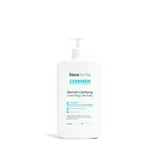
| Perricone MDCleanse & Firm Intensive Hydration RegimenYOUR PRODUCT | Skincare by Dr VMicellar Gel Wash | Face factsCeramide Blemish Foaming Cleanser | LACURAFoaming Gel Cleanser | |
|---|---|---|---|---|
| Match | — | 66% | 65% | 65% |
| Price | $162.00 | $25.46−$136.54 | $7.82−$154.18 | — |
| Shared key ingredients | — | 5 of 36 | 5 of 36 | 4 of 36 |
| Key difference | — | Lactic Acid | Salicylic Acid | Panthenol |
| Irritancy | High | Low | Low | Medium |
| Drying alcohol | — | — | — | — |
| View product | Shop | Shop | Shop |


More alternatives: Mixa Anti-Imperfection Comfort CleanserFilorga Age-Purify Clean Smoothing Purifying Cleansing Gel
Sources cited in this review
Every concentration estimate and effectiveness label is anchored to one of these 35 studies and safety reviews.
- 1Surfactants and experimental irritant contact dermatitisncbi.nlm.nih.gov
- 2
- 3Zinc salts in dermatologyncbi.nlm.nih.gov
- 4
- 5
- 6

Affiliate links · As an Amazon Associate, WIMJ earns from qualifying purchases.