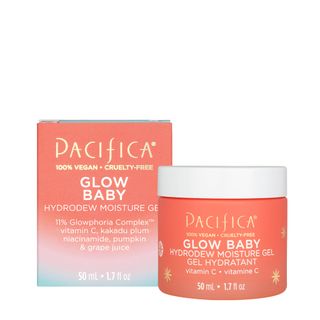
Pacifica Glow Baby Hydrodew Moisture Gel
Works for
1 of 1 advertised claim delivered
Moisturizing14 ingredients credited for this claimGood support
“Glow Baby Hydrodew Moisture Gel”
This product can help improve hydration of the skin with the two types of ingredients.
The first type is called “humectants”:
these ingredients help attract water.
When humectants are on the surface of the skin, they “pull in” the moisture from the outside environment, or from
within deeper layers of the skin. The following ingredients in this product do the job:
arginine, biosaccharide gum-1.
This product also contains ingredients called “occlusives”. They help reduce the speed with which our skin loses moisture to the outside environment. These ingredients also help soften the upper layer of the skin, so it feels less tight and nicer to the touch. The following ingredients in this product do the job: arginine, coco-caprylate/caprate.
Can it cause trouble?
Irritancy2 strong irritants: Boswellia serrata resin extract, ParfumMedium risk
Comedogenic2 ingredients rated 2 or more on the 0–5 pore-clogging scale2 flagged
User reviews
Be the first — your take helps the next person decide.
Ingredients
Filter by role to see what each ingredient is doing.
Water~40–60%
Glycerin~4.9–7.3%
- Irritation risk
- Low
One of the best moisturizing ingredients. Naturally present in skin. It attracts water to the upper layer of the skin working as a humectant
More about GlycerinBeta-glucan~3.8–5.7%
- Irritation risk
- Low
Helps attract water to the upper layer of the skin, calm down inflammation and irritation, restore the barrier function and support wound healing. It can be helpful in reducing fine lines and wrinkles
More about Beta-glucanAlgin~2.7–4.1%
- Irritation risk
- Low
- Comedogenicity
- 3/5
Used to thicken product formulation. Can help attract water to the upper layer of the skin
More about AlginXanthan gum~2–3%
- Irritation risk
- Low
Used to create a thicker product consistency
More about Xanthan gumHydrolyzed jojoba esters~1.8–2.7%
- Irritation risk
- Low
Helps soften the upper layer of the skin
More about Hydrolyzed jojoba estersCetearyl olivate~1.5–2.2%
Sorbitan olivate~1.3–1.9%
Coconut alkanes~1.1–1.6%
- Irritation risk
- Medium
- Comedogenicity
- 2/5
An emollient that helps soften the skin
More about Coconut alkanesCoco-caprylate/caprate~0.85–1.25%
- Irritation risk
- Low
Helps to soften the upper layer of the skin without creating a greasy texture
More about Coco-caprylate/caprateDiheptyl succinate~0.45–1.1%
- Irritation risk
- Low
Helps to soften the upper layer of the skin and creates a nice product finish on the skin
More about Diheptyl succinateCapryloyl glycerin/sebacic acid copolymer~0.4–0.9%
- Irritation risk
- Low
Helps soften the upper layer of the skin
More about Capryloyl glycerin/sebacic acid copolymerBiosaccharide gum-1~0.3–0.75%
- Irritation risk
- Low
Helps attract water to the upper layer of the skin and is claimed to provide a longer-lasting hydration because of its ability to create a water-binding film on the surface of the skin
More about Biosaccharide gum-12-hexanol~0.2–0.7%
- Irritation risk
- Low
Arginine~0.15–0.65%
- Irritation risk
- Low
An amino acid that is naturally present in skin and helps keep it hydrated. When used together with AHAs, it can reduce their irritating effect on the skin
More about ArginineAloe barbadensis leaf juice~0.15–0.7%
- Irritation risk
- Medium
Traditionally used to treat sunburns, dermatitis and inflammation, but evidence for its effectiveness is lacking. The extract can contain humectants that help attract water into the skin
More about Aloe barbadensis leaf juiceTetrahexyldecyl ascorbate~0.15–0.7%
- Irritation risk
- Medium
Being a lipid soluble form of vitamin C, it is more stable than ascorbic acid, but still degrades quickly and needs to be stabilized in a formulation with another ingredient. It is claimed to penetrate skin better than pure vitamin C and have the the similar benefits, but solid studies of its effectiveness are lacking. Is likely to require a higher concentration in a product than pure vitamin C to be effective. It might be able to help reduce pore clogging.
More about Tetrahexyldecyl ascorbateVitis vinifera juice~0.15–0.6%
- Irritation risk
- Medium
Cucurbita pepo~0.15–0.55%
- Irritation risk
- Medium
A plant extract. Might have some anti-oxidant effect
More about Cucurbita pepoSodium stearoyl glutamate~0.35–0.85%
- Irritation risk
- Medium
Helps oil and water mix together
More about Sodium stearoyl glutamateBisabolol~0.1–0.4%
- Irritation risk
- Low
An active component of chamomile plant that historically has been used to calm down irritated skin. A recent study shows that bisabolol indeed can have some anti-inflammatory effect on skin, even though conclusive data is lacking. Bisabolol has a sweet floral scent and can be added to products for its aromatic properties
More about BisabololTocopherol~0.1–0.45%
- Irritation risk
- Low
Pure form of vitamin E. Can help moisturise and protect the skin from free radicals. Often used to help stabilise other ingredients or the formula itself
More about TocopherolBoswellia serrata resin extract~0.1–0.4%
Terminalia ferdinandiana fruit extract~0.1–0.4%
- Irritation risk
- Medium
A plant extract that might have some anti-oxidant effect in skin, but evidence is lacking
More about Terminalia ferdinandiana fruit extractAscorbic acid~0.1–0.3%
- Irritation risk
- High
The most well-researched antioxidant that works in skin. Helps neutralize free radicals supporting collagen production, helping to even out the skin tone and preventing early signs of aging
More about Ascorbic acidNiacinamide~0.1–0.3%
- Irritation risk
- Low
Is proven to be effective in reducing blemishes, evening out skin tone and helping to improve lines and wrinkles. It helps the skin to repair sun damage, calm down inflammation and keep maintain good levels of moisture. The concentration of about 2% is effective for supporting the skin barrier and evening out the skin tone. Concentration of 4-6% is better for helping with acne and balancing the sebum production
More about NiacinamideEthylhexylglycerin~0.05–0.2%
Hydroxyethylcellulose~0.05–0.2%
- Irritation risk
- Low
Used to thicken product formulations and create gel-like textures
More about HydroxyethylcelluloseGluconolactone~0.05–0.15%
- Irritation risk
- Medium
A polyhydroxy acid (PHA) that helps shed the dead cells from the skin surface revealing smoother skin. Is believed to be genter than AHAs. It helps attract water to the upper layer of the skin and can stimulate production of skin's own hyaluronic acid resulting in improved hydration levels. It has been shown to be helpful against acne and clogged pores if used consistently (e.g over a period of 12 weeks) in high enough concentration. It can help reduce fine lines and wrinkles and improve skin tone with long-term application. Can help neutralize free radicals
More about GluconolactoneSodium benzoate~0.01–0.1%
Parfum~0.01–0.05%
- Irritation risk
- High
An aromatic blend of unspecified and possibly irritating ingredients
More about ParfumIngredient list view
Water, Glycerin, Beta-glucan, Algin, Xanthan gum, Hydrolyzed jojoba esters, Cetearyl olivate, Sorbitan olivate, Coconut alkanes, Coco-caprylate/caprate, Diheptyl succinate, Capryloyl glycerin/sebacic acid copolymer, Biosaccharide gum-1, 2-hexanol, Arginine, Aloe barbadensis leaf juice, Tetrahexyldecyl ascorbate, Vitis vinifera juice, Cucurbita pepo, Sodium stearoyl glutamate, Unknown, Bisabolol, Tocopherol, Boswellia serrata resin extract, Terminalia ferdinandiana fruit extract, Ascorbic acid, Niacinamide, Ethylhexylglycerin, Hydroxyethylcellulose, Gluconolactone, Sodium benzoate, Parfum
Compare prices
Retailers ranked by price — lowest first.

Affiliate links · prices updated regularly
Sources cited in this review
Every concentration estimate and effectiveness label is anchored to one of these 29 studies and safety reviews.
- 1
- 2β-Glucans: Multi-Functional Modulator of Wound Healingncbi.nlm.nih.gov
- 3
- 4
- 5
- 6

Affiliate links · As an Amazon Associate, WIMJ earns from qualifying purchases.