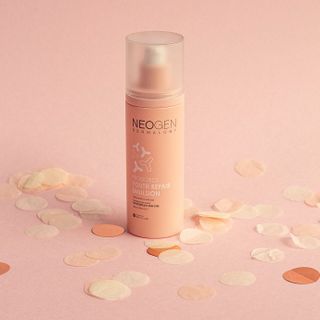
NEOGEN X SUR.MEDIC Probiotics Youth Repair Emulsion
Works for
2 of 2 advertised claims delivered
Moisturizing69 ingredients credited for this claimStrong support
“Benefits Contains SUPERPROBIOTICS™, a blend of three different kinds of probiotics, for strengthening skin and improving skin texture Contains a blend of cica and berry extracts to bring ample moisture and vitality to skin, leaving it brighter and clearer Creates a doubly protective film that hydrates and nourishes skin on top of safeguarding it against external aggressors Non-irritating emulsion formulated with a pleasant, allergy-free yogurt scent How to Use After cleansing, dispense a few pumps and apply evenly to entire face. Use morning and evening. Size 100ml”
This product can help improve hydration of the skin with the two types of ingredients.
The first type is called “humectants”:
these ingredients help attract water.
When humectants are on the surface of the skin, they “pull in” the moisture from the outside environment, or from
within deeper layers of the skin. The following ingredients in this product do the job:
alanine, arginine.
This product also contains ingredients called “occlusives”. They help reduce the speed with which our skin loses moisture to the outside environment. These ingredients also help soften the upper layer of the skin, so it feels less tight and nicer to the touch. The following ingredients in this product do the job: arginine, caprylic/capric triglyceride.
The following ingredients in this product are especially good for supporting the skin barrier and helping with the hydration level: acetyl hexapeptide-8, ceramide 1, ceramide 2, ceramide 3, ceramide 4, ceramide 6 ii, madecassoside, niacinamide, oligopeptide-1, palmitoyl tripeptide-5
Anti-aging16 ingredients credited for this claimStrong support
“Designed for those who wants to tackle premature skin aging, this emulsion contains Superprobiotics, five kinds of hyaluronic acid, as well as complexion-brightening berry extracts to thoroughly moisturize skin, lock in moisture and boost skin resilience by forming a moisture barrier. Suitable for sensitive skin.”
This product can help reduce and prevent fine lines and wrinkles, improve skin elasticity and firmness because it contains adenosine, gluconic acid, niacinamide.
These ingredients in the product can also be helpful, even though there is less evidence for their effectiveness: acetyl hexapeptide-8, asiaticoside, aspartic acid, madecassoside, oligopeptide-1, palmitoyl tripeptide-5, serine, threonine.
Keep in mind that it typically takes at least 6 weeks to notice any results because the changes that are needed to improve fine lines and elasticity happen in the deeper layers of the skin. No topical anti-aging product can “erase” wrinkles or fully reverse signs of aging.
Anti-oxidationNot advertised by the brand · 21 ingredients credited for this claimStrong support
This product contains antioxidants (asiaticoside, gluconic acid, glutathione, madecassoside) that can help neutralize free radicals in skin. By doing so, they can lessen the damage the skin gets from the UV light (sun).
The following ingredients - cornus officinalis fruit extract also can have an antioxidant effect, but there is less evidence to confirm their effectiveness in skin.
ExfoliationNot advertised by the brand · 3 ingredients credited for this claimStrong support
This product can help exfoliate the skin. In other words, it helps break down the bonds between dead cells on the surface of the skin and speed up the skin turnover. Skin often appears softer and brighter after exfoliation, but overdoing it can result in disrupted skin barrier. The following ingredient is doing the exfoliating job in this product: gluconic acid.
Evens skin toneNot advertised by the brand · 7 ingredients credited for this claimStrong support
This product can help reduce hypepigmentation and even out the skin tone because it contains the following effective ingredients: gluconic acid, glutathione, niacinamide
The following ingredient (ingredients) in this product might be helpful, but there is no evidence to confirm that it actually can help even out the skin tone: alanine, madecassoside.
Keep in mind that you would need to apply any topical skincare targetted at hypigmentation consistently for a couple of months to get a result. No topical skincare product can help get rid of hyperpigmentation (including post-acne marks and age spots) instantly.
Anti-blemishNot advertised by the brand · 5 ingredients credited for this claimStrong support
This product can help reduce breakouts and clogged pores because it contains the following ingredient: niacinamide. This ingredient is used for treating acne and can have a noticeable effect.
In addition, this product contains gluconic acid. It can help in reducing blemishes, even though it is less effective.
Can it cause trouble?
Irritancy1 strong irritant: Parfum — patch-test recommendedHigh risk
Comedogenic2 ingredients rated 2 or more on the 0–5 pore-clogging scale2 flagged


User reviews
Be the first — your take helps the next person decide.
Ingredients
Filter by role to see what each ingredient is doing.
Water~45–55%
Glycerin~4.4–5.4%
- Irritation risk
- Low
One of the best moisturizing ingredients. Naturally present in skin. It attracts water to the upper layer of the skin working as a humectant
More about GlycerinCaprylic/capric triglyceride~4.1–5%
- Irritation risk
- Medium
A good mix of fatty acids that forms a protective layer on the skin. Improves the shelf life of products. Derived from coconut and glycerin
More about Caprylic/capric triglycerideDipropylene glycol~2.8–3.4%
- Irritation risk
- Low
Helps to dissolve other ingredients in a formulation. Slows down the rate of product drying
More about Dipropylene glycolCetyl ethylhexanoate~2.3–2.8%
- Irritation risk
- Medium
An emollient that helps soften the skin and creates a thicker product texture
More about Cetyl ethylhexanoate1,2-hexanediol~0.75–1.1%
Niacinamide~1.6–1.9%
- Irritation risk
- Low
Is proven to be effective in reducing blemishes, evening out skin tone and helping to improve lines and wrinkles. It helps the skin to repair sun damage, calm down inflammation and keep maintain good levels of moisture. The concentration of about 2% is effective for supporting the skin barrier and evening out the skin tone. Concentration of 4-6% is better for helping with acne and balancing the sebum production
More about NiacinamideCyclopentasiloxane~1.4–1.7%
- Irritation risk
- Low
A silicone that helps improve the product texture and spreadability. Can absorb oil creating a short-term mattifying effect on the skin
More about CyclopentasiloxaneCyclohexasiloxane~1.2–1.4%
- Irritation risk
- Low
A silicone that serves as an emollient. Helps create a nice non-greasy feels
More about CyclohexasiloxaneButyrospermum parkii butter~0.95–1.15%
- Irritation risk
- Low
- Comedogenicity
- 3/5
A great moisturising ingredient that softens the skin and reduces water loss from its upper layer. It also can be helpful in protecting skin from free radicals
More about Butyrospermum parkii butterGlyceryl stearate~0.7–1%
- Irritation risk
- Low
An emollient that softens the skin and forms a protective layer on its surface. Helps water and oil mix together
More about Glyceryl stearateTrehalose~0.5–0.75%
- Irritation risk
- Low
A sugar that attracts water to the upper layer of the skin
More about TrehalosePeg-100 stearate~0.55–0.85%
- Irritation risk
- Low
Helps oil and water mix togehter and creates a nice product texture
More about Peg-100 stearateDimethicone~0.5–0.7%
- Irritation risk
- Low
A silicone that helps to reduce water loss from the surface of the skin. Can temporarily "fill in" lines and wrinkles, absorb oil, and create a nice product finish
More about DimethiconeCetyl alcohol~0.45–0.65%
- Irritation risk
- Low
A non-drying alcohol that works to soften the skin and stabilize product formulations helping oil and water mix together
More about Cetyl alcoholStearyl alcohol~0.45–0.65%
- Irritation risk
- Low
An emollient that helps soften the skin
More about Stearyl alcoholPalmitic acid~0.4–0.65%
- Irritation risk
- Low
An emollient that is naturally present in skin and helps soften it
More about Palmitic acidStearic acid~0.45–0.65%
- Irritation risk
- Low
Helps oil and water mix together and works as an emollient
More about Stearic acidCarbomer~0.25–0.5%
- Irritation risk
- Low
Helps create a thicker or gel-like product texture. It is not a surfactant but can be used in gentle cleansing formulations
More about CarbomerTromethamine~0.25–0.45%
Ethylhexylglycerin~0.25–0.45%
Adenosine~0.2–0.4%
- Irritation risk
- Low
Might help improve cell turnover and reduce inflammation in skin. One study shows that the ingredients might be able to help reduce dynamic wrinkles (for example, in the corners of the eyes or on the forehead)
More about AdenosineCoptis japonica extract~0.2–0.35%
- Irritation risk
- High
Butylene glycol~0.2–0.35%
- Irritation risk
- Low
Used to create a nice product texture and help delivery of other ingredients. Might be somewhat helpful in attracting water to the upper layer of the skin
More about Butylene glycolLactobacillus ferment lysate~0.2–0.35%
- Irritation risk
- Low
A "broth" with parts of dead cells of lactobacteria. Might be helpful supporting diverse microbiome in skin, but evidence is lacking
More about Lactobacillus ferment lysateIsopentyldiol~0.2–0.35%
Undaria pinnatifida extract~0.2–0.35%
- Irritation risk
- Low
A seaweed extract that helps attract water to the upper layer of the skin and might have an anti-oxidant effect
More about Undaria pinnatifida extractDextrin~0.2–0.4%
- Irritation risk
- Low
A sugar that is used to stabilize the product formulation. Can help attract water to the upper layer of the skin
More about DextrinTheobroma cacao extract~0.2–0.35%
- Irritation risk
- Low
- Comedogenicity
- 3/5
Honey extract~0.2–0.35%
- Irritation risk
- Medium
Helps attract water to the upper layer of the skin
More about Honey extractSodium pca~0.2–0.35%
- Irritation risk
- Low
Naturally present in skin and helps to attract water to its upper layer
More about Sodium pcaSodium lactate~0.2–0.35%
- Irritation risk
- Medium
Helps attract water to the upper layer of the skin. Is often used to adjust the pH level of the product
More about Sodium lactateCentella asiatica extract~0.25–0.45%
- Irritation risk
- Medium
A plant extract that has been shown to be able to reduce inflammation in skin, support restoration of skin barrier function, as well as support collagen production. Contains active compounds called centelloids: asiaticoside, madecasosside, asiatic acid and madecassic acid. Might be helpful in preventing stretch marks. It can be itself be irritating though.
More about Centella asiatica extractVaccinium macrocarpon fruit extract~0.2–0.35%
- Irritation risk
- High
A berry extract. Might have some anti-oxidant properties
More about Vaccinium macrocarpon fruit extractFragaria chiloensis fruit extract~0.2–0.35%
- Irritation risk
- Medium
Rubus idaeus fruit extract~0.15–0.3%
- Irritation risk
- Medium
A fruit extract that might have some anti-oxidant properties but evidence of effectiveness in skin is lacking
More about Rubus idaeus fruit extractVaccinium angustifolium fruit extract~0.15–0.3%
- Irritation risk
- Medium
A plant extract tha can have anti-oxidant properties, but evidence of effectiveness in skin is lacking
More about Vaccinium angustifolium fruit extractCornus officinalis fruit extract~0.2–0.35%
- Irritation risk
- High
A plant extract that contains anti-oxidants. It might help to neutralize free radicals in skin. Can be used to help preserve the product formulation
More about Cornus officinalis fruit extractEuterpe oleracea fruit extract~0.2–0.35%
- Irritation risk
- Medium
A plant extract that can have some anti-oxidant effect in skin
More about Euterpe oleracea fruit extractSambucus nigra fruit extract~0.2–0.35%
- Irritation risk
- High
A plant extract that may contain a small amount of essential oils. Might be helpful in neutralizing free radicals in skin
More about Sambucus nigra fruit extractSchisandra chinensis fruit extract~0.2–0.35%
- Irritation risk
- Medium
A berry extract that might help neutralize free radicals on the surface of the skin
More about Schisandra chinensis fruit extractPanax ginseng berry extract~0.2–0.35%
- Irritation risk
- Low
Vaccinium myrtillus fruit extract~0.2–0.35%
- Irritation risk
- Medium
A plant extract that might help neutralize free radicals in skin, but research on its efficacy in skin is lacking
More about Vaccinium myrtillus fruit extractArginine~0.2–0.35%
- Irritation risk
- Low
An amino acid that is naturally present in skin and helps keep it hydrated. When used together with AHAs, it can reduce their irritating effect on the skin
More about ArginineAspartic acid~0.2–0.35%
- Irritation risk
- Low
An amino-acid that helps increase skin hydration and might help to slightly improve skin firmness, potentially reducing lines and wrinkles
More about Aspartic acidAdansonia digitata seed oil~0.2–0.4%
- Irritation risk
- Medium
Helps soften the upper layer of the skin
More about Adansonia digitata seed oilPca~0.2–0.35%
- Irritation risk
- Low
Naturally present in skin and helps to attract water to its upper layer
More about PcaCeramide 3~0.25–0.4%
- Irritation risk
- Low
A type of lipid similar to ceramides naturally present in skin. Helps to soften the upper layer of the skin and supports the skin barrier function to keep it hydrated. Can help to prevent inflammation in skin
More about Ceramide 3Hydrogenated lecithin~0.2–0.4%
- Irritation risk
- Low
Helps to retain moisture by creating a protective barrier on the skin. Rich in fatty acids. Improves product texture and helps with the penetration of other ingredients.
More about Hydrogenated lecithinPhospholipids~0.2–0.35%
- Irritation risk
- Low
Emollients that are naturaly present in skin. In addition, they help water and oil mix together in the product
More about PhospholipidsGluconic acid~0.15–0.3%
- Irritation risk
- Medium
A polyhydroxy acid (PHA) that helps shed the dead cells from the skin surface revealing smoother skin. Is believed to be genter than AHAs. It helps attract water to the upper layer of the skin and can stimulate production of skin's own hyaluronic acid resulting in imporved hydration levels. It has been shown to be helpful against acne and clogged pores. Might help reduce fine lines and wrinkles and improve skin tone with long-term application. Can help neutralize free radicals
More about Gluconic acidGlycine~0.2–0.35%
- Irritation risk
- Low
Helps to attract water to the upper layer of the skin and can help restore the skin barrier function
More about GlycineAlanine~0.2–0.35%
- Irritation risk
- Low
An amino-acid that helps to attract water to the upper layer of the skin and might help to lighten the skin, but solid evidence is lacking
More about AlanineBetaine~0.2–0.35%
- Irritation risk
- Low
Helps attract water to the upper layer of the skin and improves the product texture
More about BetaineAllantoin~0.15–0.3%
- Irritation risk
- Low
Helps calm down inflammation in skin and can help reduce itching. Helps to repair the skin barrier and keep skin hydrated
More about AllantoinXylitol~0.2–0.35%
- Irritation risk
- Low
Helps attract water to the upper layer of the skin and repair the skin barrier function
More about XylitolPanthenol~0.2–0.35%
- Irritation risk
- Low
Helps attract water to the upper layer of the skin and can help improve skin barrier function
More about PanthenolHydrolyzed collagen~0.25–0.5%
- Irritation risk
- Low
A typically plant-derived compound that is supposed mimic human collagen. Cannot penetrate the skin barrier so is not particularly useful in skincare products beyond attracting water to the upper layer of the skin
More about Hydrolyzed collagenJuglans regia seed oil~0.2–0.4%
- Irritation risk
- Medium
Helps to soften the upper layer of the skin
More about Juglans regia seed oilRoyal jelly extract~0.2–0.4%
- Irritation risk
- Medium
A compound secreted by bees. Might be able to attract water to the top layer of the skin. Avoid if sensitive to honey and bee products
More about Royal jelly extractMusa sapientum fruit extract~0.2–0.4%
- Irritation risk
- Low
Tuber melanosporum extract~0.2–0.4%
- Irritation risk
- Low
Sodium hyaluronate~0.2–0.4%
- Irritation risk
- Low
One of the best moisturizing ingredients. Attracts water into the upper layer of the skin
More about Sodium hyaluronatePropolis extract~0.25–0.45%
- Irritation risk
- High
A complex substance produced by honey bees. Can have anti-bacterial and some anti-oxidant effect. Is an allergen and can be irritating
More about Propolis extractDaucus carota sativa root extract~0.2–0.4%
- Irritation risk
- Low
Carrot extract. Might have anti-oxidant properties and be used to add orange color
More about Daucus carota sativa root extractArtemisia capillaris extract~0.25–0.4%
- Irritation risk
- Low
Squalane~0.3–0.5%
- Irritation risk
- Low
An oil naturally present in skin. Works as an emollient to soften the skin and form a protective layer on its surface without a greasy feeling.
More about SqualaneLactic acid~0.2–0.4%
- Irritation risk
- Medium
An exfoliating and moisturizing alpha-hydroxy acid (AHA). Typically causes less irritation than other AHAs, for example, glycolic acid. At high concentrations (about 15%), lactic acid can help reduce lines and wrinkles. Recent studies show that lactic acid can support the "good" bacteria living on skin's surface (healthy skin microbiome)
More about Lactic acidSerine~0.2–0.4%
- Irritation risk
- Low
An amino-acid that helps to attract water to the upper layer of the skin. In combination with other amino-acids, might help to reduce fine lines and wrinkles
More about SerineValine~0.2–0.4%
- Irritation risk
- Low
Propanediol~0.25–0.45%
- Irritation risk
- Low
Acts as a solvent for other ingredients. Speeds up the absorption of other ingredients into the skin
More about PropanediolPalmitoyl tripeptide-5~0.2–0.4%
- Irritation risk
- Low
A type of peptide. Peptides are excellent moisturizers and might be able support collagen production reducing fine lines and wrinkles
More about Palmitoyl tripeptide-5Caprylyl glycol~0.25–0.45%
- Irritation risk
- Medium
Helps preserve products and creates a nice product texture
More about Caprylyl glycolCholesterol~0.25–0.5%
- Irritation risk
- Low
An emollient that is naturally found in skin
More about CholesterolIsoleucine~0.2–0.4%
- Irritation risk
- Low
An amino acid that can help attract water to the upper layer of the skin and support skin's barrier function
More about IsoleucineThreonine~0.25–0.4%
- Irritation risk
- Low
An amino-acid that helps to attract water to the upper layer of the skin. In combination with other amino-acids, might help to reduce fine lines and wrinkles
More about ThreonineProline~0.25–0.45%
Asiaticoside~0.2–0.35%
- Irritation risk
- Medium
An active compound of Centella Asiatica plant extract. In combination with other active compounds of Centella Asiatica extract (madecasosside, asiatic acid and madecassic acid), asiaticoside has been shown to be helpful in wound-healing, restoring skin barrier function and supporting collagen production in skin. It can, however, itself be irritating
More about AsiaticosideMadecassic acid~0.2–0.4%
- Irritation risk
- Medium
An active compound of Centella Asiatica plant extract. In combination with other active compounds of Centella Asiatica extract (asiaticoside, madecasosside and asiatic acid), madecassic acid has been shown to be helpful in wound-healing, restoring skin barrier function and supporting collagen production in skin. It can, however, itself be irritating
More about Madecassic acidAsiatic acid~0.2–0.4%
- Irritation risk
- Medium
An active compound of Centella Asiatica plant extract. In combination with other active compounds of Centella Asiatica extract (asiaticoside, madecasosside and madecassic acid) asiatic acid has been shown to be helpful in wound-healing, restoring skin barrier function and supporting collagen production in skin. It can, however, itself be irritating
More about Asiatic acidTocopheryl acetate~0.25–0.45%
- Irritation risk
- Medium
A more stable but less bio-available form of vitamin E compared to Tocopherol. Might help moisturize and protect the skin from free radicals, but mostly used in low concentrations to stabilize other ingredients.
More about Tocopheryl acetateTuber magnatum extract~0.2–0.4%
- Irritation risk
- Low
Phenylalanine~0.2–0.4%
- Irritation risk
- Low
Histidine~0.2–0.4%
Phellinus linteus extract~0.2–0.4%
- Irritation risk
- Low
Glutathione~0.25–0.4%
- Irritation risk
- Medium
A peptide that can help neutralize free radicals in skin and reduce melanin production resulting in skin lightening effect and reduction in hyperpigmentation. It can also help attract moisture to the upper layer of the skin
More about GlutathionePentylene glycol~0.25–0.5%
- Irritation risk
- Medium
Used to preserve products, dissolve other ingredients and create a nice product texture
More about Pentylene glycolCeramide 2~0.25–0.45%
- Irritation risk
- Low
A type of lipid similar to ceramides naturally present in skin. Helps to soften the upper layer of the skin and supports the skin barrier function to keep it hydrated. Can help to prevent inflammation in skin
More about Ceramide 2Ceramide 4~0.2–0.4%
Hydroxypropyltrimonium hyaluronate~0.25–0.45%
- Irritation risk
- Low
Olea europaea fruit oil~0.25–0.45%
- Irritation risk
- Medium
An emollient that helps soften the skin but is not effective for restoring its barrier function. Might be helpful to calm down inflammation
More about Olea europaea fruit oilBifida ferment lysate~0.2–0.4%
- Irritation risk
- Low
Consists of remains of dead yeast bacteria cells. Helps to hydrate the skin and reduce irritation. Might has some anti-oxidant effect
More about Bifida ferment lysateAcetyl hexapeptide-8~0.2–0.4%
- Irritation risk
- Low
A type of peptide. Peptides are excellent moisturizers and might be able support collagen production reducing fine lines and wrinkles
More about Acetyl hexapeptide-8Ceramide 1~0.25–0.5%
- Irritation risk
- Low
A type of lipid similar to ceramides naturally present in skin. Helps to soften the upper layer of the skin and supports the skin barrier function to keep it hydrated. Can help to prevent inflammation in skin
More about Ceramide 1Ceramide 6 ii~0.25–0.5%
- Irritation risk
- Low
A type of lipid similar to ceramides naturally present in skin. Helps to soften the upper layer of the skin and supports the skin barrier function to keep it hydrated. Can help to prevent inflammation in skin
More about Ceramide 6 iiBeta-glucan~0.2–0.4%
- Irritation risk
- Low
Helps attract water to the upper layer of the skin, calm down inflammation and irritation, restore the barrier function and support wound healing. It can be helpful in reducing fine lines and wrinkles
More about Beta-glucanStreptococcus thermophilus ferment~0.2–0.4%
- Irritation risk
- Low
Madecassoside~0.2–0.4%
- Irritation risk
- Medium
An antioxidant that is typically derived from plant Centella Asiatica. It can help neutralize free radicals in skin and support skin barrier function. It could, however, itself be irritating. It is often unstable in formulations
More about MadecassosideHydrolyzed hyaluronic acid~0.2–0.35%
- Irritation risk
- Low
One of the best moisturizing ingredients. Attracts water into the upper layer of the skin. A version of it is naturally present in skin
More about Hydrolyzed hyaluronic acidHyaluronic acid~0.2–0.35%
- Irritation risk
- Low
One of the best moisturizing ingredients. Attracts water into the upper layer of the skin. Naturally present in skin. Typically has large molecule size unless advertised otherwise on the product label. Helps support skin's barrier function and may help to reduce inflammation
More about Hyaluronic acidOligopeptide-1~0.15–0.3%
- Irritation risk
- Low
A type of peptide. Peptides are excellent moisturizers and might be able support collagen production reducing fine lines and wrinkles
More about Oligopeptide-1Sodium acetylated hyaluronate~0.15–0.3%
- Irritation risk
- Low
A type of hyaluronic acid that works as an excellent moisturizer by attracting water into the upper layer of the skin. Is typically feels less sticky on the skin compared to the usual hyaluronic acid
More about Sodium acetylated hyaluronatePhytosterols~0.2–0.4%
- Irritation risk
- Medium
Lipids that work as an emollient and can be helpful in repairing skin barrier function
More about PhytosterolsSodium hyaluronate crosspolymer~0.15–0.25%
- Irritation risk
- Medium
Attracts water into the upper layer of the skin
More about Sodium hyaluronate crosspolymerDisodium edta~0.05–0.1%
Parfum~0.1–0.15%
- Irritation risk
- High
An aromatic blend of unspecified and possibly irritating ingredients
More about ParfumIngredient list view
Water, Glycerin, Caprylic/capric triglyceride, Dipropylene glycol, Cetyl ethylhexanoate, 1,2-hexanediol, Niacinamide, Cyclopentasiloxane, Cyclohexasiloxane, Butyrospermum parkii butter, Glyceryl stearate, Trehalose, Peg-100 stearate, Dimethicone, Cetyl alcohol, Stearyl alcohol, Palmitic acid, Stearic acid, Carbomer, Tromethamine, Ethylhexylglycerin, Adenosine, Coptis japonica extract, Butylene glycol, Lactobacillus ferment lysate, Isopentyldiol, Undaria pinnatifida extract, Dextrin, Theobroma cacao extract, Honey extract, Sodium pca, Sodium lactate, Centella asiatica extract, Vaccinium macrocarpon fruit extract, Fragaria chiloensis fruit extract, Rubus idaeus fruit extract, Vaccinium angustifolium fruit extract, Cornus officinalis fruit extract, Euterpe oleracea fruit extract, Sambucus nigra fruit extract, Schisandra chinensis fruit extract, Panax ginseng berry extract, Vaccinium myrtillus fruit extract, Arginine, Aspartic acid, Adansonia digitata seed oil, Pca, Ceramide 3, Hydrogenated lecithin, Phospholipids, Gluconic acid, Glycine, Alanine, Betaine, Allantoin, Xylitol, Panthenol, Hydrolyzed collagen, Juglans regia seed oil, Royal jelly extract, Musa sapientum fruit extract, Tuber melanosporum extract, Sodium hyaluronate, Propolis extract, Daucus carota sativa root extract, Artemisia capillaris extract, Squalane, Lactic acid, Serine, Valine, Propanediol, Palmitoyl tripeptide-5, Caprylyl glycol, Cholesterol, Isoleucine, Threonine, Proline, Asiaticoside, Madecassic acid, Asiatic acid, Tocopheryl acetate, Tuber magnatum extract, Phenylalanine, Histidine, Phellinus linteus extract, Glutathione, Pentylene glycol, Ceramide 2, Ceramide 4, Hydroxypropyltrimonium hyaluronate, Olea europaea fruit oil, Bifida ferment lysate, Acetyl hexapeptide-8, Ceramide 1, Ceramide 6 ii, Beta-glucan, Streptococcus thermophilus ferment, Madecassoside, Hydrolyzed hyaluronic acid, Hyaluronic acid, Oligopeptide-1, Sodium acetylated hyaluronate, Phytosterols, Sodium hyaluronate crosspolymer, Disodium edta, Parfum
Compare prices
Retailers ranked by price — lowest first.


Worth comparing, line by line.
Match % combines shared ingredients, the first five ingredients, shared actives and hero ingredients, irritancy (lower counts in the alternative's favour), texture and body area. Only products in the same routine step are compared.
| NEOGEN X SUR.MEDICProbiotics Youth Repair EmulsionYOUR PRODUCT | MEDI-PEELGold Age Tox H8 Cream | TOSOWOONGJeju Mayu Cream | Serendi BeautyLa-bloom Vital Repair Cream | |
|---|---|---|---|---|
| Match | — | 82% | 74% | 72% |
| Price | $20.70 | $20.25 | — | $74.42+$53.72 |
| Shared key ingredients | — | 25 of 50 | 20 of 50 | 15 of 50 |
| Key difference | — | Copper Tripeptide-1 | Oligopeptide-3 | Oligopeptide-32 |
| Irritancy | High | High | Medium | Medium |
| Drying alcohol | — | — | — | — |
| View product | Shop | Shop | Shop |


Product summary
Based on the ingredients included, "Neogen - Probiotics Youth Repair Emulsion" works well for moisturizing the skin. The formulation is based on a combination of good humectants and emollients. Both are needed to increase the skin hydration level. Acetyl hexapeptide-8, alanine, arginine, aspartic acid and betaine in this product (humectants) attract water molecules to the upper layer of the skin (the water comes from the outside air or from the deeper layers of the skin if the air is dry). Ceramide 1, ceramide 2, ceramide 3, ceramide 6 ii and cholesterol in this product help decrease the water evoporation from the skin, so that it stays hydrated for longer. These ingredients also soften the skin and take away the feeling of tightness and dryness.
Ingredient callouts
- As a plus, this moisturizer also contains Ceramides (ceramide 2 0.25% - 0.45%, ceramide 1 0.25% - 0.50%, ceramide 6 ii 0.25% - 0.50%, ceramide 4 0.20% - 0.40% and ceramide 3 0.25% - 0.40%). Ceramides are a type of lipids that our skin produces itself. They are a building block of the skin's barrier. Ceramides used in skincare are synthetic or extracted from plants. They work well for softening the skin surface and "patch holes" in the skin's barrier.
- This moisturizer also contains Peptides (oligopeptide-1 0.15% - 0.30%, palmitoyl tripeptide-5 0.20% - 0.40% and acetyl hexapeptide-8 0.20% - 0.40%). Peptides are a very big group of ingredients. They all consist of a different combination of aminoacids. Our skin produces Peptides naturally. Some of them work as natural antibiotics, promote wound-healing and production of collagen. The scientists are still studying how effective the topical application of Peptides is, but it is very likely that they are helpful. Peptides might be able to support skin barrier restoration and even have an anti-aging benefit. At the very least, they certainly help attract water to the skin and support the hydration in this way.
- Adenosine 0.20% - 0.40%. It is a compound that in involved in many biological processes inside the skin cells. According one high-quality clinical trial, topical Adenosine in low concentrations can somewhat help improve "deep wrinkles" - the wrinkles that appear with age in places where our faces are most dynamic (for example, on the forehead or in the corners of the eyes).
- Actives derived from an extract of the Centella Asiatica plant (also known as Gotu Kola) - madecassic acid 0.20% - 0.40%, asiaticoside 0.20% - 0.35%, asiatic acid 0.20% - 0.40% and madecassoside 0.20% - 0.40% The Centella Asiatica Actives, even in low concentration, can help reduce inflammation in skin, strengthen the skin barrier and reduce photodamage. They can also help to decrease scarring.
Irritation risk
This moisturizer contains some common irritants, including those without a benefit for the skin. We assess the overall irritancy of this moisturizer to be high. For a detailed overview of all potential irritants: click here
You can see the detailed formula review with the breakdown of all actives in the product and the full ingredient list with estimated concentrations in the tables below.
Price
The product retails from 20.70$ up to 35.00$ in the United States.
For a detailed price comparison: click here.
Sources cited in this review
Every concentration estimate and effectiveness label is anchored to one of these 67 studies and safety reviews.
- 1
- 2
- 3
- 4
- 5
- 6Final Report on the Safety Assessment of Dimethicone Copolyoljournals.sagepub.com

Affiliate links · As an Amazon Associate, WIMJ earns from qualifying purchases.