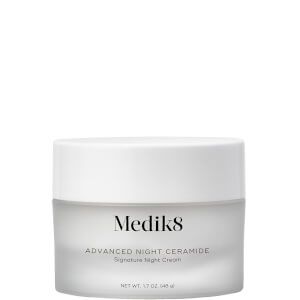
Medik8 Advanced Night Ceramide Cream
Works for
2 of 2 advertised claims delivered
Moisturizing25 ingredients credited for this claimStrong support
“Advanced Night Ceramide Cream”
This product can help improve hydration of the skin with the two types of ingredients.
The first type is called “humectants”:
these ingredients help attract water.
When humectants are on the surface of the skin, they “pull in” the moisture from the outside environment, or from
within deeper layers of the skin. The following ingredients in this product do the job:
glycerin, sorbitol.
This product also contains ingredients called “occlusives”. They help reduce the speed with which our skin loses moisture to the outside environment. These ingredients also help soften the upper layer of the skin, so it feels less tight and nicer to the touch. The following ingredients in this product do the job: caprylic/capric triglyceride, dimethicone.
The following ingredients in this product are especially good for supporting the skin barrier and helping with the hydration level: acetyl glucosamine, caprooyl phytosphingosine, caprooyl sphingosine, ceramide eop, ceramide eos, ceramide np, ceramide ns, ferric hexapeptide-35, linoleic acid, phytosphingosine
Anti-aging5 ingredients credited for this claimStrong support
“This boosts the skin’s natural protection against skin-ageing ready for the next morning.”
This product can help reduce and prevent fine lines and wrinkles, improve skin elasticity and firmness because it contains acetyl glucosamine.
These ingredients in the product can also be helpful, even though there is less evidence for their effectiveness: ferric hexapeptide-35.
Keep in mind that it typically takes at least 6 weeks to notice any results because the changes that are needed to improve fine lines and elasticity happen in the deeper layers of the skin. No topical anti-aging product can “erase” wrinkles or fully reverse signs of aging.
Evens skin toneNot advertised by the brand · 2 ingredients credited for this claimStrong support
This product can help reduce hypepigmentation and even out the skin tone because it contains the following effective ingredients: acetyl glucosamine
Keep in mind that you would need to apply any topical skincare targetted at hypigmentation consistently for a couple of months to get a result. No topical skincare product can help get rid of hyperpigmentation (including post-acne marks and age spots) instantly.
Can it cause trouble?
Irritancy8 strong irritants: Rosmarinus officinalis leaf oil, Citrus aurantium amara flower oil + 6 more — patch-test recommendedHigh risk
Comedogenic1 ingredient rated 2 or more on the 0–5 pore-clogging scale1 flagged

User reviews
Be the first — your take helps the next person decide.
Ingredients
Filter by role to see what each ingredient is doing.
Water~45–55%
Squalane~5.4–6.6%
- Irritation risk
- Low
An oil naturally present in skin. Works as an emollient to soften the skin and form a protective layer on its surface without a greasy feeling.
More about SqualaneCaprylic/capric triglyceride~4.9–5.9%
- Irritation risk
- Medium
A good mix of fatty acids that forms a protective layer on the skin. Improves the shelf life of products. Derived from coconut and glycerin
More about Caprylic/capric triglycerideDimethicone~3.3–4%
- Irritation risk
- Low
A silicone that helps to reduce water loss from the surface of the skin. Can temporarily "fill in" lines and wrinkles, absorb oil, and create a nice product finish
More about DimethiconeGlycerin~2.5–3%
- Irritation risk
- Low
One of the best moisturizing ingredients. Naturally present in skin. It attracts water to the upper layer of the skin working as a humectant
More about GlycerinStearic acid~2.1–2.6%
- Irritation risk
- Low
Helps oil and water mix together and works as an emollient
More about Stearic acidPropylene glycol~1.7–2.1%
- Irritation risk
- High
Helps oil and water mix together and can enhance the penetration of other ingredients into the skin. It can be irritating
More about Propylene glycolPhytosterols~1.6–1.9%
- Irritation risk
- Medium
Lipids that work as an emollient and can be helpful in repairing skin barrier function
More about PhytosterolsC12-16 alcohols~1.3–1.6%
- Irritation risk
- Medium
Helps soften the upper layer of the skin and improve the product's texture
More about C12-16 alcoholsSodium acrylate/sodium acryloyldimethyl taurate copolymer~1.1–1.3%
- Irritation risk
- Low
Used to create a thicker product consistency
More about Sodium acrylate/sodium acryloyldimethyl taurate copolymerCetearyl alcohol~0.95–1.2%
- Irritation risk
- Low
- Comedogenicity
- 2/5
A non-drying alcohol. Works as an emollient. Helps water and oil mix together and creates a nice product texture
More about Cetearyl alcoholPalmitic acid~0.7–1.05%
- Irritation risk
- Low
An emollient that is naturally present in skin and helps soften it
More about Palmitic acidCeramide np~0.65–0.95%
- Irritation risk
- Low
A type of lipid similar to ceramides naturally present in skin. Helps to soften the upper layer of the skin and supports the skin barrier function to keep it hydrated. Can help to prevent inflammation in skin
More about Ceramide npCetearyl olivate~0.6–0.85%
Linoleic acid~0.65–1%
- Irritation risk
- Low
An excellent emollient. Helps soften the skin, restore its barrier function, and can help to calm down inflammation. It can be helpful to prevent blemishes and clogged pores
More about Linoleic acidBehenyl alcohol~0.6–0.9%
- Irritation risk
- Low
Non-drying alcohol that helps water and oil mix together. Also serves as an emollient
More about Behenyl alcoholHydrogenated lecithin~0.55–0.8%
- Irritation risk
- Low
Helps to retain moisture by creating a protective barrier on the skin. Rich in fatty acids. Improves product texture and helps with the penetration of other ingredients.
More about Hydrogenated lecithinTocopheryl acetate~0.5–0.75%
- Irritation risk
- Medium
A more stable but less bio-available form of vitamin E compared to Tocopherol. Might help moisturize and protect the skin from free radicals, but mostly used in low concentrations to stabilize other ingredients.
More about Tocopheryl acetateSorbitan olivate~0.45–0.7%
Phenoxyethanol~0.45–0.65%
- Irritation risk
- Low
A preservative. It helps prevent bacterial growth in cosmetic products
More about PhenoxyethanolBenzyl alcohol~0.35–0.6%
- Irritation risk
- High
A preservative. Can be used to mask unpleasant smell. Can be irritating
More about Benzyl alcoholAmelanchier alnifolia fruit extract~0.35–0.65%
- Irritation risk
- Low
Ethylhexylglycerin~0.35–0.65%
Acetyl glucosamine~0.3–0.6%
- Irritation risk
- Low
An effective moisturizing ingredient that also has been shown to be effective in evening out the skin tone and reducing hyperpigmentation. It can help somewhat reduce wrinkles in skin
More about Acetyl glucosamineCitric acid~0.35–0.6%
- Irritation risk
- Medium
Can work as an exfoliant but is typically used to adjust the product pH
More about Citric acidSorbitol~0.35–0.6%
- Irritation risk
- Low
Helps attract water to the upper layer of the skin and improves the product texture
More about SorbitolRosmarinus officinalis leaf oil~0.3–0.6%
- Irritation risk
- High
A plant oil with high content of volatile compounds that can irritate the skin. Can be used as a fragrance. Has anti-bacterial properties and might help neutralize free radicals on the surface of the skin
More about Rosmarinus officinalis leaf oilCitrus aurantium amara flower oil~0.3–0.6%
- Irritation risk
- High
Used as a fragrance. Can be irritating
More about Citrus aurantium amara flower oilLavandula angustifolia oil~0.35–0.6%
- Irritation risk
- High
An essential oil. Potential allergen and can be irritating. It has some anti-bacterial properties
More about Lavandula angustifolia oilCitrus aurantium dulcis peel oil~0.3–0.6%
- Irritation risk
- High
An essentil oil from orange peel. Potential allergen and can be irritating
More about Citrus aurantium dulcis peel oilHylocereus undatus fruit extract~0.3–0.6%
- Irritation risk
- Low
Dehydroacetic acid~0.35–0.6%
Tremella fuciformis extract~0.3–0.6%
- Irritation risk
- Medium
A mushroom extract that might help attract water to the upper layer of the skin
More about Tremella fuciformis extractSodium lauroyl lactylate~0.35–0.65%
- Irritation risk
- Medium
Helps water and oil mix together
More about Sodium lauroyl lactylateAnthemis nobilis flower oil~0.3–0.55%
- Irritation risk
- High
An essential oil that is used as a fragrance and can be irritating. It might have some anti-oxidant effect in skin
More about Anthemis nobilis flower oilPogostemon cablin leaf oil~0.35–0.65%
Vetiveria zizanoides root oil~0.3–0.55%
- Irritation risk
- Low
Ascorbic acid~0.35–0.6%
- Irritation risk
- High
The most well-researched antioxidant that works in skin. Helps neutralize free radicals supporting collagen production, helping to even out the skin tone and preventing early signs of aging
More about Ascorbic acidDisodium edta~0.35–0.6%
Ceteareth-25~0.45–0.7%
Phytosphingosine~0.45–0.65%
- Irritation risk
- Low
A type of lipid that is naturally present in skin. It might help in repairing skin barrier function and has anti-bacterial effect
More about PhytosphingosineCholesterol~0.45–0.65%
- Irritation risk
- Low
An emollient that is naturally found in skin
More about CholesterolXanthan gum~0.4–0.6%
- Irritation risk
- Low
Used to create a thicker product consistency
More about Xanthan gumCarbomer~0.35–0.65%
- Irritation risk
- Low
Helps create a thicker or gel-like product texture. It is not a surfactant but can be used in gentle cleansing formulations
More about CarbomerCetyl alcohol~0.4–0.65%
- Irritation risk
- Low
A non-drying alcohol that works to soften the skin and stabilize product formulations helping oil and water mix together
More about Cetyl alcoholBehenic acid~0.45–0.7%
Ceramide ns~0.35–0.65%
- Irritation risk
- Low
A type of lipid similar to ceramides naturally present in skin. Helps to soften the upper layer of the skin and supports the skin barrier function to keep it hydrated. Can help to prevent inflammation in skin
More about Ceramide nsFerric hexapeptide-35~0.3–0.55%
- Irritation risk
- Low
A type of peptide. Peptides are excellent moisturizers and might be able support collagen production reducing fine lines and wrinkles
More about Ferric hexapeptide-35Ceramide eop~0.3–0.6%
- Irritation risk
- Low
A type of lipid similar to ceramides naturally present in skin. Helps to soften the upper layer of the skin and supports the skin barrier function to keep it hydrated. Can help to prevent inflammation in skin
More about Ceramide eopCeramide eos~0.25–0.5%
- Irritation risk
- Low
A type of lipid similar to ceramides naturally present in skin. Helps to soften the upper layer of the skin and supports the skin barrier function to keep it hydrated. Can help to prevent inflammation in skin
More about Ceramide eosCaprooyl phytosphingosine~0.3–0.5%
- Irritation risk
- Low
A component of ceramides. Helps to soften the upper layer of the skin and supports the skin barrier function to keep it hydrated. Can help to prevent inflammation in skin
More about Caprooyl phytosphingosineCaprooyl sphingosine~0.2–0.35%
- Irritation risk
- Low
A component of ceramides. Helps to soften the upper layer of the skin and supports the skin barrier function to keep it hydrated. Can help to prevent inflammation in skin
More about Caprooyl sphingosineAscorbyl palmitate~0.15–0.25%
- Irritation risk
- Medium
Being a lipid soluble form of vitamin C, it is more stable and can penetrate the skin better than L-Ascorbic acid. It is effective in protecting the skin from free radicals, as well as evening the skin tone, but is less effective in stimulating collagen production compared to L-Ascorbic acid.
More about Ascorbyl palmitateTocopherol~0.2–0.35%
- Irritation risk
- Low
Pure form of vitamin E. Can help moisturise and protect the skin from free radicals. Often used to help stabilise other ingredients or the formula itself
More about TocopherolGeraniol~0.15–0.25%
Limonene~0.1–0.15%
- Irritation risk
- High
A common frangrance that can easily irritate skin, especially if exposed to air, light or heat
More about LimoneneLinalool~0.1–0.15%
Ingredient list view
Water, Squalane, Caprylic/capric triglyceride, Dimethicone, Glycerin, Stearic acid, Propylene glycol, Phytosterols, C12-16 alcohols, Sodium acrylate/sodium acryloyldimethyl taurate copolymer, Cetearyl alcohol, Palmitic acid, Ceramide np, Cetearyl olivate, Linoleic acid, Behenyl alcohol, Hydrogenated lecithin, Tocopheryl acetate, Sorbitan olivate, Phenoxyethanol, Benzyl alcohol, Amelanchier alnifolia fruit extract, Ethylhexylglycerin, Acetyl glucosamine, Citric acid, Sorbitol, Rosmarinus officinalis leaf oil, Citrus aurantium amara flower oil, Lavandula angustifolia oil, Citrus aurantium dulcis peel oil, Hylocereus undatus fruit extract, Dehydroacetic acid, Tremella fuciformis extract, Sodium lauroyl lactylate, Anthemis nobilis flower oil, Pogostemon cablin leaf oil, Vetiveria zizanoides root oil, Ascorbic acid, Disodium edta, Ceteareth-25, Phytosphingosine, Cholesterol, Xanthan gum, Carbomer, Cetyl alcohol, Behenic acid, Ceramide ns, Ferric hexapeptide-35, Ceramide eop, Ceramide eos, Caprooyl phytosphingosine, Caprooyl sphingosine, Ascorbyl palmitate, Tocopherol, Geraniol, Limonene, Linalool
Compare prices
Retailers ranked by price — lowest first.


Worth comparing, line by line.
Match % combines shared ingredients, the first five ingredients, shared actives and hero ingredients, irritancy (lower counts in the alternative's favour), texture and body area. Only products in the same routine step are compared.
| Medik8Advanced Night Ceramide CreamYOUR PRODUCT | L300INTENSIVE MOISTURE FACE CREAM | Skinbetter ScienceHydration Boosting Cream | REVOLUTION SKINCARECeramides Moisture Cream | |
|---|---|---|---|---|
| Match | — | 57% | 56% | 56% |
| Price | $72.00 | — | $90.00+$18.00 | $11.90−$60.10 |
| Shared key ingredients | — | 11 of 17 | 11 of 17 | 10 of 17 |
| Key difference | — | Lactic Acid | Niacinamide | Ceramide Ap |
| Irritancy | High | Medium | Medium | Low |
| Drying alcohol | — | — | — | — |
| View product | Shop | Shop | Shop |


Product summary
Based on the ingredients included, "Medik8 - Advanced Night Ceramide Cream" works well for moisturizing the skin. To work well, any moisturizer needs to include a combination of water-binding and emollient ingredients. Medik8 - Advanced Night Ceramide Cream ticks this box. Acetyl glucosamine, glycerin and sorbitol in this product (humectants) attract water molecules to the upper layer of the skin (the water comes from the outside air or from the deeper layers of the skin if the air is dry). Emollients in this formulation (caprooyl phytosphingosine, ceramide eop, ceramide np, ceramide ns and linoleic acid) help to reduce the moisture loss from the skin. They also soften the skin surface and relieve the feeling of dryness and tightness.
Ingredient callouts
- This product also contains vitamin C (Ascorbic Acid). It can be an effective active for anti-aging and evening out the skin tone, but in this moisturizer it is used for stabilizing other ingredients in the formulation. In this concentration (0.35% - 0.60%) it cannot have a noticeable benefit for the skin.
- Another benefit is that this moisturizer contain ceramides (ceramide ns 0.35% - 0.65%, ceramide np 0.65% - 0.95%, ceramide eos 0.25% - 0.50%, ceramide eop 0.30% - 0.60%, caprooyl sphingosine 0.20% - 0.35%, caprooyl phytosphingosine 0.30% - 0.50% and phytosphingosine 0.45% - 0.65%). Ceramides are an important part of our natural skin barrier. The ceramides used in skincare are synthetic or come from plants. They help soften the skin and can help "fill the gaps" in the skin barrier, keeping the skin hydrated and resilient for longer.
- This moistruizer also contains peptides (ferric hexapeptide-35 0.30% - 0.55%). Peptides is a very big group of ingredients. They all consist of a different combination of amino-acids. Our skin produces peptides naturally. Some of them work as natural anti-biotics, promote wound-healing and production of collagen. The scientists are still studying how effective the topical application of peptides is, but it is very likely that peptides in skincare are helpful. They might be able to support skin barrier restoration and even have an anti-aging benefit. At the very least, they certainly help attract water to the skin and support the hydration in this way.
- Another helpful ingredient in this moisturizer is Linoleic Acid. It is one of the fatty acids naturally present in skin. It is part of the skin barrier. Preliminary research shows that it might be able to reduce clogged pores.
Irritation risk
This moisturizer contains a bunch of common irritants, including ingredients that do not provide any known benefit for the skin. It might not be the best choice if your skin is sensitive. We assess the overall irritancy of this moisturizer to be high. For a detailed overview of all potential irritants: click here
You can see the detailed formula review with the breakdown of all actives in the product and the full ingredient list with estimated concentrations in the tables below.
Price
The product retails from 72.00$ up to 74.00$ in the United States and for 86.30CA$ in Canada.
For a detailed price comparison: click here.
Sources cited in this review
Every concentration estimate and effectiveness label is anchored to one of these 30 studies and safety reviews.
- 1
- 2Final Report on the Safety Assessment of Dimethicone Copolyoljournals.sagepub.com
- 3
- 4Surfactants and experimental irritant contact dermatitisncbi.nlm.nih.gov
- 5Propylene Glycolpubmed.ncbi.nlm.nih.gov
- 6Skin-sensitizing and irritant properties of propylene glycolonlinelibrary.wiley.com

Affiliate links · As an Amazon Associate, WIMJ earns from qualifying purchases.