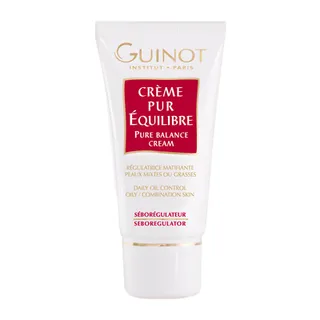
Guinot Creme Pur Équilibre Pure Balance Cream

Guinot Creme Pur Équilibre Pure Balance Cream

Efficacy87/100IrritancyHigh

Works for

Anti-blemish
Salicylic acid, Zinc gluconate + 1 more
Works well
What the product description says
“This re-balancing cream for combination and oily skin purifies, tightens pores and mattifies the complexion.”
Source: Feelunique

This product can help reduce breakouts and clogged pores because it contains the following ingredient: salicylic acid. This ingredient is used for treating acne and can have a noticeable effect.

Salicylic acidHeroEffect: HighUsed for skin exfoliation. It has an anti-inflammatory and anti-bacterial effect, helps to unclog pores, prevent blemishes and speed up healing of the existing ones. Sometimes referred to as a BHA (beta-hydroxy acid)~0.55–0.85%
Zinc gluconateEffect: Low, below effective doseTypically used to stabilize the product formulations. It is a salt of a polyhydroxy acid (PHA) and in larger concentrations, can help shed the dead cells from the skin surface revealing smoother skin. It can help attract water to the upper layer of the skin. Might to be helpful against acne and clogged pores. Could be helpful in neutralizing free radicals, but solid research is missing. Due to the zinc content, might help calm down inflammation in skin~0.4–0.65%
Oleanolic acidUnder-dosedMight be helpful against blemishes, work as an anti-oxidant, reduce inflammation and improve skin's ability to hold on to moisture, but more research is needed to confirm its effectiveness when applied topically to human skin~0.15–0.25%
Moisturizing
Glycerin, Cetyl alcohol + 10 more
Works
What the product description says
“Creme Pur Équilibre Pure Balance Cream”
From product name

This product contains good ingredients to attract water to the upper layer of the skin. These ingredients are called "humectants": glycerin, butylene glycol.

When humectants are on the surface of the skin, they “pull in” the moisture from the outside environment, or from within deeper layers of the skin. If the air is dry, humectants can speed up the moisture loss from the skin. This is why it is a good idea to use another product on top of this one to help "seal in" the moisture (look for ingredients like dimethicone, squalane, oils and butters).

GlycerinKey active· HumectantEffect: HighOne of the best moisturizing ingredients. Naturally present in skin. It attracts water to the upper layer of the skin working as a humectant~4.5–5.5%
Cetyl alcoholKey active· EmollientEffect: MediumA non-drying alcohol that works to soften the skin and stabilize product formulations helping oil and water mix together~1.3–1.5%
CyclopentasiloxaneKey active· EmollientEffect: MediumA silicone that helps improve the product texture and spreadability. Can absorb oil creating a short-term mattifying effect on the skin~1–1.3%
Isodecyl neopentanoate· Emollient, OcclusiveEffect: LowAn emollient that helps soften the skin. It also forms a protective on its surface to reduce water loss.~2.8–3.4%
Isononyl isononanoate· Emollient, OcclusiveEffect: LowForms a protective film on the surface of the skin to prevent moisture loss. Gives a velvety feel to products while reducing tackiness~2.2–2.7%
Butylene glycol· HumectantEffect: LowUsed to create a nice product texture and help delivery of other ingredients. Might be somewhat helpful in attracting water to the upper layer of the skin~0.75–1.1%
Caprylyl glycol· Humectant, EmollientEffect: LowHelps preserve products and creates a nice product texture~0.55–0.8%
Glyceryl stearate· EmollientEffect: LowAn emollient that softens the skin and forms a protective layer on its surface. Helps water and oil mix together~0.3–0.6%
BiotinEffect: LowMight have some moisturising properties. Is not effective when applied topically beyond some moisturizing effect~0.1–0.15%
CyclohexasiloxaneEffect: Low, below effective doseA silicone that serves as an emollient. Helps create a nice non-greasy feels~0.75–1.1%
Zinc gluconateUnder-dosedTypically used to stabilize the product formulations. It is a salt of a polyhydroxy acid (PHA) and in larger concentrations, can help shed the dead cells from the skin surface revealing smoother skin. It can help attract water to the upper layer of the skin. Might to be helpful against acne and clogged pores. Could be helpful in neutralizing free radicals, but solid research is missing. Due to the zinc content, might help calm down inflammation in skin~0.4–0.65%
Oleanolic acidUnder-dosedMight be helpful against blemishes, work as an anti-oxidant, reduce inflammation and improve skin's ability to hold on to moisture, but more research is needed to confirm its effectiveness when applied topically to human skin~0.15–0.25%
Exfoliation
Side benefit · Salicylic acid, Zinc gluconate
Works well

This product can help exfoliate the skin. In other words, it helps break down the bonds between dead cells on the surface of the skin and speed up the skin turnover. Skin often appears softer and brighter after exfoliation, but overdoing it can result in disrupted skin barrier. The following ingredient is doing the exfoliating job in this product: salicylic acid.

Salicylic acidKey activeEffect: HighUsed for skin exfoliation. It has an anti-inflammatory and anti-bacterial effect, helps to unclog pores, prevent blemishes and speed up healing of the existing ones. Sometimes referred to as a BHA (beta-hydroxy acid)~0.55–0.85%
Zinc gluconateEffect: Low, below effective doseTypically used to stabilize the product formulations. It is a salt of a polyhydroxy acid (PHA) and in larger concentrations, can help shed the dead cells from the skin surface revealing smoother skin. It can help attract water to the upper layer of the skin. Might to be helpful against acne and clogged pores. Could be helpful in neutralizing free radicals, but solid research is missing. Due to the zinc content, might help calm down inflammation in skin~0.4–0.65%
Anti-oxidation
Side benefit · Ficus carica fruit extract, Zinc gluconate + 2 more
May help

This product contains antioxidants (ficus carica fruit extract) that might be able to help neutralize free radicals in skin to lessen the damage it gets from the UV light (sun). There is not enough evidence to confirm their effectiveness in skin though.

Ficus carica fruit extractKey activeEffect: MediumA plant extract that can help neutralize free radicals. The concentrations typically used in cosmetics are too small to have an effect~0.65–1%
Zinc gluconateEffect: Low, below effective doseTypically used to stabilize the product formulations. It is a salt of a polyhydroxy acid (PHA) and in larger concentrations, can help shed the dead cells from the skin surface revealing smoother skin. It can help attract water to the upper layer of the skin. Might to be helpful against acne and clogged pores. Could be helpful in neutralizing free radicals, but solid research is missing. Due to the zinc content, might help calm down inflammation in skin~0.4–0.65%
Ascorbyl palmitateEffect: Low, below effective doseBeing a lipid soluble form of vitamin C, it is more stable and can penetrate the skin better than L-Ascorbic acid. It is effective in protecting the skin from free radicals, as well as evening the skin tone, but is less effective in stimulating collagen production compared to L-Ascorbic acid.~0.3–0.5%
Oleanolic acidUnder-dosedMight be helpful against blemishes, work as an anti-oxidant, reduce inflammation and improve skin's ability to hold on to moisture, but more research is needed to confirm its effectiveness when applied topically to human skin~0.15–0.25%

Can it cause trouble?

Irritancy
4 strong irritants: Parfum, Limonene + 2 more — patch-test recommended
High risk
We flagged 23 ingredients with irritancy potential. Severity depends on your sensitivity threshold; the table lists the worst offenders first.
IngredientFunctionIrritationEst. amount
ParfumAn aromatic blend of unspecified and possibly irritating ingredientsHigh~0.6–0.9%est.
Salicylic acidUsed for skin exfoliation. It has an anti-inflammatory and anti-bacterial effect, helps to unclog pores, prevent blemishes and speed up healing of the existing ones. Sometimes referred to as a BHA (beta-hydroxy acid)High~0.55–0.85%est.
Propylene glycolHelps oil and water mix together and can enhance the penetration of other ingredients into the skin. It can be irritatingHigh~0.3–0.55%est.
LimoneneA common frangrance that can easily irritate skin, especially if exposed to air, light or heatHigh~0.3–0.55%est.
GeraniolA fragrance. Can be irritatingHigh~0.25–0.5%est.
CitronellolA fragrance. Can be irritatingHigh~0.2–0.4%est.
Ci 19140A yellow dyeHigh~0.1–0.15%est.
Tribehenin peg-20 estersHelps oil and water mix togetherMedium~1.8–2.2%est.
Hydroxyethyl acrylate/sodium acryloyldimethyl taurate copolymerA gelling agent that thickens the product consistency and leaves the skin with a velvety finishMedium~1.4–1.7%est.
EthylhexylglycerinA preservativeMedium~0.8–1.15%est.
TriethanolamineUsed to adjust pH of the product and can help improve the product's smellMedium~0.65–1%est.
Ficus carica fruit extractA plant extract that can help neutralize free radicals. The concentrations typically used in cosmetics are too small to have an effectMedium~0.65–1%est.
Caprylyl glycolHelps preserve products and creates a nice product textureMedium~0.55–0.8%est.
Polysorbate 60Helps oil and water mix togetherMedium~0.5–0.8%est.
Chlorhexidine digluconateA preservativeMedium~0.15–0.3%est.
BhtA preservativeMedium~0.45–0.7%est.
Disodium edtaStabilizes the product formulationMedium~0.45–0.7%est.
Zinc gluconateTypically used to stabilize the product formulations. It is a salt of a polyhydroxy acid (PHA) and in larger concentrations, can help shed the dead cells from the skin surface revealing smoother skin. It can help attract water to the upper layer of the skin. Might to be helpful against acne and clogged pores. Could be helpful in neutralizing free radicals, but solid research is missing. Due to the zinc content, might help calm down inflammation in skinMedium~0.4–0.65%est.
Sodium citrateHelps to control the skin's pH level. Maintains the skin's natural film of amino-lactic acids and oils. Helps to preserve productsMedium~0.3–0.55%est.
Ascorbyl palmitateBeing a lipid soluble form of vitamin C, it is more stable and can penetrate the skin better than L-Ascorbic acid. It is effective in protecting the skin from free radicals, as well as evening the skin tone, but is less effective in stimulating collagen production compared to L-Ascorbic acid.Medium~0.3–0.5%est.
Citric acidCan work as an exfoliant but is typically used to adjust the product pHMedium~0.25–0.45%est.
Nordihydroguaiaretic acidUsed to stabilize the formula of product formulation. Might be helpful in neutralizing free radicals in skinMedium~0.15–0.3%est.
Sodium metabisulfiteA preservativeMedium~0.1–0.2%est.
Comedogenic
Clean of flagged comedogenic ingredients
None flagged

User reviews

Would you recommend?
No community reviews yet.

Be the first — your take helps the next person decide.

Ingredients

Filter by role to see what each ingredient is doing.

Water~45–55%
Formula
Irritation risk
Low

Plain old water

More about Water
Glycerin~4.5–5.5%
Key active
Irritation risk
Low
Works for
Moisturizing

One of the best moisturizing ingredients. Naturally present in skin. It attracts water to the upper layer of the skin working as a humectant

More about Glycerin
Talc~4.5–5.4%
Formula
Irritation risk
Low

Absorbs oil and moisture helping to create a dryer product finish

More about Talc
Methyl methacrylate crosspolymer~3.4–4.2%
Formula
Irritation risk
Low
Works for
Mattifying

Helps thicken the product consistency

More about Methyl methacrylate crosspolymer
Isodecyl neopentanoate~2.8–3.4%
Formula
Irritation risk
Low
Works for
Moisturizing

An emollient that helps soften the skin. It also forms a protective on its surface to reduce water loss.

More about Isodecyl neopentanoate
Isononyl isononanoate~2.2–2.7%
Formula
Irritation risk
Low
Works for
Moisturizing

Forms a protective film on the surface of the skin to prevent moisture loss. Gives a velvety feel to products while reducing tackiness

More about Isononyl isononanoate
Tribehenin peg-20 esters~1.8–2.2%
Irritant · medium
Irritation risk
Medium
Works for
Cleansing

Helps oil and water mix together

More about Tribehenin peg-20 esters
Beheneth-25~1.6–1.9%
Formula
Irritation risk
Low
Works for
Cleansing
More about Beheneth-25
Hydroxyethyl acrylate/sodium acryloyldimethyl taurate copolymer~1.4–1.7%
Irritant · medium
Irritation risk
Medium

A gelling agent that thickens the product consistency and leaves the skin with a velvety finish

More about Hydroxyethyl acrylate/sodium acryloyldimethyl taurate copolymer
Cetyl alcohol~1.3–1.5%
Key active
Irritation risk
Low
Works for
CleansingMoisturizing

A non-drying alcohol that works to soften the skin and stabilize product formulations helping oil and water mix together

More about Cetyl alcohol
Cyclopentasiloxane~1–1.3%
Key active
Irritation risk
Low
Works for
MattifyingMoisturizing

A silicone that helps improve the product texture and spreadability. Can absorb oil creating a short-term mattifying effect on the skin

More about Cyclopentasiloxane
Ethylhexylglycerin~0.8–1.15%
Irritant · medium
Irritation risk
Medium

A preservative

More about Ethylhexylglycerin
Butylene glycol~0.75–1.1%
Formula
Irritation risk
Low
Works for
Moisturizing

Used to create a nice product texture and help delivery of other ingredients. Might be somewhat helpful in attracting water to the upper layer of the skin

More about Butylene glycol
Cyclohexasiloxane~0.75–1.1%
Formula
Irritation risk
Low
Works for
Moisturizing

A silicone that serves as an emollient. Helps create a nice non-greasy feels

More about Cyclohexasiloxane
Triethanolamine~0.65–1%
Irritant · medium
Irritation risk
Medium
Works for
Cleansing

Used to adjust pH of the product and can help improve the product's smell

More about Triethanolamine
Ficus carica fruit extract~0.65–1%
Key activeIrritant · medium
Irritation risk
Medium
Works for
Anti-oxidation

A plant extract that can help neutralize free radicals. The concentrations typically used in cosmetics are too small to have an effect

More about Ficus carica fruit extract
Parfum~0.6–0.9%
Irritant · high
Irritation risk
High

An aromatic blend of unspecified and possibly irritating ingredients

More about Parfum
Salicylic acid~0.55–0.85%
Hero · Anti-blemishIrritant · high
Irritation risk
High
Works for
Anti-blemishAnti-inflammatoryExfoliationAntibacterialEvens skin tone

Used for skin exfoliation. It has an anti-inflammatory and anti-bacterial effect, helps to unclog pores, prevent blemishes and speed up healing of the existing ones. Sometimes referred to as a BHA (beta-hydroxy acid)

More about Salicylic acid
Maltodextrin~0.55–0.85%
Formula
Irritation risk
Low
Works for
Mattifying

Used to stabilize the product formulation and can help absorb oil

More about Maltodextrin
Peg-60 almond glycerides~0.55–0.8%
Formula
Irritation risk
Low
Works for
Cleansing
More about Peg-60 almond glycerides
Caprylyl glycol~0.55–0.8%
Irritant · medium
Irritation risk
Medium
Works for
Moisturizing

Helps preserve products and creates a nice product texture

More about Caprylyl glycol
Polysorbate 60~0.5–0.8%
Irritant · medium
Irritation risk
Medium
Works for
Cleansing

Helps oil and water mix together

More about Polysorbate 60
Sorbitan isostearate~0.45–0.7%
Formula
Irritation risk
Low
Works for
Cleansing

Helps oil and water mix together

More about Sorbitan isostearate
Chlorhexidine digluconate~0.15–0.3%
Irritant · medium
Irritation risk
Medium

A preservative

More about Chlorhexidine digluconate
Bht~0.45–0.7%
Irritant · medium
Irritation risk
Medium

A preservative

More about Bht
Disodium edta~0.45–0.7%
Irritant · medium
Irritation risk
Medium

Stabilizes the product formulation

More about Disodium edta
Zinc gluconate~0.4–0.65%
Under-dosedIrritant · medium
Irritation risk
Medium
Works for
MoisturizingEvens skin toneAnti-oxidationAnti-blemishAnti-inflammatoryAnti-agingExfoliation

Typically used to stabilize the product formulations. It is a salt of a polyhydroxy acid (PHA) and in larger concentrations, can help shed the dead cells from the skin surface revealing smoother skin. It can help attract water to the upper layer of the skin. Might to be helpful against acne and clogged pores. Could be helpful in neutralizing free radicals, but solid research is missing. Due to the zinc content, might help calm down inflammation in skin

More about Zinc gluconate
Propylene glycol~0.3–0.55%
Irritant · high
Irritation risk
High
Works for
Moisturizing

Helps oil and water mix together and can enhance the penetration of other ingredients into the skin. It can be irritating

More about Propylene glycol
Limonene~0.3–0.55%
Irritant · high
Irritation risk
High

A common frangrance that can easily irritate skin, especially if exposed to air, light or heat

More about Limonene
Sodium citrate~0.3–0.55%
Irritant · medium
Irritation risk
Medium

Helps to control the skin's pH level. Maintains the skin's natural film of amino-lactic acids and oils. Helps to preserve products

More about Sodium citrate
Geraniol~0.25–0.5%
Irritant · high
Irritation risk
High

A fragrance. Can be irritating

More about Geraniol
Ascorbyl palmitate~0.3–0.5%
Irritant · medium
Irritation risk
Medium
Works for
Anti-oxidationAnti-aging

Being a lipid soluble form of vitamin C, it is more stable and can penetrate the skin better than L-Ascorbic acid. It is effective in protecting the skin from free radicals, as well as evening the skin tone, but is less effective in stimulating collagen production compared to L-Ascorbic acid.

More about Ascorbyl palmitate
Glyceryl stearate~0.3–0.6%
Formula
Irritation risk
Low
Works for
CleansingMoisturizing

An emollient that softens the skin and forms a protective layer on its surface. Helps water and oil mix together

More about Glyceryl stearate
Citric acid~0.25–0.45%
Irritant · medium
Irritation risk
Medium

Can work as an exfoliant but is typically used to adjust the product pH

More about Citric acid
Citronellol~0.2–0.4%
Irritant · high
Irritation risk
High

A fragrance. Can be irritating

More about Citronellol
Carbomer~0.2–0.4%
Formula
Irritation risk
Low
Works for
Cleansing

Helps create a thicker or gel-like product texture. It is not a surfactant but can be used in gentle cleansing formulations

More about Carbomer
Green 5
Not recognized
Ci 61570~0.15–0.3%
Formula
Irritation risk
Low
More about Ci 61570
Nordihydroguaiaretic acid~0.15–0.3%
Irritant · medium
Irritation risk
Medium

Used to stabilize the formula of product formulation. Might be helpful in neutralizing free radicals in skin

More about Nordihydroguaiaretic acid
Oleanolic acid~0.15–0.25%
Under-dosed
Irritation risk
Low
Works for
Anti-blemishAnti-inflammatoryAnti-oxidationMoisturizingAnti-aging

Might be helpful against blemishes, work as an anti-oxidant, reduce inflammation and improve skin's ability to hold on to moisture, but more research is needed to confirm its effectiveness when applied topically to human skin

More about Oleanolic acid
Sodium metabisulfite~0.1–0.2%
Irritant · medium
Irritation risk
Medium

A preservative

More about Sodium metabisulfite
Ci 19140~0.1–0.15%
Irritant · high
Irritation risk
High

A yellow dye

More about Ci 19140
Biotin~0.1–0.15%
Formula
Irritation risk
Low
Works for
Moisturizing

Might have some moisturising properties. Is not effective when applied topically beyond some moisturizing effect

More about Biotin
Ingredient list view

Water, Glycerin, Talc, Methyl methacrylate crosspolymer, Isodecyl neopentanoate, Isononyl isononanoate, Tribehenin peg-20 esters, Beheneth-25, Hydroxyethyl acrylate/sodium acryloyldimethyl taurate copolymer, Cetyl alcohol, Cyclopentasiloxane, Ethylhexylglycerin, Butylene glycol, Cyclohexasiloxane, Triethanolamine, Ficus carica fruit extract, Parfum, Salicylic acid, Maltodextrin, Peg-60 almond glycerides, Caprylyl glycol, Polysorbate 60, Sorbitan isostearate, Chlorhexidine digluconate, Bht, Disodium edta, Zinc gluconate, Propylene glycol, Limonene, Sodium citrate, Geraniol, Ascorbyl palmitate, Glyceryl stearate, Citric acid, Citronellol, Carbomer, Unknown, Ci 61570, Nordihydroguaiaretic acid, Oleanolic acid, Sodium metabisulfite, Ci 19140, Biotin

Compare prices

Retailers ranked by price — lowest first.

🇦🇺 Amazon Australia (AU)Price as of 11/12 00:00 GMT
≈ $52.21
Buy
🇨🇦 Amazon CA (CA)Price as of 11/8 12:19 GMT
≈ $56.07
Buy
🇬🇧 Amazon UK (UK)
Price unavailable Out of stock
Check

Affiliate links · As an Amazon Associate, WIMJ earns from qualifying purchases.

Worth comparing, line by line.

Match % combines shared ingredients, the first five ingredients, shared actives and hero ingredients, irritancy (lower counts in the alternative's favour), texture and body area. Only products in the same routine step are compared.

Side-by-side comparison of this product against its closest alternatives
GuinotCreme Pur Équilibre Pure Balance CreamYOUR PRODUCTInstitut EsthedermIntensive Propolis+ Skin Perfecting Cream TubeBiodermaSebium Global Intensive Purifying Cream For Acne-Prone SkinLa Roche-PosayPure Vitamin C10 Anti-Aging Concentrate Cream
Match—90%89%87%
Price——$12.68—
Shared key ingredients—3 of 75 of 71 of 7
Key difference—AdenosineBakuchiolVitamin C
Irritancy High Medium Medium Medium
Drying alcohol————
View product Shop Shop Shop

More alternatives: Paula's choice Probiotic Nutrient MoisturizerOodee Nova Illuminating Moisturiser

Cheaper alternatives? See how this stacks up against similar formulas.
We compare ingredient profiles across our catalog — pick the closest match for your budget.
Open dupe finder

Sources cited in this review

Every concentration estimate and effectiveness label is anchored to one of these 23 studies and safety reviews.

  1. 1
  2. 2
  3. 3
  4. 4
  5. 5
  6. 6
Guinot Creme Pur Équilibre Pure Balance Cream
GuinotCreme Pur Équilibre Pure Balance Cream

Affiliate links · As an Amazon Associate, WIMJ earns from qualifying purchases.

As an Amazon Associate, WIMJ earns from qualifying purchases.