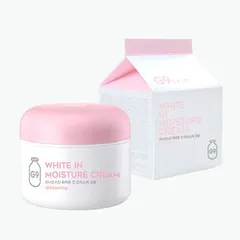
Works for:
based on ingredients and %- Moisturizing
- Anti-oxidation
- Anti-aging
- Evens skin tone
Can it cause trouble?
- Irritation risk: high
- Comedogenic risk ingredients: 1
Key actives


Product Summary
Based on the ingredient list, "G9SKIN - White In Moisture Cream" can work well for skin moisturization. This moisturizer uses a good combo of humectants and emollients. These both types of ingredients are essentials for improving the skin hydration and keeping the skin barrier healthy. Glycerin, butylene glycol and caprylyl glycol in this product (humectants) attract water molecules to the upper layer of the skin (the water comes from the outside air or from the deeper layers of the skin if the air is dry). Ceramide 3, phytosterols, salvia hispanica seed extract, caprylic/capric triglyceride and dimethicone in this product help decrease the water evoporation from the skin, so that it stays hydrated for longer. These ingredients also soften the skin and take away the feeling of tightness and dryness.
Ingredient callouts
- We particularly like that there is a good concentration of Niacinamide (3.10% - 3.70%) in this moisturizer. Niacinamide is a well-studied multi-tasking active. It is a great ingredient to have in a moisturizer. It is stable, and can work well in almost any hydrating formulation. There is solid evidence that Niacinamide can help support skin barrier, regulate oil production and reduce acne and clogged pores. It also helps to fight photodamage and help improve the skin tone, reducing pigmentation marks.
- This product also contains Vitamin C (Ascorbic Acid). It can be an effective active for anti-aging and evening out the skin tone, but in this moisturizer it is used for stabilizing other ingredients in the formulation. In this concentration (0.30% - 0.50%) it cannot have a noticeable benefit for the skin.
- As a plus, this moisturizer also contains Ceramides (ceramide 3 0.30% - 0.50%). Ceramides are a type of lipids that our skin produces itself. They are a building block of the skin's barrier. Ceramides used in skincare are synthetic or extracted from plants. They work well for softening the skin surface and "patch holes" in the skin's barrier.
Irritation risk
This moisturizer contains some common irritants, including those without a benefit for the skin. We assess the overall irritancy of this moisturizer to be high. For a detailed overview of all potential irritants: click here
You can see the detailed formula review with the breakdown of all actives in the product and the full ingredient list with estimated concentrations in the tables below.
Price
The product retails from 11.92$ up to 33.20$ in the United States, for 42.00CA$ in Canada and for 24.00£ in the United Kingdom.
For a detailed price comparison: click here.
Anti-aging
This product can help reduce and prevent fine lines and wrinkles, improve skin elasticity and firmness because it contains niacinamide.
Keep in mind that it typically takes at least 6 weeks to notice any results because the changes that are needed to improve fine lines and elasticity happen in the deeper layers of the skin. No topical anti-aging product can “erase” wrinkles or fully reverse signs of aging.
Is proven to be effective in reducing blemishes, evening out skin tone and helping to improve lines and wrinkles. It helps the skin to repair sun damage, calm down inflammation and keep maintain good levels of moisture. The concentration of about 2% is effective for supporting the skin barrier and evening out the skin tone. Concentration of 4-6% is better for helping with acne and balancing the sebum production
Helps attract water to the upper layer of the skin, calm down inflammation and irritation, restore the barrier function and support wound healing. It can be helpful in reducing fine lines and wrinkles
The most well-researched antioxidant that works in skin. Helps neutralize free radicals supporting collagen production, helping to even out the skin tone and preventing early signs of aging
A great moisturising ingredient that softens the skin and reduces water loss from its upper layer. It also can be helpful in protecting skin from free radicals
Can contain potent anti-oxidant compounds (abbreviated ECG, GCG, EGC, and EGCG) that might help protect the skin from free radicals. Can help calm down inflammation and has some anti-bacterial properties. Unfortunately, these antioxidants are unstable and lose their effectiveness very quickly in products. The concentration of the antioxidant compounds in the extract also tends to be low to be effective in topical formulation
Anti-blemish
This product can help reduce breakouts and clogged pores because it contains the following ingredient: niacinamide. This ingredient is used for treating acne and can have a noticeable effect.
Is proven to be effective in reducing blemishes, evening out skin tone and helping to improve lines and wrinkles. It helps the skin to repair sun damage, calm down inflammation and keep maintain good levels of moisture. The concentration of about 2% is effective for supporting the skin barrier and evening out the skin tone. Concentration of 4-6% is better for helping with acne and balancing the sebum production
Helps attract water to the upper layer of the skin, calm down inflammation and irritation, restore the barrier function and support wound healing. It can be helpful in reducing fine lines and wrinkles
Can contain potent anti-oxidant compounds (abbreviated ECG, GCG, EGC, and EGCG) that might help protect the skin from free radicals. Can help calm down inflammation and has some anti-bacterial properties. Unfortunately, these antioxidants are unstable and lose their effectiveness very quickly in products. The concentration of the antioxidant compounds in the extract also tends to be low to be effective in topical formulation
Anti-oxidation
This product contains antioxidants (glutathione) that can help neutralize free radicals in skin. By doing so, they can lessen the damage the skin gets from the UV light (sun).
A peptide that can help neutralize free radicals in skin and reduce melanin production resulting in skin lightening effect and reduction in hyperpigmentation. It can also help attract moisture to the upper layer of the skin
A plant extract that might have some anti-oxidant properties
Helps attract water to the upper layer of the skin, calm down inflammation and irritation, restore the barrier function and support wound healing. It can be helpful in reducing fine lines and wrinkles
A plant extract tha can have anti-oxidant properties, but evidence of effectiveness in skin is lacking
Plant extract that has some anti-oxidant properties. It can be irritating. Can be used to improve the product's smell
A plant extract that might help neutralize free radicals in skin, but research on its effectiveness is lacking
A plant extract. Can have an anti-oxidant effect, but can also contain irritants
A plant extract that can be irritating. It might contain a compound anthocyanin that could be helpful in neutralizing free radicals
A plant extract that helps attract water to the upper layer of the skin. It might be helpful in neutralizing free radicals in skin, but is less potent than the extract from the seeds
The most well-researched antioxidant that works in skin. Helps neutralize free radicals supporting collagen production, helping to even out the skin tone and preventing early signs of aging
Can contain potent anti-oxidant compounds (abbreviated ECG, GCG, EGC, and EGCG) that might help protect the skin from free radicals. Can help calm down inflammation and has some anti-bacterial properties. Unfortunately, these antioxidants are unstable and lose their effectiveness very quickly in products. The concentration of the antioxidant compounds in the extract also tends to be low to be effective in topical formulation
A more stable but less bio-available form of vitamin E compared to Tocopherol. Might help moisturize and protect the skin from free radicals, but mostly used in low concentrations to stabilize other ingredients.
An active component of chamomile plant that historically has been used to calm down irritated skin. A recent study shows that bisabolol indeed can have some anti-inflammatory effect on skin, even though conclusive data is lacking. Bisabolol has a sweet floral scent and can be added to products for its aromatic properties
Might have some anti-inflammatory properties but research is lacking
A great moisturising ingredient that softens the skin and reduces water loss from its upper layer. It also can be helpful in protecting skin from free radicals
Evens skin tone
This product can help reduce hypepigmentation and even out the skin tone because it contains the following effective ingredients: glutathione, niacinamide
Keep in mind that you would need to apply any topical skincare targetted at hypigmentation consistently for a couple of months to get a result. No topical skincare product can help get rid of hyperpigmentation (including post-acne marks and age spots) instantly.
A peptide that can help neutralize free radicals in skin and reduce melanin production resulting in skin lightening effect and reduction in hyperpigmentation. It can also help attract moisture to the upper layer of the skin
Is proven to be effective in reducing blemishes, evening out skin tone and helping to improve lines and wrinkles. It helps the skin to repair sun damage, calm down inflammation and keep maintain good levels of moisture. The concentration of about 2% is effective for supporting the skin barrier and evening out the skin tone. Concentration of 4-6% is better for helping with acne and balancing the sebum production
The most well-researched antioxidant that works in skin. Helps neutralize free radicals supporting collagen production, helping to even out the skin tone and preventing early signs of aging
Can contain potent anti-oxidant compounds (abbreviated ECG, GCG, EGC, and EGCG) that might help protect the skin from free radicals. Can help calm down inflammation and has some anti-bacterial properties. Unfortunately, these antioxidants are unstable and lose their effectiveness very quickly in products. The concentration of the antioxidant compounds in the extract also tends to be low to be effective in topical formulation
Moisturizing
What does the product description say?
White In Moisture Cream
Source: From product name
This product can help improve hydration of the skin with the two types of ingredients.
The first type is called “humectants”:
these ingredients help attract water.
When humectants are on the surface of the skin, they “pull in” the moisture from the outside environment, or from
within deeper layers of the skin. The following ingredients in this product do the job:
glycerin, butylene glycol.
This product also contains ingredients called “occlusives”. They help reduce the speed with which our skin loses moisture to the outside environment. These ingredients also help soften the upper layer of the skin, so it feels less tight and nicer to the touch. The following ingredients in this product do the job: caprylic/capric triglyceride, dimethicone.
The following ingredients in this product are especially good for supporting the skin barrier and helping with the hydration level: ceramide 3, niacinamide
A silicone that helps to reduce water loss from the surface of the skin. Can temporarily "fill in" lines and wrinkles, absorb oil, and create a nice product finish
One of the best moisturizing ingredients. Naturally present in skin. It attracts water to the upper layer of the skin working as a humectant
A type of lipid similar to ceramides naturally present in skin. Helps to soften the upper layer of the skin and supports the skin barrier function to keep it hydrated. Can help to prevent inflammation in skin
Is proven to be effective in reducing blemishes, evening out skin tone and helping to improve lines and wrinkles. It helps the skin to repair sun damage, calm down inflammation and keep maintain good levels of moisture. The concentration of about 2% is effective for supporting the skin barrier and evening out the skin tone. Concentration of 4-6% is better for helping with acne and balancing the sebum production
A peptide that can help neutralize free radicals in skin and reduce melanin production resulting in skin lightening effect and reduction in hyperpigmentation. It can also help attract moisture to the upper layer of the skin
A good mix of fatty acids that forms a protective layer on the skin. Improves the shelf life of products. Derived from coconut and glycerin
Lipids that work as an emollient and can be helpful in repairing skin barrier function
A plant extract that typically contains linolenic and linoleic acids that help soften the upper layer of the skin and can support skin barrier function
An oil naturally present in skin. Works as an emollient to soften the skin and form a protective layer on its surface without a greasy feeling.
Helps attract water to the upper layer of the skin, calm down inflammation and irritation, restore the barrier function and support wound healing. It can be helpful in reducing fine lines and wrinkles
An emollient that helps soften the skin but is not effective for restoring its barrier function. Might be helpful to calm down inflammation
A plant extract that helps attract water to the upper layer of the skin. It might be helpful in neutralizing free radicals in skin, but is less potent than the extract from the seeds
An emollient that softens the skin and forms a protective layer on its surface. Helps water and oil mix together
Used to create a nice product texture and help delivery of other ingredients. Might be somewhat helpful in attracting water to the upper layer of the skin
Helps preserve products and creates a nice product texture
Used to stabilize product formulations and help soften the upper layer of the skin
A great moisturising ingredient that softens the skin and reduces water loss from its upper layer. It also can be helpful in protecting skin from free radicals
Used mostly for creating emulsions - helping oil and water mix together. Helps soften the upper layer of the skin
Can contain potent anti-oxidant compounds (abbreviated ECG, GCG, EGC, and EGCG) that might help protect the skin from free radicals. Can help calm down inflammation and has some anti-bacterial properties. Unfortunately, these antioxidants are unstable and lose their effectiveness very quickly in products. The concentration of the antioxidant compounds in the extract also tends to be low to be effective in topical formulation
How honest is this product?
| Promise | Can it deliver? |
|---|---|
| Moisturizing |
Total Promises Fulfilled score: 100/100.
We receive a small commission for purchases made through these links at no cost for you. Thank you for your support! Learn more
Potential irritants
Comedogenic ingredients
User reviews (0)
Averages from community submissions.
No reviews yet for this product.
Be the first to share your experience!
Tried this product?
Help capture what the ingredient list can't—texture, finish, pilling, scent, and more. Answer what you can, skip the rest.
Takes ~30 seconds.
Reviews are shown in aggregate. No personal details.
| Product | Similarity | Price | Irritancy |
|---|---|---|---|
 G9SKIN White In Moisture Cream | Current | $11.92 | |
 MEDI-PEEL Gold Age Tox H8 Cream | 91% | $20.25 | |
 The Derma Co. 5% Nia-Ceramide Daily Hydrating Moisturizer with 5% Niacinamide & 2% Ceramide | 90% | - | |
 Serendi Beauty La-bloom Vital Repair Cream | 89% | $74.42 | |
Ultraceuticals Even skin tone smoothing moisturiser | 88% | $95.00 | |
 SCINIC Super Moist Facial Cream | 88% | $21.20 |
Key Actives
Is proven to be effective in reducing blemishes, evening out skin tone and helping to improve lines and wrinkles. It helps the skin to repair sun damage, calm down inflammation and keep maintain good levels of moisture. The concentration of about 2% is effective for supporting the skin barrier and evening out the skin tone. Concentration of 4-6% is better for helping with acne and balancing the sebum production
Helps attract water to the upper layer of the skin, calm down inflammation and irritation, restore the barrier function and support wound healing. It can be helpful in reducing fine lines and wrinkles
Can contain potent anti-oxidant compounds (abbreviated ECG, GCG, EGC, and EGCG) that might help protect the skin from free radicals. Can help calm down inflammation and has some anti-bacterial properties. Unfortunately, these antioxidants are unstable and lose their effectiveness very quickly in products. The concentration of the antioxidant compounds in the extract also tends to be low to be effective in topical formulation
An active component of chamomile plant that historically has been used to calm down irritated skin. A recent study shows that bisabolol indeed can have some anti-inflammatory effect on skin, even though conclusive data is lacking. Bisabolol has a sweet floral scent and can be added to products for its aromatic properties
A type of lipid similar to ceramides naturally present in skin. Helps to soften the upper layer of the skin and supports the skin barrier function to keep it hydrated. Can help to prevent inflammation in skin
A great moisturising ingredient that softens the skin and reduces water loss from its upper layer. It also can be helpful in protecting skin from free radicals
A peptide that can help neutralize free radicals in skin and reduce melanin production resulting in skin lightening effect and reduction in hyperpigmentation. It can also help attract moisture to the upper layer of the skin
A silicone that helps to reduce water loss from the surface of the skin. Can temporarily "fill in" lines and wrinkles, absorb oil, and create a nice product finish
One of the best moisturizing ingredients. Naturally present in skin. It attracts water to the upper layer of the skin working as a humectant
A good mix of fatty acids that forms a protective layer on the skin. Improves the shelf life of products. Derived from coconut and glycerin
A plant extract that typically contains linolenic and linoleic acids that help soften the upper layer of the skin and can support skin barrier function
An oil naturally present in skin. Works as an emollient to soften the skin and form a protective layer on its surface without a greasy feeling.
Lipids that work as an emollient and can be helpful in repairing skin barrier function
A type of oatmeal extract. Helps restore skin barrier and has antioxidant properties
Potential irritants
Plant extract that has some anti-oxidant properties. It can be irritating. Can be used to improve the product's smell
An aromatic blend of unspecified and possibly irritating ingredients
The most well-researched antioxidant that works in skin. Helps neutralize free radicals supporting collagen production, helping to even out the skin tone and preventing early signs of aging
A plant extract. Can have an anti-oxidant effect, but can also contain irritants
A plant extract that can be irritating. It might contain a compound anthocyanin that could be helpful in neutralizing free radicals
A good mix of fatty acids that forms a protective layer on the skin. Improves the shelf life of products. Derived from coconut and glycerin
A more stable but less bio-available form of vitamin E compared to Tocopherol. Might help moisturize and protect the skin from free radicals, but mostly used in low concentrations to stabilize other ingredients.
A plant extract that might help neutralize free radicals in skin, but research on its effectiveness is lacking
A plant extract that typically contains linolenic and linoleic acids that help soften the upper layer of the skin and can support skin barrier function
An emollient that helps soften the skin but is not effective for restoring its barrier function. Might be helpful to calm down inflammation
Lipids that work as an emollient and can be helpful in repairing skin barrier function
Might have some anti-inflammatory properties but research is lacking
A plant extract tha can have anti-oxidant properties, but evidence of effectiveness in skin is lacking
A plant extract that might have some anti-oxidant properties
A plant extract that helps attract water to the upper layer of the skin. It might be helpful in neutralizing free radicals in skin, but is less potent than the extract from the seeds
Helps preserve products and creates a nice product texture
Used to stabilize product formulations and help soften the upper layer of the skin
A peptide that can help neutralize free radicals in skin and reduce melanin production resulting in skin lightening effect and reduction in hyperpigmentation. It can also help attract moisture to the upper layer of the skin
Comedogenic ingredients
A great moisturising ingredient that softens the skin and reduces water loss from its upper layer. It also can be helpful in protecting skin from free radicals
All ingredients
One of the best moisturizing ingredients. Naturally present in skin. It attracts water to the upper layer of the skin working as a humectant
A good mix of fatty acids that forms a protective layer on the skin. Improves the shelf life of products. Derived from coconut and glycerin
Is proven to be effective in reducing blemishes, evening out skin tone and helping to improve lines and wrinkles. It helps the skin to repair sun damage, calm down inflammation and keep maintain good levels of moisture. The concentration of about 2% is effective for supporting the skin barrier and evening out the skin tone. Concentration of 4-6% is better for helping with acne and balancing the sebum production
A silicone that helps to reduce water loss from the surface of the skin. Can temporarily "fill in" lines and wrinkles, absorb oil, and create a nice product finish
Helps oil and water mix togehter and creates a nice product texture
An emollient that softens the skin and forms a protective layer on its surface. Helps water and oil mix together
Helps create a thicker or gel-like product texture. It is not a surfactant but can be used in gentle cleansing formulations
Helps attract water to the upper layer of the skin, calm down inflammation and irritation, restore the barrier function and support wound healing. It can be helpful in reducing fine lines and wrinkles
Plant extract that has some anti-oxidant properties. It can be irritating. Can be used to improve the product's smell
An aromatic blend of unspecified and possibly irritating ingredients
A more stable but less bio-available form of vitamin E compared to Tocopherol. Might help moisturize and protect the skin from free radicals, but mostly used in low concentrations to stabilize other ingredients.
The most well-researched antioxidant that works in skin. Helps neutralize free radicals supporting collagen production, helping to even out the skin tone and preventing early signs of aging
A plant extract that might help neutralize free radicals in skin, but research on its effectiveness is lacking
An active component of chamomile plant that historically has been used to calm down irritated skin. A recent study shows that bisabolol indeed can have some anti-inflammatory effect on skin, even though conclusive data is lacking. Bisabolol has a sweet floral scent and can be added to products for its aromatic properties
Used to create a nice product texture and help delivery of other ingredients. Might be somewhat helpful in attracting water to the upper layer of the skin
Can contain potent anti-oxidant compounds (abbreviated ECG, GCG, EGC, and EGCG) that might help protect the skin from free radicals. Can help calm down inflammation and has some anti-bacterial properties. Unfortunately, these antioxidants are unstable and lose their effectiveness very quickly in products. The concentration of the antioxidant compounds in the extract also tends to be low to be effective in topical formulation
A plant extract. Can have an anti-oxidant effect, but can also contain irritants
A plant extract that can be irritating. It might contain a compound anthocyanin that could be helpful in neutralizing free radicals
A plant extract that typically contains linolenic and linoleic acids that help soften the upper layer of the skin and can support skin barrier function
Used mostly for creating emulsions - helping oil and water mix together. Helps soften the upper layer of the skin
A type of lipid similar to ceramides naturally present in skin. Helps to soften the upper layer of the skin and supports the skin barrier function to keep it hydrated. Can help to prevent inflammation in skin
A great moisturising ingredient that softens the skin and reduces water loss from its upper layer. It also can be helpful in protecting skin from free radicals
An oil naturally present in skin. Works as an emollient to soften the skin and form a protective layer on its surface without a greasy feeling.
An emollient that helps soften the skin but is not effective for restoring its barrier function. Might be helpful to calm down inflammation
Lipids that work as an emollient and can be helpful in repairing skin barrier function
Acts as a solvent for other ingredients. Speeds up the absorption of other ingredients into the skin
Might have some anti-inflammatory properties but research is lacking
A plant extract tha can have anti-oxidant properties, but evidence of effectiveness in skin is lacking
A plant extract that might have some anti-oxidant properties
A plant extract that helps attract water to the upper layer of the skin. It might be helpful in neutralizing free radicals in skin, but is less potent than the extract from the seeds
A type of oatmeal extract. Helps restore skin barrier and has antioxidant properties
A preservative. It helps prevent bacterial growth in cosmetic products
Helps preserve products and creates a nice product texture
Used to stabilize product formulations and help soften the upper layer of the skin
A peptide that can help neutralize free radicals in skin and reduce melanin production resulting in skin lightening effect and reduction in hyperpigmentation. It can also help attract moisture to the upper layer of the skin
Ingredient list view
Water, Glycerin, Caprylic/capric triglyceride, Niacinamide, Dimethicone, Milk protein extract, Sorbitan stearate, Peg-100 stearate, Glyceryl stearate, Tromethamine, Carbomer, Beta-glucan, Zanthoxylum piperitum fruit extract, Pulsatilla koreana extract, Usnea barbata extract, Parfum, Disodium edta, Allantoin panthenol, Tocopheryl acetate, Ascorbic acid, Ethylhexylglycerin, Hippophae rhamnoides fruit extract, Bisabolol, Butylene glycol, Hydrolyzed pea protein, Camellia sinensis leaf extract, Linum usitatissimum seed extract, Nelumbo nucifera flower water, Origanum vulgare leaf extract, Eucalyptus globulus leaf extract, Hibiscus sabdariffa flower extract, Salvia hispanica seed extract, Hedera helix leaf extract, Pinus sylvestris leaf extract, Lecithin, Ceramide 3, Butyrospermum parkii butter, Squalane, Olea europaea fruit oil, Phytosterols, Propanediol, 1,2-hexanediol, Brassica oleracea italica extract, Vaccinium angustifolium fruit extract, Spinacia oleracea leaf extract, Vitis vinifera fruit extract, Solanum lycopersicum fruit extract, Avena sativa meal extract, Macadamia ternifolia seed extract, Phenoxyethanol, Salmon egg extract, Caprylyl glycol, Hydroxypropyl cyclodextrin, Allium sativum bulb extract, Glutathione
- Glycerol and the skin: holistic approach to its origin and functions
- Niacinamide - mechanisms of action and its topical use in dermatology
- Gehring, W. (2004). Nicotinic acid/niacinamide and the skin. Journal of Cosmetic Dermatology, 3(2), 88–93. doi:10.1111/j.1473-2130.2004.00115.x
- Dimethicone as a protective ingredient in topical medications
- Final Report on the Safety Assessment of Dimethicone Copolyol
- Safety Assessment of Tromethamine as Used in Cosmetics
- β-Glucans: Multi-Functional Modulator of Wound Healing
- Anti-Wrinkle Therapy: Significant New Findings in the Non-Invasive Cosmetic Treatment of Skin Wrinkles with Beta-Glucan
- Skin Health Promotion Effects of Natural Beta-Glucan Derived from Cereals and Microorganisms: A Review
- Anticancer properties of low molecular weight oat beta-glucan – An in vitro study
- A critical review on production and industrial applications 2 of beta-glucans
- Improving skin function with CM-glucan, a biological response modifier from yeast
- Preparation, characterization, and biological properties of β-glucans
- Characterization of a new beta(1-3)-glucan branching activity of Aspergillus fumigatus
- Abundance of active ingredients in sea-buckthorn oil
- α-(-)-Bisabolol Reduces Pro-Inflammatory Cytokine Production and Ameliorates Skin Inflammation
- Anthocyanin-rich extract from Hibiscus sabdariffa calyx counteracts UVC-caused impairments in rats
- Hibiscus sabdariffa L. – A phytochemical and pharmacological review
- Liposome-containing Hibiscus sabdariffa calyx extract formulations with increased antioxidant activity, improved dermal penetration and reduced dermal toxicity
- The Chemical Composition and Nutritional Value of Chia Seeds—Current State of Knowledge
- Topically Applied Ceramides Interact with the Stratum Corneum Lipid Matrix in Compromised Ex Vivo Skin
- Use of “natural” oils for moisturization: Review of olive, coconut, and sunflower seed oil
- The influence of alkane chain length on the skin irritation potential of 1,2-alkanediols
- Anti-Inflammatory and Neuroactive Properties of Selected Fruit Extracts
- Safety Assessment of Vitis Vinifera (Grape)-Derived Ingredients as Used in Cosmetics
- Glutathione as a skin whitening agent: Facts, myths, evidence and controversies
- Glutathione for skin lightening: a regnant myth or evidence-based verity?
- Glutathione for skin lightening for dermatologists and cosmetologists