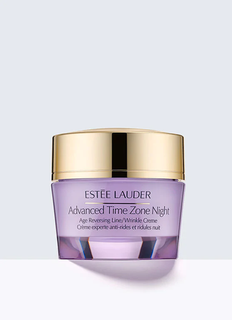
Estée Lauder Advanced Time Zone Night - Age Reversing Line/Wrinkle Creme
Works for
2 of 2 advertised claims delivered
MoisturizingTripeptide-32, Acetyl hexapeptide-8 + 48 moreStrong evidence
“* A nighttime amino acid complex helps optimize skin's natural replenishment of wrinkle-smoothing collagen.”
This product can help improve hydration of the skin with the two types of ingredients.
The first type is called “humectants”:
these ingredients help attract water.
When humectants are on the surface of the skin, they “pull in” the moisture from the outside environment, or from
within deeper layers of the skin. The following ingredients in this product do the job:
faex, glycerin.
This product also contains ingredients called “occlusives”. They help reduce the speed with which our skin loses moisture to the outside environment. These ingredients also help soften the upper layer of the skin, so it feels less tight and nicer to the touch. The following ingredients in this product do the job: bis-diglyceryl polyacyladipate-2, dimethicone.
The following ingredients in this product are especially good for supporting the skin barrier and helping with the hydration level: acetyl hexapeptide-8, tripeptide-32
Anti-agingAcetyl hexapeptide-8, Tripeptide-32 + 8 moreModerate evidence
“Age Reversing Line/Wrinkle Creme”
This product contains acetyl hexapeptide-8, arabidopsis thaliana extract, tripeptide-32, vitis vinifera seed extract. These ingredients might be able to help reduce and prevent fine lines and wrinkles, improve skin elasticity and firmness, but there is not enough evidence that it actually works.
Anti-oxidationNot advertised by the brand · Vitis vinifera seed extract, Bifida ferment lysate + 19 moreStrong evidence
This product contains antioxidants (vitis vinifera seed extract) that can help neutralize free radicals in skin. By doing so, they can lessen the damage the skin gets from the UV light (sun).
The following ingredients - bifida ferment lysate, decarboxy carnosine hcl also can have an antioxidant effect, but there is less evidence to confirm their effectiveness in skin.
Can it cause trouble?
Irritancy6 strong irritants: Rosa damascena extract, Rosmarinus officinalis extract + 4 more — patch-test recommendedHigh risk
Comedogenic2 ingredients rated 2 or more on the 0–5 pore-clogging scale2 flagged
User reviews
Be the first — your take helps the next person decide.
Ingredients
Filter by role to see what each ingredient is doing.
Water~45–55%
Bifida ferment lysate~5.3–6.4%
- Irritation risk
- Low
Consists of remains of dead yeast bacteria cells. Helps to hydrate the skin and reduce irritation. Might has some anti-oxidant effect
More about Bifida ferment lysateMethyl gluceth-20~3.8–4.6%
- Irritation risk
- Low
Helps attract water to the upper layer of the skin and soften it
More about Methyl gluceth-20Peg-75~2.9–3.5%
- Irritation risk
- Low
Helps create a nice product texture and soften the upper layer of the skin.
More about Peg-75Butylene glycol~2.2–2.7%
- Irritation risk
- Low
Used to create a nice product texture and help delivery of other ingredients. Might be somewhat helpful in attracting water to the upper layer of the skin
More about Butylene glycolBis-peg-18 methyl ether dimethyl silane~1.8–2.2%
- Irritation risk
- Low
A type of silicone that helps soften the upper layer of the skin and create a nice product texture
More about Bis-peg-18 methyl ether dimethyl silaneArabidopsis thaliana extract~1.5–1.9%
- Irritation risk
- Medium
Plant extract that might be helpful in repairing sun damage but evidence of effectiveness in skin are lacking
More about Arabidopsis thaliana extractTripeptide-32~1.2–1.4%
- Irritation risk
- Low
A type of peptide. Peptides are excellent moisturizers and might be able support collagen production reducing fine lines and wrinkles
More about Tripeptide-32Ethylhexyl methoxycinnamate~1.4–1.7%
- Irritation risk
- High
Octinoxate. When used in higher concentrations, works as a sunscreen protecting the skin from UVB rays. When used in lower concentration, helps to preserve the product formulation. Is shown to be harmful to coral reefs - consider avoiding bathing in coral reef areas when wearing a product with this ingredient. It can be irritating
More about Ethylhexyl methoxycinnamateLactobacillus ferment~0.6–0.9%
- Irritation risk
- Low
A fermentation product created by bacteria Lactobacillus. The fermented product has anti-bacterial properties and might be helpful in calming down inflammation, but studies are lacking. Helps attract water to the upper layer of the skin. Can be used as a preservative
More about Lactobacillus fermentRosa damascena extract~0.45–0.7%
- Irritation risk
- High
Oil of a very fragrant pink rose used as fragrance in cosmetics. Extensive research has shown it has mixed benefits. In the pro column, inhaling this flower’s scent seems to have relaxing properties and the plant’s petals contain skin-soothing and antioxidant compounds that can benefit skin. On the flipside, the numerous chemicals that create this rose’s distinctive fragrance pose a risk of causing skin aggravation.
More about Rosa damascena extractPantethine~0.4–0.6%
- Irritation risk
- Low
Helps to hydrate the skin by improving its barrier funciton
More about PantethineCaffeine~0.25–0.5%
- Irritation risk
- Medium
Might be helpful in neutralizing free radicals. Can have a dehydration effect that might somewhat decrease the look of puffy eyes
More about CaffeineGlycereth-26~0.2–0.4%
Triethanolamine~0.2–0.4%
- Irritation risk
- Medium
Used to adjust pH of the product and can help improve the product's smell
More about TriethanolamineSodium rna~0.2–0.35%
- Irritation risk
- Low
Is claimed to have anti-aging properties, but research about its effect in topical application is missing
More about Sodium rnaSqualane~0.25–0.45%
- Irritation risk
- Low
An oil naturally present in skin. Works as an emollient to soften the skin and form a protective layer on its surface without a greasy feeling.
More about SqualaneOleth-3 phosphate~0.15–0.3%
- Irritation risk
- Medium
- Comedogenicity
- 3/5
Helps water and oil mix together
More about Oleth-3 phosphateOleth-3~0.15–0.25%
- Irritation risk
- Medium
- Comedogenicity
- 3/5
Helps water and oil mix together
More about Oleth-3Oleth-5~0.1–0.2%
Bisabolol~0.05–0.1%
- Irritation risk
- Low
An active component of chamomile plant that historically has been used to calm down irritated skin. A recent study shows that bisabolol indeed can have some anti-inflammatory effect on skin, even though conclusive data is lacking. Bisabolol has a sweet floral scent and can be added to products for its aromatic properties
More about BisabololCholeth-24~0.1–0.15%
Ceteth-24~0.1–0.25%
Hydrogenated lecithin~0.05–0.1%
- Irritation risk
- Low
Helps to retain moisture by creating a protective barrier on the skin. Rich in fatty acids. Improves product texture and helps with the penetration of other ingredients.
More about Hydrogenated lecithinAnthemis nobilis flower oil~0.01–0.05%
- Irritation risk
- High
An essential oil that is used as a fragrance and can be irritating. It might have some anti-oxidant effect in skin
More about Anthemis nobilis flower oilChamomilla recutita extract~0.05%
- Irritation risk
- High
Plant extract that can have healing and anti-inflammatory properties. It is a potential allergen and can be irritating
More about Chamomilla recutita extractSodium hyaluronate~0.05%
- Irritation risk
- Low
One of the best moisturizing ingredients. Attracts water into the upper layer of the skin
More about Sodium hyaluronateTocopheryl acetate~0.05–0.1%
- Irritation risk
- Medium
A more stable but less bio-available form of vitamin E compared to Tocopherol. Might help moisturize and protect the skin from free radicals, but mostly used in low concentrations to stabilize other ingredients.
More about Tocopheryl acetateLecithin~0.1–0.15%
- Irritation risk
- Low
Used mostly for creating emulsions - helping oil and water mix together. Helps soften the upper layer of the skin
More about LecithinXanthan gum~0.05–0.1%
- Irritation risk
- Low
Used to create a thicker product consistency
More about Xanthan gumCarbomer~0.05–0.1%
- Irritation risk
- Low
Helps create a thicker or gel-like product texture. It is not a surfactant but can be used in gentle cleansing formulations
More about CarbomerTrisodium edta~0.05%
Bht~0.05%
Phenoxyethanol~0.05–0.1%
- Irritation risk
- Low
A preservative. It helps prevent bacterial growth in cosmetic products
More about PhenoxyethanolMethylparaben~0.05%
Benzyl alcohol~0.01–0.05%
- Irritation risk
- High
A preservative. Can be used to mask unpleasant smell. Can be irritating
More about Benzyl alcoholCi 61570~0.05–0.1%
- Irritation risk
- Low
Ci 19140~0.05–0.1%
Ci 14700~0.05–0.1%
Water~0.05–0.1%
Bis-diglyceryl polyacyladipate-2~0.1–0.15%
- Irritation risk
- Low
Helps soften the upper layer of the skin and reduce water loss from its surface
More about Bis-diglyceryl polyacyladipate-2Hdi/ppg/polycaprolactone crosspolymer~0.05–0.1%
- Irritation risk
- Low
Simmondsia chinensis seed oil~0.1–0.15%
- Irritation risk
- Medium
Softens the upper layer of skin and helps restore the healthy skin barrier. Has shown to help calm down inflammation in skin. It is a stable oil, meaning that it retains its properties even when exposed to air.
More about Simmondsia chinensis seed oilGlycerin~0.05–0.15%
- Irritation risk
- Low
One of the best moisturizing ingredients. Naturally present in skin. It attracts water to the upper layer of the skin working as a humectant
More about GlycerinCaprylic/capric triglyceride~0.1–0.2%
- Irritation risk
- Medium
A good mix of fatty acids that forms a protective layer on the skin. Improves the shelf life of products. Derived from coconut and glycerin
More about Caprylic/capric triglycerideC12-20 acid peg-8 ester~0.05–0.1%
- Irritation risk
- Medium
Helps oil and water mix together
More about C12-20 acid peg-8 esterDimethicone~0.1–0.2%
- Irritation risk
- Low
A silicone that helps to reduce water loss from the surface of the skin. Can temporarily "fill in" lines and wrinkles, absorb oil, and create a nice product finish
More about DimethiconeButylene glycol~0.05–0.1%
- Irritation risk
- Low
Used to create a nice product texture and help delivery of other ingredients. Might be somewhat helpful in attracting water to the upper layer of the skin
More about Butylene glycolSucrose~0.01–0.05%
- Irritation risk
- Low
Can help attract water to the upper layer of the skin. In crystal form, it can work as a gentle exfoliant, gentler than the salt scrub. Helps stabilize the emulsion
More about SucroseCetyl alcohol~0.1–0.15%
- Irritation risk
- Low
A non-drying alcohol that works to soften the skin and stabilize product formulations helping oil and water mix together
More about Cetyl alcoholCitrullus lanatus fruit extract~0.05%
- Irritation risk
- Medium
A plant extract that can contain an antioxidant compound
More about Citrullus lanatus fruit extractSigesbeckia orientalis extract~0.05%
- Irritation risk
- Medium
A plant extract that can contain an anti-inflammatory compound
More about Sigesbeckia orientalis extractPyrus malus fruit extract~0.05%
- Irritation risk
- Medium
Can have some moisturizing properties due to its sugar content
More about Pyrus malus fruit extractLens esculenta fruit extract~0.05%
- Irritation risk
- Medium
A plant extract containing sugars that might help attract water to the upper layer of the skin. Is claimed by the manufacturer to help reduce pore size but evidence is lacking
More about Lens esculenta fruit extractCentaurium erythraea extract~0.05%
- Irritation risk
- Medium
A plant extract that can help calm down inflammation in skin
More about Centaurium erythraea extractHordeum vulgare extract~0.05–0.1%
- Irritation risk
- Medium
A plant extract that might have some anti-oxidant properties. Avoid if you are sensitive to gluten
More about Hordeum vulgare extractCucumis sativus fruit extract~0.05–0.1%
- Irritation risk
- Medium
Might be somewhat helpful in reducing hyperpigmentation and neutralizing free radicals but its typical concentration in a product is too low for having an effect
More about Cucumis sativus fruit extractTamarindus indica seed extract~0.05–0.1%
- Irritation risk
- Low
Salicornia herbacea extract~0.05%
- Irritation risk
- Low
Polygonum cuspidatum root extract~0.05–0.1%
- Irritation risk
- Medium
A plant extract that can contain resveratrol, an antioxidant that can help neutralize free radicals in skin. The effectiveness depends on the extract quality and concentration in the product
More about Polygonum cuspidatum root extractVitis vinifera seed extract~0.05–0.1%
- Irritation risk
- Low
A plant extract that contains resveratrol and other anti-oxidant compounds that can help neutralize free radicals, reduce inflammation in skin and even out its tone. Can be also used to stabilize the product formulation
More about Vitis vinifera seed extractHydrolyzed rice extract~0.05%
- Irritation risk
- Low
A plant extract that is claimed to be helpful in moisturizing and lightening the skin, but evidence is missing
More about Hydrolyzed rice extractRosmarinus officinalis extract~0.05–0.1%
- Irritation risk
- High
Selaginella tamariscina extract~0.05%
- Irritation risk
- Low
Humulus lupulus extract~0.05%
- Irritation risk
- High
Hops extract. Can contain common irritants and allergens geraniol, limonene, linalool
More about Humulus lupulus extractCitrus reticulata peel extract~0.05%
- Irritation risk
- High
A likely irritant. Might have some anti-oxidant activity, but is mostly used as a fragrance in cosmetic products
More about Citrus reticulata peel extractRhodochrosite extract~0.05–0.1%
- Irritation risk
- Low
Cucumis melo fruit extract~0.05%
- Irritation risk
- Medium
A fruit extract that might have some anti-oxidant properties
More about Cucumis melo fruit extractYeast extract~0.05%
- Irritation risk
- Low
Helps attract water to the upper layer of the skin and might have some anti-oxidant and skin lightening properties. It can help calm down inflammation in skin
More about Yeast extractFaex~0.05%
- Irritation risk
- Low
Yeast extract. Helps to attract water to the upper layer of the skin
More about FaexYeast extract~0.05%
- Irritation risk
- Low
Helps attract water to the upper layer of the skin and might have some anti-oxidant and skin lightening properties. It can help calm down inflammation in skin
More about Yeast extractLimonium vulgare flower/leaf/stem extract~0.05%
- Irritation risk
- High
An essential oil that can be irritating
More about Limonium vulgare flower/leaf/stem extractWhey protein~0.05–0.1%
- Irritation risk
- Low
A protein derived from milk. In skincare products, might help to soften the upper layer of the skin
More about Whey proteinThermus thermophillus ferment~0.05%
- Irritation risk
- Medium
Might be helpful in neutralising free radicals in skin and have some hydration properties
More about Thermus thermophillus fermentPersea gratissima oil~0.1–0.15%
- Irritation risk
- Medium
An emollient that helps soften the skin and could be helpful in repairing its barrier function
More about Persea gratissima oilPunica granatum fruit juice~0.05%
- Irritation risk
- Medium
A fruit juice. Might have some anti-oxidant properties but is unlikely to have any benefit when used in skincare
More about Punica granatum fruit juiceCholesterol~0.1–0.15%
- Irritation risk
- Low
An emollient that is naturally found in skin
More about CholesterolLinoleic acid~0.15–0.25%
- Irritation risk
- Low
An excellent emollient. Helps soften the skin, restore its barrier function, and can help to calm down inflammation. It can be helpful to prevent blemishes and clogged pores
More about Linoleic acidCaffeine~0.05%
- Irritation risk
- Medium
Might be helpful in neutralizing free radicals. Can have a dehydration effect that might somewhat decrease the look of puffy eyes
More about CaffeineAcetyl glucosamine~0.05%
- Irritation risk
- Low
An effective moisturizing ingredient that also has been shown to be effective in evening out the skin tone and reducing hyperpigmentation. It can help somewhat reduce wrinkles in skin
More about Acetyl glucosamineLinolenic acid~0.1–0.2%
- Irritation risk
- Medium
An emollient that helps soften the skin and calm down inflammation
More about Linolenic acidAdenosine phosphate~0.05–0.1%
- Irritation risk
- Low
Might help improve cell turnover and reduce inflammation in skin. One study shows that the ingredients might be able to stimulate collagen production in skin
More about Adenosine phosphatePhospholipids~0.05–0.1%
- Irritation risk
- Low
Emollients that are naturaly present in skin. In addition, they help water and oil mix together in the product
More about PhospholipidsAcetyl hexapeptide-8~0.05–0.1%
- Irritation risk
- Low
A type of peptide. Peptides are excellent moisturizers and might be able support collagen production reducing fine lines and wrinkles
More about Acetyl hexapeptide-8Ammonium acryloyldimethyltaurate/vp copolymer~0.05–0.1%
- Irritation risk
- Low
Increases thickness of a product. Texture enhancer for oil-in-water emulsions
More about Ammonium acryloyldimethyltaurate/vp copolymerBehenyl alcohol~0.1–0.2%
- Irritation risk
- Low
Non-drying alcohol that helps water and oil mix together. Also serves as an emollient
More about Behenyl alcoholSaccharide isomerate~0.05–0.1%
- Irritation risk
- Low
Helps attract water to the upper layer of the skin
More about Saccharide isomeratePeg-100 stearate~0.15–0.25%
- Irritation risk
- Low
Helps oil and water mix togehter and creates a nice product texture
More about Peg-100 stearatePhytosterols~0.1–0.2%
- Irritation risk
- Medium
Lipids that work as an emollient and can be helpful in repairing skin barrier function
More about PhytosterolsTocopheryl acetate~0.05–0.15%
- Irritation risk
- Medium
A more stable but less bio-available form of vitamin E compared to Tocopherol. Might help moisturize and protect the skin from free radicals, but mostly used in low concentrations to stabilize other ingredients.
More about Tocopheryl acetateTriolein~0.05–0.1%
Glyceryl stearate~0.15–0.25%
- Irritation risk
- Low
An emollient that softens the skin and forms a protective layer on its surface. Helps water and oil mix together
More about Glyceryl stearateTrehalose~0.1–0.15%
- Irritation risk
- Low
A sugar that attracts water to the upper layer of the skin
More about TrehalosePotassium cetyl phosphate~0.1–0.2%
- Irritation risk
- Medium
Helps oil and water mix together
More about Potassium cetyl phosphateCaprylyl glycol~0.1–0.2%
- Irritation risk
- Medium
Helps preserve products and creates a nice product texture
More about Caprylyl glycolPropylene glycol dicaprate~0.15–0.25%
- Irritation risk
- Low
An emollient that helps soften the upper layer of the skin
More about Propylene glycol dicaprateSodium pca~0.1–0.2%
- Irritation risk
- Low
Naturally present in skin and helps to attract water to its upper layer
More about Sodium pcaHelianthus annuus seedcake~0.2–0.4%
Propylene glycol dicaprylate~0.15–0.3%
- Irritation risk
- Low
Helps soften the upper layer of the skin and create a nice product texture
More about Propylene glycol dicaprylateXanthan gum~0.15–0.25%
- Irritation risk
- Low
Used to create a thicker product consistency
More about Xanthan gumAcrylates/c10-30 alkyl acrylate crosspolymer~0.15–0.25%
- Irritation risk
- Medium
Maintains the texture of skincare products. Allows the product to spread evenly. Helps oil and water mix together
More about Acrylates/c10-30 alkyl acrylate crosspolymerSodium hyaluronate~0.1–0.25%
- Irritation risk
- Low
One of the best moisturizing ingredients. Attracts water into the upper layer of the skin
More about Sodium hyaluronateSodium lactate~0.1–0.25%
- Irritation risk
- Medium
Helps attract water to the upper layer of the skin. Is often used to adjust the pH level of the product
More about Sodium lactateDipalmitoyl hydroxyproline~0.1–0.2%
- Irritation risk
- Low
Is claimed to stimulate collagen and elastin production, as well as work as an anti-oxidant. There is however not enough evidence for its effectiveness
More about Dipalmitoyl hydroxyprolinePhytosteryl canola glycerides~0.1–0.25%
- Irritation risk
- Low
Helps soften the upper layer of the skin
More about Phytosteryl canola glyceridesOleic acid~0.15–0.3%
- Irritation risk
- Medium
Helps soften the upper layer of the skin. At the same time, it can weaken the skin's barrier enhancing penetration of other ingredients and increasing the risk of skin dryness
More about Oleic acidPalmitic acid~0.15–0.3%
- Irritation risk
- Low
An emollient that is naturally present in skin and helps soften it
More about Palmitic acidStearic acid~0.25–0.45%
- Irritation risk
- Low
Helps oil and water mix together and works as an emollient
More about Stearic acidPotassium sulfate~0.15–0.25%
Acrylamide/sodium acryloyldimethyltaurate copolymer~0.1–0.25%
- Irritation risk
- Low
Helps water and oil mix together and create gel-like textures
More about Acrylamide/sodium acryloyldimethyltaurate copolymerDecarboxy carnosine hcl~0.1–0.2%
- Irritation risk
- Low
Might be able to protect the skin from free radicals, but further evidence of effectiveness is needed
More about Decarboxy carnosine hclIsohexadecane~0.25–0.45%
- Irritation risk
- Low
Improves the texture of the product and helps soften the skin. Helps oil and water mix together and can be used as a cleansing agent
More about IsohexadecaneNordihydroguaiaretic acid~0.15–0.25%
- Irritation risk
- Medium
Used to stabilize the formula of product formulation. Might be helpful in neutralizing free radicals in skin
More about Nordihydroguaiaretic acidCarbomer~0.15–0.25%
- Irritation risk
- Low
Helps create a thicker or gel-like product texture. It is not a surfactant but can be used in gentle cleansing formulations
More about CarbomerPolysorbate 80~0.15–0.3%
Cyclodextrin~0.15–0.25%
- Irritation risk
- Low
A type of sugar that is used to support delivery of active ingredients and can enhance their penetration into the skin without disrupting the skin's barrier
More about CyclodextrinParfum~0.15–0.25%
- Irritation risk
- High
An aromatic blend of unspecified and possibly irritating ingredients
More about ParfumSilica~0.25–0.5%
Guaiacol~0.1–0.2%
- Irritation risk
- Low
Manganese chloride~0.15–0.25%
- Irritation risk
- Low
Sodium hydroxide~0.15–0.25%
Phenoxyethanol~0.15–0.25%
- Irritation risk
- Low
A preservative. It helps prevent bacterial growth in cosmetic products
More about PhenoxyethanolCi 17200~0.05–0.15%
Ci 42090~0.05–0.1%
Ingredient list view
Water, Bifida ferment lysate, Methyl gluceth-20, Peg-75, Butylene glycol, Bis-peg-18 methyl ether dimethyl silane, Arabidopsis thaliana extract, Tripeptide-32, Ethylhexyl methoxycinnamate, Lactobacillus ferment, Rosa damascena extract, Pantethine, Caffeine, Glycereth-26, Triethanolamine, Sodium rna, Squalane, Oleth-3 phosphate, Oleth-3, Oleth-5, Bisabolol, Choleth-24, Ceteth-24, Hydrogenated lecithin, Anthemis nobilis flower oil, Chamomilla recutita extract, Sodium hyaluronate, Tocopheryl acetate, Lecithin, Xanthan gum, Carbomer, Trisodium edta, Bht, Phenoxyethanol, Methylparaben, Benzyl alcohol, Unknown, Ci 61570, Ci 19140, Ci 14700, Water, Bis-diglyceryl polyacyladipate-2, Hdi/ppg/polycaprolactone crosspolymer, Simmondsia chinensis seed oil, Glycerin, Caprylic/capric triglyceride, C12-20 acid peg-8 ester, Dimethicone, Butylene glycol, Sucrose, Cetyl alcohol, Citrullus lanatus fruit extract, Sigesbeckia orientalis extract, Pyrus malus fruit extract, Lens esculenta fruit extract, Centaurium erythraea extract, Hordeum vulgare extract, Cucumis sativus fruit extract, Tamarindus indica seed extract, Salicornia herbacea extract, Polygonum cuspidatum root extract, Vitis vinifera seed extract, Hydrolyzed rice extract, Rosmarinus officinalis extract, Selaginella tamariscina extract, Humulus lupulus extract, Citrus reticulata peel extract, Rhodochrosite extract, Cucumis melo fruit extract, Yeast extract, Faex, Yeast extract, Limonium vulgare flower/leaf/stem extract, Whey protein, Thermus thermophillus ferment, Persea gratissima oil, Punica granatum fruit juice, Cholesterol, Linoleic acid, Caffeine, Acetyl glucosamine, Linolenic acid, Adenosine phosphate, Phospholipids, Acetyl hexapeptide-8, Ammonium acryloyldimethyltaurate/vp copolymer, Behenyl alcohol, Saccharide isomerate, Peg-100 stearate, Phytosterols, Tocopheryl acetate, Triolein, Glyceryl stearate, Trehalose, Potassium cetyl phosphate, Caprylyl glycol, Propylene glycol dicaprate, Sodium pca, Helianthus annuus seedcake, Propylene glycol dicaprylate, Xanthan gum, Acrylates/c10-30 alkyl acrylate crosspolymer, Sodium hyaluronate, Sodium lactate, Dipalmitoyl hydroxyproline, Phytosteryl canola glycerides, Oleic acid, Palmitic acid, Stearic acid, Potassium sulfate, Acrylamide/sodium acryloyldimethyltaurate copolymer, Decarboxy carnosine hcl, Isohexadecane, Nordihydroguaiaretic acid, Carbomer, Polysorbate 80, Cyclodextrin, Parfum, Silica, Guaiacol, Manganese chloride, Sodium hydroxide, Phenoxyethanol, Ci 17200, Ci 42090
Compare prices
Retailers ranked by price — lowest first.
Affiliate links · prices updated regularly · As an Amazon Associate, WIMJ earns from qualifying purchases.
Product summary
Based on the ingredients included, "Estée Lauder - Advanced Time Zone Night - Age Reversing Line/Wrinkle Creme" works well for moisturizing the skin. As we expect from a proper moisturizer, the formula includes a combo of effective humectants and emollients. These are the two different types of ingredients that are essential for improving the skin hydration and supporting a healthy skin barrier. Humectants in this product (acetyl hexapeptide-8, faex, glycerin, lactobacillus ferment and sodium hyaluronate) help to increase the water content in the upper layer of the skin. (These ingredients do so by "capturing" water molecules from the outside air or from within the deeper layers of the skin). Cholesterol, linolenic acid, pantethine, phytosterols and bis-diglyceryl polyacyladipate-2 in this product help decrease the water evoporation from the skin, so that it stays hydrated for longer. These ingredients also soften the skin and take away the feeling of tightness and dryness.
Ingredient callouts
- This moistruizer also contains peptides (acetyl hexapeptide-8 0.05% - 0.10% and tripeptide-32 1.20% - 1.40%). Peptides is a very big group of ingredients. They all consist of a different combination of amino-acids. Our skin produces peptides naturally. Some of them work as natural anti-biotics, promote wound-healing and production of collagen. The scientists are still studying how effective the topical application of peptides is, but it is very likely that peptides in skincare are helpful. They might be able to support skin barrier restoration and even have an anti-aging benefit. At the very least, they certainly help attract water to the skin and support the hydration in this way.
Irritation risk
There are quite a few common irritants in this product, including ingredients without particular skin benefits. We would not recommend it for sensitive skin. We assess the overall irritancy of this moisturizer to be high. For a detailed overview of all potential irritants: click here
You can see the detailed formula review with the breakdown of all actives in the product and the full ingredient list with estimated concentrations in the tables below.
Price
The product retails for 129.91$ in the United States.
For a detailed price comparison: click here.
Sources cited in this review
Every concentration estimate and effectiveness label is anchored to one of these 57 studies and safety reviews.
- 1Bifidobacterium longumlysate, a new ingredient forreactive skinonlinelibrary.wiley.com
- 2Use of Probiotics for Dermal Applicationsresearchgate.net
- 3
- 4Repair of Damaged DNA by Arabidopsis Cell Extractncbi.nlm.nih.gov
- 5
- 6

Affiliate links · As an Amazon Associate, WIMJ earns from qualifying purchases.