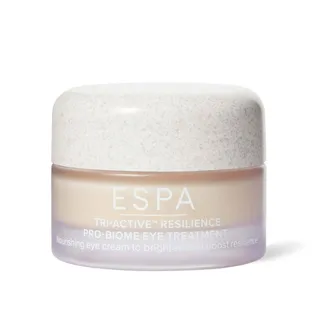
ESPA Tri-Active Resilience Pro Biome Eye Treatment

ESPA Tri-Active Resilience Pro Biome Eye Treatment

Efficacy75/100IrritancyHigh

Works for

Moisturizing
Coconut alkanes, Bifida ferment lysate + 29 more
Works
What the product description says
“A clinically proven eye cream with antioxidant properties, ESPA Tri-Active Resilience Pro Biome Eye Treatment smooths, brightens, replenishes, and hydrates the eye area.”
Source: Face the future

This product can help improve hydration of the skin with the two types of ingredients.

The first type is called “humectants”:
these ingredients help attract water. When humectants are on the surface of the skin, they “pull in” the moisture from the outside environment, or from within deeper layers of the skin. The following ingredients in this product do the job: anhydroxylitol, glycerin.

This product also contains ingredients called “occlusives”. They help reduce the speed with which our skin loses moisture to the outside environment. These ingredients also help soften the upper layer of the skin, so it feels less tight and nicer to the touch. The following ingredients in this product do the job: helianthus annuus seed oil, squalene.

Coconut alkanesKey active· EmollientEffect: MediumAn emollient that helps soften the skin~6–7.3%
Bifida ferment lysateKey activeEffect: HighConsists of remains of dead yeast bacteria cells. Helps to hydrate the skin and reduce irritation. Might has some anti-oxidant effect~4.4–5.4%
Helianthus annuus seed oil unsaponifiablesKey active· EmollientEffect: HighA great emollient due to its high linoleic acid content. One of the most effective plant oils in helping skin hydration and repairing skin barrier function~3.2–3.9%
GlycerinKey active· HumectantEffect: HighOne of the best moisturizing ingredients. Naturally present in skin. It attracts water to the upper layer of the skin working as a humectant~1.4–1.8%
Helianthus annuus seed oilKey active· Emollient, OcclusiveEffect: HighA great emollient due to its high linoleic acid content. One of the most effective plant oils in helping skin hydration and repairing skin barrier function~1.2–1.5%
XylitylglucosideKey active· HumectantEffect: HighHelps attract water to the upper layer of the skin and repair the skin barrier function~0.5–0.75%
Coco-caprylate/caprateKey active· EmollientEffect: MediumHelps to soften the upper layer of the skin without creating a greasy texture~0.5–0.7%
Cetyl alcoholKey active· EmollientEffect: MediumA non-drying alcohol that works to soften the skin and stabilize product formulations helping oil and water mix together~0.4–0.65%
AnhydroxylitolKey active· HumectantEffect: HighHelps attract water to the upper layer of the skin and repair the skin barrir function~0.35–0.6%
SqualeneKey active· Emollient, OcclusiveEffect: HighAn oil that is naturally part of skin sebum that helps to soften its upper layer, reduce water loss and neutralize free radicals. It might be comedogenic. Avoid applying large concentrations (or pure oil) before sun exposure as oxidized squalene can clog pores and lead to skin irritation. Today squalene is mostly derived from vegetable oils or synthetized by yeast~0.3–0.55%
Elaeis guineensis oilKey active· EmollientEffect: MediumHelps soften the upper layer of the skin~0.3–0.55%
Jojoba estersKey active· EmollientEffect: HighAn emollient made of jojoba oil. Helps soften the skin and support its barrier function~0.25–0.5%
Saccharide isomerateKey active· HumectantEffect: HighHelps attract water to the upper layer of the skin~0.25–0.45%
Sodium hyaluronateKey active· HumectantEffect: HighOne of the best moisturizing ingredients. Attracts water into the upper layer of the skin~0.25–0.45%
TrehaloseKey active· HumectantEffect: HighA sugar that attracts water to the upper layer of the skin~0.25–0.45%
Glyceryl linolenateKey active· EmollientEffect: MediumHelps soften the upper layer of the skin~0.25–0.45%
Gossypium herbaceum seed oilKey activeEffect: MediumCottonseed oil. It is used as an emollient and occlusive in products. It is rich palmitic, oleic acid, and linoleic fatty acids.~0.25–0.45%
Plankton extractKey activeEffect: MediumCan help attract water to the upper layer of the skin~0.25–0.45%
Chlorella vulgaris extractKey activeEffect: MediumA plant extract that can help to attract water to the upper layer of the skin and might have some anti-oxidant and anti-inflammatory properties~0.25–0.45%
GlucoseKey active· HumectantEffect: MediumHelps attract water to the upper layer of the skin. Could be helpful in restoring the skin barrier function~0.25–0.45%
Polyglyceryl-6 distearateEffect: LowHelps oil and water mix together while softening the upper layer of the skin~1.7–2.1%
Glyceryl stearate· EmollientEffect: LowAn emollient that softens the skin and forms a protective layer on its surface. Helps water and oil mix together~0.45–0.7%
Sorbitol· HumectantEffect: LowHelps attract water to the upper layer of the skin and improves the product texture~0.25–0.45%
Caprylyl glycol· Humectant, EmollientEffect: LowHelps preserve products and creates a nice product texture~0.2–0.35%
Linum usitatissimum seed oilEffect: Low~0.2–0.35%
Glyceryl caprylate· EmollientEffect: LowAn emollient that can also help water and oil mix together, as well as prevent bacteria growth in products~0.15–0.25%
Stearic acidEffect: Low, below effective doseHelps oil and water mix together and works as an emollient~0.5–0.75%
LecithinEffect: Low, below effective doseUsed mostly for creating emulsions - helping oil and water mix together. Helps soften the upper layer of the skin~0.3–0.5%
TocopherolEffect: Low, below effective dosePure form of vitamin E. Can help moisturise and protect the skin from free radicals. Often used to help stabilise other ingredients or the formula itself~0.25–0.45%
Lactic acidUnder-dosedAn exfoliating and moisturizing alpha-hydroxy acid (AHA). Typically causes less irritation than other AHAs, for example, glycolic acid. At high concentrations (about 15%), lactic acid can help reduce lines and wrinkles. Recent studies show that lactic acid can support the "good" bacteria living on skin's surface (healthy skin microbiome)~0.25–0.45%
Laminaria digitata extractUnder-dosedSeaweed extract that helps the skin to attract water and make it more smooth for touch. Also shows promise of anti-aging properties, but good research is lacking at the moment~0.25–0.45%
Anti-oxidation
Side benefit · Bifida ferment lysate, Squalene + 7 more
May help

This product contains antioxidants (bifida ferment lysate, squalene) that might be able to help neutralize free radicals in skin to lessen the damage it gets from the UV light (sun). There is not enough evidence to confirm their effectiveness in skin though.

Bifida ferment lysateKey activeEffect: MediumConsists of remains of dead yeast bacteria cells. Helps to hydrate the skin and reduce irritation. Might has some anti-oxidant effect~4.4–5.4%
SqualeneKey activeEffect: MediumAn oil that is naturally part of skin sebum that helps to soften its upper layer, reduce water loss and neutralize free radicals. It might be comedogenic. Avoid applying large concentrations (or pure oil) before sun exposure as oxidized squalene can clog pores and lead to skin irritation. Today squalene is mostly derived from vegetable oils or synthetized by yeast~0.3–0.55%
Paeonia lactiflora root extractEffect: LowA plant extract that might help neutralize free radicals and reduce hyperpigmentation, but the research on its effectiveness in skin is lacking~0.25–0.45%
Chlorella vulgaris extractEffect: LowA plant extract that can help to attract water to the upper layer of the skin and might have some anti-oxidant and anti-inflammatory properties~0.25–0.45%
Tocopheryl acetateEffect: Low, below effective doseA more stable but less bio-available form of vitamin E compared to Tocopherol. Might help moisturize and protect the skin from free radicals, but mostly used in low concentrations to stabilize other ingredients.~0.25–0.45%
Laminaria digitata extractEffect: Low, below effective doseSeaweed extract that helps the skin to attract water and make it more smooth for touch. Also shows promise of anti-aging properties, but good research is lacking at the moment~0.25–0.45%
Rosmarinus officinalis leaf extractEffect: Low, below effective doseCan be helpful in reducing inflammation in skin, including inflamed acne. It can be irritating~0.2–0.4%
TocopherolUnder-dosedPure form of vitamin E. Can help moisturise and protect the skin from free radicals. Often used to help stabilise other ingredients or the formula itself~0.25–0.45%
Sodium ascorbyl phosphateUnder-dosedA stable derivative of vitamin C. It is oil-soluble which means it is more likely to penetrate the skin compared to the pure form of vitamin C (which is water-soluble), but it is less bio-available and is way less effective in stimulating collagen and reducing wrinkles compared to the pure form of vitamin C (L-ascorbic acid) and its other derivatives (for example, magnesium ascorbyl phosphate). At the same time, this vitamin C derivative has been shown in studies to be effective in reducing acne, blemishes and clogged pores. It is less irritating then the pure form of vitamin C~0.15–0.3%

Can it cause trouble?

Irritancy
10 strong irritants: Polianthes tuberosa callus extract, Citrus aurantium amara flower oil + 8 more — patch-test recommended
High risk
We flagged 32 ingredients with irritancy potential. Severity depends on your sensitivity threshold; the table lists the worst offenders first.
IngredientFunctionIrritationEst. amount
Polianthes tuberosa callus extract—High~0.25–0.5%est.
Citrus aurantium amara flower oilUsed as a fragrance. Can be irritatingHigh~0.25–0.45%est.
LinaloolA fragrance. Can be irritatingHigh~0.2–0.4%est.
Rosmarinus officinalis leaf extractCan be helpful in reducing inflammation in skin, including inflamed acne. It can be irritatingHigh~0.2–0.4%est.
LimoneneA common frangrance that can easily irritate skin, especially if exposed to air, light or heatHigh~0.2–0.4%est.
GeraniolA fragrance. Can be irritatingHigh~0.2–0.4%est.
FarnesolAdded to create a nice product smell. Can be irritatingHigh~0.2–0.4%est.
CitronellolA fragrance. Can be irritatingHigh~0.2–0.4%est.
ParfumAn aromatic blend of unspecified and possibly irritating ingredientsHigh~0.2–0.35%est.
Retinyl palmitateThree steps removed from the active form of vitamin A - retinoic acid. To have an effect in the skin, it first needs to be converted twice to become the retinoic acid. This means it is less potent than retinol, but could also be less irritating. Once converted to the retinoic acid in the skin, it helps against all signs of aging, improves skin cell turnover and helps fight blemishes and clogged pores. However, in many cosmetic formulations, it is used in a concentration that is too low to have the full effectHigh~0.15–0.25%est.
Coconut alkanesAn emollient that helps soften the skinMedium~6–7.3%est.
Polyglyceryl-6 distearateHelps oil and water mix together while softening the upper layer of the skinMedium~1.7–2.1%est.
Polyglyceryl-2 stearateHelps water and oil mix togetherMedium~0.9–1.1%est.
Isostearyl isostearateHelps soften the upper layer of the skin and improve the product texture. It can be comedogenicMedium~0.25–0.5%est.
Potassium cetyl phosphateHelps oil and water mix togetherMedium~0.25–0.5%est.
Jojoba estersAn emollient made of jojoba oil. Helps soften the skin and support its barrier functionMedium~0.25–0.5%est.
Polyglyceryl-3 beeswaxHelps water and oil mix together. Could be an allergen (beeswax)Medium~0.25–0.5%est.
Benzoic acidA preservativeMedium~0.25–0.5%est.
Dehydroacetic acidA preservativeMedium~0.25–0.45%est.
Citric acidCan work as an exfoliant but is typically used to adjust the product pHMedium~0.25–0.45%est.
EthylhexylglycerinA preservativeMedium~0.25–0.45%est.
Plankton extractCan help attract water to the upper layer of the skinMedium~0.25–0.45%est.
Paeonia lactiflora root extractA plant extract that might help neutralize free radicals and reduce hyperpigmentation, but the research on its effectiveness in skin is lackingMedium~0.25–0.45%est.
Lactic acidAn exfoliating and moisturizing alpha-hydroxy acid (AHA). Typically causes less irritation than other AHAs, for example, glycolic acid. At high concentrations (about 15%), lactic acid can help reduce lines and wrinkles. Recent studies show that lactic acid can support the "good" bacteria living on skin's surface (healthy skin microbiome)Medium~0.25–0.45%est.
Chlorella vulgaris extractA plant extract that can help to attract water to the upper layer of the skin and might have some anti-oxidant and anti-inflammatory propertiesMedium~0.25–0.45%est.
Potassium sorbateA preservativeMedium~0.25–0.45%est.
Tocopheryl acetateA more stable but less bio-available form of vitamin E compared to Tocopherol. Might help moisturize and protect the skin from free radicals, but mostly used in low concentrations to stabilize other ingredients.Medium~0.25–0.45%est.
Maris salUsed to thicken the product formulation and might help to add minerals to the surface of the skin. It is used in scrubs as a physical exfoliant. Can increase sensitivity to other ingredients if left on the skin or used in high concentrationMedium~0.2–0.4%est.
Glyceryl linoleateHelps oil and water mix togetherMedium~0.25–0.5%est.
Sodium ascorbyl phosphateA stable derivative of vitamin C. It is oil-soluble which means it is more likely to penetrate the skin compared to the pure form of vitamin C (which is water-soluble), but it is less bio-available and is way less effective in stimulating collagen and reducing wrinkles compared to the pure form of vitamin C (L-ascorbic acid) and its other derivatives (for example, magnesium ascorbyl phosphate). At the same time, this vitamin C derivative has been shown in studies to be effective in reducing acne, blemishes and clogged pores. It is less irritating then the pure form of vitamin CMedium~0.15–0.3%est.
Caprylyl glycolHelps preserve products and creates a nice product textureMedium~0.2–0.35%est.
Disodium edtaStabilizes the product formulationMedium~0.05–0.1%est.
Comedogenic
8 ingredients rated 2 or more on the 0–5 pore-clogging scale
8 flagged
These ingredients have a comedogenic rating of 2 or more on a 0–5 scale; the table shows each one's rating. In leave-on products they can clog pores in acne-prone skin.
IngredientFunctionRatingEst. amount
Gossypium herbaceum seed oilCottonseed oil. It is used as an emollient and occlusive in products. It is rich palmitic, oleic acid, and linoleic fatty acids.3/5~0.25–0.45%est.
Isostearyl isostearateHelps soften the upper layer of the skin and improve the product texture. It can be comedogenic3/5~0.25–0.5%est.
Plankton extractCan help attract water to the upper layer of the skin3/5~0.25–0.45%est.
Laminaria digitata extractSeaweed extract that helps the skin to attract water and make it more smooth for touch. Also shows promise of anti-aging properties, but good research is lacking at the moment3/5~0.25–0.45%est.
Hydrolyzed rhodophyceae extract—3/5~0.25–0.45%est.
Chlorella vulgaris extractA plant extract that can help to attract water to the upper layer of the skin and might have some anti-oxidant and anti-inflammatory properties3/5~0.25–0.45%est.
Coconut alkanesAn emollient that helps soften the skin2/5~6–7.3%est.
SqualeneAn oil that is naturally part of skin sebum that helps to soften its upper layer, reduce water loss and neutralize free radicals. It might be comedogenic. Avoid applying large concentrations (or pure oil) before sun exposure as oxidized squalene can clog pores and lead to skin irritation. Today squalene is mostly derived from vegetable oils or synthetized by yeast2/5~0.3–0.55%est.

User reviews

Would you recommend?
No community reviews yet.

Be the first — your take helps the next person decide.

Ingredients

Filter by role to see what each ingredient is doing.

Water~45–55%
Formula
Irritation risk
Low

Plain old water

More about Water
Coconut alkanes~6–7.3%
Key activeComedogenic 2/5Irritant · medium
Irritation risk
Medium
Comedogenicity
2/5
Works for
Moisturizing

An emollient that helps soften the skin

More about Coconut alkanes
Bifida ferment lysate~4.4–5.4%
Key active
Irritation risk
Low
Works for
MoisturizingAnti-oxidationEvens skin tone

Consists of remains of dead yeast bacteria cells. Helps to hydrate the skin and reduce irritation. Might has some anti-oxidant effect

More about Bifida ferment lysate
Helianthus annuus seed oil unsaponifiables~3.2–3.9%
Key active
Irritation risk
Low
Works for
Moisturizing

A great emollient due to its high linoleic acid content. One of the most effective plant oils in helping skin hydration and repairing skin barrier function

More about Helianthus annuus seed oil unsaponifiables
Propanediol~2.4–2.9%
Formula
Irritation risk
Low

Acts as a solvent for other ingredients. Speeds up the absorption of other ingredients into the skin

More about Propanediol
Maris aqua~1.9–2.4%
Formula
Irritation risk
Low

Sea water. Helps dissolve other ingredients in a product

More about Maris aqua
Polyglyceryl-6 distearate~1.7–2.1%
Irritant · medium
Irritation risk
Medium
Works for
CleansingMoisturizing

Helps oil and water mix together while softening the upper layer of the skin

More about Polyglyceryl-6 distearate
Glycerin~1.4–1.8%
Key active
Irritation risk
Low
Works for
Moisturizing

One of the best moisturizing ingredients. Naturally present in skin. It attracts water to the upper layer of the skin working as a humectant

More about Glycerin
Helianthus annuus seed oil~1.2–1.5%
Key active
Irritation risk
Low
Works for
Moisturizing

A great emollient due to its high linoleic acid content. One of the most effective plant oils in helping skin hydration and repairing skin barrier function

More about Helianthus annuus seed oil
Polyglyceryl-2 stearate~0.9–1.1%
Irritant · medium
Irritation risk
Medium
Works for
Cleansing

Helps water and oil mix together

More about Polyglyceryl-2 stearate
Cetyl stearate~0.7–1%
Formula
Irritation risk
Low
More about Cetyl stearate
Xylitylglucoside~0.5–0.75%
Key active
Irritation risk
Low
Works for
Moisturizing

Helps attract water to the upper layer of the skin and repair the skin barrier function

More about Xylitylglucoside
Coco-caprylate/caprate~0.5–0.7%
Key active
Irritation risk
Low
Works for
Moisturizing

Helps to soften the upper layer of the skin without creating a greasy texture

More about Coco-caprylate/caprate
Glyceryl stearate~0.45–0.7%
Formula
Irritation risk
Low
Works for
CleansingMoisturizing

An emollient that softens the skin and forms a protective layer on its surface. Helps water and oil mix together

More about Glyceryl stearate
Anhydroxylitol~0.35–0.6%
Key active
Irritation risk
Low
Works for
Moisturizing

Helps attract water to the upper layer of the skin and repair the skin barrir function

More about Anhydroxylitol
Phenoxyethanol~0.35–0.65%
Formula
Irritation risk
Low

A preservative. It helps prevent bacterial growth in cosmetic products

More about Phenoxyethanol
Cetyl alcohol~0.4–0.65%
Key active
Irritation risk
Low
Works for
CleansingMoisturizing

A non-drying alcohol that works to soften the skin and stabilize product formulations helping oil and water mix together

More about Cetyl alcohol
Stearyl alcohol~0.35–0.6%
Formula
Irritation risk
Low
Works for
Cleansing

An emollient that helps soften the skin

More about Stearyl alcohol
Gossypium herbaceum seed oil~0.25–0.45%
Key activeComedogenic 3/5
Irritation risk
Low
Comedogenicity
3/5
Works for
Moisturizing

Cottonseed oil. It is used as an emollient and occlusive in products. It is rich palmitic, oleic acid, and linoleic fatty acids.

More about Gossypium herbaceum seed oil
Bentonite~0.25–0.5%
Formula
Irritation risk
Low
Works for
Anti-blemish

Helps stabilize the product formulation

More about Bentonite
Elaeis guineensis oil~0.3–0.55%
Key active
Irritation risk
Low
Works for
Moisturizing

Helps soften the upper layer of the skin

More about Elaeis guineensis oil
Isostearyl isostearate~0.25–0.5%
Comedogenic 3/5Irritant · medium
Irritation risk
Medium
Comedogenicity
3/5

Helps soften the upper layer of the skin and improve the product texture. It can be comedogenic

More about Isostearyl isostearate
Potassium cetyl phosphate~0.25–0.5%
Irritant · medium
Irritation risk
Medium
Works for
Cleansing

Helps oil and water mix together

More about Potassium cetyl phosphate
Jojoba esters~0.25–0.5%
Key activeIrritant · medium
Irritation risk
Medium
Works for
Moisturizing

An emollient made of jojoba oil. Helps soften the skin and support its barrier function

More about Jojoba esters
Bidens pilosa extract~0.2–0.4%
Formula
Linum usitatissimum seed oil~0.2–0.35%
Formula
Irritation risk
Low
Works for
Moisturizing
More about Linum usitatissimum seed oil
Sclerotium gum~0.2–0.4%
Formula
Irritation risk
Low

Used to create gel-like formulas and stabilize emulsions

More about Sclerotium gum
Sodium hyaluronate~0.25–0.45%
Key active
Irritation risk
Low
Works for
Moisturizing

One of the best moisturizing ingredients. Attracts water into the upper layer of the skin

More about Sodium hyaluronate
Xylitol~0.25–0.45%
Formula
Irritation risk
Low

Helps attract water to the upper layer of the skin and repair the skin barrier function

More about Xylitol
Polyglyceryl-3 beeswax~0.25–0.5%
Irritant · medium
Irritation risk
Medium
Works for
Cleansing

Helps water and oil mix together. Could be an allergen (beeswax)

More about Polyglyceryl-3 beeswax
Polianthes tuberosa callus extract~0.25–0.5%
Irritant · high
Citrus aurantium amara flower oil~0.25–0.45%
Irritant · high
Irritation risk
High

Used as a fragrance. Can be irritating

More about Citrus aurantium amara flower oil
Benzoic acid~0.25–0.5%
Irritant · medium
Irritation risk
Medium

A preservative

More about Benzoic acid
Olive oil decyl esters~0.25–0.45%
Formula
Dehydroacetic acid~0.25–0.45%
Irritant · medium
Irritation risk
Medium

A preservative

More about Dehydroacetic acid
Glucose~0.25–0.45%
Key active
Irritation risk
Low
Works for
Moisturizing

Helps attract water to the upper layer of the skin. Could be helpful in restoring the skin barrier function

More about Glucose
Linalool~0.2–0.4%
Irritant · high
Irritation risk
High

A fragrance. Can be irritating

More about Linalool
Citric acid~0.25–0.45%
Irritant · medium
Irritation risk
Medium

Can work as an exfoliant but is typically used to adjust the product pH

More about Citric acid
Hydrated silica~0.4–0.6%
Formula
Irritation risk
Low
Works for
Mattifying
More about Hydrated silica
Rosmarinus officinalis leaf extract~0.2–0.4%
Irritant · high
Irritation risk
High
Works for
Anti-blemishAntibacterialAnti-oxidation

Can be helpful in reducing inflammation in skin, including inflamed acne. It can be irritating

More about Rosmarinus officinalis leaf extract
Ethylhexylglycerin~0.25–0.45%
Irritant · medium
Irritation risk
Medium

A preservative

More about Ethylhexylglycerin
Plankton extract~0.25–0.45%
Key activeComedogenic 3/5Irritant · medium
Irritation risk
Medium
Comedogenicity
3/5
Works for
Moisturizing

Can help attract water to the upper layer of the skin

More about Plankton extract
Paeonia lactiflora root extract~0.25–0.45%
Irritant · medium
Irritation risk
Medium
Works for
Evens skin toneAnti-oxidation

A plant extract that might help neutralize free radicals and reduce hyperpigmentation, but the research on its effectiveness in skin is lacking

More about Paeonia lactiflora root extract
Limonene~0.2–0.4%
Irritant · high
Irritation risk
High

A common frangrance that can easily irritate skin, especially if exposed to air, light or heat

More about Limonene
Trehalose~0.25–0.45%
Key active
Irritation risk
Low
Works for
Moisturizing

A sugar that attracts water to the upper layer of the skin

More about Trehalose
Stearic acid~0.5–0.75%
Formula
Irritation risk
Low
Works for
CleansingMoisturizing

Helps oil and water mix together and works as an emollient

More about Stearic acid
Laminaria digitata extract~0.25–0.45%
Under-dosedComedogenic 3/5
Irritation risk
Low
Comedogenicity
3/5
Works for
MoisturizingAnti-oxidationAnti-aging

Seaweed extract that helps the skin to attract water and make it more smooth for touch. Also shows promise of anti-aging properties, but good research is lacking at the moment

More about Laminaria digitata extract
Lactic acid~0.25–0.45%
Under-dosedIrritant · medium
Irritation risk
Medium
Works for
ExfoliationEvens skin toneMoisturizingAnti-aging

An exfoliating and moisturizing alpha-hydroxy acid (AHA). Typically causes less irritation than other AHAs, for example, glycolic acid. At high concentrations (about 15%), lactic acid can help reduce lines and wrinkles. Recent studies show that lactic acid can support the "good" bacteria living on skin's surface (healthy skin microbiome)

More about Lactic acid
Hydrolyzed rhodophyceae extract~0.25–0.45%
Comedogenic 3/5
Irritation risk
Low
Comedogenicity
3/5
More about Hydrolyzed rhodophyceae extract
Geraniol~0.2–0.4%
Irritant · high
Irritation risk
High

A fragrance. Can be irritating

More about Geraniol
Squalene~0.3–0.55%
Key activeComedogenic 2/5
Irritation risk
Low
Comedogenicity
2/5
Works for
MoisturizingAnti-oxidation

An oil that is naturally part of skin sebum that helps to soften its upper layer, reduce water loss and neutralize free radicals. It might be comedogenic. Avoid applying large concentrations (or pure oil) before sun exposure as oxidized squalene can clog pores and lead to skin irritation. Today squalene is mostly derived from vegetable oils or synthetized by yeast

More about Squalene
Chlorella vulgaris extract~0.25–0.45%
Key activeComedogenic 3/5Irritant · medium
Irritation risk
Medium
Comedogenicity
3/5
Works for
MoisturizingAnti-inflammatoryAnti-oxidation

A plant extract that can help to attract water to the upper layer of the skin and might have some anti-oxidant and anti-inflammatory properties

More about Chlorella vulgaris extract
Farnesol~0.2–0.4%
Irritant · high
Irritation risk
High

Added to create a nice product smell. Can be irritating

More about Farnesol
Tocopherol~0.25–0.45%
Under-dosed
Irritation risk
Low
Works for
Anti-oxidationAnti-agingAnti-inflammatoryMoisturizing

Pure form of vitamin E. Can help moisturise and protect the skin from free radicals. Often used to help stabilise other ingredients or the formula itself

More about Tocopherol
Sorbitol~0.25–0.45%
Formula
Irritation risk
Low
Works for
Moisturizing

Helps attract water to the upper layer of the skin and improves the product texture

More about Sorbitol
Lecithin~0.3–0.5%
Formula
Irritation risk
Low
Works for
CleansingMoisturizing

Used mostly for creating emulsions - helping oil and water mix together. Helps soften the upper layer of the skin

More about Lecithin
Potassium sorbate~0.25–0.45%
Irritant · medium
Irritation risk
Medium

A preservative

More about Potassium sorbate
Sodium benzoate~0.25–0.45%
Formula
Irritation risk
Low

A preservative

More about Sodium benzoate
Citronellol~0.2–0.4%
Irritant · high
Irritation risk
High

A fragrance. Can be irritating

More about Citronellol
Saccharide isomerate~0.25–0.45%
Key active
Irritation risk
Low
Works for
Moisturizing

Helps attract water to the upper layer of the skin

More about Saccharide isomerate
Parfum~0.2–0.35%
Irritant · high
Irritation risk
High

An aromatic blend of unspecified and possibly irritating ingredients

More about Parfum
Tocopheryl acetate~0.25–0.45%
Irritant · medium
Irritation risk
Medium
Works for
Anti-oxidation

A more stable but less bio-available form of vitamin E compared to Tocopherol. Might help moisturize and protect the skin from free radicals, but mostly used in low concentrations to stabilize other ingredients.

More about Tocopheryl acetate
Maris sal~0.2–0.4%
Irritant · medium
Irritation risk
Medium
Works for
Exfoliation

Used to thicken the product formulation and might help to add minerals to the surface of the skin. It is used in scrubs as a physical exfoliant. Can increase sensitivity to other ingredients if left on the skin or used in high concentration

More about Maris sal
Glyceryl linoleate~0.25–0.5%
Irritant · medium
Irritation risk
Medium
Works for
Cleansing

Helps oil and water mix together

More about Glyceryl linoleate
Glyceryl linolenate~0.25–0.45%
Key active
Irritation risk
Low
Works for
Moisturizing

Helps soften the upper layer of the skin

More about Glyceryl linolenate
Sodium ascorbyl phosphate~0.15–0.3%
Under-dosedIrritant · medium
Irritation risk
Medium
Works for
Anti-blemishAnti-oxidationAnti-aging

A stable derivative of vitamin C. It is oil-soluble which means it is more likely to penetrate the skin compared to the pure form of vitamin C (which is water-soluble), but it is less bio-available and is way less effective in stimulating collagen and reducing wrinkles compared to the pure form of vitamin C (L-ascorbic acid) and its other derivatives (for example, magnesium ascorbyl phosphate). At the same time, this vitamin C derivative has been shown in studies to be effective in reducing acne, blemishes and clogged pores. It is less irritating then the pure form of vitamin C

More about Sodium ascorbyl phosphate
Xanthan gum~0.15–0.3%
Formula
Irritation risk
Low
Works for
Cleansing

Used to create a thicker product consistency

More about Xanthan gum
Caprylyl glycol~0.2–0.35%
Irritant · medium
Irritation risk
Medium
Works for
Moisturizing

Helps preserve products and creates a nice product texture

More about Caprylyl glycol
Retinyl palmitate~0.15–0.25%
Irritant · high
Irritation risk
High
Works for
Evens skin toneAnti-blemishAnti-agingExfoliation

Three steps removed from the active form of vitamin A - retinoic acid. To have an effect in the skin, it first needs to be converted twice to become the retinoic acid. This means it is less potent than retinol, but could also be less irritating. Once converted to the retinoic acid in the skin, it helps against all signs of aging, improves skin cell turnover and helps fight blemishes and clogged pores. However, in many cosmetic formulations, it is used in a concentration that is too low to have the full effect

More about Retinyl palmitate
Disodium edta~0.05–0.1%
Irritant · medium
Irritation risk
Medium

Stabilizes the product formulation

More about Disodium edta
Glyceryl caprylate~0.15–0.25%
Formula
Irritation risk
Low
Works for
CleansingMoisturizing

An emollient that can also help water and oil mix together, as well as prevent bacteria growth in products

More about Glyceryl caprylate
Ingredient list view

Water, Coconut alkanes, Bifida ferment lysate, Helianthus annuus seed oil unsaponifiables, Propanediol, Maris aqua, Polyglyceryl-6 distearate, Glycerin, Helianthus annuus seed oil, Polyglyceryl-2 stearate, Cetyl stearate, Xylitylglucoside, Coco-caprylate/caprate, Glyceryl stearate, Anhydroxylitol, Phenoxyethanol, Cetyl alcohol, Stearyl alcohol, Gossypium herbaceum seed oil, Bentonite, Elaeis guineensis oil, Isostearyl isostearate, Potassium cetyl phosphate, Jojoba esters, Bidens pilosa extract, Linum usitatissimum seed oil, Sclerotium gum, Sodium hyaluronate, Xylitol, Polyglyceryl-3 beeswax, Polianthes tuberosa callus extract, Citrus aurantium amara flower oil, Benzoic acid, Olive oil decyl esters, Dehydroacetic acid, Glucose, Linalool, Citric acid, Hydrated silica, Rosmarinus officinalis leaf extract, Ethylhexylglycerin, Plankton extract, Paeonia lactiflora root extract, Limonene, Trehalose, Stearic acid, Laminaria digitata extract, Lactic acid, Hydrolyzed rhodophyceae extract, Geraniol, Squalene, Chlorella vulgaris extract, Farnesol, Tocopherol, Sorbitol, Lecithin, Potassium sorbate, Sodium benzoate, Citronellol, Saccharide isomerate, Parfum, Tocopheryl acetate, Maris sal, Glyceryl linoleate, Glyceryl linolenate, Sodium ascorbyl phosphate, Xanthan gum, Caprylyl glycol, Retinyl palmitate, Disodium edta, Glyceryl caprylate

Compare prices

Retailers ranked by price — lowest first.

Amazon US
Price unavailable Out of stock
Check

Affiliate links · As an Amazon Associate, WIMJ earns from qualifying purchases.

Worth comparing, line by line.

Match % combines shared ingredients, the first five ingredients, shared actives and hero ingredients, irritancy (lower counts in the alternative's favour), texture and body area. Only products in the same routine step are compared.

Side-by-side comparison of this product against its closest alternatives
ESPATri-Active Resilience Pro Biome Eye TreatmentYOUR PRODUCTMALIN + GOETZRevitalizing Eye CreamUriageThermal Water Eye Contour Water CareNEOGEN X SUR.MEDICV.Biome Advanced Eye Cream
Match—47%46%45%
Price—$90.49$11.06$25.16
Shared key ingredients—8 of 165 of 160 of 16
Key difference—Isosorbide DicaprylateUreaTripeptide-1
Irritancy High Medium Low Low
Drying alcohol————
View product Shop Shop Shop

More alternatives: Cultiv Sublim-Lift Organic Eye and Lip CreamEve Lom Radiance Antioxidant Eye Cream

Cheaper alternatives? See how this stacks up against similar formulas.
We compare ingredient profiles across our catalog — pick the closest match for your budget.
Open dupe finder

Product summary

"ESPA - Tri-Active Resilience Pro Biome Eye Treatment" could be helpful for: Anti-oxidation and Moisturizing, but its actives are not the most effective or are not well-studied.

Ingredient callouts

  • this product includes a form of Retinoids (vitamin A) - retinyl palmitate 0.15% - 0.25%, but this type of vitamin A is not very effective. It could in theory help with fine lines and wrinkles, but the effect is most likely minimal.
  • Humectants (saccharide isomerate 0.25% - 0.45%, trehalose 0.25% - 0.45%, sodium hyaluronate 0.25% - 0.45%, anhydroxylitol 0.35% - 0.60%, xylitylglucoside 0.45% - 0.70% and glycerin 1.20% - 1.50%). These ingredients help attract water to the upper layer of the skin and improve the skin hydration.

Price

The product retails for 65.00£ in the United Kingdom.

For a detailed price comparison: click here.

Sources cited in this review

Every concentration estimate and effectiveness label is anchored to one of these 35 studies and safety reviews.

  1. 1
  2. 2
  3. 3
  4. 4
  5. 5
  6. 6
ESPA Tri-Active Resilience Pro Biome Eye Treatment
ESPATri-Active Resilience Pro Biome Eye Treatment

Affiliate links · As an Amazon Associate, WIMJ earns from qualifying purchases.

As an Amazon Associate, WIMJ earns from qualifying purchases.