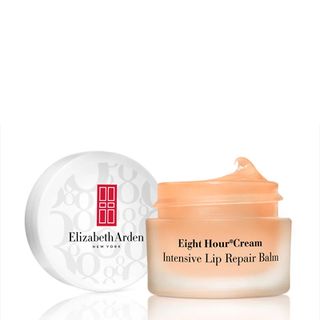
Elizabeth Arden Eight Hour Cream Intensive Lip Repair Balm
Works for
1 of 1 advertised claim delivered
Moisturizing19 ingredients credited for this claimStrong support
“strengthen their moisture barrier so they can hold hydration more effectively”
This product can help soften the skin and reduce its moisture loss with emollients and occlusives: bis-diglyceryl polyacyladipate-2, butyrospermum parkii butter.
Keep in mind that this product does not contain effective ingredients to attract water to the upper layer of the skin. This is why an additional product with humectants like glycerin or hyaluronic acid can be helpful (apply it before this product for the best results).
The following ingredients in this product are especially good for supporting the skin barrier and helping with the hydration level: linoleic acid, petrolatum
Can it cause trouble?
Irritancy13 strong irritants: Arnica montana flower extract, Menthol + 11 more — patch-test recommendedHigh risk
Comedogenic3 ingredients rated 2 or more on the 0–5 pore-clogging scale3 flagged
User reviews
Be the first — your take helps the next person decide.
Ingredients
Filter by role to see what each ingredient is doing.
Butyrospermum parkii butter~22–34%
- Irritation risk
- Low
- Comedogenicity
- 3/5
A great moisturising ingredient that softens the skin and reduces water loss from its upper layer. It also can be helpful in protecting skin from free radicals
More about Butyrospermum parkii butterPetrolatum~3.7–5.5%
- Irritation risk
- Low
One of the most effective and the most studied occlusive ingredients that creates a protective layer on top of the skin preventing moisture loss
More about PetrolatumCera alba~3.3–5%
- Irritation risk
- Medium
Forms a protective barrier that holds water and keeps dry skin hydrated. Keeps an emulsion from separating into its oil and liquid components, and increases the thickness of a product. Can be an allergen
More about Cera albaCera microcristallina~3.9–5.8%
- Irritation risk
- Low
Helps to soften the upper layer of the skin, reduce water loss from its surface and create a thicker product consistency
More about Cera microcristallinaDipentaerythrityl hexahydroxystearate~2.6–4%
Hydrogenated polyisobutene~2.2–3.3%
- Irritation risk
- Low
Used to improve the product consistency and soften the upper layer of the skin
More about Hydrogenated polyisobuteneBis-diglyceryl polyacyladipate-2~1.8–2.6%
- Irritation risk
- Low
Helps soften the upper layer of the skin and reduce water loss from its surface
More about Bis-diglyceryl polyacyladipate-2Polybutene~1.3–1.9%
Ricinus communis seed oil~1.3–2%
- Irritation risk
- Medium
A plant oil that can help soften the skin. It might be helpful in calming down inflammation, but solid research is lacking. Is often used in lip products to create the needed product consistency
More about Ricinus communis seed oilOctyldodecanol~0.95–1.45%
- Irritation risk
- Low
An emollient that helps to soften the skin and create a pleasant product texture and stabilize the formulation
More about OctyldodecanolGlycine soja oil~0.85–1.25%
- Irritation risk
- Medium
- Comedogenicity
- 2/5
A good emollient that helps soften the skin and helps repair its barrier function. It can clog pores if used in high concentrations.
More about Glycine soja oilIsopropyl myristate~0.55–1.3%
- Irritation risk
- Low
- Comedogenicity
- 3/5
An emollient that helps soften the skin. Could be comedogenic
More about Isopropyl myristatePalmitic acid~0.55–1.25%
- Irritation risk
- Low
An emollient that is naturally present in skin and helps soften it
More about Palmitic acidAstrocaryum murumuru seed butter~0.5–1.15%
- Irritation risk
- Medium
Helps soften the upper layer of the skin. Could be comedogenic due to the myrisic acid content
More about Astrocaryum murumuru seed butterHelianthus annuus seed oil~0.45–1.1%
- Irritation risk
- Low
A great emollient due to its high linoleic acid content. One of the most effective plant oils in helping skin hydration and repairing skin barrier function
More about Helianthus annuus seed oilLinoleic acid~0.5–1.2%
- Irritation risk
- Low
An excellent emollient. Helps soften the skin, restore its barrier function, and can help to calm down inflammation. It can be helpful to prevent blemishes and clogged pores
More about Linoleic acidDimethicone~0.5–1.1%
- Irritation risk
- Low
A silicone that helps to reduce water loss from the surface of the skin. Can temporarily "fill in" lines and wrinkles, absorb oil, and create a nice product finish
More about DimethiconeArnica montana flower extract~0.35–0.85%
- Irritation risk
- High
A plant extract that can be irritating. It can have some anti-bacterial properties, but there are no evidence of a beneficial effect for skin
More about Arnica montana flower extractCardiospermum halicacabum flower/leaf/vine extract~0.35–0.85%
- Irritation risk
- High
A plant extract that might have some anti-inflammatory and anti-oxidant properties but evidence is missing
More about Cardiospermum halicacabum flower/leaf/vine extractEchium plantagineum seed oil~0.35–0.8%
- Irritation risk
- Medium
A plant oil that because of its high content of alpha-linolenic acid help support skin barrier function and moisturize the skin
More about Echium plantagineum seed oilHelianthus annuus seed oil unsaponifiables~0.4–0.9%
- Irritation risk
- Low
A great emollient due to its high linoleic acid content. One of the most effective plant oils in helping skin hydration and repairing skin barrier function
More about Helianthus annuus seed oil unsaponifiablesLinolenic acid~0.4–0.95%
- Irritation risk
- Medium
An emollient that helps soften the skin and calm down inflammation
More about Linolenic acidMenthol~0.2–0.75%
- Irritation risk
- High
Menthyl lactate~0.3–0.7%
Parfum~0.2–0.75%
- Irritation risk
- High
An aromatic blend of unspecified and possibly irritating ingredients
More about ParfumRetinyl palmitate~0.2–0.8%
- Irritation risk
- High
Three steps removed from the active form of vitamin A - retinoic acid. To have an effect in the skin, it first needs to be converted twice to become the retinoic acid. This means it is less potent than retinol, but could also be less irritating. Once converted to the retinoic acid in the skin, it helps against all signs of aging, improves skin cell turnover and helps fight blemishes and clogged pores. However, in many cosmetic formulations, it is used in a concentration that is too low to have the full effect
More about Retinyl palmitateTocopherol~0.3–0.75%
- Irritation risk
- Low
Pure form of vitamin E. Can help moisturise and protect the skin from free radicals. Often used to help stabilise other ingredients or the formula itself
More about TocopherolTocopheryl acetate~0.3–0.75%
- Irritation risk
- Medium
A more stable but less bio-available form of vitamin E compared to Tocopherol. Might help moisturize and protect the skin from free radicals, but mostly used in low concentrations to stabilize other ingredients.
More about Tocopheryl acetateCi 15850~0.3–0.7%
Ci 19140~0.3–0.7%
Beta-caryophyllene~0.2–0.75%
- Irritation risk
- Low
Camphor~0.3–0.7%
- Irritation risk
- High
Citral~0.2–0.75%
Citronellol~0.2–0.75%
Citrus limon peel oil~0.2–0.7%
Eucalyptus globulus oil~0.15–0.7%
- Irritation risk
- Low
Geraniol~0.15–0.7%
Geranyl acetate~0.15–0.65%
- Irritation risk
- Low
Lemongrass oil~0.15–0.55%
- Irritation risk
- Low
Limonene~0.15–0.5%
- Irritation risk
- High
A common frangrance that can easily irritate skin, especially if exposed to air, light or heat
More about LimoneneLinalool~0.1–0.45%
Linalyl acetate~0.1–0.45%
- Irritation risk
- Low
Pelargonium graveolens flower oil~0.15–0.5%
- Irritation risk
- High
An essential oil. Can be irritating. Can become an allergen with oxidation
More about Pelargonium graveolens flower oilPinene~0.1–0.5%
- Irritation risk
- Low
Terpineol~0.1–0.35%
- Irritation risk
- Low
Turpentine~0.1–0.35%
- Irritation risk
- Low
Ingredient list view
Butyrospermum parkii butter, Petrolatum, Cera alba, Cera microcristallina, Dipentaerythrityl hexahydroxystearate, Hydrogenated polyisobutene, Bis-diglyceryl polyacyladipate-2, Polybutene, Ricinus communis seed oil, Octyldodecanol, Glycine soja oil, Isopropyl myristate, Palmitic acid, Astrocaryum murumuru seed butter, Helianthus annuus seed oil, Linoleic acid, Dimethicone, Arnica montana flower extract, Cardiospermum halicacabum flower/leaf/vine extract, Echium plantagineum seed oil, Helianthus annuus seed oil unsaponifiables, Linolenic acid, Unknown, Menthol, Menthyl lactate, Unknown, Unknown, Parfum, Retinyl palmitate, Tocopherol, Tocopheryl acetate, Ci 15850, Ci 19140, Beta-caryophyllene, Camphor, Citral, Citronellol, Citrus limon peel oil, Eucalyptus globulus oil, Geraniol, Geranyl acetate, Unknown, Lemongrass oil, Limonene, Linalool, Linalyl acetate, Pelargonium graveolens flower oil, Pinene, Terpineol, Turpentine
Compare prices
Retailers ranked by price — lowest first.
Affiliate links · prices updated regularly · As an Amazon Associate, WIMJ earns from qualifying purchases.
Worth comparing, line by line.
Match % combines shared ingredients, the first five ingredients, shared actives and hero ingredients, irritancy (lower counts in the alternative's favour), texture and body area. Only products in the same routine step are compared.
| Elizabeth ArdenEight Hour Cream Intensive Lip Repair BalmYOUR PRODUCT | CliniqueRepairwear™ Intensive Lip Treatment | |
|---|---|---|
| Match | — | 54% |
| Price | $22.88 | $25.00+$2.12 |
| Shared key ingredients | — | 6 of 17 |
| Key difference | — | Phytosphingosine |
| Irritancy | High | Medium |
| Drying alcohol | — | — |
| View product | Shop |


Product summary
"Elizabeth Arden - Eight Hour Cream Intensive Lip Repair Balm" is effective for: Moisturizing
Ingredient callouts
- it includes a form of Retinoids (vitamin A) - retinyl palmitate 0.35% - 0.80%, but this type of vitamin A is not very effective. It could in theory help with fine lines and wrinkles, but the effect is most likely minimal.
- Another helpful ingredient in this lip sunscreen is Linoleic Acid. It is one of the fatty acids naturally present in skin. It is part of the skin barrier. Preliminary research shows that it might be able to reduce clogged pores.
Price
The product retails for 35.00CA$ in Canada, for 32.00A$ in Australia and from 13.37£ up to 21.00£ in the United Kingdom.
For a detailed price comparison: click here.
Sources cited in this review
Every concentration estimate and effectiveness label is anchored to one of these 27 studies and safety reviews.
- 1
- 2
- 3
- 4
- 5
- 6

Affiliate links · As an Amazon Associate, WIMJ earns from qualifying purchases.