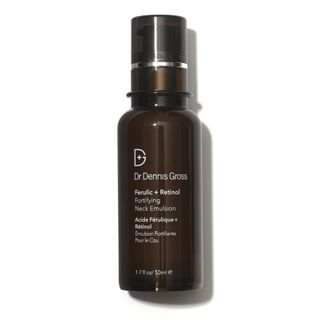
Dr Dennis Gross Ferulic + Retinol Fortifying Neck Emulsion
Works for
4 of 4 advertised claims delivered
Exfoliation6 ingredients credited for this claimStrong support
“This unique formula delivers lactic acid to renew the delicate neck surface, while ferulic acid + retinol, silkamino acids, and our exclusive ECGComple facilitate cellular repair to restore the skin‰Ûªs foundation.”
This product can help exfoliate the skin. In other words, it helps break down the bonds between dead cells on the surface of the skin and speed up the skin turnover. Skin often appears softer and brighter after exfoliation, but overdoing it can result in disrupted skin barrier. The following ingredient is doing the exfoliating job in this product: glycolic acid, lactic acid, retinol.
Evens skin tone7 ingredients credited for this claimStrong support
“ECG ComplexTM protects against damaging free radicals and diminishes the look of dark spots and other signs of age on the skin.”
This product can help reduce hypepigmentation and even out the skin tone because it contains the following effective ingredients: retinol.
In addition, this product contains ellagic acid, glycolic acid, lactic acid. This ingredient (ingredients) might help reduce hyperpigmentation, but the effect, if any, is likely to be small.
The following ingredient (ingredients) in this product might be helpful, but there is no evidence to confirm that it actually can help even out the skin tone: ferulic acid.
Keep in mind that you would need to apply any topical skincare targetted at hypigmentation consistently for a couple of months to get a result. No topical skincare product can help get rid of hyperpigmentation (including post-acne marks and age spots) instantly.
Anti-aging8 ingredients credited for this claimStrong support
“Key Benefits Reduces signs of ageing in neck and jawline areasNatural ingredientsCollagen enhancingHydrates and firmsSimple application UK200018642”
This product can help reduce and prevent fine lines and wrinkles, improve skin elasticity and firmness because it contains retinol, glycolic acid.
These ingredients in the product can also be helpful, even though there is less evidence for their effectiveness: ferulic acid, lactic acid.
Keep in mind that it typically takes at least 6 weeks to notice any results because the changes that are needed to improve fine lines and elasticity happen in the deeper layers of the skin. No topical anti-aging product can “erase” wrinkles or fully reverse signs of aging.
Moisturizing28 ingredients credited for this claimStrong support
“Key Benefits Reduces signs of ageing in neck and jawline areasNatural ingredientsCollagen enhancingHydrates and firmsSimple application UK200018642”
This product can help improve hydration of the skin with the two types of ingredients.
The first type is called “humectants”:
these ingredients help attract water.
When humectants are on the surface of the skin, they “pull in” the moisture from the outside environment, or from
within deeper layers of the skin. The following ingredients in this product do the job:
glycerin, lactic acid.
This product also contains ingredients called “occlusives”. They help reduce the speed with which our skin loses moisture to the outside environment. These ingredients also help soften the upper layer of the skin, so it feels less tight and nicer to the touch. The following ingredients in this product do the job: beeswax, dimethicone.
The following ingredients in this product are especially good for supporting the skin barrier and helping with the hydration level: urea
Anti-oxidationNot advertised by the brand · 8 ingredients credited for this claimStrong support
This product contains antioxidants (ferulic acid, retinol) that can help neutralize free radicals in skin. By doing so, they can lessen the damage the skin gets from the UV light (sun).
Anti-blemishNot advertised by the brand · 4 ingredients credited for this claimStrong support
This product can help reduce breakouts and clogged pores because it contains the following ingredient: retinol. This ingredient is used for treating acne and can have a noticeable effect.
The following ingredient (ingredients) in this product might be helpful, but there is no evidence to confirm that it actually works: glycolic acid
Can it cause trouble?
Irritancy4 strong irritants: Retinol, Citrus aurantium bergamia fruit extract + 2 more — patch-test recommendedHigh risk
Comedogenic2 ingredients rated 2 or more on the 0–5 pore-clogging scale2 flagged


User reviews
Be the first — your take helps the next person decide.
Ingredients
Filter by role to see what each ingredient is doing.
Water~45–55%
C12-15 alkyl benzoate~5.1–6.2%
- Irritation risk
- Low
Enhances the product texture and makes it more spreadable. Helps reduce water loss from the outer layer of skin. Extands the shelf life by preventing bacteria growth
More about C12-15 alkyl benzoateGlycerin~3.9–4.7%
- Irritation risk
- Low
One of the best moisturizing ingredients. Naturally present in skin. It attracts water to the upper layer of the skin working as a humectant
More about GlycerinLactic acid~3.1–3.7%
- Irritation risk
- Medium
An exfoliating and moisturizing alpha-hydroxy acid (AHA). Typically causes less irritation than other AHAs, for example, glycolic acid. At high concentrations (about 15%), lactic acid can help reduce lines and wrinkles. Recent studies show that lactic acid can support the "good" bacteria living on skin's surface (healthy skin microbiome)
More about Lactic acidBehenyl alcohol~2.4–3%
- Irritation risk
- Low
Non-drying alcohol that helps water and oil mix together. Also serves as an emollient
More about Behenyl alcoholIsopropyl palmitate~1.8–2.2%
- Irritation risk
- Medium
- Comedogenicity
- 3/5
Helps soften the upper layer of the skin and create a thicker product consistency
More about Isopropyl palmitateOctyldodecanol~1.5–1.8%
- Irritation risk
- Low
An emollient that helps to soften the skin and create a pleasant product texture and stabilize the formulation
More about OctyldodecanolDimethyl isosorbide~1.3–1.6%
- Irritation risk
- Low
Used to dissolve other ingredients in a product and can enhance their ability to penetrate the skin
More about Dimethyl isosorbideMethyl methacrylate crosspolymer~1.1–1.3%
- Irritation risk
- Low
Helps thicken the product consistency
More about Methyl methacrylate crosspolymerHelianthus annuus seed oil~0.75–1.15%
- Irritation risk
- Low
A great emollient due to its high linoleic acid content. One of the most effective plant oils in helping skin hydration and repairing skin barrier function
More about Helianthus annuus seed oilSodium hydroxide~0.55–0.85%
Dimethicone~0.5–0.8%
- Irritation risk
- Low
A silicone that helps to reduce water loss from the surface of the skin. Can temporarily "fill in" lines and wrinkles, absorb oil, and create a nice product finish
More about DimethiconeGlycolic acid~0.35–0.65%
- Irritation risk
- High
An alpha-hydroxy acid (AHA) that helps to remove the dead skin cells on the surface of the skin reveling a more even, smoother complexation. It is also able to stimulate collagen production with long-term use. Could help to reduce pore congestion. It can be irritating to the skin. Apply sunscreen daily if using products with glycolic acid
More about Glycolic acidPropanediol~0.35–0.6%
- Irritation risk
- Low
Acts as a solvent for other ingredients. Speeds up the absorption of other ingredients into the skin
More about PropanediolBeeswax~0.35–0.6%
- Irritation risk
- Low
Forms a protective barrier that holds water and keeps dry skin hydrated. Keeps an emulsion from separating into its oil and liquid components, and increases the thickness of a product. Can be an allergen
More about BeeswaxCetyl alcohol~0.35–0.6%
- Irritation risk
- Low
A non-drying alcohol that works to soften the skin and stabilize product formulations helping oil and water mix together
More about Cetyl alcoholHydrogenated lecithin~0.3–0.5%
- Irritation risk
- Low
Helps to retain moisture by creating a protective barrier on the skin. Rich in fatty acids. Improves product texture and helps with the penetration of other ingredients.
More about Hydrogenated lecithinPalmitic acid~0.3–0.55%
- Irritation risk
- Low
An emollient that is naturally present in skin and helps soften it
More about Palmitic acidButylene glycol~0.2–0.4%
- Irritation risk
- Low
Used to create a nice product texture and help delivery of other ingredients. Might be somewhat helpful in attracting water to the upper layer of the skin
More about Butylene glycolFerulic acid~0.2–0.35%
- Irritation risk
- Low
A potent anti-oxidant that has been shown to be effective in neutralizing free radicals in skin. There seem to have a synergetic effect of ferulic acid, vitamin E and C, meaning that when the ingredients are used together, they enhance each other's ability protect the skin against free radicals. Ferulic acid also helps to stabilize other ingredients - including vitamins C and E. It can help to even out the skin tone. Ferulic acid is approved for use as a sunscreen ingredient in Japan in concentrations up to 10%
More about Ferulic acidEllagic acid~0.15–0.3%
- Irritation risk
- Medium
Can help neutralize free radicals in skin. It can help prevent and treat hyperpigmentation and even out the skin tone
More about Ellagic acidGallic acid~0.15–0.3%
- Irritation risk
- Low
Collagen amino acids~0.1–0.2%
- Irritation risk
- Low
Help attract water to the upper layer of the skin, soften it and support the skin barrier function
More about Collagen amino acidsSilk amino acids~0.15–0.25%
- Irritation risk
- Low
Might help attract water to the upper layer of the skin
More about Silk amino acidsSodium hyaluronate~0.15–0.25%
- Irritation risk
- Low
One of the best moisturizing ingredients. Attracts water into the upper layer of the skin
More about Sodium hyaluronateRetinol~0.1–0.2%
- Irritation risk
- High
Two steps removed from the active form of vitamin A - retinoic acid. Once converted to the retinoic acid in the skin, retinol is proven to be effective against all signs of aging. It improves skin cell turnover, helps fight blemishes and clogged pores, can regulate excess oil production and even skin tone. It can, however, be quite irritating
More about RetinolZea mays silk extract~0.15–0.25%
- Irritation risk
- Low
Phospholipids~0.15–0.25%
- Irritation risk
- Low
Emollients that are naturaly present in skin. In addition, they help water and oil mix together in the product
More about PhospholipidsSphingolipids~0.15–0.3%
- Irritation risk
- Low
Sphingolipids are a group of lipids with a common chemical structure. Some of them are naturally present in skin and can be converted to ceramides
More about SphingolipidsSaccharide isomerate~0.15–0.25%
- Irritation risk
- Low
Helps attract water to the upper layer of the skin
More about Saccharide isomerateLeuconostoc/radish root ferment filtrate~0.15–0.3%
- Irritation risk
- Medium
A preservative that comes from radishes fermented by a bacteria. New research suggests that the preservation properties in the ingredient come from an ammonium salt that is not present naturally in radish root but used in its cultivation. Is problematic because the exact amount of the preservative agents is difficult to determine
More about Leuconostoc/radish root ferment filtrateGlycine soja oil~0.15–0.3%
- Irritation risk
- Medium
- Comedogenicity
- 2/5
A good emollient that helps soften the skin and helps repair its barrier function. It can clog pores if used in high concentrations.
More about Glycine soja oilAscorbyl palmitate~0.15–0.25%
- Irritation risk
- Medium
Being a lipid soluble form of vitamin C, it is more stable and can penetrate the skin better than L-Ascorbic acid. It is effective in protecting the skin from free radicals, as well as evening the skin tone, but is less effective in stimulating collagen production compared to L-Ascorbic acid.
More about Ascorbyl palmitateTocopherol~0.15–0.3%
- Irritation risk
- Low
Pure form of vitamin E. Can help moisturise and protect the skin from free radicals. Often used to help stabilise other ingredients or the formula itself
More about TocopherolUrea~0.15–0.25%
- Irritation risk
- Low
Naturally present in skin (urea makes up about 7% of natural moisturizing factors in skin). Attracts water to the upper layer of the skin. Also has a positive effect on the skin barrier beyond the humectant action. Can enhance penetration of other ingredients. Is an exfoliating ingredient when used in high concentrations
More about UreaSodium pca~0.15–0.25%
- Irritation risk
- Low
Naturally present in skin and helps to attract water to its upper layer
More about Sodium pcaMannitol~0.15–0.25%
- Irritation risk
- Low
Helps to attract water to the upper layer of the skin
More about MannitolCitrullus lanatus fruit extract~0.15–0.25%
- Irritation risk
- Medium
A plant extract that can contain an antioxidant compound
More about Citrullus lanatus fruit extractXanthan gum~0.15–0.3%
- Irritation risk
- Low
Used to create a thicker product consistency
More about Xanthan gumCaprylyl glycol~0.15–0.3%
- Irritation risk
- Medium
Helps preserve products and creates a nice product texture
More about Caprylyl glycolAcrylates/carbamate copolymer~0.15–0.25%
- Irritation risk
- Low
Caprylic/capric triglyceride~0.2–0.35%
- Irritation risk
- Medium
A good mix of fatty acids that forms a protective layer on the skin. Improves the shelf life of products. Derived from coconut and glycerin
More about Caprylic/capric triglycerideMagnesium aspartate~0.15–0.25%
- Irritation risk
- Low
Might be helpful in restoring skin barrier function and calm down inflammation in skin
More about Magnesium aspartateZinc gluconate~0.15–0.25%
- Irritation risk
- Medium
Typically used to stabilize the product formulations. It is a salt of a polyhydroxy acid (PHA) and in larger concentrations, can help shed the dead cells from the skin surface revealing smoother skin. It can help attract water to the upper layer of the skin. Might to be helpful against acne and clogged pores. Could be helpful in neutralizing free radicals, but solid research is missing. Due to the zinc content, might help calm down inflammation in skin
More about Zinc gluconateCopper gluconate~0.1–0.2%
- Irritation risk
- Medium
Typically used to stabilize the product formulations. It is a salt of polyhydroxy acid (PHA) and in larger concentrations, can help shed the dead cells from the skin surface revealing smoother skin. It can help attract water to the upper layer of the skin. Might to be helpful against acne and clogged pores. Could be helpful in neutralizing free radicals, but solid research is missing
More about Copper gluconateEthylhexylglycerin~0.1–0.25%
Acrylates/c10-30 alkyl acrylate crosspolymer~0.15–0.25%
- Irritation risk
- Medium
Maintains the texture of skincare products. Allows the product to spread evenly. Helps oil and water mix together
More about Acrylates/c10-30 alkyl acrylate crosspolymerDisodium edta~0.1–0.25%
Citric acid~0.15–0.25%
- Irritation risk
- Medium
Can work as an exfoliant but is typically used to adjust the product pH
More about Citric acidSodium citrate~0.15–0.25%
- Irritation risk
- Medium
Helps to control the skin's pH level. Maintains the skin's natural film of amino-lactic acids and oils. Helps to preserve products
More about Sodium citrateHexylene glycol~0.1–0.2%
- Irritation risk
- Medium
Helps create a more spreadable product texture
More about Hexylene glycolCitrus aurantium bergamia fruit extract~0.1–0.2%
- Irritation risk
- High
Citrus limon peel extract~0.1–0.15%
Lavandula angustifolia flower/leaf/stem extract~0.1–0.25%
Phenoxyethanol~0.1–0.25%
- Irritation risk
- Low
A preservative. It helps prevent bacterial growth in cosmetic products
More about PhenoxyethanolPotassium sorbate~0.1–0.2%
Ingredient list view
Water, C12-15 alkyl benzoate, Glycerin, Lactic acid, Behenyl alcohol, Isopropyl palmitate, Octyldodecanol, Dimethyl isosorbide, Methyl methacrylate crosspolymer, Helianthus annuus seed oil, Sodium hydroxide, Dimethicone, Glycolic acid, Propanediol, Beeswax, Cetyl alcohol, Hydrogenated lecithin, Palmitic acid, Butylene glycol, Ferulic acid, Ellagic acid, Gallic acid, Collagen amino acids, Silk amino acids, Sodium hyaluronate, Retinol, Zea mays silk extract, Phospholipids, Sphingolipids, Saccharide isomerate, Leuconostoc/radish root ferment filtrate, Glycine soja oil, Ascorbyl palmitate, Tocopherol, Urea, Sodium pca, Mannitol, Citrullus lanatus fruit extract, Xanthan gum, Caprylyl glycol, Acrylates/carbamate copolymer, Caprylic/capric triglyceride, Magnesium aspartate, Zinc gluconate, Copper gluconate, Ethylhexylglycerin, Acrylates/c10-30 alkyl acrylate crosspolymer, Disodium edta, Citric acid, Sodium citrate, Hexylene glycol, Citrus aurantium bergamia fruit extract, Citrus limon peel extract, Lavandula angustifolia flower/leaf/stem extract, Phenoxyethanol, Potassium sorbate
Compare prices
Retailers ranked by price — lowest first.
Affiliate links · prices updated regularly · As an Amazon Associate, WIMJ earns from qualifying purchases.
Worth comparing, line by line.
Match % combines shared ingredients, the first five ingredients, shared actives and hero ingredients, irritancy (lower counts in the alternative's favour), texture and body area. Only products in the same routine step are compared.
| Dr Dennis GrossFerulic + Retinol Fortifying Neck EmulsionYOUR PRODUCT | YEOUTHHyaluronic Acid Cream with Vitamin C E, Ferulic Acid, Tripeptide 31 Shea Butter | Medica ForteThe Perfect Body Lotion | Dr. DeneseFirming Facial Collagen Face Cream | |
|---|---|---|---|---|
| Match | — | 63% | 63% | 62% |
| Price | $60.00 | $31.99−$28.01 | — | $39.00−$21.00 |
| Shared key ingredients | — | 5 of 21 | 6 of 21 | 6 of 21 |
| Key difference | — | Butyrospermum Parkii Butter | Azelaic Acid | Panthenol |
| Irritancy | High | Low | Medium | High |
| Drying alcohol | — | — | — | — |
| View product | Shop | Shop | Shop |


Product summary
"Dr Dennis Gross - Ferulic + Retinol Fortifying Neck Emulsion" has a good moisturizing formula. This moisturizer uses a good combo of humectants and emollients. These both types of ingredients are essentials for improving the skin hydration and keeping the skin barrier healthy. Humectants in this product (urea, glycerin, lactic acid, mannitol and saccharide isomerate) help to increase the water content in the upper layer of the skin. (These ingredients do so by "capturing" water molecules from the outside air or from within the deeper layers of the skin). Glycine soja oil, sphingolipids, beeswax, dimethicone and helianthus annuus seed oil in this product help decrease the water evoporation from the skin, so that it stays hydrated for longer. These ingredients also soften the skin and take away the feeling of tightness and dryness.
Ingredient callouts
- this moisturizer contains an effective form of retinoids (vitamin A): retinol 0.10% - 0.20%. Retinoids are potent multitasking actives. They work to improve and prevent early signs of aging, reduce hyperpigmentation (age spots and post-acne marks), and prevent inflamed blemishes and clogged pores. The downside of retinoids is that they can be irritating. If you are not already using a retinoid in your routine, it is best to start slowly and apply the retinoid product only a few times per week. If your skin tolerates it well, you can gradually increase the frequency to daily. Because of the irritation risk of retinoids, we recommend to have another, retinoid-free moisturizer in your routine to use on the alternative days or when your skin feels dry.
Irritation risk
This moisturizer contains some common irritants, including those without a benefit for the skin. We assess the overall irritancy of this moisturizer to be high. For a detailed overview of all potential irritants: click here
You can see the detailed formula review with the breakdown of all actives in the product and the full ingredient list with estimated concentrations in the tables below.
About the brand
According to Cruelty-Free Kitty "Dr Dennis Gross" is cruelty free and so is its parent company.
Price
The product retails for 208.12A$ in Australia, from 110.00£ up to 133.55£ in the United Kingdom and for 75.00$ in the United States.
For a detailed price comparison: click here.
Sources cited in this review
Every concentration estimate and effectiveness label is anchored to one of these 36 studies and safety reviews.
- 1
- 2Epidermal and dermal effects of topical lactic acidncbi.nlm.nih.gov
- 3Dual Effects of Alpha-Hydroxy Acids on the Skinpdfs.semanticscholar.org
- 4Final Report on the Safety Assessment of Isopropyl Isostearatejournals.sagepub.com
- 5
- 6

Affiliate links · As an Amazon Associate, WIMJ earns from qualifying purchases.