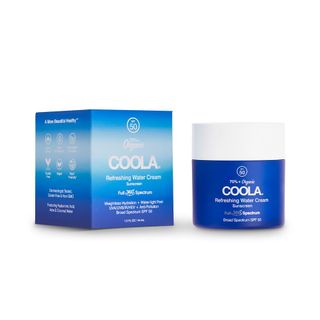
Coola Full Spectrum 360º Refreshing Water Cream Organic Face Sunscreen SPF 50
Works for
1 of 1 advertised claim delivered
Sun protectionSPF 50 · 5 UV filtersBroad spectrum
This product offers a good level of protection against both UVB and UVA rays.
This sunscreen uses organic (so-called "chemical") sunscreen filters. Organic, or "chemical" filters usually provide reliable sun protection and rarely leave a white cast. Sunscreens with organic filters can sting eyes.
This product can be considered "reef safe" because it does not contain the UV filters (oxybenzone and octinoxate) that can be harmful to coral reefs when present in the water in high concentrations.
Evens skin toneNot advertised by the brand · GluconolactoneStrong evidence
This product offers broad spectrum sun protection. It means that it can prevent hyperpigmentation and help keep the skin tone even (sun damage is the main factor causing age spots, darkening of post-acne marks and other discolorations).
Anti-agingNot advertised by the brand · Hyaluronic acid, Aloe barbadensis leaf juice + 1 moreStrong evidence
This product can help prevent early signs of skin aging because it offers a good level of broad spectrum sun protection. Sun damage is the main cause of premature skin aging, and protecting your skin from the sun is the best anti-aging strategy.
MoisturizingNot advertised by the brand · Glycerin, Argania spinosa kernel oil + 12 moreGood evidence
This product can help improve hydration of the skin with the two types of ingredients.
The first type is called “humectants”:
these ingredients help attract water.
When humectants are on the surface of the skin, they “pull in” the moisture from the outside environment, or from
within deeper layers of the skin. The following ingredients in this product do the job:
glycerin, hyaluronic acid.
This product also contains ingredients called “occlusives”. They help reduce the speed with which our skin loses moisture to the outside environment. These ingredients also help soften the upper layer of the skin, so it feels less tight and nicer to the touch. The following ingredients in this product do the job: argania spinosa kernel oil, isododecane.
Can it cause trouble?
Irritancy3 strong irritants: Jasminum sambac leaf cell extract, Ocimum basilicum flower/leaf extract + 1 more — patch-test recommendedHigh risk
Comedogenic2 ingredients rated 2 or more on the 0–5 pore-clogging scale2 flagged
User reviews
Ingredients
Filter by role to see what each ingredient is doing.
Butyl methoxydibenzoylmethane3%
- Irritation risk
- Medium
Avobenzone. An organic, or so-called "chemical" UV filter. Protects against both UVA and UVB rays. Needs to be combined with other filters in a formulation to be stable.
More about Butyl methoxydibenzoylmethaneHomosalate5%
- Irritation risk
- Medium
A weak sunscreen that offers some protection against the sun rays that cause sunburn (UVB), but does not offer meaningful protection against protect against the most aging sun rays (UVA). It loses its effectiveness quickly when exposed to sunlight. It is an organic, or so called "chemical" sunscreen. When used in low concentrations, helps to stabilize the product formulation
More about HomosalateEthylhexyl salicylate3%
- Irritation risk
- Low
Octisalate. A UV filter. It offers some protection against the sun rays that cause sunburn (UVB), but does not protect against the most aging sun rays (UVA). It loses its effectiveness quickly when exposed to sunlight. It is an organic, or so called "chemical" sunscreen
More about Ethylhexyl salicylateOctocrylene5%
- Irritation risk
- Medium
A weak sunscreen that protects against the sun rays that cause sunburn (UVB) and is somewhat effective against the UVA rays. It is quite stable and can help stabilize other, more vulnerable, sunscreen ingredients like Avobenzone. It is an organic, or so called "chemical" sunscreen
More about OctocryleneAdipic acid/diglycol crosspolymer~23–34%
- Irritation risk
- Low
Aloe barbadensis flower extract~4.1–6.1%
- Irritation risk
- High
A plant extract that might have some anti-oxidant effect
More about Aloe barbadensis flower extractAloe barbadensis leaf juice~4.1–6.2%
- Irritation risk
- Medium
Traditionally used to treat sunburns, dermatitis and inflammation, but evidence for its effectiveness is lacking. The extract can contain humectants that help attract water into the skin
More about Aloe barbadensis leaf juiceAnisaldehyde~3.2–4.8%
- Irritation risk
- Low
Argania spinosa kernel oil~2.8–4.2%
- Irritation risk
- Medium
An emollient that helps soften the upper layer of the skin. Might have some weak anti-oxidant properties
More about Argania spinosa kernel oilBenzyl acetate~1.8–2.7%
- Irritation risk
- Low
Bisabolol~1.4–2.1%
- Irritation risk
- Low
An active component of chamomile plant that historically has been used to calm down irritated skin. A recent study shows that bisabolol indeed can have some anti-inflammatory effect on skin, even though conclusive data is lacking. Bisabolol has a sweet floral scent and can be added to products for its aromatic properties
More about BisabololButylene glycol~1.2–1.7%
- Irritation risk
- Low
Used to create a nice product texture and help delivery of other ingredients. Might be somewhat helpful in attracting water to the upper layer of the skin
More about Butylene glycolCaprylhydroxamic acid~0.95–1.4%
Carthamus tinctorius oleosomes~0.8–1.2%
- Irritation risk
- Low
Helps soften the upper layer of the skin
More about Carthamus tinctorius oleosomesCitric acid~0.4–0.95%
- Irritation risk
- Medium
Can work as an exfoliant but is typically used to adjust the product pH
More about Citric acidCoccinia indica fruit extract~0.3–0.7%
- Irritation risk
- Medium
A plant extract that might have some anti-oxidant effect helping neutralize free radicals in skin
More about Coccinia indica fruit extractCocos nucifera water~0.15–0.55%
- Irritation risk
- Low
Might help to attract water to the upper layer of the skin
More about Cocos nucifera waterCorallina officinalis extract~0.1–0.5%
- Irritation risk
- Low
- Comedogenicity
- 3/5
Red algae extract that helps attract water to the upper layer of the skin and might contain antioxidants
More about Corallina officinalis extractCurcuma longa root extract~0.1–0.45%
- Irritation risk
- High
A plant extract that can contain an active compound curcumin, that may have some anti-inflammatory properties when applied to the skin, but solid research is lacking and the typical concentration used in skincare products is too low. Can be an irritant
More about Curcuma longa root extractDelta-decalactone~0.1–0.45%
- Irritation risk
- Low
Ethyl butyrate~0.1–0.45%
- Irritation risk
- Low
Gamma-nonalactone~0.1–0.45%
- Irritation risk
- Low
Gamma-octalactone~0.1–0.45%
- Irritation risk
- Low
Gluconolactone~0.1–0.4%
- Irritation risk
- Medium
A polyhydroxy acid (PHA) that helps shed the dead cells from the skin surface revealing smoother skin. Is believed to be genter than AHAs. It helps attract water to the upper layer of the skin and can stimulate production of skin's own hyaluronic acid resulting in improved hydration levels. It has been shown to be helpful against acne and clogged pores if used consistently (e.g over a period of 12 weeks) in high enough concentration. It can help reduce fine lines and wrinkles and improve skin tone with long-term application. Can help neutralize free radicals
More about GluconolactoneGlycerin~0.1–0.45%
- Irritation risk
- Low
One of the best moisturizing ingredients. Naturally present in skin. It attracts water to the upper layer of the skin working as a humectant
More about GlycerinGlyceryl caprylate~0.15–0.55%
- Irritation risk
- Low
An emollient that can also help water and oil mix together, as well as prevent bacteria growth in products
More about Glyceryl caprylateGlyceryl stearate~0.15–0.5%
- Irritation risk
- Low
An emollient that softens the skin and forms a protective layer on its surface. Helps water and oil mix together
More about Glyceryl stearateHeliotropine~0.05–0.3%
- Irritation risk
- Low
Hyaluronic acid~0.1–0.35%
- Irritation risk
- Low
One of the best moisturizing ingredients. Attracts water into the upper layer of the skin. Naturally present in skin. Typically has large molecule size unless advertised otherwise on the product label. Helps support skin's barrier function and may help to reduce inflammation
More about Hyaluronic acidIsododecane~0.1–0.45%
- Irritation risk
- Low
An emollient that helps soften the skin and can decrease moisture loss. Helps create a nice product texture
More about IsododecaneJasminum sambac leaf cell extract~0.05–0.3%
Lecithin~0.15–0.5%
- Irritation risk
- Low
Used mostly for creating emulsions - helping oil and water mix together. Helps soften the upper layer of the skin
More about LecithinLeuconostoc/radish root ferment filtrate~0.1–0.35%
- Irritation risk
- Medium
A preservative that comes from radishes fermented by a bacteria. New research suggests that the preservation properties in the ingredient come from an ammonium salt that is not present naturally in radish root but used in its cultivation. Is problematic because the exact amount of the preservative agents is difficult to determine
More about Leuconostoc/radish root ferment filtrateLeuconostoc ferment filtrate~0.1–0.35%
Melia azadirachta flower extract~0.1–0.35%
- Irritation risk
- Medium
A plant extract that might be helpful to neutralize free radicals in skin
More about Melia azadirachta flower extractMelia azadirachta leaf extract~0.1–0.35%
- Irritation risk
- High
A plant extract that has anti-bacterial properties. Can be used to preserve the product. Can be irritating
More about Melia azadirachta leaf extractMethyl anthranilate~0.1–0.35%
- Irritation risk
- Medium
Used as a fragrance. It can be used a booster for UV filters in non-European sunscreen formulations. A draft regulation in the EU proposes to restrict the usage of this ingredient to a low concentration in sunscreens because of concerns of photo-toxicity
More about Methyl anthranilateMethyl benzoate~0.05–0.25%
Methylbenzyl acetate~0.05–0.3%
- Irritation risk
- Low
Mimosa tenuiflora bark extract~0.1–0.3%
- Irritation risk
- Low
Neopentyl glycol diheptanoate~0.1–0.5%
- Irritation risk
- Low
Helps soften the upper layer of the skin and create a nice product consistency
More about Neopentyl glycol diheptanoateNerolidol~0.05–0.3%
- Irritation risk
- Low
Ocimum basilicum flower/leaf extract~0.1–0.3%
- Irritation risk
- High
Used as a fragrance. Canbe irritating
More about Ocimum basilicum flower/leaf extractOcimum sanctum leaf extract~0.1–0.35%
- Irritation risk
- High
A plant extract that is rich in a fragrance compound eugenol that is a frequent allergen and can be irritating. It might also contain anti-oxidants to help neutralize free radicals
More about Ocimum sanctum leaf extractPhenethyl alcohol~0.1–0.4%
Propanediol~0.1–0.35%
- Irritation risk
- Low
Acts as a solvent for other ingredients. Speeds up the absorption of other ingredients into the skin
More about PropanediolSchinus molle extract~0.1–0.3%
- Irritation risk
- Low
Sodium acrylates copolymer~0.1–0.5%
- Irritation risk
- Medium
Used to create a thicker product consistency
More about Sodium acrylates copolymerSodium benzoate~0.1–0.35%
Sodium hydroxide~0.1–0.4%
Sodium stearoyl glutamate~0.15–0.6%
- Irritation risk
- Medium
Helps oil and water mix together
More about Sodium stearoyl glutamateSolanum melongena fruit extract~0.1–0.45%
- Irritation risk
- Medium
Eggplant fruit extract. Might have some anti-oxidant effect
More about Solanum melongena fruit extractTheobroma cacao seed extract~0.1–0.4%
- Irritation risk
- Low
- Comedogenicity
- 3/5
Tocopheryl acetate~0.1–0.4%
- Irritation risk
- Medium
A more stable but less bio-available form of vitamin E compared to Tocopherol. Might help moisturize and protect the skin from free radicals, but mostly used in low concentrations to stabilize other ingredients.
More about Tocopheryl acetateTriethyl citrate~0.1–0.35%
Vanillin~0.1–0.35%
- Irritation risk
- Low
Water~0.05–0.3%
Xanthan gum~0.05–0.3%
- Irritation risk
- Low
Used to create a thicker product consistency
More about Xanthan gumIngredient list view
Butyl methoxydibenzoylmethane, Homosalate, Ethylhexyl salicylate, Octocrylene, Adipic acid/diglycol crosspolymer, Aloe barbadensis flower extract, Aloe barbadensis leaf juice, Anisaldehyde, Argania spinosa kernel oil, Benzyl acetate, Bisabolol, Butylene glycol, Caprylhydroxamic acid, Carthamus tinctorius oleosomes, Citric acid, Coccinia indica fruit extract, Cocos nucifera water, Corallina officinalis extract, Curcuma longa root extract, Delta-decalactone, Ethyl butyrate, Gamma-nonalactone, Gamma-octalactone, Gluconolactone, Glycerin, Glyceryl caprylate, Glyceryl stearate, Heliotropine, Hyaluronic acid, Isododecane, Jasminum sambac leaf cell extract, Unknown, Lecithin, Leuconostoc/radish root ferment filtrate, Leuconostoc ferment filtrate, Melia azadirachta flower extract, Melia azadirachta leaf extract, Methyl anthranilate, Methyl benzoate, Methylbenzyl acetate, Mimosa tenuiflora bark extract, Neopentyl glycol diheptanoate, Nerolidol, Ocimum basilicum flower/leaf extract, Ocimum sanctum leaf extract, Phenethyl alcohol, Propanediol, Schinus molle extract, Sodium acrylates copolymer, Sodium benzoate, Sodium hydroxide, Sodium stearoyl glutamate, Solanum melongena fruit extract, Theobroma cacao seed extract, Tocopheryl acetate, Triethyl citrate, Vanillin, Water, Xanthan gum
Compare prices
Retailers ranked by price — lowest first.

Affiliate links · prices updated regularly
Product summary
We believe that "Coola - Full Spectrum 360º Refreshing Water Cream Organic Face Sunscreen SPF 50" can provide reliable sun protection based on the ingredients listed. We love that it can protect from both UVA and UVB rays (not all sunscreens with SPF ratings give UVA protection. UVA rays do not cause sunburn, but still damage our skin and lead to early aging).
It also works as a moisturizer, so you do not have to use an additional hydrating product. This product prevents early signs of aging by protecting against sun damage (all broad spectrum sunscreens do that).
Sunscreen filters
This is a so-called "chemical" sunscreen. It means that it uses organic UV filters. They typically offer good sun protection and rarely leave a white cast, but they can be irritating for some people with sensitive skin. Here are the exact UV filters in this sunscreen: avobenzone 3.00% (declared), octisalate 3.00% (declared), homosalate 5.00% (declared), methyl anthranilate 0.10% - 0.35% and octocrylene 5.00% (declared).
Irritation risk
There are some common irritants in this product, including ingredients that do not have benefits for the skin. We assess the overall irritancy of this moisturizer to be high. For a detailed overview of all potential irritants: click here
You can see the detailed formula review with the breakdown of all actives in the product and the full ingredient list with estimated concentrations in the tables below.
About the brand
According to Cruelty-Free Kitty "Coola" is cruelty free and so is its parent company.
Price
The product retails for 46.00$ in the United States.
For a detailed price comparison: click here.
Sources cited in this review
Every concentration estimate and effectiveness label is anchored to one of these 25 studies and safety reviews.
- 1
- 2
- 3
- 4
- 5
- 6

Affiliate links · As an Amazon Associate, WIMJ earns from qualifying purchases.