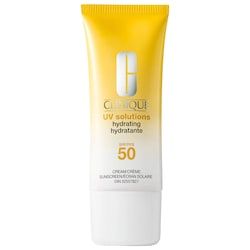
Clinique UV Solutions Hydrating Sunscreen SPF 50 with Hyaluronic Acid
Works for
1 of 1 advertised claim delivered
Sun protectionSPF 50 · 5 UV filtersBroad spectrum
This product offers a good level of protection against both UVB and UVA rays.
This sunscreen uses organic (so-called "chemical") sunscreen filters. Organic, or "chemical" filters usually provide reliable sun protection and rarely leave a white cast. Sunscreens with organic filters can sting eyes.
This product can be considered "reef safe" because it does not contain the UV filters (oxybenzone and octinoxate) that can be harmful to coral reefs when present in the water in high concentrations.
Evens skin toneNot advertised by the brand · No ingredient credited for this claimStrong evidence
This product offers broad spectrum sun protection. It means that it can prevent hyperpigmentation and help keep the skin tone even (sun damage is the main factor causing age spots, darkening of post-acne marks and other discolorations).
Anti-agingNot advertised by the brand · Algae extract, TocopherolStrong evidence
This product can help prevent early signs of skin aging because it offers a good level of broad spectrum sun protection. Sun damage is the main cause of premature skin aging, and protecting your skin from the sun is the best anti-aging strategy.
MoisturizingNot advertised by the brand · Biosaccharide gum-1, Glycerin + 8 moreGood evidence
This product can help improve hydration of the skin with the two types of ingredients.
The first type is called “humectants”:
these ingredients help attract water.
When humectants are on the surface of the skin, they “pull in” the moisture from the outside environment, or from
within deeper layers of the skin. The following ingredients in this product do the job:
algae extract, biosaccharide gum-1.
This product also contains ingredients called “occlusives”. They help reduce the speed with which our skin loses moisture to the outside environment. These ingredients also help soften the upper layer of the skin, so it feels less tight and nicer to the touch. The following ingredients in this product do the job: phenyl trimethicone, algae extract.
Can it cause trouble?
Irritancy13 flagged ingredientsLow risk
Comedogenic1 ingredient rated 2 or more on the 0–5 pore-clogging scale1 flagged
User reviews
Be the first — your take helps the next person decide.
Ingredients
Filter by role to see what each ingredient is doing.
Homosalate7%
- Irritation risk
- Medium
A weak sunscreen that offers some protection against the sun rays that cause sunburn (UVB), but does not offer meaningful protection against protect against the most aging sun rays (UVA). It loses its effectiveness quickly when exposed to sunlight. It is an organic, or so called "chemical" sunscreen. When used in low concentrations, helps to stabilize the product formulation
More about HomosalateOctocrylene7%
- Irritation risk
- Medium
A weak sunscreen that protects against the sun rays that cause sunburn (UVB) and is somewhat effective against the UVA rays. It is quite stable and can help stabilize other, more vulnerable, sunscreen ingredients like Avobenzone. It is an organic, or so called "chemical" sunscreen
More about OctocryleneEthylhexyl salicylate4.5%
- Irritation risk
- Low
Octisalate. A UV filter. It offers some protection against the sun rays that cause sunburn (UVB), but does not protect against the most aging sun rays (UVA). It loses its effectiveness quickly when exposed to sunlight. It is an organic, or so called "chemical" sunscreen
More about Ethylhexyl salicylateButyl methoxydibenzoylmethane3%
- Irritation risk
- Medium
Avobenzone. An organic, or so-called "chemical" UV filter. Protects against both UVA and UVB rays. Needs to be combined with other filters in a formulation to be stable.
More about Butyl methoxydibenzoylmethaneWater~45–55%
Glycerin~5.3–6.5%
- Irritation risk
- Low
One of the best moisturizing ingredients. Naturally present in skin. It attracts water to the upper layer of the skin working as a humectant
More about GlycerinPhenyl trimethicone~5.7–7%
- Irritation risk
- Low
A type of silicone that can decrease loss of moisture from the skin surface. It helps create a nice product texture
More about Phenyl trimethiconeSilica~4–4.9%
Dextrin palmitate~3–3.7%
- Irritation risk
- Medium
Helps water and oil mix together
More about Dextrin palmitateButyloctyl salicylate~2.3–2.9%
- Irritation risk
- Medium
A synthetic ester of salicylic acid that is used to help disperse pigments and boost effectiveness of sunscreen ingredients. It is able to absorb UV light (working as an organic, or chemical filter), but is not approved as a sunscreen ingredient on its own
More about Butyloctyl salicylateButylene glycol~1.8–2.2%
- Irritation risk
- Low
Used to create a nice product texture and help delivery of other ingredients. Might be somewhat helpful in attracting water to the upper layer of the skin
More about Butylene glycolTriacontanyl pvp~1.6–2%
- Irritation risk
- Low
Hydrogenated lecithin~1.3–1.5%
- Irritation risk
- Low
Helps to retain moisture by creating a protective barrier on the skin. Rich in fatty acids. Improves product texture and helps with the penetration of other ingredients.
More about Hydrogenated lecithinPhenoxyethanol~0.5–1%
- Irritation risk
- Low
A preservative. It helps prevent bacterial growth in cosmetic products
More about PhenoxyethanolHydroxyethyl acrylate/sodium acryloyldimethyl taurate copolymer~0.75–1.1%
- Irritation risk
- Medium
A gelling agent that thickens the product consistency and leaves the skin with a velvety finish
More about Hydroxyethyl acrylate/sodium acryloyldimethyl taurate copolymerTocopheryl acetate~0.65–0.95%
- Irritation risk
- Medium
A more stable but less bio-available form of vitamin E compared to Tocopherol. Might help moisturize and protect the skin from free radicals, but mostly used in low concentrations to stabilize other ingredients.
More about Tocopheryl acetateGlyceryl stearate~0.65–1%
- Irritation risk
- Low
An emollient that softens the skin and forms a protective layer on its surface. Helps water and oil mix together
More about Glyceryl stearatePeg-100 stearate~0.65–0.95%
- Irritation risk
- Low
Helps oil and water mix togehter and creates a nice product texture
More about Peg-100 stearatePolysorbate 20~0.55–0.8%
Algae extract~0.6–0.9%
- Irritation risk
- Low
- Comedogenicity
- 3/5
Plant extract that helps the skin to attract water and make it more smooth for touch. Also shows promise of anti-aging properties, but research is not extensive yet
More about Algae extractSodium benzoate~0.25–0.5%
Xanthan gum~0.5–0.7%
- Irritation risk
- Low
Used to create a thicker product consistency
More about Xanthan gumIsododecane~0.45–0.7%
- Irritation risk
- Low
An emollient that helps soften the skin and can decrease moisture loss. Helps create a nice product texture
More about IsododecaneAmmonium acryloyldimethyltaurate/beheneth-25 methacrylate crosspolymer~0.4–0.6%
- Irritation risk
- Medium
Used to stabilize product formulations
More about Ammonium acryloyldimethyltaurate/beheneth-25 methacrylate crosspolymerAcrylates/dimethicone copolymer~0.45–0.7%
- Irritation risk
- Medium
Used to stabilize product formulation, help create an even product layer over skin (for example, in sunscreen), evenly disperse pigements and create a nice product consistency
More about Acrylates/dimethicone copolymerTocopherol~0.35–0.6%
- Irritation risk
- Low
Pure form of vitamin E. Can help moisturise and protect the skin from free radicals. Often used to help stabilise other ingredients or the formula itself
More about TocopherolCitric acid~0.3–0.55%
- Irritation risk
- Medium
Can work as an exfoliant but is typically used to adjust the product pH
More about Citric acidDisodium edta~0.25–0.5%
Sodium hyaluronate~0.25–0.45%
- Irritation risk
- Low
One of the best moisturizing ingredients. Attracts water into the upper layer of the skin
More about Sodium hyaluronateOryzanol~0.25–0.45%
- Irritation risk
- Low
An anti-oxidant that helps stabilize product formulations. Might help neutralise free radicals in skin
More about OryzanolLitchi chinensis seed extract~0.25–0.4%
- Irritation risk
- Low
Polysorbate 60~0.2–0.4%
Sorbitan isostearate~0.15–0.3%
- Irritation risk
- Low
Helps oil and water mix together
More about Sorbitan isostearateBiosaccharide gum-1~0.15–0.25%
- Irritation risk
- Low
Helps attract water to the upper layer of the skin and is claimed to provide a longer-lasting hydration because of its ability to create a water-binding film on the surface of the skin
More about Biosaccharide gum-17-dehydrocholesterol~0.15–0.3%
- Irritation risk
- Medium
Pro-vitamin D. It is claimed to have anti-inflammatory effect in skin, but there is no research available confirming that this compound converts to vitamin D in skin or has any other benefits apart from softening the upper layer of the skin. This compound is different from the Vitamin D3 analogues used in medicine to treat psoriasis
More about 7-dehydrocholesterolIngredient list view
Homosalate, Octocrylene, Ethylhexyl salicylate, Butyl methoxydibenzoylmethane, Water, Glycerin, Phenyl trimethicone, Silica, Dextrin palmitate, Butyloctyl salicylate, Butylene glycol, Triacontanyl pvp, Hydrogenated lecithin, Phenoxyethanol, Hydroxyethyl acrylate/sodium acryloyldimethyl taurate copolymer, Tocopheryl acetate, Glyceryl stearate, Peg-100 stearate, Polysorbate 20, Algae extract, Sodium benzoate, Xanthan gum, Isododecane, Ammonium acryloyldimethyltaurate/beheneth-25 methacrylate crosspolymer, Acrylates/dimethicone copolymer, Tocopherol, Citric acid, Disodium edta, Sodium hyaluronate, Oryzanol, Litchi chinensis seed extract, Polysorbate 60, Sorbitan isostearate, Biosaccharide gum-1, 7-dehydrocholesterol
Compare prices
Retailers ranked by price — lowest first.
Affiliate links · prices updated regularly · As an Amazon Associate, WIMJ earns from qualifying purchases.
Sources cited in this review
Every concentration estimate and effectiveness label is anchored to one of these 14 studies and safety reviews.
- 1
- 2
- 3
- 4
- 5
- 6Vitamin E in dermatologyncbi.nlm.nih.gov

Affiliate links · As an Amazon Associate, WIMJ earns from qualifying purchases.