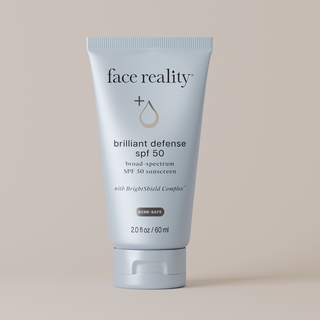
Face Reality Skincare Brilliant Defense SPF 50
Works for
4 of 4 advertised claims delivered
Sun protectionSPF 50 · 5 UV filtersBroad spectrum
This product offers a good level of protection against both UVB and UVA rays.
This sunscreen uses organic (so-called "chemical") sunscreen filters. Organic, or "chemical" filters usually provide reliable sun protection and rarely leave a white cast. Sunscreens with organic filters can sting eyes.
This product can be considered "reef safe" because it does not contain the UV filters (oxybenzone and octinoxate) that can be harmful to coral reefs when present in the water in high concentrations.
Anti-aging1 ingredient credited for this claimStrong support
“Brilliant Defense SPF 50 actively works to minimize discoloration and signs of aging.”
This product can help prevent early signs of skin aging because it offers a good level of broad spectrum sun protection. Sun damage is the main cause of premature skin aging, and protecting your skin from the sun is the best anti-aging strategy.
Evens skin tone1 ingredient credited for this claimStrong support
“Brilliant Defense SPF 50 actively works to minimize discoloration and signs of aging.”
This product offers broad spectrum sun protection. It means that it can prevent hyperpigmentation and help keep the skin tone even (sun damage is the main factor causing age spots, darkening of post-acne marks and other discolorations).
Moisturizing11 ingredients credited for this claimStrong support
“Featuring BrightShield Complex™ an exclusive brightening blend that promotes skin radiance while improving hydration.”
This product can help improve hydration of the skin with the two types of ingredients.
The first type is called “humectants”:
these ingredients help attract water.
When humectants are on the surface of the skin, they “pull in” the moisture from the outside environment, or from
within deeper layers of the skin. The following ingredients in this product do the job:
allantoin, glycerin.
This product also contains ingredients called “occlusives”. They help reduce the speed with which our skin loses moisture to the outside environment. These ingredients also help soften the upper layer of the skin, so it feels less tight and nicer to the touch. The following ingredients in this product do the job: caprylic/capric triglyceride, dimethicone.
The following ingredients in this product are especially good for supporting the skin barrier and helping with the hydration level: panthenol
Can it cause trouble?
Irritancy17 flagged ingredientsLow risk
ComedogenicClean of flagged comedogenic ingredientsNone flagged


User reviews
Be the first — your take helps the next person decide.
Ingredients
Filter by role to see what each ingredient is doing.
Octocrylene9%
- Irritation risk
- Medium
A weak sunscreen that protects against the sun rays that cause sunburn (UVB) and is somewhat effective against the UVA rays. It is quite stable and can help stabilize other, more vulnerable, sunscreen ingredients like Avobenzone. It is an organic, or so called "chemical" sunscreen
More about OctocryleneHomosalate6%
- Irritation risk
- Medium
A weak sunscreen that offers some protection against the sun rays that cause sunburn (UVB), but does not offer meaningful protection against protect against the most aging sun rays (UVA). It loses its effectiveness quickly when exposed to sunlight. It is an organic, or so called "chemical" sunscreen. When used in low concentrations, helps to stabilize the product formulation
More about HomosalateEthylhexyl salicylate5%
- Irritation risk
- Low
Octisalate. A UV filter. It offers some protection against the sun rays that cause sunburn (UVB), but does not protect against the most aging sun rays (UVA). It loses its effectiveness quickly when exposed to sunlight. It is an organic, or so called "chemical" sunscreen
More about Ethylhexyl salicylateButyl methoxydibenzoylmethane3%
- Irritation risk
- Medium
Avobenzone. An organic, or so-called "chemical" UV filter. Protects against both UVA and UVB rays. Needs to be combined with other filters in a formulation to be stable.
More about Butyl methoxydibenzoylmethaneWater~45–55%
Carthamus tinctorius oleosomes~6.5–8%
- Irritation risk
- Low
Helps soften the upper layer of the skin
More about Carthamus tinctorius oleosomesGlycerin~5.3–6.5%
- Irritation risk
- Low
One of the best moisturizing ingredients. Naturally present in skin. It attracts water to the upper layer of the skin working as a humectant
More about GlycerinButyloctyl salicylate~4.2–5.1%
- Irritation risk
- Medium
A synthetic ester of salicylic acid that is used to help disperse pigments and boost effectiveness of sunscreen ingredients. It is able to absorb UV light (working as an organic, or chemical filter), but is not approved as a sunscreen ingredient on its own
More about Butyloctyl salicylateHydroxyethyl acrylate/sodium acryloyldimethyl taurate copolymer~3.1–3.8%
- Irritation risk
- Medium
A gelling agent that thickens the product consistency and leaves the skin with a velvety finish
More about Hydroxyethyl acrylate/sodium acryloyldimethyl taurate copolymerAllantoin~2.1–2.6%
- Irritation risk
- Low
Helps calm down inflammation in skin and can help reduce itching. Helps to repair the skin barrier and keep skin hydrated
More about AllantoinArctostaphylos uva-ursi leaf extract~1.8–2.2%
- Irritation risk
- Low
Sodium hyaluronate~1.5–1.8%
- Irritation risk
- Low
One of the best moisturizing ingredients. Attracts water into the upper layer of the skin
More about Sodium hyaluronatePanthenol~1.2–1.5%
- Irritation risk
- Low
Helps attract water to the upper layer of the skin and can help improve skin barrier function
More about PanthenolTocopheryl acetate~1–1.2%
- Irritation risk
- Medium
A more stable but less bio-available form of vitamin E compared to Tocopherol. Might help moisturize and protect the skin from free radicals, but mostly used in low concentrations to stabilize other ingredients.
More about Tocopheryl acetateBisabolol~0.65–1%
- Irritation risk
- Low
An active component of chamomile plant that historically has been used to calm down irritated skin. A recent study shows that bisabolol indeed can have some anti-inflammatory effect on skin, even though conclusive data is lacking. Bisabolol has a sweet floral scent and can be added to products for its aromatic properties
More about BisabololCaprylic/capric triglyceride~0.7–1%
- Irritation risk
- Medium
A good mix of fatty acids that forms a protective layer on the skin. Improves the shelf life of products. Derived from coconut and glycerin
More about Caprylic/capric triglycerideCoco-caprylate/caprate~0.6–0.9%
- Irritation risk
- Low
Helps to soften the upper layer of the skin without creating a greasy texture
More about Coco-caprylate/caprateMorus nigra leaf extract~0.45–0.7%
- Irritation risk
- Low
Myrica cerifera bark extract~0.45–0.65%
- Irritation risk
- Low
Bis-dodecylhexadecyl dimer dilinoleate/propanediol copolymer~0.5–0.75%
- Irritation risk
- Low
Silica~0.65–0.95%
Phenoxyethanol~0.35–0.65%
- Irritation risk
- Low
A preservative. It helps prevent bacterial growth in cosmetic products
More about PhenoxyethanolLauryl glucoside~0.45–0.65%
Polyglyceryl-6 laurate~0.3–0.6%
- Irritation risk
- Medium
Helps oil and water mix together
More about Polyglyceryl-6 laurateAminopropyl ascorbyl phosphate~0.25–0.5%
- Irritation risk
- Medium
A more stable but less potent derivative of vitamin C. It can help neautralize free radicals and even out the skin tone if used in high enough concentration (required levels are likely to be much higher than for pure vitamin C, and solid studies are lacking at the moment)
More about Aminopropyl ascorbyl phosphateC15-19 alkane~0.25–0.5%
- Irritation risk
- Low
Helps soften the upper layer of the skin and create a nice product texture
More about C15-19 alkaneC12-15 alkyl benzoate~0.3–0.6%
- Irritation risk
- Low
Enhances the product texture and makes it more spreadable. Helps reduce water loss from the outer layer of skin. Extands the shelf life by preventing bacteria growth
More about C12-15 alkyl benzoateCalcium sodium borosilicate~0.25–0.5%
Ethylhexylglycerin~0.25–0.45%
Diethylhexyl syringylidenemalonate~0.25–0.5%
- Irritation risk
- Medium
Used to stabilize the product formulation
More about Diethylhexyl syringylidenemalonateXanthan gum~0.3–0.55%
- Irritation risk
- Low
Used to create a thicker product consistency
More about Xanthan gumMyristyl glucoside~0.35–0.6%
- Irritation risk
- Low
Raspberry ketone~0.25–0.45%
- Irritation risk
- High
Used as a fragrance. It can reduce skin pigmentation, but it is not safe to use for these purposes in high concentrations as use of raspberry ketone and its derivative is linked to causing loss of skin pigmentation in people (leukoderma)
More about Raspberry ketoneSodium stearoyl glutamate~0.35–0.65%
- Irritation risk
- Medium
Helps oil and water mix together
More about Sodium stearoyl glutamatePolyhydroxystearic acid~0.3–0.55%
- Irritation risk
- Medium
Used to create a thicker product consistency and stabilize the formulation
More about Polyhydroxystearic acidDimethicone~0.4–0.6%
- Irritation risk
- Low
A silicone that helps to reduce water loss from the surface of the skin. Can temporarily "fill in" lines and wrinkles, absorb oil, and create a nice product finish
More about DimethiconePolyglyceryl-6 polyricinoleate~0.3–0.5%
- Irritation risk
- Medium
Helps oil and water mix together
More about Polyglyceryl-6 polyricinoleateTetrasodium glutamate diacetate~0.25–0.45%
- Irritation risk
- Low
Helps stabilize the product formulation
More about Tetrasodium glutamate diacetateDilinoleic acid/butanediol copolymer~0.35–0.6%
- Irritation risk
- Low
Castor oil/ipdi copolymer~0.3–0.6%
Sodium hydroxide~0.2–0.35%
Propanediol~0.15–0.3%
- Irritation risk
- Low
Acts as a solvent for other ingredients. Speeds up the absorption of other ingredients into the skin
More about PropanediolButylene glycol~0.1–0.2%
- Irritation risk
- Low
Used to create a nice product texture and help delivery of other ingredients. Might be somewhat helpful in attracting water to the upper layer of the skin
More about Butylene glycolIron oxides~0.1–0.2%
- Irritation risk
- Low
An umbrella term for the following three colorants: CI 77491, CI 77492, CI 77499. They might be able to offer some protection against visible light, but the degree of the protection is not clear
More about Iron oxidesIngredient list view
Octocrylene, Homosalate, Ethylhexyl salicylate, Butyl methoxydibenzoylmethane, Water, Carthamus tinctorius oleosomes, Glycerin, Butyloctyl salicylate, Hydroxyethyl acrylate/sodium acryloyldimethyl taurate copolymer, Allantoin, Arctostaphylos uva-ursi leaf extract, Sodium hyaluronate, Panthenol, Tocopheryl acetate, Bisabolol, Caprylic/capric triglyceride, Coco-caprylate/caprate, Morus nigra leaf extract, Myrica cerifera bark extract, Bis-dodecylhexadecyl dimer dilinoleate/propanediol copolymer, Silica, Phenoxyethanol, Lauryl glucoside, Polyglyceryl-6 laurate, Aminopropyl ascorbyl phosphate, C15-19 alkane, C12-15 alkyl benzoate, Calcium sodium borosilicate, Ethylhexylglycerin, Diethylhexyl syringylidenemalonate, Xanthan gum, Myristyl glucoside, Raspberry ketone, Sodium stearoyl glutamate, Polyhydroxystearic acid, Dimethicone, Polyglyceryl-6 polyricinoleate, Tetrasodium glutamate diacetate, Dilinoleic acid/butanediol copolymer, Castor oil/ipdi copolymer, Sodium hydroxide, Propanediol, Butylene glycol, Iron oxides
Compare prices
Retailers ranked by price — lowest first.

Affiliate links · prices updated regularly
Worth comparing, line by line.
Match % combines shared ingredients, the first five ingredients, shared actives and hero ingredients, irritancy (lower counts in the alternative's favour), texture and body area. Only products in the same routine step are compared.
| Face Reality SkincareBrilliant Defense SPF 50YOUR PRODUCT | La Roche-PosayAnthelios Melt-In Milk Sunscreen for Face & Body SPF 100 | e.l.f.SUNTOUCHABLE! WHOA GLOW SPF 30 | Peter Thomas RothMax Vitamin D-Fense Sunscreen Serum Broad Spectrum SPF 50 | |
|---|---|---|---|---|
| Match | — | 61% | 57% | 54% |
| Price | $42.00 | $20.99−$21.01 | $7.99−$34.01 | $42.00 |
| Shared key ingredients | — | 7 of 12 | 7 of 12 | 5 of 12 |
| Key difference | — | Polymethylsilsesquioxane | Niacinamide | Fructooligosaccharides |
| Irritancy | Low | Low | Low | Low |
| SPF | SPF 50 | SPF 100 | SPF 30 | SPF 50 |
| Drying alcohol | — | — | — | — |
| View product | Shop | Shop | Shop |

Sources cited in this review
Every concentration estimate and effectiveness label is anchored to one of these 14 studies and safety reviews.
- 1
- 2
- 3
- 4
- 5Hyaluronic acid: A key molecule in skin agingncbi.nlm.nih.gov
- 6

Affiliate links · As an Amazon Associate, WIMJ earns from qualifying purchases.