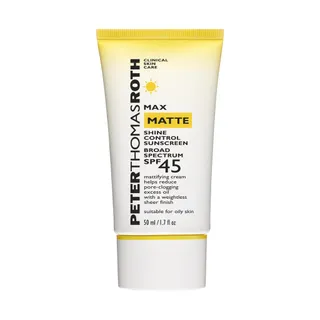
Peter Thomas Roth Max Matte Shine Control Sunscreen Broad Spectrum SPF 45
Works for
Sun protectionSPF 45 · 4 UV filtersBroad spectrum
This product offers a good level of protection against both UVB and UVA rays.
This sunscreen uses organic (so-called "chemical") sunscreen filters. Organic, or "chemical" filters usually provide reliable sun protection and rarely leave a white cast. Sunscreens with organic filters can sting eyes.
This product can be considered "reef safe" because it does not contain the UV filters (oxybenzone and octinoxate) that can be harmful to coral reefs when present in the water in high concentrations.
MoisturizingCeramide ns, Ceramide eop + 22 moreWorks well
“Formulated with Oil-Absorbing Technology, Hyaluronic Acid and ProHyal+®, this mattifying SPF 45 sunscreen provides weightless shine control and effectively hydrates without clogging pores.”
This product can help improve hydration of the skin with the two types of ingredients.
The first type is called “humectants”:
these ingredients help attract water.
When humectants are on the surface of the skin, they “pull in” the moisture from the outside environment, or from
within deeper layers of the skin. The following ingredients in this product do the job:
glycerin, saccharide isomerate.
This product also contains ingredients called “occlusives”. They help reduce the speed with which our skin loses moisture to the outside environment. These ingredients also help soften the upper layer of the skin, so it feels less tight and nicer to the touch. The following ingredients in this product do the job: dimethicone, argania spinosa kernel oil.
The following ingredients in this product are especially good for supporting the skin barrier and helping with the hydration level: caprooyl phytosphingosine, caprooyl sphingosine, ceramide ap, ceramide eop, ceramide eos, ceramide np, ceramide ns
Evens skin toneSide benefit · Yeast extractWorks well
This product offers broad spectrum sun protection. It means that it can prevent hyperpigmentation and help keep the skin tone even (sun damage is the main factor causing age spots, darkening of post-acne marks and other discolorations).
Anti-agingSide benefit the brand mentions · Tocopherol, Ascorbyl palmitateWorks well
“Reef-safe sunscreens help protect skin from aging UVA/UVB rays Oil-Absorbing Technology .”
This product can help prevent early signs of skin aging because it offers a good level of broad spectrum sun protection. Sun damage is the main cause of premature skin aging, and protecting your skin from the sun is the best anti-aging strategy.
Anti-oxidationSide benefit · Yeast extract, Argania spinosa kernel oil + 4 moreMay help
This product contains antioxidants (yeast extract) that might be able to help neutralize free radicals in skin to lessen the damage it gets from the UV light (sun). There is not enough evidence to confirm their effectiveness in skin though.
Can it cause trouble?
Irritancy18 flagged ingredientsLow risk
ComedogenicClean of flagged comedogenic ingredientsNone flagged
User reviews
Be the first — your take helps the next person decide.
Ingredients
Filter by role to see what each ingredient is doing.
Butyl methoxydibenzoylmethane3%
- Irritation risk
- Medium
Avobenzone. An organic, or so-called "chemical" UV filter. Protects against both UVA and UVB rays. Needs to be combined with other filters in a formulation to be stable.
More about Butyl methoxydibenzoylmethaneHomosalate9%
- Irritation risk
- Medium
A weak sunscreen that offers some protection against the sun rays that cause sunburn (UVB), but does not offer meaningful protection against protect against the most aging sun rays (UVA). It loses its effectiveness quickly when exposed to sunlight. It is an organic, or so called "chemical" sunscreen. When used in low concentrations, helps to stabilize the product formulation
More about HomosalateEthylhexyl salicylate5%
- Irritation risk
- Low
Octisalate. A UV filter. It offers some protection against the sun rays that cause sunburn (UVB), but does not protect against the most aging sun rays (UVA). It loses its effectiveness quickly when exposed to sunlight. It is an organic, or so called "chemical" sunscreen
More about Ethylhexyl salicylateOctocrylene10%
- Irritation risk
- Medium
A weak sunscreen that protects against the sun rays that cause sunburn (UVB) and is somewhat effective against the UVA rays. It is quite stable and can help stabilize other, more vulnerable, sunscreen ingredients like Avobenzone. It is an organic, or so called "chemical" sunscreen
More about OctocryleneWater~45–55%
Silica~5.5–6.8%
Butylene glycol~5.4–6.6%
- Irritation risk
- Low
Used to create a nice product texture and help delivery of other ingredients. Might be somewhat helpful in attracting water to the upper layer of the skin
More about Butylene glycolOctyldodecyl neopentanoate~4.5–5.5%
- Irritation risk
- Low
An emollient that helps soften the skin. Often used to stabilize other ingredients, for example, sunscreen
More about Octyldodecyl neopentanoateArgania spinosa kernel oil~3.4–4.1%
- Irritation risk
- Medium
An emollient that helps soften the upper layer of the skin. Might have some weak anti-oxidant properties
More about Argania spinosa kernel oilTocopheryl acetate~2.2–2.7%
- Irritation risk
- Medium
A more stable but less bio-available form of vitamin E compared to Tocopherol. Might help moisturize and protect the skin from free radicals, but mostly used in low concentrations to stabilize other ingredients.
More about Tocopheryl acetateGlyceryl stearate~1.8–2.2%
- Irritation risk
- Low
An emollient that softens the skin and forms a protective layer on its surface. Helps water and oil mix together
More about Glyceryl stearateStyrene/acrylates copolymer~1.6–2%
- Irritation risk
- Low
Used to create an even product consistency. Can help boost efficiency of sunscreen filters
More about Styrene/acrylates copolymerDimethicone~1.5–1.8%
- Irritation risk
- Low
A silicone that helps to reduce water loss from the surface of the skin. Can temporarily "fill in" lines and wrinkles, absorb oil, and create a nice product finish
More about DimethiconeYeast extract~1–1.2%
- Irritation risk
- Low
Helps attract water to the upper layer of the skin and might have some anti-oxidant and skin lightening properties. It can help calm down inflammation in skin
More about Yeast extractPeg-100 stearate~0.95–1.15%
- Irritation risk
- Low
Helps oil and water mix togehter and creates a nice product texture
More about Peg-100 stearateCetyl alcohol~0.9–1.1%
- Irritation risk
- Low
A non-drying alcohol that works to soften the skin and stabilize product formulations helping oil and water mix together
More about Cetyl alcoholStearic acid~0.7–1.1%
- Irritation risk
- Low
Helps oil and water mix together and works as an emollient
More about Stearic acidPhenoxyethanol~0.5–0.8%
- Irritation risk
- Low
A preservative. It helps prevent bacterial growth in cosmetic products
More about PhenoxyethanolSaccharide isomerate~0.5–0.75%
- Irritation risk
- Low
Helps attract water to the upper layer of the skin
More about Saccharide isomeratePersea gratissima oil~0.6–0.9%
- Irritation risk
- Medium
An emollient that helps soften the skin and could be helpful in repairing its barrier function
More about Persea gratissima oilDiethylhexyl syringylidenemalonate~0.5–0.75%
- Irritation risk
- Medium
Used to stabilize the product formulation
More about Diethylhexyl syringylidenemalonatePentylene glycol~0.55–0.8%
- Irritation risk
- Medium
Used to preserve products, dissolve other ingredients and create a nice product texture
More about Pentylene glycolHydrolyzed wheat protein/pvp crosspolymer~0.5–0.8%
- Irritation risk
- Low
Sodium hyaluronate~0.35–0.65%
- Irritation risk
- Low
One of the best moisturizing ingredients. Attracts water into the upper layer of the skin
More about Sodium hyaluronateSclerotium gum~0.35–0.6%
- Irritation risk
- Low
Used to create gel-like formulas and stabilize emulsions
More about Sclerotium gumBisabolol~0.3–0.55%
- Irritation risk
- Low
An active component of chamomile plant that historically has been used to calm down irritated skin. A recent study shows that bisabolol indeed can have some anti-inflammatory effect on skin, even though conclusive data is lacking. Bisabolol has a sweet floral scent and can be added to products for its aromatic properties
More about BisabololOctyldodecanol~0.4–0.6%
- Irritation risk
- Low
An emollient that helps to soften the skin and create a pleasant product texture and stabilize the formulation
More about OctyldodecanolSodium phytate~0.3–0.6%
Caprylic/capric triglyceride~0.45–0.7%
- Irritation risk
- Medium
A good mix of fatty acids that forms a protective layer on the skin. Improves the shelf life of products. Derived from coconut and glycerin
More about Caprylic/capric triglyceridePotassium sorbate~0.3–0.6%
Sodium benzoate~0.25–0.5%
Ethylhexylglycerin~0.3–0.55%
Disodium edta~0.3–0.55%
Ceramide np~0.4–0.65%
- Irritation risk
- Low
A type of lipid similar to ceramides naturally present in skin. Helps to soften the upper layer of the skin and supports the skin barrier function to keep it hydrated. Can help to prevent inflammation in skin
More about Ceramide npCitric acid~0.3–0.55%
- Irritation risk
- Medium
Can work as an exfoliant but is typically used to adjust the product pH
More about Citric acidSodium citrate~0.3–0.6%
- Irritation risk
- Medium
Helps to control the skin's pH level. Maintains the skin's natural film of amino-lactic acids and oils. Helps to preserve products
More about Sodium citrateAmmonium hydroxide~0.3–0.55%
Ceteareth-25~0.45–0.65%
Glycerin~0.35–0.65%
- Irritation risk
- Low
One of the best moisturizing ingredients. Naturally present in skin. It attracts water to the upper layer of the skin working as a humectant
More about GlycerinBehenic acid~0.5–0.75%
Cholesterol~0.45–0.7%
- Irritation risk
- Low
An emollient that is naturally found in skin
More about CholesterolCeramide ns~0.45–0.7%
- Irritation risk
- Low
A type of lipid similar to ceramides naturally present in skin. Helps to soften the upper layer of the skin and supports the skin barrier function to keep it hydrated. Can help to prevent inflammation in skin
More about Ceramide nsCeramide eos~0.3–0.55%
- Irritation risk
- Low
A type of lipid similar to ceramides naturally present in skin. Helps to soften the upper layer of the skin and supports the skin barrier function to keep it hydrated. Can help to prevent inflammation in skin
More about Ceramide eosCeramide eop~0.4–0.6%
- Irritation risk
- Low
A type of lipid similar to ceramides naturally present in skin. Helps to soften the upper layer of the skin and supports the skin barrier function to keep it hydrated. Can help to prevent inflammation in skin
More about Ceramide eopCeramide ap~0.4–0.6%
- Irritation risk
- Low
A type of lipid similar to ceramides naturally present in skin. Helps to soften the upper layer of the skin and supports the skin barrier function to keep it hydrated. Can help to prevent inflammation in skin
More about Ceramide apCaprooyl phytosphingosine~0.4–0.65%
- Irritation risk
- Low
A component of ceramides. Helps to soften the upper layer of the skin and supports the skin barrier function to keep it hydrated. Can help to prevent inflammation in skin
More about Caprooyl phytosphingosineCaprooyl sphingosine~0.25–0.5%
- Irritation risk
- Low
A component of ceramides. Helps to soften the upper layer of the skin and supports the skin barrier function to keep it hydrated. Can help to prevent inflammation in skin
More about Caprooyl sphingosineTocopherol~0.2–0.4%
- Irritation risk
- Low
Pure form of vitamin E. Can help moisturise and protect the skin from free radicals. Often used to help stabilise other ingredients or the formula itself
More about TocopherolAscorbyl palmitate~0.2–0.35%
- Irritation risk
- Medium
Being a lipid soluble form of vitamin C, it is more stable and can penetrate the skin better than L-Ascorbic acid. It is effective in protecting the skin from free radicals, as well as evening the skin tone, but is less effective in stimulating collagen production compared to L-Ascorbic acid.
More about Ascorbyl palmitateIngredient list view
Butyl methoxydibenzoylmethane, Homosalate, Ethylhexyl salicylate, Octocrylene, Water, Silica, Butylene glycol, Octyldodecyl neopentanoate, Argania spinosa kernel oil, Tocopheryl acetate, Glyceryl stearate, Styrene/acrylates copolymer, Dimethicone, Yeast extract, Peg-100 stearate, Cetyl alcohol, Stearic acid, Phenoxyethanol, Saccharide isomerate, Persea gratissima oil, Diethylhexyl syringylidenemalonate, Pentylene glycol, Hydrolyzed wheat protein/pvp crosspolymer, Sodium hyaluronate, Sclerotium gum, Bisabolol, Octyldodecanol, Sodium phytate, Caprylic/capric triglyceride, Potassium sorbate, Sodium benzoate, Ethylhexylglycerin, Disodium edta, Ceramide np, Citric acid, Sodium citrate, Ammonium hydroxide, Ceteareth-25, Glycerin, Behenic acid, Cholesterol, Ceramide ns, Ceramide eos, Ceramide eop, Ceramide ap, Caprooyl phytosphingosine, Caprooyl sphingosine, Tocopherol, Ascorbyl palmitate
Compare prices
Retailers ranked by price — lowest first.


Worth comparing, line by line.
Match % combines shared ingredients, the first five ingredients, shared actives and hero ingredients, irritancy (lower counts in the alternative's favour), texture and body area. Only products in the same routine step are compared.
| Peter Thomas RothMax Matte Shine Control Sunscreen Broad Spectrum SPF 45YOUR PRODUCT | CeraVeHydrating for Face and Body Sheer Sunscreen SPF 30 | EltaMDUV Skin Recovery Broad Spectrum SPF 50 | Transparent LabLightweight Sunscreen SPF50+ | |
|---|---|---|---|---|
| Match | — | 40% | 38% | 38% |
| Price | $34.00 | $13.97−$20.03 | $25.50−$8.50 | — |
| Shared key ingredients | — | 9 of 22 | 10 of 22 | 9 of 22 |
| Key difference | — | Niacinamide | Lactic Acid | Ceramide As |
| Irritancy | Low | Low | Low | Low |
| SPF | SPF 45 | SPF 30 | SPF 50 | SPF 50 |
| Drying alcohol | — | — | — | — |
| View product | Shop | Shop | Shop |

More alternatives: Clinique UV Solutions Hydrating Sunscreen SPF 50 with Hyaluronic AcidCell Fusion C Laser UV Defense Sunscreen SPF 50
Product summary
We believe that "Peter Thomas Roth - Max Matte Shine Control Sunscreen Broad Spectrum SPF 45" can provide reliable sun protection based on the ingredients listed. We love that it can protect from both UVA and UVB rays (not all sunscreens with SPF ratings give UVA protection. UVA rays do not cause sunburn, but still damage our skin and lead to early aging).
Because it includes good moisturizing ingredients, it can also work as a hydrating day cream. This product prevents early signs of aging by protecting against sun damage (all broad spectrum sunscreens do that).
Sunscreen filters
This sunscreen uses so-called "chemical", or organic UV filters (organic simply means that their molecules contain atoms of carbon). These filters typically give good sun protection and rarely leave a white cast, but they can be irritating for sensitive skin. The UV filters in this sunscreen are: avobenzone 3.00% (declared), octisalate 5.00% (declared), homosalate 9.00% (declared) and octocrylene 10.00% (declared).
Irritation risk
This product does not contain known common irritants and is suitable for sensitive skin. We assess the overall irritancy of this sunscreen to be medium. For a detailed overview of all potential irritants: click here
You can see the detailed formula review with the breakdown of all actives in the product and the full ingredient list with estimated concentrations in the tables below.
Price
The product retails from 34.00$ up to 38.00$ in the United States, for 25.37£ in the United Kingdom and for 47.90CA$ in Canada.
For a detailed price comparison: click here.
Sources cited in this review
Every concentration estimate and effectiveness label is anchored to one of these 19 studies and safety reviews.
- 1
- 2
- 3
- 4
- 5
- 6Final Report on the Safety Assessment of Dimethicone Copolyoljournals.sagepub.com

Affiliate links · As an Amazon Associate, WIMJ earns from qualifying purchases.