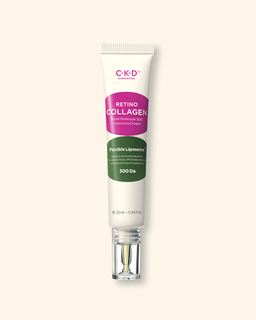
CKD Guaranteed Retino Collagen Small Molecule 300 Intensive Cream
Works for
2 of 2 advertised claims delivered
Anti-agingRetinal, Niacinamide + 18 moreStrong evidence
“Hydrolyzed Elastin is a natural elasticity booster, ensuring skin firmness and structure.”
This product can help reduce and prevent fine lines and wrinkles, improve skin elasticity and firmness because it contains retinal, adenosine, niacinamide.
These ingredients in the product can also be helpful, even though there is less evidence for their effectiveness: acetyl dipeptide-1 cetyl ester, acetyl hexapeptide-8, aspartic acid, copper tripeptide-1, dipeptide diaminobutyroyl benzylamide diacetate, hexapeptide-9, lysine, nonapeptide-1, palmitoyl pentapeptide-4, palmitoyl tetrapeptide-7, palmitoyl tripeptide-1, serine, threonine, tripeptide-1.
Keep in mind that it typically takes at least 6 weeks to notice any results because the changes that are needed to improve fine lines and elasticity happen in the deeper layers of the skin. No topical anti-aging product can “erase” wrinkles or fully reverse signs of aging.
MoisturizingNiacinamide, Copper tripeptide-1 + 51 moreStrong evidence
“Retino Collagen Small Molecule 300 Intensive Cream”
This product can help improve hydration of the skin with the two types of ingredients.
The first type is called “humectants”:
these ingredients help attract water.
When humectants are on the surface of the skin, they “pull in” the moisture from the outside environment, or from
within deeper layers of the skin. The following ingredients in this product do the job:
alanine, arginine.
This product also contains ingredients called “occlusives”. They help reduce the speed with which our skin loses moisture to the outside environment. These ingredients also help soften the upper layer of the skin, so it feels less tight and nicer to the touch. The following ingredients in this product do the job: arginine, cholesterol.
The following ingredients in this product are especially good for supporting the skin barrier and helping with the hydration level: acetyl dipeptide-1 cetyl ester, acetyl hexapeptide-8, ceramide np, copper tripeptide-1, dipeptide diaminobutyroyl benzylamide diacetate, hexapeptide-9, niacinamide, nonapeptide-1, palmitoyl pentapeptide-4, palmitoyl tetrapeptide-7, palmitoyl tripeptide-1, tripeptide-1
Evens skin toneNot advertised by the brand · Retinal, Niacinamide + 2 moreStrong evidence
This product can help reduce hypepigmentation and even out the skin tone because it contains the following effective ingredients: retinal.
In addition, this product contains niacinamide. This ingredient (ingredients) might help reduce hyperpigmentation, but the effect, if any, is likely to be small.
The following ingredient (ingredients) in this product might be helpful, but there is no evidence to confirm that it actually can help even out the skin tone: alanine, cysteine.
Keep in mind that you would need to apply any topical skincare targetted at hypigmentation consistently for a couple of months to get a result. No topical skincare product can help get rid of hyperpigmentation (including post-acne marks and age spots) instantly.
Anti-blemishNot advertised by the brand · Niacinamide, Retinal + 3 moreStrong evidence
This product can help reduce breakouts and clogged pores because it contains the following ingredient: niacinamide, retinal. These ingredients is used for treating acne and can have a noticeable effect.
Anti-oxidationNot advertised by the brand · Ficus carica fruit extract, Cysteine + 11 moreModerate evidence
This product contains antioxidants (cysteine, ficus carica fruit extract) that might be able to help neutralize free radicals in skin to lessen the damage it gets from the UV light (sun). There is not enough evidence to confirm their effectiveness in skin though.
Can it cause trouble?
Irritancy16 strong irritants: Eclipta prostrata leaf extract, Cymbopogon martini oil + 14 more — patch-test recommendedHigh risk
Comedogenic4 ingredients rated 2 or more on the 0–5 pore-clogging scale4 flagged


User reviews
Be the first — your take helps the next person decide.
Ingredients
Filter by role to see what each ingredient is doing.
Water~45–55%
Glycerin~4.3–5.3%
- Irritation risk
- Low
One of the best moisturizing ingredients. Naturally present in skin. It attracts water to the upper layer of the skin working as a humectant
More about GlycerinButylene glycol~3.9–4.8%
- Irritation risk
- Low
Used to create a nice product texture and help delivery of other ingredients. Might be somewhat helpful in attracting water to the upper layer of the skin
More about Butylene glycolCyclohexasiloxane~3.1–3.8%
- Irritation risk
- Low
A silicone that serves as an emollient. Helps create a nice non-greasy feels
More about CyclohexasiloxanePropanediol~2.3–2.8%
- Irritation risk
- Low
Acts as a solvent for other ingredients. Speeds up the absorption of other ingredients into the skin
More about PropanediolBetaine~1.8–2.2%
- Irritation risk
- Low
Helps attract water to the upper layer of the skin and improves the product texture
More about BetaineHydrogenated poly(c6-14 olefin)~1.6–1.9%
- Irritation risk
- Low
Helps soften the upper layer of the skin and create a nice product texture
More about Hydrogenated poly(c6-14 olefin)Pentaerythrityl tetraethylhexanoate~1.5–1.8%
- Irritation risk
- Low
Used to create a nice product consistency while softening the upper layer of the skin
More about Pentaerythrityl tetraethylhexanoateNiacinamide~1.1–1.4%
- Irritation risk
- Low
Is proven to be effective in reducing blemishes, evening out skin tone and helping to improve lines and wrinkles. It helps the skin to repair sun damage, calm down inflammation and keep maintain good levels of moisture. The concentration of about 2% is effective for supporting the skin barrier and evening out the skin tone. Concentration of 4-6% is better for helping with acne and balancing the sebum production
More about NiacinamideDicaprylyl ether~0.95–1.15%
- Irritation risk
- Low
Helps soften the upper layer of the skin while creating a non-greasy feel on the skin. Helps to dissolve other ingredients
More about Dicaprylyl ether1,2-hexanediol~0.6–0.9%
Cetyl alcohol~0.65–0.95%
- Irritation risk
- Low
A non-drying alcohol that works to soften the skin and stabilize product formulations helping oil and water mix together
More about Cetyl alcoholCetearyl olivate~0.5–0.75%
Cetearyl alcohol~0.55–0.8%
- Irritation risk
- Low
- Comedogenicity
- 2/5
A non-drying alcohol. Works as an emollient. Helps water and oil mix together and creates a nice product texture
More about Cetearyl alcoholCaprylic/capric triglyceride~0.45–0.7%
- Irritation risk
- Medium
A good mix of fatty acids that forms a protective layer on the skin. Improves the shelf life of products. Derived from coconut and glycerin
More about Caprylic/capric triglycerideSorbitan olivate~0.4–0.6%
Polyglyceryl-2 stearate~0.4–0.6%
- Irritation risk
- Medium
Helps water and oil mix together
More about Polyglyceryl-2 stearateBehenyl alcohol~0.4–0.6%
- Irritation risk
- Low
Non-drying alcohol that helps water and oil mix together. Also serves as an emollient
More about Behenyl alcoholPhytosteryl/behenyl/octyldodecyl lauroyl glutamate~0.3–0.5%
- Irritation risk
- Low
Glyceryl stearate~0.3–0.6%
- Irritation risk
- Low
An emollient that softens the skin and forms a protective layer on its surface. Helps water and oil mix together
More about Glyceryl stearateSoluble collagen~0.25–0.45%
- Irritation risk
- Low
A typically plant-derived compound that is supposed mimic human collagen. Cannot penetrate the skin barrier so is not particularly useful in skincare products beyond attracting water to the upper layer of the skin
More about Soluble collagenStearyl alcohol~0.3–0.5%
- Irritation risk
- Low
An emollient that helps soften the skin
More about Stearyl alcoholSodium stearoyl glutamate~0.25–0.5%
- Irritation risk
- Medium
Helps oil and water mix together
More about Sodium stearoyl glutamatePentaerythrityl distearate~0.25–0.45%
Hydrogenated lecithin~0.25–0.45%
- Irritation risk
- Low
Helps to retain moisture by creating a protective barrier on the skin. Rich in fatty acids. Improves product texture and helps with the penetration of other ingredients.
More about Hydrogenated lecithinSodium polyacryloyldimethyl taurate~0.2–0.4%
- Irritation risk
- Medium
Helps oil and water mix together
More about Sodium polyacryloyldimethyl taurateDipropylene glycol~0.2–0.4%
- Irritation risk
- Low
Helps to dissolve other ingredients in a formulation. Slows down the rate of product drying
More about Dipropylene glycolHydrolyzed collagen~0.25–0.45%
- Irritation risk
- Low
A typically plant-derived compound that is supposed mimic human collagen. Cannot penetrate the skin barrier so is not particularly useful in skincare products beyond attracting water to the upper layer of the skin
More about Hydrolyzed collagenLaminaria japonica extract~0.2–0.4%
- Irritation risk
- Low
- Comedogenicity
- 3/5
Seaweed extract that might help to attract water to the upper layer of the skin and have some anti-oxidant properties
More about Laminaria japonica extractEclipta prostrata leaf extract~0.2–0.4%
- Irritation risk
- High
A plant extract that is mostly used as a fragrance. Might have some anti-oxidant effect
More about Eclipta prostrata leaf extractGlyceryl stearate se~0.25–0.45%
- Irritation risk
- Low
- Comedogenicity
- 2/5
Used to stabilize the product formulations and works as an emollient
More about Glyceryl stearate seHydroxyacetophenone~0.2–0.4%
Ethylhexylglycerin~0.2–0.4%
Cholesterol~0.25–0.5%
- Irritation risk
- Low
An emollient that is naturally found in skin
More about CholesterolCymbopogon martini oil~0.2–0.4%
- Irritation risk
- High
Aromatic plant oil used in cosmetics as a fragrance. A likely irritant
More about Cymbopogon martini oilXanthan gum~0.25–0.45%
- Irritation risk
- Low
Used to create a thicker product consistency
More about Xanthan gumCitrus aurantium bergamia fruit oil~0.2–0.4%
- Irritation risk
- High
A plant oil with a high content of volatile compounds that can irritate the skin and lead to allergic reactions. Can lead to photosensitivity
More about Citrus aurantium bergamia fruit oilAdenosine~0.2–0.4%
- Irritation risk
- Low
Might help improve cell turnover and reduce inflammation in skin. One study shows that the ingredients might be able to help reduce dynamic wrinkles (for example, in the corners of the eyes or on the forehead)
More about AdenosineOlea europaea fruit oil~0.25–0.45%
- Irritation risk
- Medium
An emollient that helps soften the skin but is not effective for restoring its barrier function. Might be helpful to calm down inflammation
More about Olea europaea fruit oilFructooligosaccharides~0.2–0.4%
- Irritation risk
- Low
Help attract water to the upper layer of the skin
More about FructooligosaccharidesMelia azadirachta flower extract~0.2–0.4%
- Irritation risk
- Medium
A plant extract that might be helpful to neutralize free radicals in skin
More about Melia azadirachta flower extractDisodium edta~0.2–0.4%
Melia azadirachta leaf extract~0.2–0.4%
- Irritation risk
- High
A plant extract that has anti-bacterial properties. Can be used to preserve the product. Can be irritating
More about Melia azadirachta leaf extractCeramide np~0.25–0.5%
- Irritation risk
- Low
A type of lipid similar to ceramides naturally present in skin. Helps to soften the upper layer of the skin and supports the skin barrier function to keep it hydrated. Can help to prevent inflammation in skin
More about Ceramide npPelargonium graveolens flower oil~0.25–0.45%
- Irritation risk
- High
An essential oil. Can be irritating. Can become an allergen with oxidation
More about Pelargonium graveolens flower oilRetinal~0.2–0.4%
- Irritation risk
- High
One step removed from the biologically active in skin form of vitamin A. Once converted to the retinoic acid in the skin, retinal is proven to be effective against all signs of aging. It improves skin cell turnover, helps fight blemishes and clogged pores, can regulate excess oil production and even skin tone. Concentrations of 0.05% and 0.1% are shown to be effective. It can, however, be irritating
More about RetinalBeta-glucan~0.2–0.4%
- Irritation risk
- Low
Helps attract water to the upper layer of the skin, calm down inflammation and irritation, restore the barrier function and support wound healing. It can be helpful in reducing fine lines and wrinkles
More about Beta-glucanHydrolyzed hyaluronic acid~0.2–0.4%
- Irritation risk
- Low
One of the best moisturizing ingredients. Attracts water into the upper layer of the skin. A version of it is naturally present in skin
More about Hydrolyzed hyaluronic acidOcimum sanctum leaf extract~0.2–0.4%
- Irritation risk
- High
A plant extract that is rich in a fragrance compound eugenol that is a frequent allergen and can be irritating. It might also contain anti-oxidants to help neutralize free radicals
More about Ocimum sanctum leaf extractCurcuma longa root extract~0.2–0.4%
- Irritation risk
- High
A plant extract that can contain an active compound curcumin, that may have some anti-inflammatory properties when applied to the skin, but solid research is lacking and the typical concentration used in skincare products is too low. Can be an irritant
More about Curcuma longa root extractLavandula angustifolia oil~0.2–0.4%
- Irritation risk
- High
An essential oil. Potential allergen and can be irritating. It has some anti-bacterial properties
More about Lavandula angustifolia oilSorbitan laurate~0.25–0.5%
Centella asiatica extract~0.3–0.55%
- Irritation risk
- Medium
A plant extract that has been shown to be able to reduce inflammation in skin, support restoration of skin barrier function, as well as support collagen production. Contains active compounds called centelloids: asiaticoside, madecasosside, asiatic acid and madecassic acid. Might be helpful in preventing stretch marks. It can be itself be irritating though.
More about Centella asiatica extractFicus carica fruit extract~0.25–0.45%
- Irritation risk
- Medium
A plant extract that can help neutralize free radicals. The concentrations typically used in cosmetics are too small to have an effect
More about Ficus carica fruit extractAnthemis nobilis flower oil~0.2–0.4%
- Irritation risk
- High
An essential oil that is used as a fragrance and can be irritating. It might have some anti-oxidant effect in skin
More about Anthemis nobilis flower oilJuniperus virginiana oil~0.25–0.45%
- Irritation risk
- Medium
Cedarwood oil. Used as a fragrance. Can be irritating
More about Juniperus virginiana oilCorallina officinalis extract~0.25–0.45%
- Irritation risk
- Low
- Comedogenicity
- 3/5
Red algae extract that helps attract water to the upper layer of the skin and might contain antioxidants
More about Corallina officinalis extractGlycine~0.25–0.45%
- Irritation risk
- Low
Helps to attract water to the upper layer of the skin and can help restore the skin barrier function
More about GlycineCitrus aurantium dulcis peel oil~0.25–0.45%
- Irritation risk
- High
An essentil oil from orange peel. Potential allergen and can be irritating
More about Citrus aurantium dulcis peel oilSucrose distearate~0.3–0.55%
Serine~0.25–0.45%
- Irritation risk
- Low
An amino-acid that helps to attract water to the upper layer of the skin. In combination with other amino-acids, might help to reduce fine lines and wrinkles
More about SerineGlutamic acid~0.25–0.45%
- Irritation risk
- Low
An amino-acid that helps attract water to the upper layer of the skin
More about Glutamic acidMichelia alba flower oil~0.25–0.5%
- Irritation risk
- High
A plant essential oil. Used as a fragrance. Can be irritating
More about Michelia alba flower oilAniba rosodora wood oil~0.25–0.45%
Hydroxyethylcellulose~0.3–0.5%
- Irritation risk
- Low
Used to thicken product formulations and create gel-like textures
More about HydroxyethylcelluloseHydrolyzed elastin~0.3–0.5%
- Irritation risk
- Low
Sodium hyaluronate~0.25–0.45%
- Irritation risk
- Low
One of the best moisturizing ingredients. Attracts water into the upper layer of the skin
More about Sodium hyaluronateJuniperus mexicana oil~0.25–0.5%
- Irritation risk
- Low
Acetyl dipeptide-1 cetyl ester~0.25–0.5%
- Irritation risk
- Low
A type of peptide. Peptides are excellent moisturizers and might be able support collagen production reducing fine lines and wrinkles
More about Acetyl dipeptide-1 cetyl esterAspartic acid~0.25–0.45%
- Irritation risk
- Low
An amino-acid that helps increase skin hydration and might help to slightly improve skin firmness, potentially reducing lines and wrinkles
More about Aspartic acidTocopherol~0.25–0.5%
- Irritation risk
- Low
Pure form of vitamin E. Can help moisturise and protect the skin from free radicals. Often used to help stabilise other ingredients or the formula itself
More about TocopherolLeucine~0.25–0.45%
- Irritation risk
- Low
Alanine~0.25–0.45%
- Irritation risk
- Low
An amino-acid that helps to attract water to the upper layer of the skin and might help to lighten the skin, but solid evidence is lacking
More about AlanineLysine~0.25–0.45%
- Irritation risk
- Low
An amino-acid that helps to attract water to the upper layer of the skin. In combination with other amino-acids, might help to reduce fine lines and wrinkles
More about LysineArginine~0.25–0.45%
- Irritation risk
- Low
An amino acid that is naturally present in skin and helps keep it hydrated. When used together with AHAs, it can reduce their irritating effect on the skin
More about ArginineTyrosine~0.25–0.45%
Phenylalanine~0.25–0.45%
- Irritation risk
- Low
Proline~0.25–0.5%
Valine~0.25–0.45%
- Irritation risk
- Low
Threonine~0.25–0.5%
- Irritation risk
- Low
An amino-acid that helps to attract water to the upper layer of the skin. In combination with other amino-acids, might help to reduce fine lines and wrinkles
More about ThreonineIsoleucine~0.25–0.45%
- Irritation risk
- Low
An amino acid that can help attract water to the upper layer of the skin and support skin's barrier function
More about IsoleucineCaprylyl glycol~0.3–0.5%
- Irritation risk
- Medium
Helps preserve products and creates a nice product texture
More about Caprylyl glycolDipeptide diaminobutyroyl benzylamide diacetate~0.25–0.45%
- Irritation risk
- Low
A type of peptide. Peptides are excellent moisturizers and might be able support collagen production reducing fine lines and wrinkles
More about Dipeptide diaminobutyroyl benzylamide diacetateCitrus aurantium dulcis flower oil~0.25–0.45%
- Irritation risk
- High
Histidine~0.25–0.45%
Viola odorata leaf extract~0.25–0.45%
- Irritation risk
- Low
Cysteine~0.25–0.45%
- Irritation risk
- Low
Might help neutralize free radicals in skin and might be helpful against hyperpigmentation
More about CysteineMethionine~0.25–0.45%
- Irritation risk
- Low
Sodium acetylated hyaluronate~0.25–0.45%
- Irritation risk
- Low
A type of hyaluronic acid that works as an excellent moisturizer by attracting water into the upper layer of the skin. Is typically feels less sticky on the skin compared to the usual hyaluronic acid
More about Sodium acetylated hyaluronatePalmitoyl tetrapeptide-7~0.25–0.5%
- Irritation risk
- Low
A type of peptide. Peptides are excellent moisturizers and might be able support collagen production reducing fine lines and wrinkles
More about Palmitoyl tetrapeptide-7Hexapeptide-9~0.25–0.45%
- Irritation risk
- Low
A type of peptide. Peptides are excellent moisturizers and might be able support collagen production reducing fine lines and wrinkles
More about Hexapeptide-9Acetyl hexapeptide-8~0.2–0.4%
- Irritation risk
- Low
A type of peptide. Peptides are excellent moisturizers and might be able support collagen production reducing fine lines and wrinkles
More about Acetyl hexapeptide-8Nonapeptide-1~0.2–0.4%
- Irritation risk
- Low
A type of peptide. Peptides are excellent moisturizers and might be able support collagen production reducing fine lines and wrinkles
More about Nonapeptide-1Tripeptide-1~0.25–0.45%
- Irritation risk
- Low
A type of peptide. Peptides are excellent moisturizers and might be able support collagen production reducing fine lines and wrinkles
More about Tripeptide-1Palmitoyl pentapeptide-4~0.2–0.35%
- Irritation risk
- Low
A type of peptide. Peptides are excellent moisturizers and might be able support collagen production reducing fine lines and wrinkles
More about Palmitoyl pentapeptide-4Palmitoyl tripeptide-1~0.2–0.4%
- Irritation risk
- Low
A type of peptide. Peptides are excellent moisturizers and might be able support collagen production reducing fine lines and wrinkles
More about Palmitoyl tripeptide-1Copper tripeptide-1~0.15–0.3%
- Irritation risk
- Low
A naturally occurring peptide. One of the most studied peptides in dermatology. It is sometimes abbreviated GHK-Cu. Belongs to the class of carrier peptides. It stimulates both synthesis and breakdown of collagen in skin. It is released in skin wounds and inflammation to support healing. It accelerates wound-healing of the skin and can stimulate hair growth. There are preliminary studies that confirm that copper tripeptide can help support collagen production reducing fine lines and wrinkles and decrease inflammation in skin.
More about Copper tripeptide-1Citral~0.1–0.2%
Limonene~0.15–0.25%
- Irritation risk
- High
A common frangrance that can easily irritate skin, especially if exposed to air, light or heat
More about LimoneneLinalool~0.1–0.2%
Geraniol~0.05–0.1%
Citronellol~0.05–0.1%
Ingredient list view
Water, Glycerin, Butylene glycol, Cyclohexasiloxane, Propanediol, Betaine, Hydrogenated poly(c6-14 olefin), Pentaerythrityl tetraethylhexanoate, Niacinamide, Dicaprylyl ether, 1,2-hexanediol, Cetyl alcohol, Cetearyl olivate, Cetearyl alcohol, Caprylic/capric triglyceride, Sorbitan olivate, Polyglyceryl-2 stearate, Behenyl alcohol, Phytosteryl/behenyl/octyldodecyl lauroyl glutamate, Glyceryl stearate, Soluble collagen, Stearyl alcohol, Sodium stearoyl glutamate, Pentaerythrityl distearate, Hydrogenated lecithin, Sodium polyacryloyldimethyl taurate, Dipropylene glycol, Hydrolyzed collagen, Laminaria japonica extract, Eclipta prostrata leaf extract, Glyceryl stearate se, Hydroxyacetophenone, Ethylhexylglycerin, Cholesterol, Cymbopogon martini oil, Xanthan gum, Citrus aurantium bergamia fruit oil, Adenosine, Olea europaea fruit oil, Fructooligosaccharides, Melia azadirachta flower extract, Disodium edta, Melia azadirachta leaf extract, Ceramide np, Pelargonium graveolens flower oil, Retinal, Beta-glucan, Hydrolyzed hyaluronic acid, Ocimum sanctum leaf extract, Curcuma longa root extract, Lavandula angustifolia oil, Sorbitan laurate, Centella asiatica extract, Ficus carica fruit extract, Anthemis nobilis flower oil, Juniperus virginiana oil, Corallina officinalis extract, Glycine, Citrus aurantium dulcis peel oil, Sucrose distearate, Serine, Glutamic acid, Michelia alba flower oil, Aniba rosodora wood oil, Hydroxyethylcellulose, Hydrolyzed elastin, Sodium hyaluronate, Juniperus mexicana oil, Acetyl dipeptide-1 cetyl ester, Aspartic acid, Tocopherol, Leucine, Alanine, Lysine, Arginine, Tyrosine, Phenylalanine, Proline, Valine, Threonine, Isoleucine, Caprylyl glycol, Dipeptide diaminobutyroyl benzylamide diacetate, Citrus aurantium dulcis flower oil, Histidine, Viola odorata leaf extract, Cysteine, Methionine, Sodium acetylated hyaluronate, Palmitoyl tetrapeptide-7, Hexapeptide-9, Acetyl hexapeptide-8, Nonapeptide-1, Tripeptide-1, Palmitoyl pentapeptide-4, Palmitoyl tripeptide-1, Copper tripeptide-1, Citral, Limonene, Linalool, Geraniol, Citronellol
Compare prices
Retailers ranked by price — lowest first.

Affiliate links · prices updated regularly
Worth comparing, line by line.
Match % combines shared ingredients, the first five ingredients, shared actives and hero ingredients, irritancy (lower counts in the alternative's favour), texture and body area. Only products in the same routine step are compared.
| CKD GuaranteedRetino Collagen Small Molecule 300 Intensive CreamYOUR PRODUCT | HSGNRetinally Liposomal Retinal Cream | AbibYesStyle Exclusive PDRN Volume Fill-it Booster Crème 2.5 Tube Mini 5pcs Bundle Set | ArenciaRetinal Booster Shot 30ml | |
|---|---|---|---|---|
| Match | — | 87% | 79% | 78% |
| Price | $24.70 | $13.20−$11.50 | $37.53+$12.83 | $24.00−$0.70 |
| Shared key ingredients | — | 20 of 43 | 13 of 43 | 16 of 43 |
| Key difference | — | Ascorbic Acid Polypeptide | Acetyl Tetrapeptide-5 | Hexapeptide-2 |
| Irritancy | High | Medium | Medium | Medium |
| Drying alcohol | — | — | — | — |
| View product | Shop | Shop | Shop |

Product summary
"CKD Guaranteed - Retino Collagen Small Molecule 300 Intensive Cream" is effective for: Anti-aging, Moisturizing, Evens skin tone and Anti-blemish
Ingredient callouts
- this moisturizer contains an effective form of Retinoids (vitamin A): retinal 0.20% - 0.40%. Retinoids are potent multitasking actives. They work to improve and prevent early signs of aging, reduce hyperpigmentation (age spots and post-acne marks), and prevent inflamed blemishes and clogged pores. The downside of Retinoids is that they can be irritating. If you are not already using a Retinoid in your routine, it is best to start slowly and apply the Retinoid product only a few times per week. If your skin tolerates it well, you can gradually increase the frequency to daily. Because of the irritation risk of Retinoids, we recommend to have another, retinoid-free moisturizer in your routine to use on the alternate days or when your skin feels dry.
- As a plus, this moisturizer also contains Ceramides (ceramide np 0.25% - 0.50%). Ceramides are a type of lipids that our skin produces itself. They are a building block of the skin's barrier. Ceramides used in skincare are synthetic or extracted from plants. They work well for softening the skin surface and "patch holes" in the skin's barrier.
- We like that this moisturizer contains peptides (copper tripeptide-1 0.15% - 0.30%, palmitoyl tripeptide-1 0.20% - 0.40%, palmitoyl pentapeptide-4 0.20% - 0.35%, tripeptide-1 0.25% - 0.45%, nonapeptide-1 0.20% - 0.40%, acetyl hexapeptide-8 0.20% - 0.40%, hexapeptide-9 0.25% - 0.45%, palmitoyl tetrapeptide-7 0.25% - 0.50%, dipeptide diaminobutyroyl benzylamide diacetate 0.25% - 0.45% and acetyl dipeptide-1 cetyl ester 0.25% - 0.50%). There are many different kind of Peptides and they are naturally present in our skin. They all are a combination of aminoacids. Some of them work as natural antibiotics, promote wound-healing and production of collagen. The science is still not settled on how effective Peptides are in skincare, but it is very likely that they have a benefit. Peptides might help restore the skin barrier and fight the signs of aging. At the very least, Peptides work as humectants: they attract water to the upper layer of the skin and improve its hydration.
- Adenosine 0.20% - 0.40%. It is a compound that in involved in many biological processes inside the skin cells. According one high-quality clinical trial, topical Adenosine in low concentrations can somewhat help improve "deep wrinkles" - the wrinkles that appear with age in places where our faces are most dynamic (for example, on the forehead or in the corners of the eyes).
Price
The product retails for 24.70$ in the United States.
For a detailed price comparison: click here.
Sources cited in this review
Every concentration estimate and effectiveness label is anchored to one of these 56 studies and safety reviews.
- 1
- 2Safety Assessment of Pentaerythrityl Tetraesters as Used in Cosmeticsjournals.sagepub.com
- 3
- 4
- 5
- 6

Affiliate links · As an Amazon Associate, WIMJ earns from qualifying purchases.