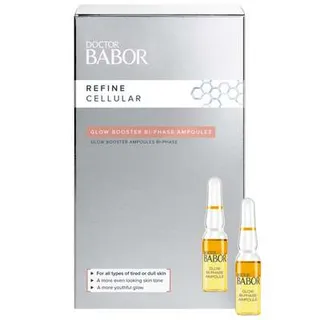
BABOR Doctor Babor Refine Cellular: Glow Booster Bi-Phase Ampoules
Works for
MoisturizingLimnanthes alba seed oil, Glycerin + 5 moreWorks
“Then, if required, apply a moisturising cream.”
This product can help improve hydration of the skin with the two types of ingredients.
The first type is called “humectants”:
these ingredients help attract water.
When humectants are on the surface of the skin, they “pull in” the moisture from the outside environment, or from
within deeper layers of the skin. The following ingredients in this product do the job:
glycerin, caprylyl glycol.
This product also contains ingredients called “occlusives”. They help reduce the speed with which our skin loses moisture to the outside environment. These ingredients also help soften the upper layer of the skin, so it feels less tight and nicer to the touch. The following ingredients in this product do the job: limnanthes alba seed oil, prunus amygdalus dulcis oil.
Evens skin toneNot advertised by the brand · 3-o-ethyl ascorbic acid, Ascorbic acidMay help
The following ingredient (ingredients) in this product might be helpful, but there is no evidence to confirm that it actually works: 3-o-ethyl ascorbic acid.
Anti-oxidationNot advertised by the brand · 3-o-ethyl ascorbic acid, Hippophae rhamnoides fruit extract + 9 moreMay help
This product contains antioxidants (3-o-ethyl ascorbic acid) that might be able to help neutralize free radicals in skin to lessen the damage it gets from the UV light (sun). There is not enough evidence to confirm their effectiveness in skin though.
Can it cause trouble?
Irritancy7 strong irritants: Rosmarinus officinalis leaf extract, Limonene + 5 more — patch-test recommendedHigh risk
ComedogenicClean of flagged comedogenic ingredientsNone flagged


User reviews
Be the first — your take helps the next person decide.
Ingredients
Filter by role to see what each ingredient is doing.
3-o-ethyl ascorbic acid~23–34%
- Irritation risk
- High
A vitamin C derivative that is more stable but less potent than pure form of vitamin C. Can help neutralize free radicals and help reduce hyperpigmentation, but the required concentration is likely to be much higher than for the pure form of vitamin C, limiting the ingredient's effectiveness in products
More about 3-o-ethyl ascorbic acidHippophae rhamnoides fruit extract~4.5–6.8%
- Irritation risk
- Medium
A plant extract that might help neutralize free radicals in skin, but research on its effectiveness is lacking
More about Hippophae rhamnoides fruit extractPhenoxyethanol~0.5–1%
- Irritation risk
- Low
A preservative. It helps prevent bacterial growth in cosmetic products
More about PhenoxyethanolHydroxyethylcellulose~3.5–5.3%
- Irritation risk
- Low
Used to thicken product formulations and create gel-like textures
More about HydroxyethylcelluloseEthylhexylglycerin~2.6–3.9%
Tris(tetramethylhydroxypiperidinol) citrate~1.8–2.8%
- Irritation risk
- Low
Rosmarinus officinalis leaf extract~1.2–1.9%
- Irritation risk
- High
Can be helpful in reducing inflammation in skin, including inflamed acne. It can be irritating
More about Rosmarinus officinalis leaf extractLimonene~1.2–1.7%
- Irritation risk
- High
A common frangrance that can easily irritate skin, especially if exposed to air, light or heat
More about LimoneneLimnanthes alba seed oil~1.2–1.7%
- Irritation risk
- Low
This oil's cmposition is closest to rapeseed oil. It is a very stable oil and serves as an emoillient
More about Limnanthes alba seed oilGlycerin~0.95–1.45%
- Irritation risk
- Low
One of the best moisturizing ingredients. Naturally present in skin. It attracts water to the upper layer of the skin working as a humectant
More about GlycerinDisodium phosphate~0.55–1.35%
- Irritation risk
- Low
Helps adjust the product pH and stabilize the formulation
More about Disodium phosphateAlcohol~0.5–1.15%
- Irritation risk
- High
Can be drying and contribute to skin irritation. Used in formulars to dissolve other ingredients, create a thinner product consistency or for its antibacterial properties
More about AlcoholCaprylic/capric triglyceride~0.5–1.2%
- Irritation risk
- Medium
A good mix of fatty acids that forms a protective layer on the skin. Improves the shelf life of products. Derived from coconut and glycerin
More about Caprylic/capric triglycerideAscorbyl palmitate~0.4–0.95%
- Irritation risk
- Medium
Being a lipid soluble form of vitamin C, it is more stable and can penetrate the skin better than L-Ascorbic acid. It is effective in protecting the skin from free radicals, as well as evening the skin tone, but is less effective in stimulating collagen production compared to L-Ascorbic acid.
More about Ascorbyl palmitateCitronellol~0.35–0.85%
Benzyl alcohol~0.35–0.85%
- Irritation risk
- High
A preservative. Can be used to mask unpleasant smell. Can be irritating
More about Benzyl alcoholPrunus amygdalus dulcis oil~0.45–1%
- Irritation risk
- Low
An emollient that softens the skin
More about Prunus amygdalus dulcis oilRosa canina fruit oil~0.4–0.95%
- Irritation risk
- Medium
A great emollient. Contains vitamin E (tocopherol) which may give it some anti-oxidant properties. Can contain volatile compounds and can be irritating
More about Rosa canina fruit oilParfum~0.3–0.7%
- Irritation risk
- High
An aromatic blend of unspecified and possibly irritating ingredients
More about ParfumCitric acid~0.3–0.7%
- Irritation risk
- Medium
Can work as an exfoliant but is typically used to adjust the product pH
More about Citric acidDisodium edta~0.2–0.8%
Hexylene glycol~0.2–0.75%
- Irritation risk
- Medium
Helps create a more spreadable product texture
More about Hexylene glycolXanthan gum~0.2–0.75%
- Irritation risk
- Low
Used to create a thicker product consistency
More about Xanthan gumTocopherol~0.2–0.75%
- Irritation risk
- Low
Pure form of vitamin E. Can help moisturise and protect the skin from free radicals. Often used to help stabilise other ingredients or the formula itself
More about TocopherolCi 15510~0.2–0.7%
- Irritation risk
- Low
Water~0.15–0.7%
Tocopheryl acetate~0.15–0.7%
- Irritation risk
- Medium
A more stable but less bio-available form of vitamin E compared to Tocopherol. Might help moisturize and protect the skin from free radicals, but mostly used in low concentrations to stabilize other ingredients.
More about Tocopheryl acetateSodium chloride~0.2–0.75%
- Irritation risk
- Low
Used to stabilize mixtures of oil and water, and create thicker, gel-like product textures
More about Sodium chlorideBenzophenone-3~0.2–0.8%
- Irritation risk
- High
Same as oxybenzone. Protects in the UVB and short UVA range. In small concentrations, used to stabilize product formulation. Can be irritating. Is shown to be harmful to coral reefs - consider avoiding bathing in coral reef areas when wearing a product with this ingredient. It can penetrate the skin and get absorbed into bloodstream faster than other popular filters available in the US. The study that produced this finding did not address any potential health effects of the absorption
More about Benzophenone-3Linalool~0.1–0.45%
Polygonum bistorta root extract~0.15–0.55%
- Irritation risk
- Medium
A plant extract that might have some anti-oxidant properties and is claimed by its manufacturer to be able to decrease lines and wrinkles but evidence is lacking
More about Polygonum bistorta root extractCaprylyl glycol~0.15–0.65%
- Irritation risk
- Medium
Helps preserve products and creates a nice product texture
More about Caprylyl glycolAscorbic acid~0.1–0.4%
- Irritation risk
- High
The most well-researched antioxidant that works in skin. Helps neutralize free radicals supporting collagen production, helping to even out the skin tone and preventing early signs of aging
More about Ascorbic acidCi 19140~0.1–0.4%
Ingredient list view
3-o-ethyl ascorbic acid, Hippophae rhamnoides fruit extract, Phenoxyethanol, Hydroxyethylcellulose, Ethylhexylglycerin, Tris(tetramethylhydroxypiperidinol) citrate, Rosmarinus officinalis leaf extract, Limonene, Limnanthes alba seed oil, Glycerin, Disodium phosphate, Alcohol, Caprylic/capric triglyceride, Ascorbyl palmitate, Citronellol, Benzyl alcohol, Prunus amygdalus dulcis oil, Rosa canina fruit oil, Parfum, Citric acid, Disodium edta, Hexylene glycol, Xanthan gum, Tocopherol, Ci 15510, Water, Tocopheryl acetate, Sodium chloride, Benzophenone-3, Linalool, Polygonum bistorta root extract, Caprylyl glycol, Ascorbic acid, Ci 19140
Compare prices
Retailers ranked by price — lowest first.
Worth comparing, line by line.
Match % combines shared ingredients, the first five ingredients, shared actives and hero ingredients, irritancy (lower counts in the alternative's favour), texture and body area. Only products in the same routine step are compared.
| BABORDoctor Babor Refine Cellular: Glow Booster Bi-Phase AmpoulesYOUR PRODUCT | FunctionalabRetinol 0,5% Serum | OptimumVitamin C Serum | Josh RosebrookC Bright Complex Vitamin C Serum | |
|---|---|---|---|---|
| Match | — | 56% | 55% | 55% |
| Price | — | $96.64 | $20.06 | $73.00 |
| Shared key ingredients | — | 4 of 8 | 3 of 8 | 3 of 8 |
| Key difference | — | Mineral Oil | Niacinamide | Azelaic Acid |
| Irritancy | High | Medium | Medium | Medium |
| Drying alcohol | Contains drying alcohol | — | — | — |
| View product | Shop | Shop | Shop |

More alternatives: Arencia Vitamin C Booster ShotBoots Ingredients Vitamin C Serum
Product summary
"BABOR - Doctor Babor Refine Cellular: Glow Booster Bi-Phase Ampoules" could be helpful for: Moisturizing, Evens skin tone and Anti-oxidation, but its actives are not the most effective or are not well-studied.
Ingredient callouts
- This product also contains Vitamin C (Ascorbic Acid). It can be an effective active for anti-aging and evening out the skin tone, but in this product it is used for stabilizing other ingredients in the formulation. In this concentration (0.10% - 0.40%) it cannot have a noticeable benefit for the skin.
- Humectants (glycerin 0.95% - 1.45%). These ingredients help attract water to the upper layer of the skin and improve the skin hydration.
Sources cited in this review
Every concentration estimate and effectiveness label is anchored to one of these 15 studies and safety reviews.
- 1
- 2Abundance of active ingredients in sea-buckthorn oilncbi.nlm.nih.gov
- 3Allergic contact dermatitis induced by rosemary leaf extract in a cleansing gelpubmed.ncbi.nlm.nih.gov
- 4
- 5
- 6

Affiliate links · As an Amazon Associate, WIMJ earns from qualifying purchases.