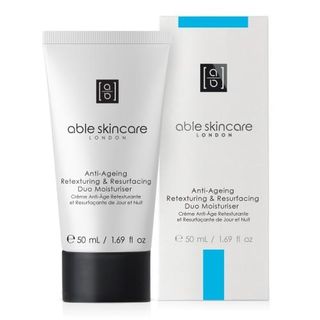
Able Skincare Anti-Ageing Retexturing and Resurfacing Duo Moisturiser
Works for
2 of 3 advertised claims delivered
MoisturizingCeramide 1, Ceramide 3 + 54 moreStrong evidence
“Anti-Ageing Retexturing and Resurfacing Duo Moisturiser”
This product can help improve hydration of the skin with the two types of ingredients.
The first type is called “humectants”:
these ingredients help attract water.
When humectants are on the surface of the skin, they “pull in” the moisture from the outside environment, or from
within deeper layers of the skin. The following ingredients in this product do the job:
alanine, arginine.
This product also contains ingredients called “occlusives”. They help reduce the speed with which our skin loses moisture to the outside environment. These ingredients also help soften the upper layer of the skin, so it feels less tight and nicer to the touch. The following ingredients in this product do the job: arginine, butyrospermum parkii butter.
The following ingredients in this product are especially good for supporting the skin barrier and helping with the hydration level: ceramide 1, ceramide 3, ceramide 6 ii, phytosphingosine, urea
Anti-agingSerine, Folic acid + 11 moreModerate evidence
“The Anti-Ageing Retexturing and Resurfacing Duo Moisturiser has been formulated with Cosmetic DroneTM, the most advanced delivery system for active ingredients. Harbouring signature ingredients, the day and night Moisturiser is designed with an anti-ageing Cosmetics DroneTM infused wiith Shea butter and Cottonseed oil.”
This product contains aspartic acid, folic acid, lysine, phloretin, serine, threonine. These ingredients might be able to help reduce and prevent fine lines and wrinkles, improve skin elasticity and firmness, but there is not enough evidence that it actually works.
ExfoliationUrea, Retinyl palmitate + 2 moreLimited evidence
“Anti-Ageing Retexturing and Resurfacing Duo Moisturiser”
This product might help exfoliate the skin with urea, but This ingredient is not the most effective.
Anti-oxidationNot advertised by the brand · Phloretin, Ubiquinone + 8 moreStrong evidence
This product contains antioxidants (phloretin, thioctic acid, ubiquinone) that can help neutralize free radicals in skin. By doing so, they can lessen the damage the skin gets from the UV light (sun).
The following ingredients - cysteine, pyridoxine also can have an antioxidant effect, but there is less evidence to confirm their effectiveness in skin.
Evens skin toneNot advertised by the brand · Phloretin, Phenylethyl resorcinol + 6 moreModerate evidence
The following ingredient (ingredients) in this product might be helpful, but there is no evidence to confirm that it actually works: alanine, cysteine, phenylethyl resorcinol, phloretin.
Can it cause trouble?
Irritancy9 strong irritants: Parfum, Butylphenyl methylpropional + 7 more — patch-test recommendedHigh risk
Comedogenic1 ingredient rated 2 or more on the 0–5 pore-clogging scale1 flagged


User reviews
Be the first — your take helps the next person decide.
Ingredients
Filter by role to see what each ingredient is doing.
Water~45–55%
Caprylic/capric triglyceride~5.1–6.3%
- Irritation risk
- Medium
A good mix of fatty acids that forms a protective layer on the skin. Improves the shelf life of products. Derived from coconut and glycerin
More about Caprylic/capric triglyceridePropylheptyl caprylate~4.2–5.1%
- Irritation risk
- Low
Helps soften the upper layer of the skin
More about Propylheptyl caprylateGlyceryl stearate~2.9–3.5%
- Irritation risk
- Low
An emollient that softens the skin and forms a protective layer on its surface. Helps water and oil mix together
More about Glyceryl stearateCetyl alcohol~2.3–2.9%
- Irritation risk
- Low
A non-drying alcohol that works to soften the skin and stabilize product formulations helping oil and water mix together
More about Cetyl alcoholC12-15 alkyl benzoate~1.9–2.4%
- Irritation risk
- Low
Enhances the product texture and makes it more spreadable. Helps reduce water loss from the outer layer of skin. Extands the shelf life by preventing bacteria growth
More about C12-15 alkyl benzoateDiglycerin~1.6–2%
- Irritation risk
- Low
Helps attract water to the upper layer of the skin
More about DiglycerinButyrospermum parkii butter~1.5–1.8%
- Irritation risk
- Low
- Comedogenicity
- 3/5
A great moisturising ingredient that softens the skin and reduces water loss from its upper layer. It also can be helpful in protecting skin from free radicals
More about Butyrospermum parkii butterPeg-75 stearate~1.1–1.4%
Cera alba~1.1–1.3%
- Irritation risk
- Medium
Forms a protective barrier that holds water and keeps dry skin hydrated. Keeps an emulsion from separating into its oil and liquid components, and increases the thickness of a product. Can be an allergen
More about Cera albaTrehalose~0.65–0.95%
- Irritation risk
- Low
A sugar that attracts water to the upper layer of the skin
More about TrehalosePhenoxyethanol~0.5–0.8%
- Irritation risk
- Low
A preservative. It helps prevent bacterial growth in cosmetic products
More about PhenoxyethanolDimethicone~0.55–0.8%
- Irritation risk
- Low
A silicone that helps to reduce water loss from the surface of the skin. Can temporarily "fill in" lines and wrinkles, absorb oil, and create a nice product finish
More about DimethiconeSodium polyacrylate~0.45–0.7%
- Irritation risk
- Low
Used to create a gel-like product texture, as well as to stabilize emulsions
More about Sodium polyacrylateParfum~0.35–0.6%
- Irritation risk
- High
An aromatic blend of unspecified and possibly irritating ingredients
More about ParfumSteareth-20~0.5–0.75%
Ceteth-20~0.5–0.75%
Ethylhexylglycerin~0.3–0.6%
Synthetic fluorphlogopite~0.3–0.55%
- Irritation risk
- Low
A mineral that is used as an optical filter (makes the skin looks nicer through light reflection) and to improve the texture of cosmetic products
More about Synthetic fluorphlogopiteTocopheryl acetate~0.25–0.5%
- Irritation risk
- Medium
A more stable but less bio-available form of vitamin E compared to Tocopherol. Might help moisturize and protect the skin from free radicals, but mostly used in low concentrations to stabilize other ingredients.
More about Tocopheryl acetatePhenylethyl resorcinol~0.25–0.5%
- Irritation risk
- High
Might help reduce hyperpigmentation in skin and help neutralize free radicals
More about Phenylethyl resorcinolTitanium dioxide~0.3–0.6%
- Irritation risk
- Low
Works as a UV filter when used in high concentrations. It is photostable and is effective mostly against the UVB light, with some protection in the UVA range. In small concentrations, used for its ability to improve the color of cosmetic products. Is usually well tolerated by the skin
More about Titanium dioxidePotassium sorbate~0.2–0.4%
Disodium edta~0.2–0.4%
Allantoin~0.2–0.35%
- Irritation risk
- Low
Helps calm down inflammation in skin and can help reduce itching. Helps to repair the skin barrier and keep skin hydrated
More about AllantoinPolyglyceryl-10 dilaurate~0.2–0.4%
Glycerin~0.25–0.45%
- Irritation risk
- Low
One of the best moisturizing ingredients. Naturally present in skin. It attracts water to the upper layer of the skin working as a humectant
More about GlycerinLactic acid~0.2–0.35%
- Irritation risk
- Medium
An exfoliating and moisturizing alpha-hydroxy acid (AHA). Typically causes less irritation than other AHAs, for example, glycolic acid. At high concentrations (about 15%), lactic acid can help reduce lines and wrinkles. Recent studies show that lactic acid can support the "good" bacteria living on skin's surface (healthy skin microbiome)
More about Lactic acidHazelnut seed oil polyglyceryl-6 esters~0.25–0.45%
Watermelon seed oil polyglyceryl-6 esters~0.2–0.4%
Hydrolyzed glycosaminoglycans~0.2–0.35%
- Irritation risk
- Low
Long sugars that help attract water to the upper layer of the skin
More about Hydrolyzed glycosaminoglycansButylene glycol~0.2–0.4%
- Irritation risk
- Low
Used to create a nice product texture and help delivery of other ingredients. Might be somewhat helpful in attracting water to the upper layer of the skin
More about Butylene glycolTitanium dioxide~0.3–0.55%
- Irritation risk
- Low
Works as a UV filter when used in high concentrations. It is photostable and is effective mostly against the UVB light, with some protection in the UVA range. In small concentrations, used for its ability to improve the color of cosmetic products. Is usually well tolerated by the skin
More about Titanium dioxideNaringin~0.2–0.4%
- Irritation risk
- Low
Sorbitan palmitate~0.2–0.4%
- Irritation risk
- Medium
Helps water and oil mix together and stabilize the product formulation
More about Sorbitan palmitateMorinda citrifolia seed extract~0.2–0.35%
- Irritation risk
- Low
Sodium lauroyl lactylate~0.2–0.4%
- Irritation risk
- Medium
Helps water and oil mix together
More about Sodium lauroyl lactylateDicetyl phosphate~0.25–0.4%
Niacinamide~0.2–0.4%
- Irritation risk
- Low
Is proven to be effective in reducing blemishes, evening out skin tone and helping to improve lines and wrinkles. It helps the skin to repair sun damage, calm down inflammation and keep maintain good levels of moisture. The concentration of about 2% is effective for supporting the skin barrier and evening out the skin tone. Concentration of 4-6% is better for helping with acne and balancing the sebum production
More about NiacinamideArginine~0.2–0.35%
- Irritation risk
- Low
An amino acid that is naturally present in skin and helps keep it hydrated. When used together with AHAs, it can reduce their irritating effect on the skin
More about ArginineButylphenyl methylpropional~0.2–0.35%
- Irritation risk
- High
A fragrance. Can trigger allergic reactions and be irritating
More about Butylphenyl methylpropionalPhloretin~0.25–0.4%
- Irritation risk
- Medium
A potent antioxidant that is able to penetrate the skin barrier. It can help neutralize free radicals in skin, fight photodamage and reduce hyperpigmentation. It is, however, unstable and loses effectiveness when exposed to light. Effective products with phloretin must come in air-tight opaque packaging and use a sophisticated delivery technology
More about PhloretinCitronellol~0.2–0.35%
Sodium hyaluronate~0.2–0.4%
- Irritation risk
- Low
One of the best moisturizing ingredients. Attracts water into the upper layer of the skin
More about Sodium hyaluronateSodium starch octenylsuccinate~0.2–0.4%
- Irritation risk
- Low
Hexyl cinnamal~0.2–0.35%
Pyridoxine hcl~0.2–0.35%
- Irritation risk
- Medium
Might help neutralize free radicals in skin
More about Pyridoxine hclMaltodextrin~0.2–0.4%
- Irritation risk
- Low
Used to stabilize the product formulation and can help absorb oil
More about MaltodextrinCalcium pantothenate~0.2–0.4%
- Irritation risk
- Low
Helps support skin barrier function improving skin hydration and reducing sensitivity
More about Calcium pantothenateDisodium adenosine triphosphate~0.2–0.35%
- Irritation risk
- Low
Mannitol~0.2–0.35%
- Irritation risk
- Low
Helps to attract water to the upper layer of the skin
More about MannitolAlpha-isomethyl ionone~0.2–0.35%
- Irritation risk
- High
A fragrance. Potential allergen and can be irritating
More about Alpha-isomethyl iononeRna~0.2–0.35%
- Irritation risk
- Low
Tin oxide~0.3–0.55%
- Irritation risk
- Low
A colorant that can add a pearl-like appearance to the formulation
More about Tin oxideHydroxycitronellal~0.2–0.35%
- Irritation risk
- High
A fragrance. A likely allergen and can be irritating
More about HydroxycitronellalSodium ascorbyl phosphate~0.2–0.4%
- Irritation risk
- Medium
A stable derivative of vitamin C. It is oil-soluble which means it is more likely to penetrate the skin compared to the pure form of vitamin C (which is water-soluble), but it is less bio-available and is way less effective in stimulating collagen and reducing wrinkles compared to the pure form of vitamin C (L-ascorbic acid) and its other derivatives (for example, magnesium ascorbyl phosphate). At the same time, this vitamin C derivative has been shown in studies to be effective in reducing acne, blemishes and clogged pores. It is less irritating then the pure form of vitamin C
More about Sodium ascorbyl phosphateCetyl hydroxyethylcellulose~0.25–0.45%
- Irritation risk
- Low
Used to create a thicker product consistency and stabilize formulations
More about Cetyl hydroxyethylcelluloseDna~0.2–0.35%
- Irritation risk
- Low
Polysorbate 20~0.25–0.45%
Histidine hcl~0.2–0.35%
- Irritation risk
- Low
A salt of an amino-acid that helps attract water to the upper layer of the skin. Might be helpful in restoring the skin barrier function
More about Histidine hclSorbitol~0.2–0.4%
- Irritation risk
- Low
Helps attract water to the upper layer of the skin and improves the product texture
More about SorbitolLecithin~0.25–0.45%
- Irritation risk
- Low
Used mostly for creating emulsions - helping oil and water mix together. Helps soften the upper layer of the skin
More about LecithinXanthan gum~0.2–0.4%
- Irritation risk
- Low
Used to create a thicker product consistency
More about Xanthan gumPropylene glycol~0.2–0.35%
- Irritation risk
- High
Helps oil and water mix together and can enhance the penetration of other ingredients into the skin. It can be irritating
More about Propylene glycolPolymethyl methacrylate~0.25–0.45%
- Irritation risk
- Low
Is used to enhance product texture and can help to optically mask skin imperfections
More about Polymethyl methacrylatePhenylalanine~0.2–0.4%
- Irritation risk
- Low
Geraniol~0.2–0.35%
Linalool~0.2–0.35%
Cholesterol~0.25–0.5%
- Irritation risk
- Low
An emollient that is naturally found in skin
More about CholesterolPhytosphingosine~0.3–0.55%
- Irritation risk
- Low
A type of lipid that is naturally present in skin. It might help in repairing skin barrier function and has anti-bacterial effect
More about PhytosphingosineCeramide 1~0.3–0.5%
- Irritation risk
- Low
A type of lipid similar to ceramides naturally present in skin. Helps to soften the upper layer of the skin and supports the skin barrier function to keep it hydrated. Can help to prevent inflammation in skin
More about Ceramide 1Ceramide 6 ii~0.3–0.5%
- Irritation risk
- Low
A type of lipid similar to ceramides naturally present in skin. Helps to soften the upper layer of the skin and supports the skin barrier function to keep it hydrated. Can help to prevent inflammation in skin
More about Ceramide 6 iiCeramide 3~0.3–0.5%
- Irritation risk
- Low
A type of lipid similar to ceramides naturally present in skin. Helps to soften the upper layer of the skin and supports the skin barrier function to keep it hydrated. Can help to prevent inflammation in skin
More about Ceramide 3Carbomer~0.25–0.45%
- Irritation risk
- Low
Helps create a thicker or gel-like product texture. It is not a surfactant but can be used in gentle cleansing formulations
More about CarbomerTrilaurin~0.25–0.45%
- Irritation risk
- Low
Tyrosine~0.25–0.45%
Citric acid~0.25–0.45%
- Irritation risk
- Medium
Can work as an exfoliant but is typically used to adjust the product pH
More about Citric acidThioctic acid~0.25–0.5%
Diacetyl boldine~0.25–0.45%
- Irritation risk
- Low
Saccharomyces/magnesium ferment~0.25–0.45%
- Irritation risk
- Low
Yeast extract that contains magnesium. Can help to attract water to the upper layer of the skin. Evidence of effectiveness for other benefits is missing
More about Saccharomyces/magnesium fermentCaprylyl glycol~0.3–0.5%
- Irritation risk
- Medium
Helps preserve products and creates a nice product texture
More about Caprylyl glycolGlyceryl linoleate~0.3–0.55%
- Irritation risk
- Medium
Helps oil and water mix together
More about Glyceryl linoleateGlyceryl linolenate~0.3–0.55%
- Irritation risk
- Low
Helps soften the upper layer of the skin
More about Glyceryl linolenateUbiquinone~0.25–0.5%
- Irritation risk
- Low
Coenzyme Q10. It helps neutralize free radicals in skin, improves skin hydration and might be helpful agains fine lines and wrinkles. It can be an allergen
More about UbiquinoneBht~0.25–0.45%
Retinyl palmitate~0.25–0.45%
- Irritation risk
- High
Three steps removed from the active form of vitamin A - retinoic acid. To have an effect in the skin, it first needs to be converted twice to become the retinoic acid. This means it is less potent than retinol, but could also be less irritating. Once converted to the retinoic acid in the skin, it helps against all signs of aging, improves skin cell turnover and helps fight blemishes and clogged pores. However, in many cosmetic formulations, it is used in a concentration that is too low to have the full effect
More about Retinyl palmitateSilica~0.4–0.6%
Aspartic acid~0.25–0.45%
- Irritation risk
- Low
An amino-acid that helps increase skin hydration and might help to slightly improve skin firmness, potentially reducing lines and wrinkles
More about Aspartic acidValine~0.25–0.45%
- Irritation risk
- Low
Isoleucine~0.25–0.45%
- Irritation risk
- Low
An amino acid that can help attract water to the upper layer of the skin and support skin's barrier function
More about IsoleucineProline~0.25–0.5%
Alanine~0.25–0.45%
- Irritation risk
- Low
An amino-acid that helps to attract water to the upper layer of the skin and might help to lighten the skin, but solid evidence is lacking
More about AlanineSerine~0.25–0.45%
- Irritation risk
- Low
An amino-acid that helps to attract water to the upper layer of the skin. In combination with other amino-acids, might help to reduce fine lines and wrinkles
More about SerineLeucine~0.25–0.45%
- Irritation risk
- Low
Histidine~0.25–0.45%
Glycine~0.25–0.45%
- Irritation risk
- Low
Helps to attract water to the upper layer of the skin and can help restore the skin barrier function
More about GlycineLysine~0.25–0.45%
- Irritation risk
- Low
An amino-acid that helps to attract water to the upper layer of the skin. In combination with other amino-acids, might help to reduce fine lines and wrinkles
More about LysineThreonine~0.25–0.5%
- Irritation risk
- Low
An amino-acid that helps to attract water to the upper layer of the skin. In combination with other amino-acids, might help to reduce fine lines and wrinkles
More about ThreonineGlutamic acid~0.25–0.45%
- Irritation risk
- Low
An amino-acid that helps attract water to the upper layer of the skin
More about Glutamic acidYeast amino acids~0.25–0.45%
- Irritation risk
- Low
Urea~0.25–0.45%
- Irritation risk
- Low
Naturally present in skin (urea makes up about 7% of natural moisturizing factors in skin). Attracts water to the upper layer of the skin. Also has a positive effect on the skin barrier beyond the humectant action. Can enhance penetration of other ingredients. Is an exfoliating ingredient when used in high concentrations
More about UreaSaccharomyces/iron ferment~0.25–0.45%
- Irritation risk
- Low
Yeast extract that contains iron. Can help to attract water to the upper layer of the skin. Evidence of effectiveness for other benefits is missing
More about Saccharomyces/iron fermentSaccharomyces/copper ferment~0.25–0.45%
- Irritation risk
- Low
Yeast extract that contains copper. Can help to attract water to the upper layer of the skin and can help in skin wound healing
More about Saccharomyces/copper fermentThiamine/yeast polypeptide~0.25–0.45%
- Irritation risk
- Low
Betaine~0.25–0.45%
- Irritation risk
- Low
Helps attract water to the upper layer of the skin and improves the product texture
More about BetaineInositol~0.25–0.45%
Taurine~0.25–0.5%
- Irritation risk
- Medium
Could be helpful in reducing inflammation in skin, evening out the skin tone and neutralizing free radicals, but more research is needed to confirm its effectiveness
More about TaurineSaccharomyces/silicon ferment~0.25–0.45%
- Irritation risk
- Low
Yeast extract that contains silicon. Can help to attract water to the upper layer of the skin. Evidence of effectiveness for other benefits is missing
More about Saccharomyces/silicon fermentSaccharomyces/zinc ferment~0.25–0.45%
- Irritation risk
- Low
Yeast extract that contains zinc. Can help to attract water to the upper layer of the skin. Evidence of effectiveness for other benefits is missing
More about Saccharomyces/zinc fermentCysteine~0.2–0.4%
- Irritation risk
- Low
Might help neutralize free radicals in skin and might be helpful against hyperpigmentation
More about CysteineTryptophan~0.2–0.4%
- Irritation risk
- Low
Methionine~0.2–0.4%
- Irritation risk
- Low
Glyceryl caprylate~0.25–0.5%
- Irritation risk
- Low
An emollient that can also help water and oil mix together, as well as prevent bacteria growth in products
More about Glyceryl caprylatePantothenic acid~0.2–0.35%
- Irritation risk
- Low
Helps attract water to the upper layer of the skin and may help reduce inflammation in skin
More about Pantothenic acidSodium metabisulfite~0.1–0.2%
Riboflavin~0.15–0.3%
- Irritation risk
- Low
Biotin~0.15–0.3%
- Irritation risk
- Low
Might have some moisturising properties. Is not effective when applied topically beyond some moisturizing effect
More about BiotinFolic acid~0.15–0.3%
- Irritation risk
- Low
Can help stimulate collagen production in skin. While available studies are promising, more research is needed to confirm the efficacy in skin
More about Folic acidCyanocobalamin~0.1–0.2%
- Irritation risk
- Low
Can support skin barrier function and reduce inflammation in skin
More about CyanocobalaminPyridoxine~0.1–0.2%
- Irritation risk
- High
Might help neutralize free radicals in skin, but evidence of effectiveness in skin is lacking. It might be irritating
More about PyridoxineIngredient list view
Water, Caprylic/capric triglyceride, Propylheptyl caprylate, Glyceryl stearate, Cetyl alcohol, C12-15 alkyl benzoate, Diglycerin, Butyrospermum parkii butter, Peg-75 stearate, Cera alba, Trehalose, Phenoxyethanol, Dimethicone, Sodium polyacrylate, Parfum, Steareth-20, Ceteth-20, Ethylhexylglycerin, Synthetic fluorphlogopite, Tocopheryl acetate, Phenylethyl resorcinol, Titanium dioxide, Potassium sorbate, Disodium edta, Allantoin, Polyglyceryl-10 dilaurate, Glycerin, Lactic acid, Hazelnut seed oil polyglyceryl-6 esters, Watermelon seed oil polyglyceryl-6 esters, Hydrolyzed glycosaminoglycans, Butylene glycol, Titanium dioxide, Naringin, Sorbitan palmitate, Morinda citrifolia seed extract, Sodium lauroyl lactylate, Dicetyl phosphate, Niacinamide, Arginine, Butylphenyl methylpropional, Phloretin, Citronellol, Sodium hyaluronate, Sodium starch octenylsuccinate, Hexyl cinnamal, Pyridoxine hcl, Maltodextrin, Calcium pantothenate, Disodium adenosine triphosphate, Mannitol, Alpha-isomethyl ionone, Rna, Tin oxide, Hydroxycitronellal, Sodium ascorbyl phosphate, Cetyl hydroxyethylcellulose, Dna, Polysorbate 20, Histidine hcl, Sorbitol, Lecithin, Xanthan gum, Propylene glycol, Polymethyl methacrylate, Phenylalanine, Geraniol, Linalool, Cholesterol, Phytosphingosine, Ceramide 1, Ceramide 6 ii, Ceramide 3, Carbomer, Trilaurin, Tyrosine, Citric acid, Thioctic acid, Diacetyl boldine, Saccharomyces/magnesium ferment, Caprylyl glycol, Glyceryl linoleate, Glyceryl linolenate, Ubiquinone, Bht, Retinyl palmitate, Silica, Aspartic acid, Valine, Isoleucine, Proline, Alanine, Serine, Leucine, Histidine, Glycine, Lysine, Threonine, Glutamic acid, Yeast amino acids, Urea, Saccharomyces/iron ferment, Saccharomyces/copper ferment, Thiamine/yeast polypeptide, Betaine, Inositol, Taurine, Saccharomyces/silicon ferment, Saccharomyces/zinc ferment, Cysteine, Tryptophan, Methionine, Glyceryl caprylate, Pantothenic acid, Sodium metabisulfite, Riboflavin, Biotin, Folic acid, Cyanocobalamin, Pyridoxine
Compare prices
Retailers ranked by price — lowest first.
Affiliate links · prices updated regularly · As an Amazon Associate, WIMJ earns from qualifying purchases.
Worth comparing, line by line.
Match % combines shared ingredients, the first five ingredients, shared actives and hero ingredients, irritancy (lower counts in the alternative's favour), texture and body area. Only products in the same routine step are compared.
| Able SkincareAnti-Ageing Retexturing and Resurfacing Duo MoisturiserYOUR PRODUCT | Avant Skincare2-1 Glutamic Skin Lightening and Dark Spot Reducer | MEDI-PEELGold Age Tox H8 Cream | CeraVeBaby Moisturizing Lotion | |
|---|---|---|---|---|
| Match | — | 79% | 75% | 72% |
| Price | — | $116.30 | $20.25 | $9.99 |
| Shared key ingredients | — | 33 of 50 | 21 of 50 | 7 of 50 |
| Key difference | — | Oleyl Erucate | Oligopeptide-1 | Ceramide Np |
| Irritancy | High | High | High | Low |
| Drying alcohol | — | — | — | — |
| View product | Shop | Shop | Shop |

Sources cited in this review
Every concentration estimate and effectiveness label is anchored to one of these 47 studies and safety reviews.
- 1
- 2
- 3Final Report on the Safety Assessment of Dimethicone Copolyoljournals.sagepub.com
- 4
- 5
- 6Epidermal and dermal effects of topical lactic acidncbi.nlm.nih.gov

Affiliate links · As an Amazon Associate, WIMJ earns from qualifying purchases.