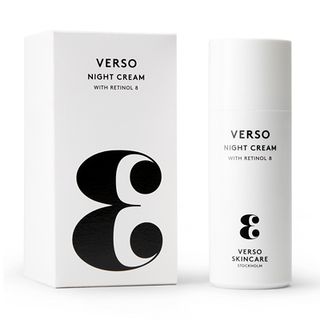
Works for
2 of 2 advertised claims delivered
Anti-aging5 ingredients credited for this claimStrong support
“Verso Skincare VERSO 3 Night Cream helps to increase the skin's own production of collagen, reversing the signs of ageing.”
This product can help reduce and prevent fine lines and wrinkles, improve skin elasticity and firmness because it contains retinyl retinoate.
Keep in mind that it typically takes at least 6 weeks to notice any results because the changes that are needed to improve fine lines and elasticity happen in the deeper layers of the skin. No topical anti-aging product can “erase” wrinkles or fully reverse signs of aging.
Moisturizing18 ingredients credited for this claimGood support
“3 Night Cream”
This product can help improve hydration of the skin with the two types of ingredients.
The first type is called “humectants”:
these ingredients help attract water.
When humectants are on the surface of the skin, they “pull in” the moisture from the outside environment, or from
within deeper layers of the skin. The following ingredients in this product do the job:
glycerin, sodium hyaluronate.
This product also contains ingredients called “occlusives”. They help reduce the speed with which our skin loses moisture to the outside environment. These ingredients also help soften the upper layer of the skin, so it feels less tight and nicer to the touch. The following ingredients in this product do the job: butyrospermum parkii butter, caprylic/capric triglyceride.
ExfoliationNot advertised by the brand · 1 ingredient credited for this claimStrong support
This product can help exfoliate the skin. In other words, it helps break down the bonds between dead cells on the surface of the skin and speed up the skin turnover. Skin often appears softer and brighter after exfoliation, but overdoing it can result in disrupted skin barrier. The following ingredient is doing the exfoliating job in this product: retinyl retinoate.
Anti-blemishNot advertised by the brand · 1 ingredient credited for this claimStrong support
This product can help reduce breakouts and clogged pores because it contains the following ingredient: retinyl retinoate. This ingredient is used for treating acne and can have a noticeable effect.
Anti-oxidationNot advertised by the brand · 6 ingredients credited for this claimModerate support
This product contains antioxidants (squalene, tetrahydrodiferuloylmethane) that might be able to help neutralize free radicals in skin to lessen the damage it gets from the UV light (sun). There is not enough evidence to confirm their effectiveness in skin though.
Evens skin toneNot advertised by the brand · 2 ingredients credited for this claimModerate support
The following ingredient (ingredients) in this product might be helpful, but there is no evidence to confirm that it actually works: retinyl retinoate, tetrahydrodiferuloylmethane.
Can it cause trouble?
Irritancy3 strong irritants: Alcohol, Parfum + 1 more — patch-test recommendedHigh risk
Comedogenic4 ingredients rated 2 or more on the 0–5 pore-clogging scale4 flagged
User reviews
Be the first — your take helps the next person decide.
Ingredients
Filter by role to see what each ingredient is doing.
Water~45–55%
Glycerin~4.9–6%
- Irritation risk
- Low
One of the best moisturizing ingredients. Naturally present in skin. It attracts water to the upper layer of the skin working as a humectant
More about GlycerinButyrospermum parkii butter~4.2–5.1%
- Irritation risk
- Low
- Comedogenicity
- 3/5
A great moisturising ingredient that softens the skin and reduces water loss from its upper layer. It also can be helpful in protecting skin from free radicals
More about Butyrospermum parkii butterButylene glycol~3–3.7%
- Irritation risk
- Low
Used to create a nice product texture and help delivery of other ingredients. Might be somewhat helpful in attracting water to the upper layer of the skin
More about Butylene glycolCaprylic/capric triglyceride~2.4–3%
- Irritation risk
- Medium
A good mix of fatty acids that forms a protective layer on the skin. Improves the shelf life of products. Derived from coconut and glycerin
More about Caprylic/capric triglycerideHeptyl undecylenate~2–2.5%
- Irritation risk
- Medium
Helps soften the upper layer of the skin, reduce water loss from the skin surface over time and create a nice product finish
More about Heptyl undecylenatePentylene glycol~1.7–2.1%
- Irritation risk
- Medium
Used to preserve products, dissolve other ingredients and create a nice product texture
More about Pentylene glycolSqualane~1.6–1.9%
- Irritation risk
- Low
An oil naturally present in skin. Works as an emollient to soften the skin and form a protective layer on its surface without a greasy feeling.
More about SqualaneGlyceryl stearate~1.3–1.5%
- Irritation risk
- Low
An emollient that softens the skin and forms a protective layer on its surface. Helps water and oil mix together
More about Glyceryl stearatePeg-100 stearate~1.1–1.3%
- Irritation risk
- Low
Helps oil and water mix togehter and creates a nice product texture
More about Peg-100 stearateCetearyl alcohol~0.8–1.2%
- Irritation risk
- Low
- Comedogenicity
- 2/5
A non-drying alcohol. Works as an emollient. Helps water and oil mix together and creates a nice product texture
More about Cetearyl alcoholHydroxyethyl acrylate/sodium acryloyldimethyl taurate copolymer~0.6–0.9%
- Irritation risk
- Medium
A gelling agent that thickens the product consistency and leaves the skin with a velvety finish
More about Hydroxyethyl acrylate/sodium acryloyldimethyl taurate copolymerJojoba esters~0.55–0.85%
- Irritation risk
- Medium
An emollient made of jojoba oil. Helps soften the skin and support its barrier function
More about Jojoba estersPhenoxyethanol~0.45–0.7%
- Irritation risk
- Low
A preservative. It helps prevent bacterial growth in cosmetic products
More about PhenoxyethanolCaprylyl glycol~0.45–0.7%
- Irritation risk
- Medium
Helps preserve products and creates a nice product texture
More about Caprylyl glycolCanola oil~0.45–0.7%
- Irritation risk
- Medium
A plant oil that can help soften the upper layer of the skin
More about Canola oilTocopheryl acetate~0.45–0.65%
- Irritation risk
- Medium
A more stable but less bio-available form of vitamin E compared to Tocopherol. Might help moisturize and protect the skin from free radicals, but mostly used in low concentrations to stabilize other ingredients.
More about Tocopheryl acetateTetrahydrodiferuloylmethane~0.35–0.65%
- Irritation risk
- High
An anti-oxidant derived from curcumin (naturally present in tumeric). Is a part of the tetrahydrocurcuminoids complex (THC). The complex might be helpful in neutralizing free radicals in skin and possibly help even out the skin tone. Can be irritating
More about TetrahydrodiferuloylmethaneAlcohol~0.3–0.6%
- Irritation risk
- High
Can be drying and contribute to skin irritation. Used in formulars to dissolve other ingredients, create a thinner product consistency or for its antibacterial properties
More about AlcoholParfum~0.25–0.5%
- Irritation risk
- High
An aromatic blend of unspecified and possibly irritating ingredients
More about ParfumHydroxyphenyl propamidobenzoic acid~0.25–0.5%
- Irritation risk
- Low
Might help to reduce inflammation in skin, but solid research is lacking
More about Hydroxyphenyl propamidobenzoic acidCurcuma longa root extract~0.25–0.45%
- Irritation risk
- High
A plant extract that can contain an active compound curcumin, that may have some anti-inflammatory properties when applied to the skin, but solid research is lacking and the typical concentration used in skincare products is too low. Can be an irritant
More about Curcuma longa root extractLecithin~0.25–0.5%
- Irritation risk
- Low
Used mostly for creating emulsions - helping oil and water mix together. Helps soften the upper layer of the skin
More about LecithinPolysorbate 20~0.25–0.45%
Sorbitan isostearate~0.25–0.45%
- Irritation risk
- Low
Helps oil and water mix together
More about Sorbitan isostearateGlycine soja oil~0.2–0.4%
- Irritation risk
- Medium
- Comedogenicity
- 2/5
A good emollient that helps soften the skin and helps repair its barrier function. It can clog pores if used in high concentrations.
More about Glycine soja oilRetinyl retinoate~0.2–0.4%
- Irritation risk
- High
A "hybrid" of retinol and retinoic acid. It is more stable than retinol and is likely to be more effective based on the early research data available. Is as irritating as retinol
More about Retinyl retinoateCitric acid~0.2–0.35%
- Irritation risk
- Medium
Can work as an exfoliant but is typically used to adjust the product pH
More about Citric acidSodium hyaluronate~0.2–0.35%
- Irritation risk
- Low
One of the best moisturizing ingredients. Attracts water into the upper layer of the skin
More about Sodium hyaluronateTetrahydropiperine~0.2–0.35%
- Irritation risk
- Low
Sodium hydroxide~0.15–0.3%
Tocopherol~0.15–0.3%
- Irritation risk
- Low
Pure form of vitamin E. Can help moisturise and protect the skin from free radicals. Often used to help stabilise other ingredients or the formula itself
More about TocopherolBeta-sitosterol~0.15–0.3%
- Irritation risk
- Low
A phytosterol that can support skin's barrier function and help the skin stay hydrated
More about Beta-sitosterolSoy isoflavones~0.1–0.2%
- Irritation risk
- Low
Squalene~0.15–0.25%
- Irritation risk
- Low
- Comedogenicity
- 2/5
An oil that is naturally part of skin sebum that helps to soften its upper layer, reduce water loss and neutralize free radicals. It might be comedogenic. Avoid applying large concentrations (or pure oil) before sun exposure as oxidized squalene can clog pores and lead to skin irritation. Today squalene is mostly derived from vegetable oils or synthetized by yeast
More about SqualeneAscorbyl palmitate~0.05–0.1%
- Irritation risk
- Medium
Being a lipid soluble form of vitamin C, it is more stable and can penetrate the skin better than L-Ascorbic acid. It is effective in protecting the skin from free radicals, as well as evening the skin tone, but is less effective in stimulating collagen production compared to L-Ascorbic acid.
More about Ascorbyl palmitateIngredient list view
Water, Glycerin, Butyrospermum parkii butter, Butylene glycol, Caprylic/capric triglyceride, Heptyl undecylenate, Pentylene glycol, Squalane, Glyceryl stearate, Peg-100 stearate, Cetearyl alcohol, Hydroxyethyl acrylate/sodium acryloyldimethyl taurate copolymer, Jojoba esters, Phenoxyethanol, Caprylyl glycol, Canola oil, Tocopheryl acetate, Tetrahydrodiferuloylmethane, Alcohol, Parfum, Hydroxyphenyl propamidobenzoic acid, Curcuma longa root extract, Lecithin, Polysorbate 20, Sorbitan isostearate, Glycine soja oil, Retinyl retinoate, Citric acid, Sodium hyaluronate, Tetrahydropiperine, Sodium hydroxide, Tocopherol, Beta-sitosterol, Soy isoflavones, Squalene, Ascorbyl palmitate
Compare prices
Retailers ranked by price — lowest first.
Affiliate links · prices updated regularly · As an Amazon Associate, WIMJ earns from qualifying purchases.
Worth comparing, line by line.
Match % combines shared ingredients, the first five ingredients, shared actives and hero ingredients, irritancy (lower counts in the alternative's favour), texture and body area. Only products in the same routine step are compared.
| VERSO3 Night CreamYOUR PRODUCT | Medik8r-Retinoate Youth Activating Cream Intense | It CosmeticsConfidence in a Cream Hydrating Moisturiser | NaturopathicaArgan & Retinol Wrinkle Repair Night Cream | |
|---|---|---|---|---|
| Match | — | 89% | 87% | 83% |
| Price | $112.37 | $227.06+$114.69 | $16.00−$96.37 | $134.00+$21.63 |
| Shared key ingredients | — | 5 of 11 | 4 of 11 | 3 of 11 |
| Key difference | — | Copper Heptapeptide-14 Pantothenate | Colloidal Oatmeal | Retinol |
| Irritancy | High | High | High | High |
| Drying alcohol | Contains drying alcohol | — | — | Contains drying alcohol |
| View product | Shop | Shop | Shop |


Sources cited in this review
Every concentration estimate and effectiveness label is anchored to one of these 17 studies and safety reviews.
- 1
- 2Canola Oilsciencedirect.com
- 3
- 4
- 5Skin lightening effect of tetrahydrocurcuminomicsonline.org
- 6

Affiliate links · As an Amazon Associate, WIMJ earns from qualifying purchases.