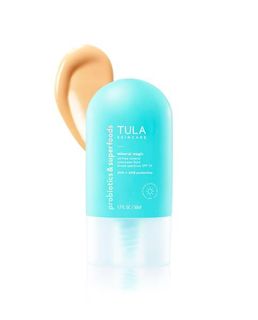
Tula Mineral Sunscreen Fluid Broad Spectrum SPF 30
Works for
1 of 1 advertised claim delivered
Sun protectionSPF 30 · 3 UV filtersBroad spectrum
This product offers a good level of protection against both UVB and UVA rays.
This sunscreen uses organic (so-called "chemical") sunscreen filters. Organic, or "chemical" filters usually provide reliable sun protection and rarely leave a white cast. Sunscreens with organic filters can sting eyes.
This product can be considered "reef safe" because it does not contain the UV filters (oxybenzone and octinoxate) that can be harmful to coral reefs when present in the water in high concentrations.
Anti-agingNot advertised by the brand · Lactococcus ferment lysate, Prunus persica leaf extract + 2 moreStrong evidence
This product can help prevent early signs of skin aging because it offers a good level of broad spectrum sun protection. Sun damage is the main cause of premature skin aging, and protecting your skin from the sun is the best anti-aging strategy.
Evens skin toneNot advertised by the brand · Lactic acidStrong evidence
This product offers broad spectrum sun protection. It means that it can prevent hyperpigmentation and help keep the skin tone even (sun damage is the main factor causing age spots, darkening of post-acne marks and other discolorations).
MoisturizingNot advertised by the brand · Corallina officinalis extract, Glycerin + 24 moreGood evidence
This product can help improve hydration of the skin with the two types of ingredients.
The first type is called “humectants”:
these ingredients help attract water.
When humectants are on the surface of the skin, they “pull in” the moisture from the outside environment, or from
within deeper layers of the skin. The following ingredients in this product do the job:
glycerin, lactobacillus ferment.
This product also contains ingredients called “occlusives”. They help reduce the speed with which our skin loses moisture to the outside environment. These ingredients also help soften the upper layer of the skin, so it feels less tight and nicer to the touch. The following ingredients in this product do the job: caprylic/capric triglyceride, dimethicone.
Anti-oxidationNot advertised by the brand · Epilobium angustifolium flower/leaf/stem extract, Lactobacillus ferment + 12 moreModerate evidence
This product contains antioxidants (epilobium angustifolium flower/leaf/stem extract) that might be able to help neutralize free radicals in skin to lessen the damage it gets from the UV light (sun). There is not enough evidence to confirm their effectiveness in skin though.
Can it cause trouble?
Irritancy1 strong irritant: Ocimum sanctum leaf extractMedium risk
Comedogenic3 ingredients rated 2 or more on the 0–5 pore-clogging scale3 flagged
User reviews
Be the first — your take helps the next person decide.
Ingredients
Filter by role to see what each ingredient is doing.
Zinc oxide2.34%
- Irritation risk
- Low
A broad spectrum sunblock (protects from both UVA and UVB rays). Is suitable for most sensitive skins. In small concentrations, can be used as a colorant
More about Zinc oxideWater~45–55%
Isododecane~6.6–8.1%
- Irritation risk
- Low
An emollient that helps soften the skin and can decrease moisture loss. Helps create a nice product texture
More about IsododecaneC12-15 alkyl benzoate~5–6.1%
- Irritation risk
- Low
Enhances the product texture and makes it more spreadable. Helps reduce water loss from the outer layer of skin. Extands the shelf life by preventing bacteria growth
More about C12-15 alkyl benzoateDimethicone~3.2–3.9%
- Irritation risk
- Low
A silicone that helps to reduce water loss from the surface of the skin. Can temporarily "fill in" lines and wrinkles, absorb oil, and create a nice product finish
More about DimethiconeTriethylhexanoin~2–2.4%
- Irritation risk
- Medium
Helps soften the upper layer of the skin
More about TriethylhexanoinCaprylic/capric triglyceride~2–2.4%
- Irritation risk
- Medium
A good mix of fatty acids that forms a protective layer on the skin. Improves the shelf life of products. Derived from coconut and glycerin
More about Caprylic/capric triglycerideButyloctyl salicylate~1.6–2%
- Irritation risk
- Medium
A synthetic ester of salicylic acid that is used to help disperse pigments and boost effectiveness of sunscreen ingredients. It is able to absorb UV light (working as an organic, or chemical filter), but is not approved as a sunscreen ingredient on its own
More about Butyloctyl salicylateCaprylyl methicone~1.5–1.8%
- Irritation risk
- Low
A type of silicone that helps to soften the upper layer of the skin and create a nice product finish on the skin
More about Caprylyl methiconeSilica~1.5–1.9%
Styrene/acrylates copolymer~1.1–1.3%
- Irritation risk
- Low
Used to create an even product consistency. Can help boost efficiency of sunscreen filters
More about Styrene/acrylates copolymerPentylene glycol~0.8–1.2%
- Irritation risk
- Medium
Used to preserve products, dissolve other ingredients and create a nice product texture
More about Pentylene glycolTriolein~0.6–0.9%
Magnesium sulfate~0.6–0.95%
Lactobacillus~0.5–0.8%
- Irritation risk
- Low
A non-living ingredient made by fermentation with the bacteria Lactobacillus. It can help attract water to the upper layer of the skin and might help reduce inflammation
More about LactobacillusLactobacillus ferment~0.5–0.75%
- Irritation risk
- Low
A fermentation product created by bacteria Lactobacillus. The fermented product has anti-bacterial properties and might be helpful in calming down inflammation, but studies are lacking. Helps attract water to the upper layer of the skin. Can be used as a preservative
More about Lactobacillus fermentLactococcus ferment lysate~0.5–0.7%
- Irritation risk
- Low
Consists of remains of dead bacteria cells. Is likely helpful in attracting water to the upper layer of the skin. Might be helpful in reducing inflammation and neutralizing free radicals in skin
More about Lactococcus ferment lysateBeta vulgaris root extract~0.45–0.7%
- Irritation risk
- Medium
A plant extract that might have some antioxidant properties, but mostly used in cosmetics for its color
More about Beta vulgaris root extractCurcuma longa root extract~0.4–0.65%
- Irritation risk
- High
A plant extract that can contain an active compound curcumin, that may have some anti-inflammatory properties when applied to the skin, but solid research is lacking and the typical concentration used in skincare products is too low. Can be an irritant
More about Curcuma longa root extractPrunus persica fruit extract~0.5–0.75%
- Irritation risk
- High
A fruit extact. Might have some anti-oxidant properties
More about Prunus persica fruit extractPrunus persica leaf extract~0.45–0.65%
- Irritation risk
- High
Might be helpful in supporting collagen and ellastin production but solid research is lacking. Could be irritating
More about Prunus persica leaf extractEpilobium angustifolium flower/leaf/stem extract~0.3–0.6%
- Irritation risk
- High
A plant extract that might contain antioxidants
More about Epilobium angustifolium flower/leaf/stem extractHedychium coronarium root extract~0.35–0.65%
- Irritation risk
- Low
Inulin~0.35–0.6%
- Irritation risk
- Low
Helps attract water to the upper layer of the skin. Is claimed to support the growth of "good" bacteria in skin (as a "prebiotic"), but the research is lacking
More about InulinLactic acid~0.35–0.6%
- Irritation risk
- Medium
An exfoliating and moisturizing alpha-hydroxy acid (AHA). Typically causes less irritation than other AHAs, for example, glycolic acid. At high concentrations (about 15%), lactic acid can help reduce lines and wrinkles. Recent studies show that lactic acid can support the "good" bacteria living on skin's surface (healthy skin microbiome)
More about Lactic acidPolymnia sonchifolia root juice~0.35–0.65%
- Irritation risk
- High
A plant extract that helps attract water to the upper layer of the skin and might have some anti-oxidant properties
More about Polymnia sonchifolia root juiceAlpha-glucan oligosaccharide~0.45–0.65%
- Irritation risk
- Low
Helps attract water to the upper layer of the skin
More about Alpha-glucan oligosaccharideLithothamnion calcareum powder~0.45–0.7%
- Irritation risk
- Low
- Comedogenicity
- 3/5
Ocimum sanctum leaf extract~0.35–0.6%
- Irritation risk
- High
A plant extract that is rich in a fragrance compound eugenol that is a frequent allergen and can be irritating. It might also contain anti-oxidants to help neutralize free radicals
More about Ocimum sanctum leaf extractZinc sulfate~0.35–0.6%
Aloe barbadensis flower extract~0.4–0.6%
- Irritation risk
- High
A plant extract that might have some anti-oxidant effect
More about Aloe barbadensis flower extractAminopropyl triethoxysilane~0.35–0.65%
Butylene glycol~0.35–0.65%
- Irritation risk
- Low
Used to create a nice product texture and help delivery of other ingredients. Might be somewhat helpful in attracting water to the upper layer of the skin
More about Butylene glycolCoccinia indica fruit extract~0.35–0.6%
- Irritation risk
- Medium
A plant extract that might have some anti-oxidant effect helping neutralize free radicals in skin
More about Coccinia indica fruit extractCocos nucifera fruit extract~0.4–0.6%
- Irritation risk
- Low
- Comedogenicity
- 3/5
An emollient. Found to be as effective as a moisturizer for dry skin as mineral oil. Could be comedogenic
More about Cocos nucifera fruit extractTocopherol~0.35–0.65%
- Irritation risk
- Low
Pure form of vitamin E. Can help moisturise and protect the skin from free radicals. Often used to help stabilise other ingredients or the formula itself
More about TocopherolCorallina officinalis extract~0.35–0.6%
- Irritation risk
- Low
- Comedogenicity
- 3/5
Red algae extract that helps attract water to the upper layer of the skin and might contain antioxidants
More about Corallina officinalis extractDiatomaceous earth~0.5–0.75%
Polyglyceryl-3 polyricinoleate~0.4–0.6%
- Irritation risk
- Medium
Helps oil and water mix together
More about Polyglyceryl-3 polyricinoleateDimethicone/peg-10/15 crosspolymer~0.35–0.6%
Dipropylene glycol~0.3–0.6%
- Irritation risk
- Low
Helps to dissolve other ingredients in a formulation. Slows down the rate of product drying
More about Dipropylene glycolGlycerin~0.4–0.65%
- Irritation risk
- Low
One of the best moisturizing ingredients. Naturally present in skin. It attracts water to the upper layer of the skin working as a humectant
More about GlycerinDisteardimonium hectorite~0.35–0.65%
- Irritation risk
- Low
A type of clay that is used to thicken the product consistency
More about Disteardimonium hectoriteIsopropyl titanium triisostearate~0.45–0.65%
- Irritation risk
- Medium
Helps water and oil mix together
More about Isopropyl titanium triisostearateIsostearic acid~0.5–0.7%
- Irritation risk
- Low
Used to create a nice product texture
More about Isostearic acidSolanum melongena fruit extract~0.35–0.6%
- Irritation risk
- Medium
Eggplant fruit extract. Might have some anti-oxidant effect
More about Solanum melongena fruit extractMaltodextrin~0.35–0.65%
- Irritation risk
- Low
Used to stabilize the product formulation and can help absorb oil
More about MaltodextrinMannitol~0.35–0.6%
- Irritation risk
- Low
Helps to attract water to the upper layer of the skin
More about MannitolMelia azadirachta flower extract~0.35–0.6%
- Irritation risk
- Medium
A plant extract that might be helpful to neutralize free radicals in skin
More about Melia azadirachta flower extractMelia azadirachta leaf extract~0.35–0.6%
- Irritation risk
- High
A plant extract that has anti-bacterial properties. Can be used to preserve the product. Can be irritating
More about Melia azadirachta leaf extractMica~0.45–0.65%
- Irritation risk
- Low
Creates an illusion of smoother and more radiant skin tone. Adds shimmer to the skin by reflecting light
More about MicaNylon-12~0.45–0.65%
Peg-9 polydimethylsiloxyethyl dimethicone~0.4–0.6%
- Irritation risk
- Medium
A type of silicone that helps water and oil mix together
More about Peg-9 polydimethylsiloxyethyl dimethiconePhenyl trimethicone~0.4–0.6%
- Irritation risk
- Low
A type of silicone that can decrease loss of moisture from the skin surface. It helps create a nice product texture
More about Phenyl trimethiconePolyhydroxystearic acid~0.4–0.6%
- Irritation risk
- Medium
Used to create a thicker product consistency and stabilize the formulation
More about Polyhydroxystearic acidPropanediol~0.35–0.65%
- Irritation risk
- Low
Acts as a solvent for other ingredients. Speeds up the absorption of other ingredients into the skin
More about PropanediolPropylene carbonate~0.35–0.65%
- Irritation risk
- Low
Is used to dissolve other ingredients and create nice product texture
More about Propylene carbonateRubus idaeus fruit extract~0.3–0.55%
- Irritation risk
- Medium
A fruit extract that might have some anti-oxidant properties but evidence of effectiveness in skin is lacking
More about Rubus idaeus fruit extractPyrus malus fruit extract~0.3–0.55%
- Irritation risk
- Medium
Can have some moisturizing properties due to its sugar content
More about Pyrus malus fruit extractSodium benzoate~0.25–0.5%
Prunus armeniaca kernel extract~0.3–0.5%
- Irritation risk
- Low
Sodium citrate~0.3–0.5%
- Irritation risk
- Medium
Helps to control the skin's pH level. Maintains the skin's natural film of amino-lactic acids and oils. Helps to preserve products
More about Sodium citrateSodium metabisulfite~0.1–0.2%
Stearic acid~0.4–0.65%
- Irritation risk
- Low
Helps oil and water mix together and works as an emollient
More about Stearic acidEthylhexylglycerin~0.25–0.45%
Phenoxyethanol~0.25–0.45%
- Irritation risk
- Low
A preservative. It helps prevent bacterial growth in cosmetic products
More about PhenoxyethanolSodium chloride~0.25–0.45%
- Irritation risk
- Low
Used to stabilize mixtures of oil and water, and create thicker, gel-like product textures
More about Sodium chlorideAmmonium hydroxide~0.15–0.3%
Trisodium ethylenediamine disuccinate~0.15–0.25%
- Irritation risk
- Medium
Used to improve stability of the formulation
More about Trisodium ethylenediamine disuccinate1,2-hexanediol~0.15–0.25%
Caprylyl glycol~0.2–0.35%
- Irritation risk
- Medium
Helps preserve products and creates a nice product texture
More about Caprylyl glycolTitanium dioxide3.6%
- Irritation risk
- Low
Works as a UV filter when used in high concentrations. It is photostable and is effective mostly against the UVB light, with some protection in the UVA range. In small concentrations, used for its ability to improve the color of cosmetic products. Is usually well tolerated by the skin
More about Titanium dioxideIron oxides~0.1–0.15%
- Irritation risk
- Low
An umbrella term for the following three colorants: CI 77491, CI 77492, CI 77499. They might be able to offer some protection against visible light, but the degree of the protection is not clear
More about Iron oxidesIngredient list view
Zinc oxide, Water, Isododecane, C12-15 alkyl benzoate, Dimethicone, Triethylhexanoin, Caprylic/capric triglyceride, Butyloctyl salicylate, Caprylyl methicone, Silica, Styrene/acrylates copolymer, Pentylene glycol, Triolein, Magnesium sulfate, Lactobacillus, Lactobacillus ferment, Lactococcus ferment lysate, Beta vulgaris root extract, Curcuma longa root extract, Prunus persica fruit extract, Prunus persica leaf extract, Epilobium angustifolium flower/leaf/stem extract, Hedychium coronarium root extract, Inulin, Lactic acid, Polymnia sonchifolia root juice, Alpha-glucan oligosaccharide, Lithothamnion calcareum powder, Ocimum sanctum leaf extract, Zinc sulfate, Aloe barbadensis flower extract, Aminopropyl triethoxysilane, Butylene glycol, Coccinia indica fruit extract, Cocos nucifera fruit extract, Tocopherol, Corallina officinalis extract, Diatomaceous earth, Polyglyceryl-3 polyricinoleate, Dimethicone/peg-10/15 crosspolymer, Dipropylene glycol, Glycerin, Disteardimonium hectorite, Isopropyl titanium triisostearate, Isostearic acid, Solanum melongena fruit extract, Maltodextrin, Mannitol, Melia azadirachta flower extract, Melia azadirachta leaf extract, Mica, Nylon-12, Peg-9 polydimethylsiloxyethyl dimethicone, Phenyl trimethicone, Polyhydroxystearic acid, Propanediol, Propylene carbonate, Rubus idaeus fruit extract, Pyrus malus fruit extract, Sodium benzoate, Prunus armeniaca kernel extract, Sodium citrate, Sodium metabisulfite, Stearic acid, Ethylhexylglycerin, Phenoxyethanol, Sodium chloride, Ammonium hydroxide, Trisodium ethylenediamine disuccinate, 1,2-hexanediol, Caprylyl glycol, Titanium dioxide, Iron oxides
Compare prices
Retailers ranked by price — lowest first.
Affiliate links · prices updated regularly · As an Amazon Associate, WIMJ earns from qualifying purchases.
Product summary
"TULA Skincare - Mineral Sunscreen Fluid Broad Spectrum SPF 30" is using UV filters in a relatively low concentration. Because of this, it might not be able to provide reliable sun protection.
It also works as a moisturizer, so you do not have to use an additional hydrating product.
Sunscreen filters
It is a mineral sunscreen. It uses titanium dioxide and zinc oxide for sun protection. Both titanium dioxide and zinc oxide almost never irritate even the most sensitive skin and eyes, but can leave a white cast.
Irritation risk
There are some common irritants in this product, including ingredients that do not have benefits for the skin. We assess the overall irritancy of this product to be medium. For a detailed overview of all potential irritants: click here
You can see the detailed formula review with the breakdown of all actives in the product and the full ingredient list with estimated concentrations in the tables below.
About the brand
According to Cruelty-Free Kitty "TULA Skincare" is cruelty free and so is its parent company.
Price
The product retails for 38.00$ in the United States.
For a detailed price comparison: click here.
Sources cited in this review
Every concentration estimate and effectiveness label is anchored to one of these 28 studies and safety reviews.
- 1A review of inorganic UV filters zinc oxide and titanium dioxideonlinelibrary.wiley.com
- 2
- 3
- 4
- 5
- 6

Affiliate links · As an Amazon Associate, WIMJ earns from qualifying purchases.