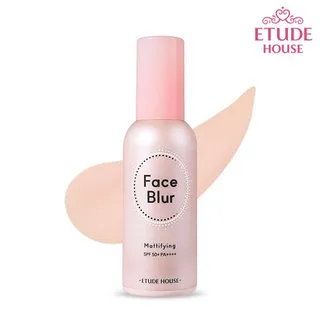
Etude House [ Etude House ] Face Blur - Mattifying SPF50+ PA++++
Works for
Sun protectionSPF 50 · 5 UV filtersBroad spectrum
This product offers a good level of protection against both UVB and UVA rays.
This sunscreen uses organic (so-called "chemical") sunscreen filters. Organic, or "chemical" filters usually provide reliable sun protection and rarely leave a white cast. Sunscreens with organic filters can sting eyes.
This product can be considered "reef safe" because it does not contain the UV filters (oxybenzone and octinoxate) that can be harmful to coral reefs when present in the water in high concentrations.
Anti-blemishSalicylic acid, Glycolic acidWorks well
“Covers pores to give flawless skin.”
This product can help reduce breakouts and clogged pores because it contains the following ingredient: salicylic acid. This ingredient is used for treating acne and can have a noticeable effect.
The following ingredient (ingredients) in this product might be helpful, but there is no evidence to confirm that it actually works: glycolic acid
ExfoliationSide benefit · Glycolic acid, Lactic acid + 1 moreWorks well
This product can help exfoliate the skin. In other words, it helps break down the bonds between dead cells on the surface of the skin and speed up the skin turnover. Skin often appears softer and brighter after exfoliation, but overdoing it can result in disrupted skin barrier. The following ingredient is doing the exfoliating job in this product: glycolic acid, lactic acid, salicylic acid.
Anti-agingSide benefit · Glycolic acid, Lactic acidWorks well
This product can help reduce and prevent fine lines and wrinkles, improve skin elasticity and firmness because it contains glycolic acid.
These ingredients in the product can also be helpful, even though there is less evidence for their effectiveness: lactic acid.
Keep in mind that it typically takes at least 6 weeks to notice any results because the changes that are needed to improve fine lines and elasticity happen in the deeper layers of the skin. No topical anti-aging product can “erase” wrinkles or fully reverse signs of aging.
This product can also help prevent early signs of skin aging because it offers a good level of broad spectrum sun protection. Sun damage is the main cause of premature skin aging, and protecting your skin from the sun is the best anti-aging strategy.
Evens skin toneSide benefit · Glycolic acid, Lactic acid + 1 moreWorks well
This product offers broad spectrum sun protection. It means that it can prevent hyperpigmentation and help keep the skin tone even (sun damage is the main factor causing age spots, darkening of post-acne marks and other discolorations).
MoisturizingSide benefit the brand mentions · Lactic acid, Cyclopentasiloxane + 8 moreWorks
“5 types of hyaluronic acids hydrate skin from deep within to provide moisture blurring effect and smooth out skin texture BLURRING EFFECT FOR YOUR SKIN!”
This product can help improve hydration of the skin with the two types of ingredients.
The first type is called “humectants”:
these ingredients help attract water.
When humectants are on the surface of the skin, they “pull in” the moisture from the outside environment, or from
within deeper layers of the skin. The following ingredients in this product do the job:
lactic acid, butylene glycol.
This product also contains ingredients called “occlusives”. They help reduce the speed with which our skin loses moisture to the outside environment. These ingredients also help soften the upper layer of the skin, so it feels less tight and nicer to the touch. The following ingredients in this product do the job: dimethicone, c12-15 alkyl benzoate.
Can it cause trouble?
Irritancy2 strong irritants: Glycolic acid, ParfumMedium risk
Comedogenic2 ingredients rated 2 or more on the 0–5 pore-clogging scale2 flagged


User reviews
1 of 1 community members would buy it again.
Ingredients
Filter by role to see what each ingredient is doing.
Glycolic acid15%
- Irritation risk
- High
An alpha-hydroxy acid (AHA) that helps to remove the dead skin cells on the surface of the skin reveling a more even, smoother complexation. It is also able to stimulate collagen production with long-term use. Could help to reduce pore congestion. It can be irritating to the skin. Apply sunscreen daily if using products with glycolic acid
More about Glycolic acidSalicylic acid~1.25–2.5%
- Irritation risk
- High
Used for skin exfoliation. It has an anti-inflammatory and anti-bacterial effect, helps to unclog pores, prevent blemishes and speed up healing of the existing ones. Sometimes referred to as a BHA (beta-hydroxy acid)
More about Salicylic acidLactic acid~6.3–9.4%
- Irritation risk
- Medium
An exfoliating and moisturizing alpha-hydroxy acid (AHA). Typically causes less irritation than other AHAs, for example, glycolic acid. At high concentrations (about 15%), lactic acid can help reduce lines and wrinkles. Recent studies show that lactic acid can support the "good" bacteria living on skin's surface (healthy skin microbiome)
More about Lactic acidTin~4.9–7.3%
Water~3.9–5.8%
Cyclopentasiloxane~3.1–4.6%
- Irritation risk
- Low
A silicone that helps improve the product texture and spreadability. Can absorb oil creating a short-term mattifying effect on the skin
More about CyclopentasiloxaneHomosalate~2.7–4%
- Irritation risk
- Medium
A weak sunscreen that offers some protection against the sun rays that cause sunburn (UVB), but does not offer meaningful protection against protect against the most aging sun rays (UVA). It loses its effectiveness quickly when exposed to sunlight. It is an organic, or so called "chemical" sunscreen. When used in low concentrations, helps to stabilize the product formulation
More about HomosalateSilica~1.9–2.8%
Ethylhexyl salicylate~1.9–2.8%
- Irritation risk
- Low
Octisalate. A UV filter. It offers some protection against the sun rays that cause sunburn (UVB), but does not protect against the most aging sun rays (UVA). It loses its effectiveness quickly when exposed to sunlight. It is an organic, or so called "chemical" sunscreen
More about Ethylhexyl salicylateTitanium dioxide~1.5–2.3%
- Irritation risk
- Low
Works as a UV filter when used in high concentrations. It is photostable and is effective mostly against the UVB light, with some protection in the UVA range. In small concentrations, used for its ability to improve the color of cosmetic products. Is usually well tolerated by the skin
More about Titanium dioxideDipropylene glycol~0.9–1.35%
- Irritation risk
- Low
Helps to dissolve other ingredients in a formulation. Slows down the rate of product drying
More about Dipropylene glycolAlcohol denat.~0.55–1.3%
- Irritation risk
- High
Produces temporary toning effect. Can help dissolve other ingredients or preserve products
More about Alcohol denat.Lauryl peg-10 tris(trimethylsiloxy)silylethyl dimethicone~0.5–1.15%
- Irritation risk
- Low
Isopropyl palmitate~0.5–1.1%
- Irritation risk
- Medium
- Comedogenicity
- 3/5
Helps soften the upper layer of the skin and create a thicker product consistency
More about Isopropyl palmitateCaprylyl methicone~0.4–0.95%
- Irritation risk
- Low
A type of silicone that helps to soften the upper layer of the skin and create a nice product finish on the skin
More about Caprylyl methiconeDiethylamino hydroxybenzoyl hexyl benzoate~0.5–1.2%
- Irritation risk
- Medium
Uvinul A Plus. A new generation broad spectrum sunscreen that offers an effective protection especially in the UVA range. It is stable in formulations. Unfortunately, is not approved by the FDA (US) yet
More about Diethylamino hydroxybenzoyl hexyl benzoateTitanium dioxide~0.5–1.15%
- Irritation risk
- Low
Works as a UV filter when used in high concentrations. It is photostable and is effective mostly against the UVB light, with some protection in the UVA range. In small concentrations, used for its ability to improve the color of cosmetic products. Is usually well tolerated by the skin
More about Titanium dioxideCi 77891~0.4–0.95%
- Irritation risk
- Low
C12-15 alkyl benzoate~0.4–0.95%
- Irritation risk
- Low
Enhances the product texture and makes it more spreadable. Helps reduce water loss from the outer layer of skin. Extands the shelf life by preventing bacteria growth
More about C12-15 alkyl benzoateMagnesium sulfate~0.35–0.8%
Bis-ethylhexyloxyphenol methoxyphenyl triazine~0.45–1.05%
- Irritation risk
- Medium
Tinosorb S. One of the most effective broad spectrum sunscreen ingredients. Protects from both UVA and UVB rays. It is photostable. Approved by the US FDA in 2026 (listed as bemotrizinol on US labels).
More about Bis-ethylhexyloxyphenol methoxyphenyl triazineAluminum hydroxide~0.35–0.85%
- Irritation risk
- Low
Is used to add opaque (non-transparent) appearance to formulations. Can be used to coat other ingredients for even dispersion. This is a different ingredient compared to the ones used in antipersperants (aluminium chloride and aluminium chlorohydrate)
More about Aluminum hydroxideStearic acid~0.4–0.95%
- Irritation risk
- Low
Helps oil and water mix together and works as an emollient
More about Stearic acid1,2-hexanediol~0.2–0.75%
Synthetic fluorphlogopite~0.3–0.7%
- Irritation risk
- Low
A mineral that is used as an optical filter (makes the skin looks nicer through light reflection) and to improve the texture of cosmetic products
More about Synthetic fluorphlogopiteQuaternium-18 bentonite~0.2–0.8%
- Irritation risk
- Low
Phenoxyethanol~0.2–0.8%
- Irritation risk
- Low
A preservative. It helps prevent bacterial growth in cosmetic products
More about PhenoxyethanolSilica dimethyl silylate~0.35–0.8%
Dimethicone/vinyl dimethicone crosspolymer~0.2–0.8%
- Irritation risk
- Low
Used to stabilize product formulations and create a nice product texture
More about Dimethicone/vinyl dimethicone crosspolymerDimethicone~0.35–0.8%
- Irritation risk
- Low
A silicone that helps to reduce water loss from the surface of the skin. Can temporarily "fill in" lines and wrinkles, absorb oil, and create a nice product finish
More about DimethiconeDisodium edta~0.2–0.75%
Tocopheryl acetate~0.2–0.75%
- Irritation risk
- Medium
A more stable but less bio-available form of vitamin E compared to Tocopherol. Might help moisturize and protect the skin from free radicals, but mostly used in low concentrations to stabilize other ingredients.
More about Tocopheryl acetatePolyhydroxystearic acid~0.3–0.7%
- Irritation risk
- Medium
Used to create a thicker product consistency and stabilize the formulation
More about Polyhydroxystearic acidIsostearic acid~0.35–0.8%
- Irritation risk
- Low
Used to create a nice product texture
More about Isostearic acidLecithin~0.35–0.8%
- Irritation risk
- Low
Used mostly for creating emulsions - helping oil and water mix together. Helps soften the upper layer of the skin
More about LecithinEthylhexyl palmitate~0.2–0.8%
- Irritation risk
- Low
- Comedogenicity
- 3/5
An emollient that helps soften the skin and create a nice product texture
More about Ethylhexyl palmitatePolyglyceryl-3 polyricinoleate~0.15–0.6%
- Irritation risk
- Medium
Helps oil and water mix together
More about Polyglyceryl-3 polyricinoleateTin oxide~0.2–0.8%
- Irritation risk
- Low
A colorant that can add a pearl-like appearance to the formulation
More about Tin oxidePrunus serrulata flower extract~0.1–0.5%
- Irritation risk
- Low
Butylene glycol~0.1–0.35%
- Irritation risk
- Low
Used to create a nice product texture and help delivery of other ingredients. Might be somewhat helpful in attracting water to the upper layer of the skin
More about Butylene glycolCi 77491~0.1–0.3%
- Irritation risk
- Low
A red colorant made of iron oxide. Typically is not irritating
More about Ci 77491Parfum~0.1–0.3%
- Irritation risk
- High
An aromatic blend of unspecified and possibly irritating ingredients
More about ParfumIngredient list view
Glycolic acid, Salicylic acid, Lactic acid, Tin, Unknown, Water, Cyclopentasiloxane, Homosalate, Silica, Ethylhexyl salicylate, Titanium dioxide, Dipropylene glycol, Alcohol denat., Lauryl peg-10 tris(trimethylsiloxy)silylethyl dimethicone, Isopropyl palmitate, Caprylyl methicone, Diethylamino hydroxybenzoyl hexyl benzoate, Titanium dioxide, Ci 77891, C12-15 alkyl benzoate, Magnesium sulfate, Bis-ethylhexyloxyphenol methoxyphenyl triazine, Aluminum hydroxide, Stearic acid, 1,2-hexanediol, Synthetic fluorphlogopite, Quaternium-18 bentonite, Phenoxyethanol, Silica dimethyl silylate, Dimethicone/vinyl dimethicone crosspolymer, Dimethicone, Disodium edta, Tocopheryl acetate, Polyhydroxystearic acid, Isostearic acid, Lecithin, Ethylhexyl palmitate, Polyglyceryl-3 polyricinoleate, Tin oxide, Prunus serrulata flower extract, Butylene glycol, Ci 77491, Parfum
Compare prices
Retailers ranked by price — lowest first.
Worth comparing, line by line.
Match % combines shared ingredients, the first five ingredients, shared actives and hero ingredients, irritancy (lower counts in the alternative's favour), texture and body area. Only products in the same routine step are compared.
| Etude House[ Etude House ] Face Blur - Mattifying SPF50+ PA++++YOUR PRODUCT | SkinCeuticalsPhysical UV Defense SPF 30 Mineral sunscreen for sensitive skin | BiodermaPhotoderm AKN Mat SPF30 Matifying Fluid | CliniqueNEW UV Solutions Mattifying Sunscreen SPF 50 | |
|---|---|---|---|---|
| Match | — | 67% | 66% | 65% |
| Price | — | $34.99 | $17.26 | $39.68 |
| Shared key ingredients | — | 2 of 9 | 2 of 9 | 2 of 9 |
| Key difference | — | Artemia Extract | Mineral Oil | Avobenzone |
| Irritancy | Medium | Low | Medium | Low |
| SPF | SPF 50 | SPF 30 | SPF 30 | SPF 50 |
| Drying alcohol | Contains drying alcohol | — | — | — |
| View product | Shop | Shop | Shop |


More alternatives: SVR SEBIACLEAR Crème SPF50L'Oréal Paris Bright reveal dark spot uv fluid spf 50+
Product summary
We assess that "Etude House - [ Etude House ] Face Blur - Mattifying SPF50+ PA++++" can provide reliable sun protection based on the ingredient list. We love that it can protect from both UVA and UVB rays (not all sunscreens with SPF ratings give UVA protection. UVA rays do not cause sunburn, but still damage our skin and lead to early aging).
It contains good moisturizing ingredients and can double as a hydrating day cream. This product prevents early signs of aging by protecting against sun damage (all broad spectrum sunscreens do that).
Sunscreen filters
This sunscreen uses a mixture of both mineral and organic (so-called "chemical") UV filters. The organic filters in the product are: tinosorb s, uvinul a plus and homosalate. As for the mineral filters, this sunscreen uses titanium dioxide.
Irritation risk
It contains some common irritants, including those without a benefit for the skin. We assess the overall irritancy of it to be medium. For a detailed overview of all potential irritants: click here
You can see the detailed formula review with the breakdown of all actives in the product and the full ingredient list with estimated concentrations in the tables below.
What our users say
Based on 1 review 100% recommend this product- When it comes to comedogenicity, the reviewer found that it does not clog pores.
- As for the white cast, it did not leave a noticeable white residue for the reviewer.
- When it comes to using this sunscreen under makeup, the user found that it pills under a foundation.
- As for using this sunscreen in the eye area, the reviewer reported that it does not sting eyes.
Sources cited in this review
Every concentration estimate and effectiveness label is anchored to one of these 17 studies and safety reviews.
- 1
- 2Glycolic acid peel therapy – a current reviewncbi.nlm.nih.gov
- 3
- 4Salicylic acid as a peeling agent: a comprehensive reviewncbi.nlm.nih.gov
- 5Beta Hydroxy Acidsfda.gov
- 6A review of toxicity from topical salicylic acid preparationssciencedirect.com

Affiliate links · As an Amazon Associate, WIMJ earns from qualifying purchases.