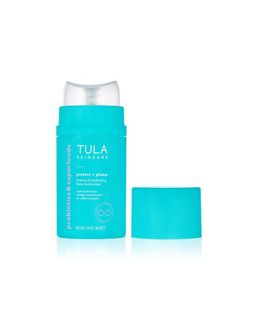
Tula Firming & Hydrating Face Moisturizer
Works for
2 of 2 advertised claims delivered
Anti-aging12 ingredients credited for this claimStrong support
“, Smart Peptides Promote visibly firm, bouncy skin.”
This product can help reduce and prevent fine lines and wrinkles, improve skin elasticity and firmness because it contains heptapeptide-15 palmitate.
These ingredients in the product can also be helpful, even though there is less evidence for their effectiveness: copper palmitoyl heptapeptide-14.
Keep in mind that it typically takes at least 6 weeks to notice any results because the changes that are needed to improve fine lines and elasticity happen in the deeper layers of the skin. No topical anti-aging product can “erase” wrinkles or fully reverse signs of aging.
Moisturizing34 ingredients credited for this claimStrong support
“Firming & Hydrating Face Moisturizer”
This product can help improve hydration of the skin with the two types of ingredients.
The first type is called “humectants”:
these ingredients help attract water.
When humectants are on the surface of the skin, they “pull in” the moisture from the outside environment, or from
within deeper layers of the skin. The following ingredients in this product do the job:
betaine, glycerin.
This product also contains ingredients called “occlusives”. They help reduce the speed with which our skin loses moisture to the outside environment. These ingredients also help soften the upper layer of the skin, so it feels less tight and nicer to the touch. The following ingredients in this product do the job: butyrospermum parkii butter, caprylic/capric triglyceride.
The following ingredients in this product are especially good for supporting the skin barrier and helping with the hydration level: copper palmitoyl heptapeptide-14, heptapeptide-15 palmitate, phytosphingosine
Anti-oxidationNot advertised by the brand · 11 ingredients credited for this claimStrong support
This product contains antioxidants (dimethylmethoxy chromanol) that can help neutralize free radicals in skin. By doing so, they can lessen the damage the skin gets from the UV light (sun).
The following ingredients - lycium barbarum fruit extract, pinus pinaster bark extract also can have an antioxidant effect, but there is less evidence to confirm their effectiveness in skin.
Can it cause trouble?
Irritancy20 flagged ingredientsMedium risk
Comedogenic1 ingredient rated 2 or more on the 0–5 pore-clogging scale1 flagged


User reviews
Be the first — your take helps the next person decide.
Ingredients
Filter by role to see what each ingredient is doing.
Water~45–55%
Squalane~5.4–6.6%
- Irritation risk
- Low
An oil naturally present in skin. Works as an emollient to soften the skin and form a protective layer on its surface without a greasy feeling.
More about SqualaneCaprylic/capric triglyceride~4.9–5.9%
- Irritation risk
- Medium
A good mix of fatty acids that forms a protective layer on the skin. Improves the shelf life of products. Derived from coconut and glycerin
More about Caprylic/capric triglycerideGlycerin~3.1–3.8%
- Irritation risk
- Low
One of the best moisturizing ingredients. Naturally present in skin. It attracts water to the upper layer of the skin working as a humectant
More about GlycerinLactococcus ferment lysate~2.4–2.9%
- Irritation risk
- Low
Consists of remains of dead bacteria cells. Is likely helpful in attracting water to the upper layer of the skin. Might be helpful in reducing inflammation and neutralizing free radicals in skin
More about Lactococcus ferment lysateIsoamyl laurate~2–2.5%
- Irritation risk
- Medium
Helps stabilize emulsions and create a nice product texture
More about Isoamyl laurateCetearyl olivate~1.7–2.1%
Butyrospermum parkii butter~1.5–1.9%
- Irritation risk
- Low
- Comedogenicity
- 3/5
A great moisturising ingredient that softens the skin and reduces water loss from its upper layer. It also can be helpful in protecting skin from free radicals
More about Butyrospermum parkii butterPseudozyma epicola/argania spinosa kernel oil/olive fruit oil/sunflower seed oil/(angelica gigas/licorice/lithospermum erythrorhizon) root ferment extract filtrate~1.3–1.6%
Sorbitan olivate~1–1.2%
Lycium barbarum fruit extract~0.7–1.1%
- Irritation risk
- Medium
A plant extract that can help neutralize free radicals in skin and attract water to its upper layer
More about Lycium barbarum fruit extractCopper palmitoyl heptapeptide-14~0.6–0.95%
- Irritation risk
- Low
The copper palmitoyl heptapeptide-14 is a synthetic peptide developed by ingredient supplier Infinitec, which claims that it can increase collagen production in skin when combined with Heptapeptide-15 Palmitate. The complex was tested in vitro (in a lab) and in a clinical test with 30 volunteers, but the latter wasn't placebo-controlled. The manufacturer reported wrinkle reduction after 28 days of use, but the details of the study aren't publicly available.
More about Copper palmitoyl heptapeptide-14Heptapeptide-15 palmitate~0.55–0.85%
- Irritation risk
- Low
A type of peptide. Peptides are excellent moisturizers and might be able support collagen production reducing fine lines and wrinkles
More about Heptapeptide-15 palmitateHoney~0.55–0.8%
- Irritation risk
- Low
Helps attract water to the skin and might have some anti-bacterial properties. Can be an allergen
More about HoneyMel~0.55–0.8%
- Irritation risk
- Low
Helps to soften the upper layer of the skin and attract water to it
More about MelPhospholipids~0.55–0.8%
- Irritation risk
- Low
Emollients that are naturaly present in skin. In addition, they help water and oil mix together in the product
More about PhospholipidsBetaine~0.5–0.75%
- Irritation risk
- Low
Helps attract water to the upper layer of the skin and improves the product texture
More about BetaineNiacinamide~0.5–0.75%
- Irritation risk
- Low
Is proven to be effective in reducing blemishes, evening out skin tone and helping to improve lines and wrinkles. It helps the skin to repair sun damage, calm down inflammation and keep maintain good levels of moisture. The concentration of about 2% is effective for supporting the skin barrier and evening out the skin tone. Concentration of 4-6% is better for helping with acne and balancing the sebum production
More about NiacinamideSodium phytate~0.45–0.7%
Sorbitol~0.45–0.65%
- Irritation risk
- Low
Helps attract water to the upper layer of the skin and improves the product texture
More about SorbitolGluconolactone~0.4–0.6%
- Irritation risk
- Medium
A polyhydroxy acid (PHA) that helps shed the dead cells from the skin surface revealing smoother skin. Is believed to be genter than AHAs. It helps attract water to the upper layer of the skin and can stimulate production of skin's own hyaluronic acid resulting in improved hydration levels. It has been shown to be helpful against acne and clogged pores if used consistently (e.g over a period of 12 weeks) in high enough concentration. It can help reduce fine lines and wrinkles and improve skin tone with long-term application. Can help neutralize free radicals
More about GluconolactoneLactic acid~0.4–0.6%
- Irritation risk
- Medium
An exfoliating and moisturizing alpha-hydroxy acid (AHA). Typically causes less irritation than other AHAs, for example, glycolic acid. At high concentrations (about 15%), lactic acid can help reduce lines and wrinkles. Recent studies show that lactic acid can support the "good" bacteria living on skin's surface (healthy skin microbiome)
More about Lactic acidPhosphatidylcholine~0.4–0.6%
- Irritation risk
- Medium
Used to enhance the delivery of other ingredients
More about PhosphatidylcholineSesamum indicum seed extract~0.3–0.55%
- Irritation risk
- Low
Plant oil that due to its high content of linoleic acid can help support skin's barrier function improving its hydration
More about Sesamum indicum seed extractTremella fuciformis sporocarp extract~0.35–0.65%
- Irritation risk
- Low
Mushroom extract that helps attract water to the upper layer of the skin
More about Tremella fuciformis sporocarp extractDehydroacetic acid~0.3–0.6%
Docosahexaenoic acid~0.35–0.6%
- Irritation risk
- Low
Sphingolipids~0.4–0.65%
- Irritation risk
- Low
Sphingolipids are a group of lipids with a common chemical structure. Some of them are naturally present in skin and can be converted to ceramides
More about SphingolipidsXanthan gum~0.4–0.6%
- Irritation risk
- Low
Used to create a thicker product consistency
More about Xanthan gumPinus pinaster bark extract~0.4–0.6%
- Irritation risk
- Medium
A plant extract that might help neutralize free radicals and reduce hyperpigmentation, but evidence of effectiveness of topical application is lacking. It can be an INCI name for the trademarked ingredient Pycnogenol (but could also be a different type of this plant's bark extract)
More about Pinus pinaster bark extractSodium acetylated hyaluronate~0.35–0.65%
- Irritation risk
- Low
A type of hyaluronic acid that works as an excellent moisturizer by attracting water into the upper layer of the skin. Is typically feels less sticky on the skin compared to the usual hyaluronic acid
More about Sodium acetylated hyaluronateSodium hyaluronate~0.35–0.65%
- Irritation risk
- Low
One of the best moisturizing ingredients. Attracts water into the upper layer of the skin
More about Sodium hyaluronateHyaluronic acid~0.35–0.65%
- Irritation risk
- Low
One of the best moisturizing ingredients. Attracts water into the upper layer of the skin. Naturally present in skin. Typically has large molecule size unless advertised otherwise on the product label. Helps support skin's barrier function and may help to reduce inflammation
More about Hyaluronic acidEicosapentaenoic acid~0.4–0.65%
- Irritation risk
- Low
Lactic acid/glycolic acid copolymer~0.35–0.6%
- Irritation risk
- Low
Caprylyl glycol~0.4–0.65%
- Irritation risk
- Medium
Helps preserve products and creates a nice product texture
More about Caprylyl glycolSodium hyaluronate crosspolymer~0.35–0.65%
- Irritation risk
- Medium
Attracts water into the upper layer of the skin
More about Sodium hyaluronate crosspolymerTocopherol~0.4–0.6%
- Irritation risk
- Low
Pure form of vitamin E. Can help moisturise and protect the skin from free radicals. Often used to help stabilise other ingredients or the formula itself
More about TocopherolTetrasodium glutamate diacetate~0.35–0.65%
- Irritation risk
- Low
Helps stabilize the product formulation
More about Tetrasodium glutamate diacetateTocopheryl acetate~0.4–0.6%
- Irritation risk
- Medium
A more stable but less bio-available form of vitamin E compared to Tocopherol. Might help moisturize and protect the skin from free radicals, but mostly used in low concentrations to stabilize other ingredients.
More about Tocopheryl acetateHydrolyzed sodium hyaluronate~0.35–0.6%
- Irritation risk
- Low
Attracts water into the upper layer of the skin
More about Hydrolyzed sodium hyaluronateCalcium gluconate~0.4–0.65%
- Irritation risk
- Low
Helps attract water to the upper layer of the skin and helps to improve appearance of the product
More about Calcium gluconateGlyceryl caprylate~0.45–0.7%
- Irritation risk
- Low
An emollient that can also help water and oil mix together, as well as prevent bacteria growth in products
More about Glyceryl caprylatePolyvinyl alcohol~0.4–0.65%
Phenylpropanol~0.35–0.6%
- Irritation risk
- High
Helps mask the smell of other ingredients and helps preserve the product formulation
More about PhenylpropanolPhytosphingosine~0.45–0.65%
- Irritation risk
- Low
A type of lipid that is naturally present in skin. It might help in repairing skin barrier function and has anti-bacterial effect
More about PhytosphingosineCurcuma longa root extract~0.3–0.6%
- Irritation risk
- High
A plant extract that can contain an active compound curcumin, that may have some anti-inflammatory properties when applied to the skin, but solid research is lacking and the typical concentration used in skincare products is too low. Can be an irritant
More about Curcuma longa root extractDimethylmethoxy chromanol~0.35–0.65%
- Irritation risk
- Low
Can help neutralize free radicals in skin
More about Dimethylmethoxy chromanolAscorbyl palmitate~0.35–0.65%
- Irritation risk
- Medium
Being a lipid soluble form of vitamin C, it is more stable and can penetrate the skin better than L-Ascorbic acid. It is effective in protecting the skin from free radicals, as well as evening the skin tone, but is less effective in stimulating collagen production compared to L-Ascorbic acid.
More about Ascorbyl palmitateLecithin~0.45–0.65%
- Irritation risk
- Low
Used mostly for creating emulsions - helping oil and water mix together. Helps soften the upper layer of the skin
More about LecithinHydrogenated palm glycerides~0.45–0.65%
- Irritation risk
- Low
An emollient that softens the skin
More about Hydrogenated palm glyceridesPhenoxyethanol~0.4–0.6%
- Irritation risk
- Low
A preservative. It helps prevent bacterial growth in cosmetic products
More about PhenoxyethanolTetrahexyldecyl ascorbate~0.35–0.6%
- Irritation risk
- Medium
Being a lipid soluble form of vitamin C, it is more stable than ascorbic acid, but still degrades quickly and needs to be stabilized in a formulation with another ingredient. It is claimed to penetrate skin better than pure vitamin C and have the the similar benefits, but solid studies of its effectiveness are lacking. Is likely to require a higher concentration in a product than pure vitamin C to be effective. It might be able to help reduce pore clogging.
More about Tetrahexyldecyl ascorbatePotassium sorbate~0.35–0.6%
Carbomer~0.3–0.6%
- Irritation risk
- Low
Helps create a thicker or gel-like product texture. It is not a surfactant but can be used in gentle cleansing formulations
More about CarbomerCetyl palmitate~0.35–0.6%
- Irritation risk
- Low
An emollient that helps soften the skin and is used to improve product texture and stability
More about Cetyl palmitatePropanediol~0.3–0.55%
- Irritation risk
- Low
Acts as a solvent for other ingredients. Speeds up the absorption of other ingredients into the skin
More about PropanediolSodium chloride~0.3–0.55%
- Irritation risk
- Low
Used to stabilize mixtures of oil and water, and create thicker, gel-like product textures
More about Sodium chlorideDimethyl isosorbide~0.25–0.45%
- Irritation risk
- Low
Used to dissolve other ingredients in a product and can enhance their ability to penetrate the skin
More about Dimethyl isosorbideSorbitan palmitate~0.2–0.35%
- Irritation risk
- Medium
Helps water and oil mix together and stabilize the product formulation
More about Sorbitan palmitateCetyl alcohol~0.2–0.4%
- Irritation risk
- Low
A non-drying alcohol that works to soften the skin and stabilize product formulations helping oil and water mix together
More about Cetyl alcoholPentylene glycol~0.25–0.4%
- Irritation risk
- Medium
Used to preserve products, dissolve other ingredients and create a nice product texture
More about Pentylene glycolSodium hydroxide~0.15–0.3%
Sodium benzoate~0.15–0.25%
Ethylhexylglycerin~0.1–0.2%
Ingredient list view
Water, Squalane, Caprylic/capric triglyceride, Glycerin, Lactococcus ferment lysate, Isoamyl laurate, Cetearyl olivate, Butyrospermum parkii butter, Pseudozyma epicola/argania spinosa kernel oil/olive fruit oil/sunflower seed oil/(angelica gigas/licorice/lithospermum erythrorhizon) root ferment extract filtrate, Sorbitan olivate, Lycium barbarum fruit extract, Copper palmitoyl heptapeptide-14, Heptapeptide-15 palmitate, Honey, Mel, Phospholipids, Betaine, Niacinamide, Sodium phytate, Sorbitol, Gluconolactone, Lactic acid, Phosphatidylcholine, Sesamum indicum seed extract, Tremella fuciformis sporocarp extract, Dehydroacetic acid, Docosahexaenoic acid, Sphingolipids, Xanthan gum, Unknown, Pinus pinaster bark extract, Sodium acetylated hyaluronate, Sodium hyaluronate, Hyaluronic acid, Eicosapentaenoic acid, Lactic acid/glycolic acid copolymer, Caprylyl glycol, Sodium hyaluronate crosspolymer, Tocopherol, Tetrasodium glutamate diacetate, Tocopheryl acetate, Hydrolyzed sodium hyaluronate, Calcium gluconate, Glyceryl caprylate, Polyvinyl alcohol, Phenylpropanol, Phytosphingosine, Curcuma longa root extract, Dimethylmethoxy chromanol, Ascorbyl palmitate, Lecithin, Hydrogenated palm glycerides, Phenoxyethanol, Tetrahexyldecyl ascorbate, Potassium sorbate, Carbomer, Cetyl palmitate, Propanediol, Sodium chloride, Dimethyl isosorbide, Sorbitan palmitate, Cetyl alcohol, Pentylene glycol, Sodium hydroxide, Sodium benzoate, Ethylhexylglycerin
Compare prices
Retailers ranked by price — lowest first.


Worth comparing, line by line.
Match % combines shared ingredients, the first five ingredients, shared actives and hero ingredients, irritancy (lower counts in the alternative's favour), texture and body area. Only products in the same routine step are compared.
| TulaFirming & Hydrating Face MoisturizerYOUR PRODUCT | LumeneNordic Ageless [AJATON] Radiant Youth Night Cream | Shani Darden Skin CareHydration Peptide Cream | FaceGymSupreme Restructure Cream | |
|---|---|---|---|---|
| Match | — | 77% | 75% | 74% |
| Price | $44.80 | $56.72+$11.92 | $60.00+$15.20 | $120.00+$75.20 |
| Shared key ingredients | — | 9 of 24 | 10 of 24 | 8 of 24 |
| Key difference | — | Copper Heptapeptide-14 Pantothenate | Palmitoyl Hexapeptide-12 | Hexapeptide-9 |
| Irritancy | Medium | Medium | Low | Medium |
| Drying alcohol | — | — | — | — |
| View product | Shop | Shop | Shop |


Product summary
"Tula - Firming & Hydrating Face Moisturizer" is a well-rounded moisturizing product. This moisturizer uses a good combo of humectants and emollients. These both types of ingredients are essentials for improving the skin hydration and keeping the skin barrier healthy. Humectants in this product (copper palmitoyl heptapeptide-14, heptapeptide-15 palmitate, betaine, glycerin and hyaluronic acid) help to increase the water content in the upper layer of the skin. (These ingredients do so by "capturing" water molecules from the outside air or from within the deeper layers of the skin). Phytosphingosine, sphingolipids, butyrospermum parkii butter, caprylic/capric triglyceride and squalane in this product help decrease the water evoporation from the skin, so that it stays hydrated for longer. These ingredients also soften the skin and take away the feeling of tightness and dryness.
Ingredient callouts
- This product contains acids (gluconolactone 0.40% - 0.60% and lactic acid 0.40% - 0.60%). Their concentration is low, and they will not have a strong exfoliating effect. Instead, they work to support the skin natural acid mantle and to attract water (as humectants). PHAs (gluconolactone) especially are great for improving skin hydration. They might be even able to stimulate the production of skin's natural humectants and support the healthy skin microbiome.
- As a plus, this moisturizer also contains Ceramides (phytosphingosine 0.45% - 0.65%). Ceramides are a type of lipids that our skin produces itself. They are a building block of the skin's barrier. Ceramides used in skincare are synthetic or extracted from plants. They work well for softening the skin surface and "patch holes" in the skin's barrier.
- This moisturizer also contains Peptides (heptapeptide-15 palmitate 0.55% - 0.85% and copper palmitoyl heptapeptide-14 0.60% - 0.95%). Peptides are a very big group of ingredients. They all consist of a different combination of aminoacids. Our skin produces Peptides naturally. Some of them work as natural antibiotics, promote wound-healing and production of collagen. The scientists are still studying how effective the topical application of Peptides is, but it is very likely that they are helpful. Peptides might be able to support skin barrier restoration and even have an anti-aging benefit. At the very least, they certainly help attract water to the skin and support the hydration in this way.
Irritation risk
This formulation includes some common irritants, including ingredients that do not provide a benefit for the skin. We assess the overall irritancy of this moisturizer to be medium. For a detailed overview of all potential irritants: click here
You can see the detailed formula review with the breakdown of all actives in the product and the full ingredient list with estimated concentrations in the tables below.
About the brand
According to Cruelty-Free Kitty "Tula" is cruelty free, but its parent company is not.
Price
The product retails from 57.50$ up to 64.00$ in the United States and from 84.00CA$ up to 92.00CA$ in Canada.
For a detailed price comparison: click here.
Sources cited in this review
Every concentration estimate and effectiveness label is anchored to one of these 38 studies and safety reviews.
- 1
- 2
- 3
- 4Lycium Barbarum and Human Healthlink.springer.com
- 5
- 6X50 Anti-aging Powder Brochureinfinitec.es

Affiliate links · As an Amazon Associate, WIMJ earns from qualifying purchases.