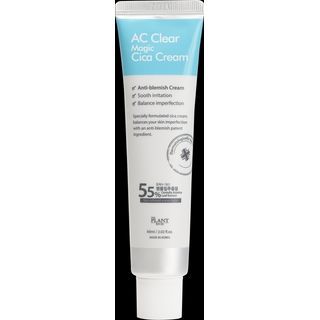
THE PLANT BASE AC Clear Magic Cica Cream
Works for
3 of 3 advertised claims delivered
Anti-agingAdenosine, Niacinamide + 3 moreStrong evidence
“Containing 55% centella asiatica leaf extract as well as other skin-repairing botanical ingredients, this cream boasts anti-inflammatory and antibacterial properties while also improving signs of aging.”
This product can help reduce and prevent fine lines and wrinkles, improve skin elasticity and firmness because it contains adenosine, niacinamide.
These ingredients in the product can also be helpful, even though there is less evidence for their effectiveness: centella asiatica leaf extract.
Keep in mind that it typically takes at least 6 weeks to notice any results because the changes that are needed to improve fine lines and elasticity happen in the deeper layers of the skin. No topical anti-aging product can “erase” wrinkles or fully reverse signs of aging.
MoisturizingNiacinamide, Saccharum officinarum extract + 25 moreStrong evidence
“55% centella asiatica (cica) extract and green tea powder calm inflammation upon application, while murumuru seed butter deeply moisturizes skin, helping to soothe even the most sensitive or irritated skin barrier.”
This product can help improve hydration of the skin with the two types of ingredients.
The first type is called “humectants”:
these ingredients help attract water.
When humectants are on the surface of the skin, they “pull in” the moisture from the outside environment, or from
within deeper layers of the skin. The following ingredients in this product do the job:
hydrolyzed hyaluronic acid, butylene glycol.
This product also contains ingredients called “occlusives”. They help reduce the speed with which our skin loses moisture to the outside environment. These ingredients also help soften the upper layer of the skin, so it feels less tight and nicer to the touch. The following ingredients in this product do the job: beeswax, caprylic/capric triglyceride.
The following ingredients in this product are especially good for supporting the skin barrier and helping with the hydration level: niacinamide
Anti-blemishNiacinamide, Capryloyl salicylic acid + 2 moreGood evidence
“Try this lightweight, refreshing lotion that aims to control excessive sebum and blemishes.”
This product might be able to help reduce blemishes and clogged pores because it contains niacinamide.
The following ingredient (ingredients) in this product might be helpful, but there is no evidence to confirm that it actually works: capryloyl salicylic acid
Evens skin toneNot advertised by the brand · Niacinamide, Capryloyl salicylic acid + 2 moreStrong evidence
This product can help reduce hypepigmentation and even out the skin tone because it contains the following effective ingredients: niacinamide
The following ingredient (ingredients) in this product might be helpful, but there is no evidence to confirm that it actually can help even out the skin tone: capryloyl salicylic acid, glycyrrhiza glabra root extract, morus alba bark extract.
Keep in mind that you would need to apply any topical skincare targetted at hypigmentation consistently for a couple of months to get a result. No topical skincare product can help get rid of hyperpigmentation (including post-acne marks and age spots) instantly.
ExfoliationNot advertised by the brand · Capryloyl salicylic acid, Salix nigra bark extract + 1 moreStrong evidence
This product can help exfoliate the skin. In other words, it helps break down the bonds between dead cells on the surface of the skin and speed up the skin turnover. Skin often appears softer and brighter after exfoliation, but overdoing it can result in disrupted skin barrier. The following ingredient is doing the exfoliating job in this product: capryloyl salicylic acid.
Can it cause trouble?
Irritancy7 strong irritants: Melaleuca alternifolia leaf oil, Allium cepa bulb extract + 5 more — patch-test recommendedHigh risk
Comedogenic2 ingredients rated 2 or more on the 0–5 pore-clogging scale2 flagged

User reviews
Be the first — your take helps the next person decide.
Ingredients
Filter by role to see what each ingredient is doing.
Centella asiatica leaf extract55%
- Irritation risk
- Medium
A plant extract that has been shown to be able to reduce inflammation in skin, support restoration of skin barrier function, as well as support collagen production. It can be irritating to sensitive skin. Might be helpful in preventing stretch marks. It could, however, itself be irritating.
More about Centella asiatica leaf extractDipropylene glycol~26–32%
- Irritation risk
- Low
Helps to dissolve other ingredients in a formulation. Slows down the rate of product drying
More about Dipropylene glycolAstrocaryum murumuru seed butter~4.9–5.9%
- Irritation risk
- Medium
Helps soften the upper layer of the skin. Could be comedogenic due to the myrisic acid content
More about Astrocaryum murumuru seed butterCyclopentasiloxane~5.2–6.4%
- Irritation risk
- Low
A silicone that helps improve the product texture and spreadability. Can absorb oil creating a short-term mattifying effect on the skin
More about CyclopentasiloxaneSqualane~4.5–5.5%
- Irritation risk
- Low
An oil naturally present in skin. Works as an emollient to soften the skin and form a protective layer on its surface without a greasy feeling.
More about SqualaneGlyceryl stearate se~3–3.7%
- Irritation risk
- Low
- Comedogenicity
- 2/5
Used to stabilize the product formulations and works as an emollient
More about Glyceryl stearate seTrimethylolpropane triisostearate~2.5–3%
- Irritation risk
- Low
Beeswax~2.1–2.6%
- Irritation risk
- Low
Forms a protective barrier that holds water and keeps dry skin hydrated. Keeps an emulsion from separating into its oil and liquid components, and increases the thickness of a product. Can be an allergen
More about BeeswaxDiphenylsiloxy phenyl trimethicone~1.5–1.8%
- Irritation risk
- Low
Help improve the product's texture
More about Diphenylsiloxy phenyl trimethiconeNiacinamide~1.2–1.5%
- Irritation risk
- Low
Is proven to be effective in reducing blemishes, evening out skin tone and helping to improve lines and wrinkles. It helps the skin to repair sun damage, calm down inflammation and keep maintain good levels of moisture. The concentration of about 2% is effective for supporting the skin barrier and evening out the skin tone. Concentration of 4-6% is better for helping with acne and balancing the sebum production
More about NiacinamideCaprylic/capric triglyceride~1.1–1.3%
- Irritation risk
- Medium
A good mix of fatty acids that forms a protective layer on the skin. Improves the shelf life of products. Derived from coconut and glycerin
More about Caprylic/capric triglycerideCyclohexasiloxane~0.75–1.15%
- Irritation risk
- Low
A silicone that serves as an emollient. Helps create a nice non-greasy feels
More about Cyclohexasiloxane1,2-hexanediol~0.55–0.8%
Cetyl alcohol~0.65–1%
- Irritation risk
- Low
A non-drying alcohol that works to soften the skin and stabilize product formulations helping oil and water mix together
More about Cetyl alcoholGlyceryl stearate~0.55–0.8%
- Irritation risk
- Low
An emollient that softens the skin and forms a protective layer on its surface. Helps water and oil mix together
More about Glyceryl stearateLimnanthes alba seed oil~0.5–0.75%
- Irritation risk
- Low
This oil's cmposition is closest to rapeseed oil. It is a very stable oil and serves as an emoillient
More about Limnanthes alba seed oilWater~0.4–0.65%
Lauryl alcohol~0.5–0.75%
Stearyl alcohol~0.45–0.7%
- Irritation risk
- Low
An emollient that helps soften the skin
More about Stearyl alcoholXanthan gum~0.3–0.6%
- Irritation risk
- Low
Used to create a thicker product consistency
More about Xanthan gumStearic acid~0.6–0.9%
- Irritation risk
- Low
Helps oil and water mix together and works as an emollient
More about Stearic acidDimethicone~0.45–0.65%
- Irritation risk
- Low
A silicone that helps to reduce water loss from the surface of the skin. Can temporarily "fill in" lines and wrinkles, absorb oil, and create a nice product finish
More about DimethiconePhytosteryl/behenyl/octyldodecyl lauroyl glutamate~0.3–0.55%
- Irritation risk
- Low
Phenoxyethanol~0.3–0.55%
- Irritation risk
- Low
A preservative. It helps prevent bacterial growth in cosmetic products
More about PhenoxyethanolPalmitic acid~0.4–0.6%
- Irritation risk
- Low
An emollient that is naturally present in skin and helps soften it
More about Palmitic acidCamellia sinensis leaf powder~0.25–0.5%
- Irritation risk
- Low
Tocopheryl acetate~0.35–0.65%
- Irritation risk
- Medium
A more stable but less bio-available form of vitamin E compared to Tocopherol. Might help moisturize and protect the skin from free radicals, but mostly used in low concentrations to stabilize other ingredients.
More about Tocopheryl acetateSodium methyl stearoyl taurate~0.65–0.95%
Butylene glycol~0.3–0.55%
- Irritation risk
- Low
Used to create a nice product texture and help delivery of other ingredients. Might be somewhat helpful in attracting water to the upper layer of the skin
More about Butylene glycolPeg-100 stearate~0.5–0.75%
- Irritation risk
- Low
Helps oil and water mix togehter and creates a nice product texture
More about Peg-100 stearateTromethamine~0.3–0.55%
Myristyl alcohol~0.4–0.6%
- Irritation risk
- High
Helps to stabilize the product formulation while softening the upper layer of the skin. Can be irritating
More about Myristyl alcoholMelaleuca alternifolia leaf oil~0.35–0.6%
- Irritation risk
- High
An essential oil that can be irritating. Has some anti-bacterial properties
More about Melaleuca alternifolia leaf oilGlycyrrhiza glabra root extract~0.25–0.5%
- Irritation risk
- Medium
A plant extract that can help lighten the skin and calm down inflammation. Might be helpful in neutralizing free radicals
More about Glycyrrhiza glabra root extractDisodium edta~0.3–0.55%
Adenosine~0.3–0.55%
- Irritation risk
- Low
Might help improve cell turnover and reduce inflammation in skin. One study shows that the ingredients might be able to help reduce dynamic wrinkles (for example, in the corners of the eyes or on the forehead)
More about AdenosinePolysorbate 80~0.3–0.6%
Propylene glycol~0.3–0.5%
- Irritation risk
- High
Helps oil and water mix together and can enhance the penetration of other ingredients into the skin. It can be irritating
More about Propylene glycolMorus alba bark extract~0.3–0.55%
- Irritation risk
- High
A plant extract that might have anti-oxidant properties and help even out skin tone, but solid evidence is lacking
More about Morus alba bark extractOpuntia coccinellifera fruit extract~0.3–0.55%
- Irritation risk
- High
A plant extract that might help neutralize free radicals in skin
More about Opuntia coccinellifera fruit extractDiospyros kaki leaf extract~0.3–0.5%
- Irritation risk
- Low
Vaccinium myrtillus fruit extract~0.3–0.55%
- Irritation risk
- Medium
A plant extract that might help neutralize free radicals in skin, but research on its efficacy in skin is lacking
More about Vaccinium myrtillus fruit extractSalix nigra bark extract~0.3–0.55%
- Irritation risk
- Medium
A plant extract that might contain salicylic acid
More about Salix nigra bark extractPropanediol~0.3–0.55%
- Irritation risk
- Low
Acts as a solvent for other ingredients. Speeds up the absorption of other ingredients into the skin
More about PropanediolSaccharum officinarum extract~0.3–0.55%
- Irritation risk
- Low
Sugar extract that helps attract water to the upper layer of the skin
More about Saccharum officinarum extractCapryloyl glycine~0.45–0.65%
- Irritation risk
- Low
Helps oil and water mix together, preserve cosmetic products, and attract water to the upper layer of the skin
More about Capryloyl glycineCapryloyl salicylic acid~0.3–0.55%
- Irritation risk
- High
Allium cepa bulb extract~0.3–0.55%
- Irritation risk
- High
Carbomer~0.3–0.55%
- Irritation risk
- Low
Helps create a thicker or gel-like product texture. It is not a surfactant but can be used in gentle cleansing formulations
More about CarbomerSodium tocopheryl phosphate~0.4–0.6%
Sophora angustifolia root extract~0.3–0.55%
- Irritation risk
- High
Aloe barbadensis leaf extract~0.45–0.65%
- Irritation risk
- Medium
Traditionally used to treat sunburns, dermatitis and inflammation, but evidence for its effectiveness is lacking. The extract can contain humectants that help attract water into the skin
More about Aloe barbadensis leaf extractCitrus aurantium dulcis fruit extract~0.3–0.55%
- Irritation risk
- High
A plant extract that is used as a fragrance. Can be irritating and lead to photosensitivity
More about Citrus aurantium dulcis fruit extractCitrus limon fruit extract~0.3–0.55%
- Irritation risk
- High
Used as a fragrance. Can be irritating and cause photosensitivity
More about Citrus limon fruit extractChenopodium quinoa extract~0.3–0.55%
- Irritation risk
- Low
Tocopherol~0.35–0.65%
- Irritation risk
- Low
Pure form of vitamin E. Can help moisturise and protect the skin from free radicals. Often used to help stabilise other ingredients or the formula itself
More about TocopherolSalix alba bark extract~0.25–0.45%
- Irritation risk
- High
A plant extract that can help neutralize free radicals in skin. It contains a compound salicin that can theoretically be converted into salicylic acid that, in turn, helps reduce inflammation in skin, but the evidence of effectiveness in skin is lacking and the extract is usually not used in a concentration that would enable an exfoliating effect
More about Salix alba bark extractChamaecyparis obtusa leaf extract~0.3–0.6%
Origanum vulgare leaf extract~0.3–0.55%
- Irritation risk
- High
A plant extract. Can have an anti-oxidant effect, but can also contain irritants
More about Origanum vulgare leaf extractArachidic acid~0.6–0.85%
Acer saccharum extract~0.4–0.6%
- Irritation risk
- Medium
A plant extract that contains small percentage of AHAs. Is unlikely to have any skin benefit due the small concentration of the active compounds
More about Acer saccharum extractMyristic acid~0.55–0.8%
- Irritation risk
- Medium
- Comedogenicity
- 3/5
Helps oil and water mix together. Could be comedogenic
More about Myristic acidHydrogenated lecithin~0.4–0.65%
- Irritation risk
- Low
Helps to retain moisture by creating a protective barrier on the skin. Rich in fatty acids. Improves product texture and helps with the penetration of other ingredients.
More about Hydrogenated lecithinScutellaria baicalensis root extract~0.25–0.45%
- Irritation risk
- High
A plant extract that might contain a compound baicalin that could be helpful in neutralizing free radicals and reducing inflammation in skin. The baicalin concentration in skincare products is often too low for an effective action. Can be used for its fragrant properties
More about Scutellaria baicalensis root extractCinnamomum zeylanicum bark extract~0.35–0.6%
- Irritation risk
- High
Portulaca oleracea extract~0.25–0.45%
- Irritation risk
- Medium
A plant extract that has some anti-oxidant activity, but solid research is lacking. Can help attract water to the upper layer of the skin
More about Portulaca oleracea extractLactobacillus/soybean ferment extract~0.25–0.4%
- Irritation risk
- Low
A fermentation product created by bacteria Lactobacillus out of soybean. The fermented product helps to attract water to the upper layer of the skin and has anti-bacterial properties. It might be helpful in calming down inflammation and could be helpful in evening out skin tone, but studies are lacking
More about Lactobacillus/soybean ferment extractEthylhexylglycerin~0.2–0.4%
Hydrolyzed hyaluronic acid~0.2–0.4%
- Irritation risk
- Low
One of the best moisturizing ingredients. Attracts water into the upper layer of the skin. A version of it is naturally present in skin
More about Hydrolyzed hyaluronic acidCaprylyl glycol~0.25–0.45%
- Irritation risk
- Medium
Helps preserve products and creates a nice product texture
More about Caprylyl glycolSh-decapeptide-9~0.2–0.35%
- Irritation risk
- Low
Ingredient list view
Centella asiatica leaf extract, Dipropylene glycol, Astrocaryum murumuru seed butter, Cyclopentasiloxane, Squalane, Glyceryl stearate se, Trimethylolpropane triisostearate, Beeswax, Diphenylsiloxy phenyl trimethicone, Niacinamide, Caprylic/capric triglyceride, Cyclohexasiloxane, 1,2-hexanediol, Cetyl alcohol, Glyceryl stearate, Limnanthes alba seed oil, Water, Lauryl alcohol, Stearyl alcohol, Xanthan gum, Stearic acid, Dimethicone, Phytosteryl/behenyl/octyldodecyl lauroyl glutamate, Phenoxyethanol, Palmitic acid, Camellia sinensis leaf powder, Tocopheryl acetate, Sodium methyl stearoyl taurate, Butylene glycol, Peg-100 stearate, Tromethamine, Myristyl alcohol, Melaleuca alternifolia leaf oil, Glycyrrhiza glabra root extract, Disodium edta, Adenosine, Polysorbate 80, Propylene glycol, Morus alba bark extract, Opuntia coccinellifera fruit extract, Diospyros kaki leaf extract, Vaccinium myrtillus fruit extract, Salix nigra bark extract, Propanediol, Saccharum officinarum extract, Capryloyl glycine, Capryloyl salicylic acid, Allium cepa bulb extract, Carbomer, Sodium tocopheryl phosphate, Sophora angustifolia root extract, Aloe barbadensis leaf extract, Citrus aurantium dulcis fruit extract, Citrus limon fruit extract, Chenopodium quinoa extract, Tocopherol, Salix alba bark extract, Chamaecyparis obtusa leaf extract, Origanum vulgare leaf extract, Arachidic acid, Acer saccharum extract, Myristic acid, Hydrogenated lecithin, Scutellaria baicalensis root extract, Cinnamomum zeylanicum bark extract, Portulaca oleracea extract, Lactobacillus/soybean ferment extract, Ethylhexylglycerin, Hydrolyzed hyaluronic acid, Caprylyl glycol, Sh-decapeptide-9
Compare prices
Retailers ranked by price — lowest first.


Worth comparing, line by line.
Match % combines shared ingredients, the first five ingredients, shared actives and hero ingredients, irritancy (lower counts in the alternative's favour), texture and body area. Only products in the same routine step are compared.
| THE PLANT BASEAC Clear Magic Cica CreamYOUR PRODUCT | TOSOWOONGDexpanthenol Cream | MedicubePDRN Pink Peptide Cream | MAXCLINICCollarich Intensive Cream | |
|---|---|---|---|---|
| Match | — | 80% | 79% | 79% |
| Price | $9.00 | $19.10+$10.10 | $27.15+$18.15 | $18.00+$9.00 |
| Shared key ingredients | — | 7 of 14 | 7 of 14 | 5 of 14 |
| Key difference | — | Madecassoside | Copper Tripeptide-1 | Acetylphytosphingosine |
| Irritancy | High | Medium | Medium | Medium |
| Drying alcohol | — | Contains drying alcohol | — | — |
| View product | Shop | Shop | Shop |


Product summary
Based on the ingredients included, "THE PLANT BASE - AC Clear Magic Cica Cream" works well for moisturizing the skin. As we expect from a proper moisturizer, the formula includes a combo of effective humectants and emollients. These are the two different types of ingredients that are essential for improving the skin hydration and supporting a healthy skin barrier. Humectants in this product (hydrolyzed hyaluronic acid, butylene glycol, caprylyl glycol, portulaca oleracea extract and scutellaria baicalensis root extract) help to increase the water content in the upper layer of the skin. (These ingredients do so by "capturing" water molecules from the outside air or from within the deeper layers of the skin). Astrocaryum murumuru seed butter, limnanthes alba seed oil, beeswax, caprylic/capric triglyceride and dimethicone in this product help decrease the water evoporation from the skin, so that it stays hydrated for longer. These ingredients also soften the skin and take away the feeling of tightness and dryness.
Ingredient callouts
- Adenosine 0.30% - 0.55% in this product adds an anti-aging property to it. Adenosine is a chemical present inside our skin cells. A clinical trial confirmed that topical application of adenosine in a low concentration reduce dynamic wrinkles (these are the wrinkles that appear with age in a places where we our mimic is the most active, for example, in the corners of the eyes or on the forehead).
Irritation risk
There are quite a few common irritants in this product, including ingredients without particular skin benefits. We would not recommend it for sensitive skin. We assess the overall irritancy of this moisturizer to be high. For a detailed overview of all potential irritants: click here
You can see the detailed formula review with the breakdown of all actives in the product and the full ingredient list with estimated concentrations in the tables below.
Price
The product retails from 9.00$ up to 14.80$ in the United States.
For a detailed price comparison: click here.
Sources cited in this review
Every concentration estimate and effectiveness label is anchored to one of these 35 studies and safety reviews.
- 1Centella asiatica in Dermatology: An Overviewonlinelibrary.wiley.com
- 2Contact dermatitis due to Madecassolonlinelibrary.wiley.com
- 3
- 4
- 5
- 6

Affiliate links · As an Amazon Associate, WIMJ earns from qualifying purchases.