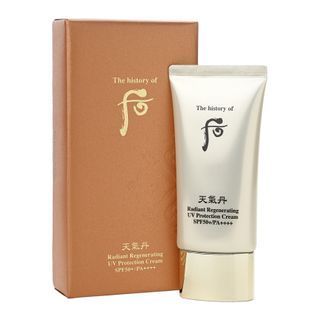
The History of Whoo Cheongidan Radiant Regenerating UV Protection Cream
Works for
3 of 3 advertised claims delivered
Sun protectionSPF 50 · 6 UV filtersBroad spectrum
This product offers a good level of protection against both UVB and UVA rays.
This sunscreen uses organic (so-called "chemical") sunscreen filters. Organic, or "chemical" filters usually provide reliable sun protection and rarely leave a white cast. Sunscreens with organic filters can sting eyes.
Evens skin tone2 ingredients credited for this claimStrong support
“Helps improve skin tone and skin texture, and offers moisturizing effect.”
This product offers broad spectrum sun protection. It means that it can prevent hyperpigmentation and help keep the skin tone even (sun damage is the main factor causing age spots, darkening of post-acne marks and other discolorations).
Moisturizing24 ingredients credited for this claimStrong support
“Cheongidan Radiant Regenerating UV Protection Cream”
This product can help improve hydration of the skin with the two types of ingredients.
The first type is called “humectants”:
these ingredients help attract water.
When humectants are on the surface of the skin, they “pull in” the moisture from the outside environment, or from
within deeper layers of the skin. The following ingredients in this product do the job:
arginine, hydroxyethyl urea.
This product also contains ingredients called “occlusives”. They help reduce the speed with which our skin loses moisture to the outside environment. These ingredients also help soften the upper layer of the skin, so it feels less tight and nicer to the touch. The following ingredients in this product do the job: arginine, dimethicone.
The following ingredients in this product are especially good for supporting the skin barrier and helping with the hydration level: panthenol
Anti-agingNot advertised by the brand · 6 ingredients credited for this claimStrong support
This product can help reduce and prevent fine lines and wrinkles, improve skin elasticity and firmness because it contains adenosine.
These ingredients in the product can also be helpful, even though there is less evidence for their effectiveness: ferulic acid, serine.
Keep in mind that it typically takes at least 6 weeks to notice any results because the changes that are needed to improve fine lines and elasticity happen in the deeper layers of the skin. No topical anti-aging product can “erase” wrinkles or fully reverse signs of aging.
This product can also help prevent early signs of skin aging because it offers a good level of broad spectrum sun protection. Sun damage is the main cause of premature skin aging, and protecting your skin from the sun is the best anti-aging strategy.
Anti-oxidationNot advertised by the brand · 11 ingredients credited for this claimStrong support
This product contains antioxidants (ferulic acid) that can help neutralize free radicals in skin. By doing so, they can lessen the damage the skin gets from the UV light (sun).
The following ingredients - quercetin also can have an antioxidant effect, but there is less evidence to confirm their effectiveness in skin.
ExfoliationNot advertised by the brand · 1 ingredient credited for this claimStrong support
This product can help exfoliate the skin. In other words, it helps break down the bonds between dead cells on the surface of the skin and speed up the skin turnover. Skin often appears softer and brighter after exfoliation, but overdoing it can result in disrupted skin barrier. The following ingredient is doing the exfoliating job in this product: hydroxyethyl urea.
Can it cause trouble?
Irritancy12 strong irritants: Chrysanthellum indicum extract, Gardenia florida fruit extract + 10 more — patch-test recommendedHigh risk
Comedogenic2 ingredients rated 2 or more on the 0–5 pore-clogging scale2 flagged
User reviews
Be the first — your take helps the next person decide.
Ingredients
Filter by role to see what each ingredient is doing.
Water~45–55%
Ethylhexyl methoxycinnamate~5.5–6.8%
- Irritation risk
- High
Octinoxate. When used in higher concentrations, works as a sunscreen protecting the skin from UVB rays. When used in lower concentration, helps to preserve the product formulation. Is shown to be harmful to coral reefs - consider avoiding bathing in coral reef areas when wearing a product with this ingredient. It can be irritating
More about Ethylhexyl methoxycinnamateEthylhexyl salicylate~4.7–5.7%
- Irritation risk
- Low
Octisalate. A UV filter. It offers some protection against the sun rays that cause sunburn (UVB), but does not protect against the most aging sun rays (UVA). It loses its effectiveness quickly when exposed to sunlight. It is an organic, or so called "chemical" sunscreen
More about Ethylhexyl salicylateC12-15 alkyl benzoate~3.2–3.9%
- Irritation risk
- Low
Enhances the product texture and makes it more spreadable. Helps reduce water loss from the outer layer of skin. Extands the shelf life by preventing bacteria growth
More about C12-15 alkyl benzoatePropanediol~2.3–2.8%
- Irritation risk
- Low
Acts as a solvent for other ingredients. Speeds up the absorption of other ingredients into the skin
More about PropanediolAlcohol denat.~1.9–2.3%
- Irritation risk
- High
Produces temporary toning effect. Can help dissolve other ingredients or preserve products
More about Alcohol denat.Diethylamino hydroxybenzoyl hexyl benzoate~2.1–2.5%
- Irritation risk
- Medium
Uvinul A Plus. A new generation broad spectrum sunscreen that offers an effective protection especially in the UVA range. It is stable in formulations. Unfortunately, is not approved by the FDA (US) yet
More about Diethylamino hydroxybenzoyl hexyl benzoateTitanium dioxide~1.8–2.2%
- Irritation risk
- Low
Works as a UV filter when used in high concentrations. It is photostable and is effective mostly against the UVB light, with some protection in the UVA range. In small concentrations, used for its ability to improve the color of cosmetic products. Is usually well tolerated by the skin
More about Titanium dioxidePhenylbenzimidazole sulfonic acid~1.6–1.9%
- Irritation risk
- Medium
Ensulizole. A UV filter that is effective against UVB rays. Does not protect against UVA light. It is photostable and can be used to help stabilize other sunscreen ingredients. It is water-soluble meaning that it can help create lighter sunscreen formulations
More about Phenylbenzimidazole sulfonic acidDimethicone~0.95–1.2%
- Irritation risk
- Low
A silicone that helps to reduce water loss from the surface of the skin. Can temporarily "fill in" lines and wrinkles, absorb oil, and create a nice product finish
More about DimethiconeBis-ethylhexyloxyphenol methoxyphenyl triazine~1.1–1.3%
- Irritation risk
- Medium
Tinosorb S. One of the most effective broad spectrum sunscreen ingredients. Protects from both UVA and UVB rays. It is photostable. Unfortunately, not approved by FDA (US) yet.
More about Bis-ethylhexyloxyphenol methoxyphenyl triazineHydrogenated lecithin~0.55–0.8%
- Irritation risk
- Low
Helps to retain moisture by creating a protective barrier on the skin. Rich in fatty acids. Improves product texture and helps with the penetration of other ingredients.
More about Hydrogenated lecithin1,2-hexanediol~0.45–0.65%
Tromethamine~0.4–0.65%
Potassium cetyl phosphate~0.4–0.6%
- Irritation risk
- Medium
Helps oil and water mix together
More about Potassium cetyl phosphatePolyglyceryl-3 methylglucose distearate~0.4–0.6%
- Irritation risk
- Medium
Helps water and oil mix together
More about Polyglyceryl-3 methylglucose distearatePanthenol~0.3–0.6%
- Irritation risk
- Low
Helps attract water to the upper layer of the skin and can help improve skin barrier function
More about PanthenolVinyl dimethicone/methicone silsesquioxane crosspolymer~0.3–0.55%
- Irritation risk
- Low
A type of silicone that create a smooth product finish and can create an optical soft-focus effect on the skin. Helps to thicken the product consistency
More about Vinyl dimethicone/methicone silsesquioxane crosspolymerStearic acid~0.4–0.65%
- Irritation risk
- Low
Helps oil and water mix together and works as an emollient
More about Stearic acidPalmitic acid~0.3–0.55%
- Irritation risk
- Low
An emollient that is naturally present in skin and helps soften it
More about Palmitic acidAluminum stearate~0.25–0.45%
- Irritation risk
- Medium
Used to help evenly disperse other ingredients (for example, pigment) in a formulation
More about Aluminum stearatePolyhydroxystearic acid~0.25–0.45%
- Irritation risk
- Medium
Used to create a thicker product consistency and stabilize the formulation
More about Polyhydroxystearic acidCaprylic/capric triglyceride~0.25–0.5%
- Irritation risk
- Medium
A good mix of fatty acids that forms a protective layer on the skin. Improves the shelf life of products. Derived from coconut and glycerin
More about Caprylic/capric triglyceridePolyurethane-15~0.25–0.45%
- Irritation risk
- Low
Polyacrylate crosspolymer-6~0.2–0.4%
- Irritation risk
- Low
Peg-10 rapeseed sterol~0.3–0.55%
Phytosteryl/octyldodecyl lauroyl glutamate~0.25–0.45%
- Irritation risk
- Low
A mix of amino acids and plant-based lipids. Helps to soften the upper layer of the skin and reduce water loss over time
More about Phytosteryl/octyldodecyl lauroyl glutamateAlumina~0.3–0.6%
- Irritation risk
- Low
The same compound that is used safely in dental implants and bone cements. In cosmetics, it is used to improve the consistency of products
More about AluminaButylene glycol~0.2–0.4%
- Irritation risk
- Low
Used to create a nice product texture and help delivery of other ingredients. Might be somewhat helpful in attracting water to the upper layer of the skin
More about Butylene glycolAmmonium polyacryloyldimethyl taurate~0.2–0.4%
- Irritation risk
- Low
Used to create a thicker product consistency
More about Ammonium polyacryloyldimethyl taurateXanthan gum~0.2–0.4%
- Irritation risk
- Low
Used to create a thicker product consistency
More about Xanthan gumAdenosine~0.2–0.35%
- Irritation risk
- Low
Might help improve cell turnover and reduce inflammation in skin. One study shows that the ingredients might be able to help reduce dynamic wrinkles (for example, in the corners of the eyes or on the forehead)
More about AdenosineBehenic acid~0.3–0.55%
Tocopherol~0.2–0.4%
- Irritation risk
- Low
Pure form of vitamin E. Can help moisturise and protect the skin from free radicals. Often used to help stabilise other ingredients or the formula itself
More about TocopherolMyristic acid~0.25–0.45%
- Irritation risk
- Medium
- Comedogenicity
- 3/5
Helps oil and water mix together. Could be comedogenic
More about Myristic acidGlycine soja oil~0.2–0.4%
- Irritation risk
- Medium
- Comedogenicity
- 2/5
A good emollient that helps soften the skin and helps repair its barrier function. It can clog pores if used in high concentrations.
More about Glycine soja oilSerine~0.2–0.35%
- Irritation risk
- Low
An amino-acid that helps to attract water to the upper layer of the skin. In combination with other amino-acids, might help to reduce fine lines and wrinkles
More about SerineArginine~0.2–0.35%
- Irritation risk
- Low
An amino acid that is naturally present in skin and helps keep it hydrated. When used together with AHAs, it can reduce their irritating effect on the skin
More about ArgininePhytosterols~0.25–0.45%
- Irritation risk
- Medium
Lipids that work as an emollient and can be helpful in repairing skin barrier function
More about PhytosterolsPeg-240/hdi copolymer bis-decyltetradeceth-20 ether~0.2–0.4%
- Irritation risk
- Medium
Helps create a gel-like product texture
More about Peg-240/hdi copolymer bis-decyltetradeceth-20 etherT-butyl alcohol~0.2–0.35%
- Irritation risk
- Medium
Used to dissolve other ingredients and to improve smell of products. It could be irritating
More about T-butyl alcoholCitric acid~0.2–0.35%
- Irritation risk
- Medium
Can work as an exfoliant but is typically used to adjust the product pH
More about Citric acidSoluble proteoglycan~0.2–0.35%
- Irritation risk
- Low
Trideceth-6~0.2–0.4%
Triethoxycaprylylsilane~0.25–0.45%
- Irritation risk
- Low
A type of silicone that helps oil and water mix well together. Helps to disperse other ingredients, e.g. pigments, evenly in a formulation
More about TriethoxycaprylylsilaneGanoderma lucidum extract~0.25–0.45%
- Irritation risk
- Medium
Helps attract water to the upper layer of the skin
More about Ganoderma lucidum extractSodium pca~0.25–0.45%
- Irritation risk
- Low
Naturally present in skin and helps to attract water to its upper layer
More about Sodium pcaPanax ginseng root extract~0.25–0.5%
- Irritation risk
- High
A plant extract that might have some anti-inflammatory properties, but solid evidence is lacking. It can be irritating
More about Panax ginseng root extractGold~0.25–0.45%
Hydroxyethyl urea~0.25–0.45%
- Irritation risk
- Low
A derivative of urea, a compound that is naturally present in skin. Attracts water to the upper layer of the skin. Can enhance penetration of other ingredients
More about Hydroxyethyl ureaTrichosanthes kirilowii root extract~0.25–0.45%
- Irritation risk
- Low
Chrysanthellum indicum extract~0.25–0.45%
Lonicera japonica flower extract~0.25–0.45%
- Irritation risk
- High
A plant extract that might help neutralize free radicals in skin. Can contain volalite oils and be irritating
More about Lonicera japonica flower extractBambusa arundinacea juice~0.3–0.6%
- Irritation risk
- Low
Betula platyphylla japonica juice~0.25–0.45%
- Irritation risk
- Low
Phellinus linteus extract~0.25–0.45%
- Irritation risk
- Low
Angelica gigas root extract~0.25–0.45%
- Irritation risk
- Low
Angelica tenuissima root extract~0.25–0.45%
- Irritation risk
- Low
Atractylodes japonica rhizome extract~0.25–0.45%
- Irritation risk
- Low
Cnidium officinale root extract~0.25–0.45%
- Irritation risk
- Low
Cuscuta australis seed extract~0.25–0.45%
- Irritation risk
- Low
Cyperus rotundus root extract~0.25–0.45%
- Irritation risk
- Low
Dioscorea japonica root extract~0.25–0.45%
- Irritation risk
- Low
Gardenia florida fruit extract~0.25–0.45%
- Irritation risk
- High
Used as a fragrance. Can be irritating.
More about Gardenia florida fruit extractGlycine soja seed extract~0.3–0.55%
- Irritation risk
- Medium
An emollient that helps soften the skin. Might be somewhat helpful in evening the skin tone.
More about Glycine soja seed extractLedebouriella divaricata root extract~0.25–0.45%
- Irritation risk
- Low
Lycium chinense fruit extract~0.25–0.45%
- Irritation risk
- Low
Ophiopogon japonicus root extract~0.25–0.4%
- Irritation risk
- Medium
Plant extract that might help neutralize free radicals and support skin barrier function, but research on its effectiveness in skin is lacking
More about Ophiopogon japonicus root extractOyster shell extract~0.25–0.45%
- Irritation risk
- Low
Paeonia suffruticosa root extract~0.25–0.45%
Polygonatum officinale rhizome/root extract~0.25–0.45%
- Irritation risk
- Low
Poria cocos sclerotium extract~0.25–0.5%
- Irritation risk
- Low
A mushroom extract that can help attract water to the upper layer of the skin and might be able to help reduce irritation and support restoration of skin barrier
More about Poria cocos sclerotium extractPrunus armeniaca kernel extract~0.25–0.45%
- Irritation risk
- Low
Rehmannia chinensis root extract~0.25–0.4%
- Irritation risk
- Low
Sesamum indicum seed extract~0.2–0.4%
- Irritation risk
- Low
Plant oil that due to its high content of linoleic acid can help support skin's barrier function improving its hydration
More about Sesamum indicum seed extractViscum album extract~0.2–0.4%
- Irritation risk
- Low
Cedrol~0.25–0.5%
Linoleic acid~0.4–0.6%
- Irritation risk
- Low
An excellent emollient. Helps soften the skin, restore its barrier function, and can help to calm down inflammation. It can be helpful to prevent blemishes and clogged pores
More about Linoleic acidFerulic acid~0.25–0.45%
- Irritation risk
- Low
A potent anti-oxidant that has been shown to be effective in neutralizing free radicals in skin. There seem to have a synergetic effect of ferulic acid, vitamin E and C, meaning that when the ingredients are used together, they enhance each other's ability protect the skin against free radicals. Ferulic acid also helps to stabilize other ingredients - including vitamins C and E. It can help to even out the skin tone. Ferulic acid is approved for use as a sunscreen ingredient in Japan in concentrations up to 10%
More about Ferulic acidBeta-sitosterol~0.25–0.5%
- Irritation risk
- Low
A phytosterol that can support skin's barrier function and help the skin stay hydrated
More about Beta-sitosterolRosmarinic acid~0.2–0.4%
- Irritation risk
- Low
Ursolic acid~0.2–0.4%
- Irritation risk
- Low
Quercetin~0.25–0.45%
- Irritation risk
- Low
Might be able to help neutralize free radicals in skin
More about QuercetinTrisodium edta~0.25–0.4%
Parfum~0.2–0.35%
- Irritation risk
- High
An aromatic blend of unspecified and possibly irritating ingredients
More about ParfumBenzyl benzoate~0.2–0.35%
- Irritation risk
- High
Fragrance with sweet balsamic smell. Help to preserve products and dissolve other ingredients. Could trigger allergic reactions and be irritating
More about Benzyl benzoateHydroxycitronellal~0.2–0.35%
- Irritation risk
- High
A fragrance. A likely allergen and can be irritating
More about HydroxycitronellalGeraniol~0.15–0.3%
Limonene~0.15–0.3%
- Irritation risk
- High
A common frangrance that can easily irritate skin, especially if exposed to air, light or heat
More about LimoneneHexyl cinnamal~0.15–0.25%
Citronellol~0.1–0.2%
Linalool~0.15–0.25%
Alpha-isomethyl ionone~0.15–0.25%
- Irritation risk
- High
A fragrance. Potential allergen and can be irritating
More about Alpha-isomethyl iononeCi 77492~0.1–0.15%
Ci 77491~0.1–0.15%
- Irritation risk
- Low
A red colorant made of iron oxide. Typically is not irritating
More about Ci 77491Ingredient list view
Water, Ethylhexyl methoxycinnamate, Ethylhexyl salicylate, C12-15 alkyl benzoate, Propanediol, Alcohol denat., Diethylamino hydroxybenzoyl hexyl benzoate, Titanium dioxide, Phenylbenzimidazole sulfonic acid, Dimethicone, Bis-ethylhexyloxyphenol methoxyphenyl triazine, Hydrogenated lecithin, 1,2-hexanediol, Tromethamine, Potassium cetyl phosphate, Polyglyceryl-3 methylglucose distearate, Panthenol, Vinyl dimethicone/methicone silsesquioxane crosspolymer, Stearic acid, Palmitic acid, Aluminum stearate, Polyhydroxystearic acid, Caprylic/capric triglyceride, Polyurethane-15, Polyacrylate crosspolymer-6, Peg-10 rapeseed sterol, Phytosteryl/octyldodecyl lauroyl glutamate, Alumina, Butylene glycol, Ammonium polyacryloyldimethyl taurate, Xanthan gum, Adenosine, Behenic acid, Tocopherol, Myristic acid, Glycine soja oil, Serine, Arginine, Phytosterols, Peg-240/hdi copolymer bis-decyltetradeceth-20 ether, T-butyl alcohol, Citric acid, Soluble proteoglycan, Trideceth-6, Triethoxycaprylylsilane, Ganoderma lucidum extract, Sodium pca, Panax ginseng root extract, Gold, Hydroxyethyl urea, Trichosanthes kirilowii root extract, Chrysanthellum indicum extract, Lonicera japonica flower extract, Bambusa arundinacea juice, Betula platyphylla japonica juice, Phellinus linteus extract, Angelica gigas root extract, Angelica tenuissima root extract, Atractylodes japonica rhizome extract, Cnidium officinale root extract, Cuscuta australis seed extract, Cyperus rotundus root extract, Dioscorea japonica root extract, Gardenia florida fruit extract, Glycine soja seed extract, Ledebouriella divaricata root extract, Lycium chinense fruit extract, Ophiopogon japonicus root extract, Oyster shell extract, Paeonia suffruticosa root extract, Polygonatum officinale rhizome/root extract, Poria cocos sclerotium extract, Prunus armeniaca kernel extract, Rehmannia chinensis root extract, Sesamum indicum seed extract, Viscum album extract, Cedrol, Linoleic acid, Ferulic acid, Beta-sitosterol, Rosmarinic acid, Ursolic acid, Quercetin, Trisodium edta, Parfum, Benzyl benzoate, Hydroxycitronellal, Geraniol, Limonene, Hexyl cinnamal, Citronellol, Linalool, Alpha-isomethyl ionone, Ci 77492, Ci 77491
Compare prices
Retailers ranked by price — lowest first.

Affiliate links · prices updated regularly
Product summary
Based on the ingredients included, we believe that "The History of Whoo - Cheongidan Radiant Regenerating UV Protection Cream" can offer reliable sun protection. We love that it can protect from both UVA and UVB rays (not all sunscreens with SPF ratings give UVA protection. UVA rays do not cause sunburn, but still damage our skin and lead to early aging).
It also works as a moisturizer, so you do not have to use an additional hydrating product. Like all broad-spectrum sunscreens, this product helps prevent early signs of aging.
Sunscreen filters
This is a "mixed" sunscreen in the sense that it uses both mineral and organic (so-called "chemical") sun filters. The organic filters in the product are: tinosorb s, uvinul a plus, octinoxate, octisalate and ensulizole. As for the mineral filters, this sunscreen uses titanium dioxide.
Irritation risk
There are quite a few common irritants in this product, including ingredients without particular skin benefits. We would not recommend it for sensitive skin. We assess the overall irritancy of this moisturizer to be high. For a detailed overview of all potential irritants: click here
You can see the detailed formula review with the breakdown of all actives in the product and the full ingredient list with estimated concentrations in the tables below.
Price
The product retails for 92.50$ in the United States.
For a detailed price comparison: click here.
Sources cited in this review
Every concentration estimate and effectiveness label is anchored to one of these 39 studies and safety reviews.
- 1
- 2Final Report on the Safety Assessment of Dimethicone Copolyoljournals.sagepub.com
- 3
- 4Safety Assessment of Tromethamine as Used in Cosmeticscir-safety.org
- 5Skin moisturizing effects of panthenol-based formulationspdfs.semanticscholar.org
- 6

Affiliate links · As an Amazon Associate, WIMJ earns from qualifying purchases.