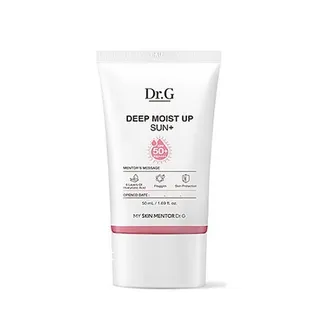
Doctor.G DEEP MOIST UP SUN PLUS SPF50+ PA++++_
Works for
Sun protectionSPF 50 · 6 UV filtersBroad spectrum
This product offers a good level of protection against both UVB and UVA rays.
This sunscreen uses organic (so-called "chemical") sunscreen filters. Organic, or "chemical" filters usually provide reliable sun protection and rarely leave a white cast. Sunscreens with organic filters can sting eyes.
MoisturizingCeramide np, C12-15 alkyl benzoate + 19 moreWorks well
“DEEP MOIST UP SUN PLUS SPF50+ PA++++_”
This product can help improve hydration of the skin with the two types of ingredients.
The first type is called “humectants”:
these ingredients help attract water.
When humectants are on the surface of the skin, they “pull in” the moisture from the outside environment, or from
within deeper layers of the skin. The following ingredients in this product do the job:
glycerin, hydrolyzed hyaluronic acid.
This product also contains ingredients called “occlusives”. They help reduce the speed with which our skin loses moisture to the outside environment. These ingredients also help soften the upper layer of the skin, so it feels less tight and nicer to the touch. The following ingredients in this product do the job: dimethiconol, phenyl trimethicone.
The following ingredients in this product are especially good for supporting the skin barrier and helping with the hydration level: ceramide np
Evens skin toneSide benefit · Pinus pinaster bark extract, NiacinamideWorks well
This product offers broad spectrum sun protection. It means that it can prevent hyperpigmentation and help keep the skin tone even (sun damage is the main factor causing age spots, darkening of post-acne marks and other discolorations).
Anti-agingSide benefit · Adenosine, NiacinamideWorks well
This product can help reduce and prevent fine lines and wrinkles, improve skin elasticity and firmness because it contains adenosine.
Keep in mind that it typically takes at least 6 weeks to notice any results because the changes that are needed to improve fine lines and elasticity happen in the deeper layers of the skin. No topical anti-aging product can “erase” wrinkles or fully reverse signs of aging.
This product can also help prevent early signs of skin aging because it offers a good level of broad spectrum sun protection. Sun damage is the main cause of premature skin aging, and protecting your skin from the sun is the best anti-aging strategy.
Anti-oxidationSide benefit · Pinus pinaster bark extract, Pelargonium graveolens flower oil + 1 moreMay help
This product contains antioxidants (pinus pinaster bark extract) that might be able to help neutralize free radicals in skin to lessen the damage it gets from the UV light (sun). There is not enough evidence to confirm their effectiveness in skin though.
Can it cause trouble?
Irritancy3 strong irritants: Pelargonium graveolens flower oil, Salvia officinalis oil + 1 more — patch-test recommendedHigh risk
Comedogenic2 ingredients rated 2 or more on the 0–5 pore-clogging scale2 flagged

User reviews
Be the first — your take helps the next person decide.
Ingredients
Filter by role to see what each ingredient is doing.
Water~45–55%
Ethylhexyl methoxycinnamate~5.2–6.4%
- Irritation risk
- High
Octinoxate. When used in higher concentrations, works as a sunscreen protecting the skin from UVB rays. When used in lower concentration, helps to preserve the product formulation. Is shown to be harmful to coral reefs - consider avoiding bathing in coral reef areas when wearing a product with this ingredient. It can be irritating
More about Ethylhexyl methoxycinnamatePropanediol~4–4.9%
- Irritation risk
- Low
Acts as a solvent for other ingredients. Speeds up the absorption of other ingredients into the skin
More about PropanediolEthylhexyl salicylate~3.6–4.4%
- Irritation risk
- Low
Octisalate. A UV filter. It offers some protection against the sun rays that cause sunburn (UVB), but does not protect against the most aging sun rays (UVA). It loses its effectiveness quickly when exposed to sunlight. It is an organic, or so called "chemical" sunscreen
More about Ethylhexyl salicylateC12-15 alkyl benzoate~2.4–2.9%
- Irritation risk
- Low
Enhances the product texture and makes it more spreadable. Helps reduce water loss from the outer layer of skin. Extands the shelf life by preventing bacteria growth
More about C12-15 alkyl benzoateDiethylamino hydroxybenzoyl hexyl benzoate~2.5–3.1%
- Irritation risk
- Medium
Uvinul A Plus. A new generation broad spectrum sunscreen that offers an effective protection especially in the UVA range. It is stable in formulations. Unfortunately, is not approved by the FDA (US) yet
More about Diethylamino hydroxybenzoyl hexyl benzoateHomosalate~2.1–2.6%
- Irritation risk
- Medium
A weak sunscreen that offers some protection against the sun rays that cause sunburn (UVB), but does not offer meaningful protection against protect against the most aging sun rays (UVA). It loses its effectiveness quickly when exposed to sunlight. It is an organic, or so called "chemical" sunscreen. When used in low concentrations, helps to stabilize the product formulation
More about HomosalateOctocrylene~2–2.4%
- Irritation risk
- Medium
A weak sunscreen that protects against the sun rays that cause sunburn (UVB) and is somewhat effective against the UVA rays. It is quite stable and can help stabilize other, more vulnerable, sunscreen ingredients like Avobenzone. It is an organic, or so called "chemical" sunscreen
More about OctocryleneTitanium dioxide~1.6–2%
- Irritation risk
- Low
Works as a UV filter when used in high concentrations. It is photostable and is effective mostly against the UVB light, with some protection in the UVA range. In small concentrations, used for its ability to improve the color of cosmetic products. Is usually well tolerated by the skin
More about Titanium dioxideNiacinamide~0.95–1.15%
- Irritation risk
- Low
Is proven to be effective in reducing blemishes, evening out skin tone and helping to improve lines and wrinkles. It helps the skin to repair sun damage, calm down inflammation and keep maintain good levels of moisture. The concentration of about 2% is effective for supporting the skin barrier and evening out the skin tone. Concentration of 4-6% is better for helping with acne and balancing the sebum production
More about NiacinamideButylene glycol~0.7–1%
- Irritation risk
- Low
Used to create a nice product texture and help delivery of other ingredients. Might be somewhat helpful in attracting water to the upper layer of the skin
More about Butylene glycolCaprylyl methicone~0.55–0.85%
- Irritation risk
- Low
A type of silicone that helps to soften the upper layer of the skin and create a nice product finish on the skin
More about Caprylyl methicone1,2-hexanediol~0.5–0.75%
Glycerin~0.5–0.75%
- Irritation risk
- Low
One of the best moisturizing ingredients. Naturally present in skin. It attracts water to the upper layer of the skin working as a humectant
More about GlycerinPentylene glycol~0.5–0.7%
- Irritation risk
- Medium
Used to preserve products, dissolve other ingredients and create a nice product texture
More about Pentylene glycolPelargonium graveolens flower oil~0.45–0.65%
- Irritation risk
- High
An essential oil. Can be irritating. Can become an allergen with oxidation
More about Pelargonium graveolens flower oilOlea europaea oil unsaponifiables~0.4–0.6%
- Irritation risk
- Low
Help soften the upper layer of the skin
More about Olea europaea oil unsaponifiablesTriticum vulgare germ oil unsaponifiables~0.4–0.6%
- Irritation risk
- Low
- Comedogenicity
- 2/5
Glycine soja oil unsaponifiables~0.35–0.6%
- Irritation risk
- Low
- Comedogenicity
- 2/5
Salvia officinalis oil~0.25–0.5%
- Irritation risk
- High
Pogostemon cablin oil~0.3–0.5%
- Irritation risk
- Low
Pollen extract~0.3–0.55%
- Irritation risk
- Low
Citrus aurantium bergamia fruit oil~0.2–0.4%
- Irritation risk
- High
A plant oil with a high content of volatile compounds that can irritate the skin and lead to allergic reactions. Can lead to photosensitivity
More about Citrus aurantium bergamia fruit oilPinus pinaster bark extract~0.25–0.45%
- Irritation risk
- Medium
A plant extract that might help neutralize free radicals and reduce hyperpigmentation, but evidence of effectiveness of topical application is lacking. It can be an INCI name for the trademarked ingredient Pycnogenol (but could also be a different type of this plant's bark extract)
More about Pinus pinaster bark extractAluminum stearate~0.25–0.4%
- Irritation risk
- Medium
Used to help evenly disperse other ingredients (for example, pigment) in a formulation
More about Aluminum stearatePhenyl trimethicone~0.25–0.45%
- Irritation risk
- Low
A type of silicone that can decrease loss of moisture from the skin surface. It helps create a nice product texture
More about Phenyl trimethiconePolyhydroxystearic acid~0.25–0.45%
- Irritation risk
- Medium
Used to create a thicker product consistency and stabilize the formulation
More about Polyhydroxystearic acidEthylhexyl olivate~0.2–0.4%
- Irritation risk
- Low
Helps soften the upper layer of the skin
More about Ethylhexyl olivateDimethicone/vinyl dimethicone crosspolymer~0.25–0.4%
- Irritation risk
- Low
Used to stabilize product formulations and create a nice product texture
More about Dimethicone/vinyl dimethicone crosspolymerAcrylates/dimethicone copolymer~0.25–0.45%
- Irritation risk
- Medium
Used to stabilize product formulation, help create an even product layer over skin (for example, in sunscreen), evenly disperse pigements and create a nice product consistency
More about Acrylates/dimethicone copolymerSodium acrylates copolymer~0.2–0.35%
- Irritation risk
- Medium
Used to create a thicker product consistency
More about Sodium acrylates copolymerHydroxypropyl methylcellulose stearoxy ether~0.25–0.4%
- Irritation risk
- Low
Helps create a thicker product formulation
More about Hydroxypropyl methylcellulose stearoxy etherPolyacrylate crosspolymer-6~0.25–0.45%
- Irritation risk
- Low
Dimethiconol~0.25–0.5%
- Irritation risk
- Low
A silicone that makes products more spreadable and keeps skin smooth. Helps to add gloss to skin and may visually fill in fine lines/wrinkles for short time
More about DimethiconolTrisiloxane~0.2–0.4%
Cetyl alcohol~0.25–0.5%
- Irritation risk
- Low
A non-drying alcohol that works to soften the skin and stabilize product formulations helping oil and water mix together
More about Cetyl alcoholAmmonium acryloyldimethyltaurate/vp copolymer~0.25–0.4%
- Irritation risk
- Low
Increases thickness of a product. Texture enhancer for oil-in-water emulsions
More about Ammonium acryloyldimethyltaurate/vp copolymerEthylhexylglycerin~0.25–0.45%
Polyglyceryl-4 oleate~0.25–0.45%
- Irritation risk
- Medium
Helps oil and water mix together
More about Polyglyceryl-4 oleateAdenosine~0.2–0.4%
- Irritation risk
- Low
Might help improve cell turnover and reduce inflammation in skin. One study shows that the ingredients might be able to help reduce dynamic wrinkles (for example, in the corners of the eyes or on the forehead)
More about AdenosineT-butyl alcohol~0.2–0.35%
- Irritation risk
- Medium
Used to dissolve other ingredients and to improve smell of products. It could be irritating
More about T-butyl alcoholSodium hyaluronate~0.2–0.35%
- Irritation risk
- Low
One of the best moisturizing ingredients. Attracts water into the upper layer of the skin
More about Sodium hyaluronateCeramide np~0.25–0.45%
- Irritation risk
- Low
A type of lipid similar to ceramides naturally present in skin. Helps to soften the upper layer of the skin and supports the skin barrier function to keep it hydrated. Can help to prevent inflammation in skin
More about Ceramide npCholesterol~0.25–0.45%
- Irritation risk
- Low
An emollient that is naturally found in skin
More about CholesterolHydroxypropyltrimonium hyaluronate~0.2–0.35%
- Irritation risk
- Low
Hydrolyzed hyaluronic acid~0.15–0.3%
- Irritation risk
- Low
One of the best moisturizing ingredients. Attracts water into the upper layer of the skin. A version of it is naturally present in skin
More about Hydrolyzed hyaluronic acidCaprylic/capric triglyceride~0.2–0.4%
- Irritation risk
- Medium
A good mix of fatty acids that forms a protective layer on the skin. Improves the shelf life of products. Derived from coconut and glycerin
More about Caprylic/capric triglycerideGlycine soja sterols~0.2–0.4%
- Irritation risk
- Low
An emollient that helps soften the skin
More about Glycine soja sterolsLinoleic acid~0.3–0.5%
- Irritation risk
- Low
An excellent emollient. Helps soften the skin, restore its barrier function, and can help to calm down inflammation. It can be helpful to prevent blemishes and clogged pores
More about Linoleic acidPhospholipids~0.1–0.2%
- Irritation risk
- Low
Emollients that are naturaly present in skin. In addition, they help water and oil mix together in the product
More about PhospholipidsSodium acetylated hyaluronate~0.1–0.2%
- Irritation risk
- Low
A type of hyaluronic acid that works as an excellent moisturizer by attracting water into the upper layer of the skin. Is typically feels less sticky on the skin compared to the usual hyaluronic acid
More about Sodium acetylated hyaluronateIngredient list view
Water, Ethylhexyl methoxycinnamate, Propanediol, Ethylhexyl salicylate, C12-15 alkyl benzoate, Diethylamino hydroxybenzoyl hexyl benzoate, Homosalate, Octocrylene, Titanium dioxide, Niacinamide, Butylene glycol, Caprylyl methicone, 1,2-hexanediol, Glycerin, Pentylene glycol, Pelargonium graveolens flower oil, Olea europaea oil unsaponifiables, Triticum vulgare germ oil unsaponifiables, Glycine soja oil unsaponifiables, Salvia officinalis oil, Pogostemon cablin oil, Pollen extract, Citrus aurantium bergamia fruit oil, Pinus pinaster bark extract, Aluminum stearate, Phenyl trimethicone, Polyhydroxystearic acid, Ethylhexyl olivate, Dimethicone/vinyl dimethicone crosspolymer, Acrylates/dimethicone copolymer, Sodium acrylates copolymer, Hydroxypropyl methylcellulose stearoxy ether, Polyacrylate crosspolymer-6, Dimethiconol, Trisiloxane, Cetyl alcohol, Ammonium acryloyldimethyltaurate/vp copolymer, Ethylhexylglycerin, Polyglyceryl-4 oleate, Adenosine, T-butyl alcohol, Sodium hyaluronate, Ceramide np, Cholesterol, Hydroxypropyltrimonium hyaluronate, Hydrolyzed hyaluronic acid, Caprylic/capric triglyceride, Glycine soja sterols, Linoleic acid, Phospholipids, Sodium acetylated hyaluronate
Compare prices
Retailers ranked by price — lowest first.
Worth comparing, line by line.
Match % combines shared ingredients, the first five ingredients, shared actives and hero ingredients, irritancy (lower counts in the alternative's favour), texture and body area. Only products in the same routine step are compared.
| Doctor.GDEEP MOIST UP SUN PLUS SPF50+ PA++++_YOUR PRODUCT | OttieWater Barrier Sunscreen | Dr.GDeep Moist Up Sun Plus SPF50+ PA++++ | ISNTREEHyaluronic Acid Perfect Sun Block SPF50+ PA++++ | |
|---|---|---|---|---|
| Match | — | 83% | 82% | 82% |
| Price | — | $14.89 | $28.90 | — |
| Shared key ingredients | — | 9 of 20 | 15 of 20 | 10 of 20 |
| Key difference | — | Madecassoside | Echium Plantagineum Seed Oil | Centella Asiatica Extract |
| Irritancy | High | Medium | High | Low |
| SPF | SPF 50 | SPF 50 | SPF 50 | SPF 50 |
| Drying alcohol | — | — | Contains drying alcohol | — |
| View product | Shop | Shop | Shop |


More alternatives: fromrier EGF Cica Mineral SunscreenP.CALM Water Barrier Sun Cream
Product summary
We assess that "Doctor. G - DEEP MOIST UP SUN PLUS SPF50+ PA++++_" can provide reliable sun protection based on the ingredient list. It can protect from both UVA and UVB rays. This is great news because not all sunscreens with SPF ratings give UVA protection. (UVA rays do not cause sunburn, but still damage our skin and lead to early aging).
Its formula is also hydrating, so you might not need an additional moistruizer during the day. Like all broad-spectrum sunscreens, this product helps prevent early signs of aging.
Sunscreen filters
This sunscreen uses a mixture of both mineral and organic (so-called "chemical") UV filters. The organic filters in the product are: uvinul a plus, octinoxate, octisalate, homosalate and octocrylene. As for the mineral filters, this sunscreen uses titanium dioxide.
Irritation risk
There are some common irritants in this product, including ingredients that do not have benefits for the skin. We assess the overall irritancy of this sunscreen to be high. For a detailed overview of all potential irritants: click here
You can see the detailed formula review with the breakdown of all actives in the product and the full ingredient list with estimated concentrations in the tables below.
Sources cited in this review
Every concentration estimate and effectiveness label is anchored to one of these 22 studies and safety reviews.
- 1
- 2
- 3
- 4
- 5
- 6

Affiliate links · As an Amazon Associate, WIMJ earns from qualifying purchases.