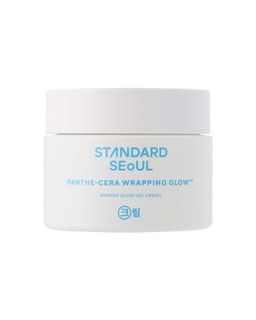
Standard Seoul Barrier Glass Gel Cream
Works for
1 of 1 advertised claim delivered
MoisturizingPhytosphingosine, Ceramide as + 38 moreStrong evidence
“Barrier Glass Gel Cream wraps skin in a cool, refreshing layer of moisture powered by aloe vera leaf extract to calm irritation and shield against stress.”
This product can help improve hydration of the skin with the two types of ingredients.
The first type is called “humectants”:
these ingredients help attract water.
When humectants are on the surface of the skin, they “pull in” the moisture from the outside environment, or from
within deeper layers of the skin. The following ingredients in this product do the job:
arginine, biosaccharide gum-1.
This product also contains ingredients called “occlusives”. They help reduce the speed with which our skin loses moisture to the outside environment. These ingredients also help soften the upper layer of the skin, so it feels less tight and nicer to the touch. The following ingredients in this product do the job: arginine, borago officinalis seed oil.
The following ingredients in this product are especially good for supporting the skin barrier and helping with the hydration level: ceramide ap, ceramide as, ceramide eop, ceramide np, ceramide ns, niacinamide, panthenol, phytosphingosine
Anti-agingNot advertised by the brand · Adenosine, Niacinamide + 4 moreStrong evidence
This product can help reduce and prevent fine lines and wrinkles, improve skin elasticity and firmness because it contains adenosine, niacinamide.
Keep in mind that it typically takes at least 6 weeks to notice any results because the changes that are needed to improve fine lines and elasticity happen in the deeper layers of the skin. No topical anti-aging product can “erase” wrinkles or fully reverse signs of aging.
Evens skin toneNot advertised by the brand · Niacinamide, Dipotassium glycyrrhizate + 1 moreStrong evidence
This product can help reduce hypepigmentation and even out the skin tone because it contains the following effective ingredients: niacinamide
Keep in mind that you would need to apply any topical skincare targetted at hypigmentation consistently for a couple of months to get a result. No topical skincare product can help get rid of hyperpigmentation (including post-acne marks and age spots) instantly.
Anti-blemishNot advertised by the brand · Niacinamide, Phytosphingosine + 2 moreStrong evidence
This product can help reduce breakouts and clogged pores because it contains the following ingredient: niacinamide. This ingredient is used for treating acne and can have a noticeable effect.
Can it cause trouble?
Irritancy3 strong irritants: Melissa officinalis leaf extract, Mentha piperita leaf extract + 1 more — patch-test recommendedHigh risk
Comedogenic1 ingredient rated 2 or more on the 0–5 pore-clogging scale1 flagged

User reviews
Be the first — your take helps the next person decide.
Ingredients
Filter by role to see what each ingredient is doing.
Water~45–55%
Propanediol~4.4–5.4%
- Irritation risk
- Low
Acts as a solvent for other ingredients. Speeds up the absorption of other ingredients into the skin
More about PropanediolAloe barbadensis leaf water~4.1–5%
- Irritation risk
- Medium
Traditionally used to treat sunburns, dermatitis and inflammation, but data on its effectiveness is lacking. While the majority of the content is plain water, it can contain some goodies like vitamins, enzymes, minerals, and humectants that help attract water into the skin
More about Aloe barbadensis leaf waterGlycerin~2.9–3.6%
- Irritation risk
- Low
One of the best moisturizing ingredients. Naturally present in skin. It attracts water to the upper layer of the skin working as a humectant
More about GlycerinButylene glycol~2.2–2.7%
- Irritation risk
- Low
Used to create a nice product texture and help delivery of other ingredients. Might be somewhat helpful in attracting water to the upper layer of the skin
More about Butylene glycolDipropylene glycol~1.8–2.1%
- Irritation risk
- Low
Helps to dissolve other ingredients in a formulation. Slows down the rate of product drying
More about Dipropylene glycolDiethoxyethyl succinate~1.6–1.9%
- Irritation risk
- Low
Helps dissolve other ingredients in the formulation
More about Diethoxyethyl succinateNiacinamide~1.4–1.7%
- Irritation risk
- Low
Is proven to be effective in reducing blemishes, evening out skin tone and helping to improve lines and wrinkles. It helps the skin to repair sun damage, calm down inflammation and keep maintain good levels of moisture. The concentration of about 2% is effective for supporting the skin barrier and evening out the skin tone. Concentration of 4-6% is better for helping with acne and balancing the sebum production
More about NiacinamideTrehalose~1.1–1.3%
- Irritation risk
- Low
A sugar that attracts water to the upper layer of the skin
More about Trehalose1,2-hexanediol~0.65–0.95%
Sodium hyaluronate~0.6–0.9%
- Irritation risk
- Low
One of the best moisturizing ingredients. Attracts water into the upper layer of the skin
More about Sodium hyaluronateLeontopodium alpinum callus culture extract~0.5–0.75%
- Irritation risk
- Low
A plant stem cell extract that might help neutralize free radicals and reduce inflammation in skin
More about Leontopodium alpinum callus culture extractHydrolyzed hyaluronic acid~0.45–0.65%
- Irritation risk
- Low
One of the best moisturizing ingredients. Attracts water into the upper layer of the skin. A version of it is naturally present in skin
More about Hydrolyzed hyaluronic acidHyaluronic acid~0.35–0.65%
- Irritation risk
- Low
One of the best moisturizing ingredients. Attracts water into the upper layer of the skin. Naturally present in skin. Typically has large molecule size unless advertised otherwise on the product label. Helps support skin's barrier function and may help to reduce inflammation
More about Hyaluronic acidAlchemilla vulgaris extract~0.3–0.55%
- Irritation risk
- High
A plant extract that has astringent properties. In other words, it might be able to interact with keratin in the uppermost layer of the skin to reduce swelling and create a temporal tightening effect. It can be irritating
More about Alchemilla vulgaris extractMalva sylvestris flower/leaf/stem extract~0.3–0.55%
- Irritation risk
- Low
Melissa officinalis leaf extract~0.3–0.55%
- Irritation risk
- High
A plant extract that is added for its fragrance. Can be irritating
More about Melissa officinalis leaf extractMentha piperita leaf extract~0.25–0.5%
- Irritation risk
- High
Used as a fragrance and can be irritating
More about Mentha piperita leaf extractEquisetum arvense extract~0.3–0.6%
- Irritation risk
- High
A plant extract that might have anti-oxidant properties. Can be irritating
More about Equisetum arvense extractVeronica officinalis flower/leaf/stem extract~0.25–0.45%
- Irritation risk
- Low
Primula veris extract~0.25–0.45%
- Irritation risk
- High
Borago officinalis seed oil~0.25–0.45%
- Irritation risk
- Low
A plant oil that is effective in reducing irritation in skin, restore the barrier function and support its hydration
More about Borago officinalis seed oilAmmonium acryloyldimethyltaurate/beheneth-25 methacrylate crosspolymer~0.2–0.35%
- Irritation risk
- Medium
Used to stabilize product formulations
More about Ammonium acryloyldimethyltaurate/beheneth-25 methacrylate crosspolymerCaprylic/capric triglyceride~0.25–0.45%
- Irritation risk
- Medium
A good mix of fatty acids that forms a protective layer on the skin. Improves the shelf life of products. Derived from coconut and glycerin
More about Caprylic/capric triglycerideDiglycerin~0.2–0.35%
- Irritation risk
- Low
Helps attract water to the upper layer of the skin
More about DiglycerinTromethamine~0.2–0.35%
Hydroxyethyl acrylate/sodium acryloyldimethyl taurate copolymer~0.2–0.35%
- Irritation risk
- Medium
A gelling agent that thickens the product consistency and leaves the skin with a velvety finish
More about Hydroxyethyl acrylate/sodium acryloyldimethyl taurate copolymerEthylhexylglycerin~0.2–0.35%
Panthenol~0.2–0.35%
- Irritation risk
- Low
Helps attract water to the upper layer of the skin and can help improve skin barrier function
More about PanthenolAdenosine~0.2–0.35%
- Irritation risk
- Low
Might help improve cell turnover and reduce inflammation in skin. One study shows that the ingredients might be able to help reduce dynamic wrinkles (for example, in the corners of the eyes or on the forehead)
More about AdenosineBiosaccharide gum-1~0.2–0.35%
- Irritation risk
- Low
Helps attract water to the upper layer of the skin and is claimed to provide a longer-lasting hydration because of its ability to create a water-binding film on the surface of the skin
More about Biosaccharide gum-1Dipotassium glycyrrhizate~0.2–0.35%
- Irritation risk
- Low
A salt derived from licorice. Works as an emollient to soften the upper layer of the skin and can help calm down inflammation. Might be helpful for skin lightening
More about Dipotassium glycyrrhizateSodium phytate~0.2–0.35%
Cyamopsis tetragonoloba gum~0.2–0.4%
- Irritation risk
- Low
Agar~0.2–0.35%
- Irritation risk
- Medium
Polysaccharide derived from seaweed. Used to create a thicker product consistency and might help attract water to the upper layer of the skin
More about AgarCellulose~0.25–0.45%
- Irritation risk
- Low
Can be used to help absorb oil as well as add volume and imporve texture of products.
More about CellulosePolyglutamic acid~0.2–0.4%
- Irritation risk
- Low
Helps attract water to the upper layer of the skin.
More about Polyglutamic acidBeta-glucan~0.2–0.4%
- Irritation risk
- Low
Helps attract water to the upper layer of the skin, calm down inflammation and irritation, restore the barrier function and support wound healing. It can be helpful in reducing fine lines and wrinkles
More about Beta-glucanDimethylsilanol hyaluronate~0.2–0.4%
- Irritation risk
- Low
Hydrolyzed sodium hyaluronate~0.2–0.4%
- Irritation risk
- Low
Attracts water into the upper layer of the skin
More about Hydrolyzed sodium hyaluronateGluconolactone~0.2–0.35%
- Irritation risk
- Medium
A polyhydroxy acid (PHA) that helps shed the dead cells from the skin surface revealing smoother skin. Is believed to be genter than AHAs. It helps attract water to the upper layer of the skin and can stimulate production of skin's own hyaluronic acid resulting in improved hydration levels. It has been shown to be helpful against acne and clogged pores if used consistently (e.g over a period of 12 weeks) in high enough concentration. It can help reduce fine lines and wrinkles and improve skin tone with long-term application. Can help neutralize free radicals
More about GluconolactonePotassium hyaluronate~0.2–0.4%
- Irritation risk
- Low
Hydroxypropyltrimonium hyaluronate~0.25–0.45%
- Irritation risk
- Low
Sodium hyaluronate crosspolymer~0.2–0.4%
- Irritation risk
- Medium
Attracts water into the upper layer of the skin
More about Sodium hyaluronate crosspolymerSodium hyaluronate dimethylsilanol~0.2–0.35%
- Irritation risk
- Low
Tocopherol~0.2–0.4%
- Irritation risk
- Low
Pure form of vitamin E. Can help moisturise and protect the skin from free radicals. Often used to help stabilise other ingredients or the formula itself
More about TocopherolSodium acetylated hyaluronate~0.2–0.4%
- Irritation risk
- Low
A type of hyaluronic acid that works as an excellent moisturizer by attracting water into the upper layer of the skin. Is typically feels less sticky on the skin compared to the usual hyaluronic acid
More about Sodium acetylated hyaluronateSorbitol~0.2–0.4%
- Irritation risk
- Low
Helps attract water to the upper layer of the skin and improves the product texture
More about SorbitolCitric acid~0.2–0.4%
- Irritation risk
- Medium
Can work as an exfoliant but is typically used to adjust the product pH
More about Citric acidHydrogenated lecithin~0.25–0.45%
- Irritation risk
- Low
Helps to retain moisture by creating a protective barrier on the skin. Rich in fatty acids. Improves product texture and helps with the penetration of other ingredients.
More about Hydrogenated lecithinCeramide np~0.25–0.45%
- Irritation risk
- Low
A type of lipid similar to ceramides naturally present in skin. Helps to soften the upper layer of the skin and supports the skin barrier function to keep it hydrated. Can help to prevent inflammation in skin
More about Ceramide npStearic acid~0.45–0.7%
- Irritation risk
- Low
Helps oil and water mix together and works as an emollient
More about Stearic acidArginine~0.2–0.35%
- Irritation risk
- Low
An amino acid that is naturally present in skin and helps keep it hydrated. When used together with AHAs, it can reduce their irritating effect on the skin
More about ArginineSucrose stearate~0.25–0.5%
4-butylresorcinol~0.2–0.4%
- Irritation risk
- Low
Dextrin~0.25–0.45%
- Irritation risk
- Low
A sugar that is used to stabilize the product formulation. Can help attract water to the upper layer of the skin
More about DextrinPalmitic acid~0.25–0.45%
- Irritation risk
- Low
An emollient that is naturally present in skin and helps soften it
More about Palmitic acidLecithin~0.25–0.45%
- Irritation risk
- Low
Used mostly for creating emulsions - helping oil and water mix together. Helps soften the upper layer of the skin
More about LecithinCholesterol~0.25–0.45%
- Irritation risk
- Low
An emollient that is naturally found in skin
More about CholesterolCeramide ns~0.25–0.45%
- Irritation risk
- Low
A type of lipid similar to ceramides naturally present in skin. Helps to soften the upper layer of the skin and supports the skin barrier function to keep it hydrated. Can help to prevent inflammation in skin
More about Ceramide nsGlycosphingolipids~0.25–0.4%
- Irritation risk
- Low
A type of lipids naturally present in skin. They can be converted to ceramides in skin
More about GlycosphingolipidsPhytosphingosine~0.25–0.45%
- Irritation risk
- Low
A type of lipid that is naturally present in skin. It might help in repairing skin barrier function and has anti-bacterial effect
More about PhytosphingosineCeramide ap~0.2–0.4%
- Irritation risk
- Low
A type of lipid similar to ceramides naturally present in skin. Helps to soften the upper layer of the skin and supports the skin barrier function to keep it hydrated. Can help to prevent inflammation in skin
More about Ceramide apCeramide as~0.15–0.25%
- Irritation risk
- Low
A type of lipid similar to ceramides naturally present in skin. Helps to soften the upper layer of the skin and supports the skin barrier function to keep it hydrated. Can help to prevent inflammation in skin
More about Ceramide asCeramide eop~0.2–0.35%
- Irritation risk
- Low
A type of lipid similar to ceramides naturally present in skin. Helps to soften the upper layer of the skin and supports the skin barrier function to keep it hydrated. Can help to prevent inflammation in skin
More about Ceramide eopCarbomer~0.15–0.25%
- Irritation risk
- Low
Helps create a thicker or gel-like product texture. It is not a surfactant but can be used in gentle cleansing formulations
More about CarbomerXanthan gum~0.15–0.25%
- Irritation risk
- Low
Used to create a thicker product consistency
More about Xanthan gumCetearyl alcohol~0.15–0.25%
- Irritation risk
- Low
- Comedogenicity
- 2/5
A non-drying alcohol. Works as an emollient. Helps water and oil mix together and creates a nice product texture
More about Cetearyl alcoholGuaiazulene~0.1–0.15%
- Irritation risk
- Low
A blue-colored ingredient that is traditionally used as a colorant. It has anti-inflammatory properties. For example, it is successfully used to treat diaper rash for new borns. It can help support the skin barrier by reducing inflammation
More about GuaiazuleneIngredient list view
Water, Propanediol, Aloe barbadensis leaf water, Glycerin, Butylene glycol, Dipropylene glycol, Diethoxyethyl succinate, Niacinamide, Trehalose, 1,2-hexanediol, Sodium hyaluronate, Leontopodium alpinum callus culture extract, Hydrolyzed hyaluronic acid, Hyaluronic acid, Alchemilla vulgaris extract, Malva sylvestris flower/leaf/stem extract, Melissa officinalis leaf extract, Mentha piperita leaf extract, Equisetum arvense extract, Veronica officinalis flower/leaf/stem extract, Primula veris extract, Borago officinalis seed oil, Ammonium acryloyldimethyltaurate/beheneth-25 methacrylate crosspolymer, Caprylic/capric triglyceride, Diglycerin, Tromethamine, Hydroxyethyl acrylate/sodium acryloyldimethyl taurate copolymer, Ethylhexylglycerin, Panthenol, Adenosine, Biosaccharide gum-1, Dipotassium glycyrrhizate, Sodium phytate, Cyamopsis tetragonoloba gum, Agar, Cellulose, Polyglutamic acid, Beta-glucan, Dimethylsilanol hyaluronate, Hydrolyzed sodium hyaluronate, Gluconolactone, Potassium hyaluronate, Hydroxypropyltrimonium hyaluronate, Sodium hyaluronate crosspolymer, Sodium hyaluronate dimethylsilanol, Tocopherol, Sodium acetylated hyaluronate, Sorbitol, Citric acid, Hydrogenated lecithin, Ceramide np, Stearic acid, Arginine, Sucrose stearate, 4-butylresorcinol, Dextrin, Palmitic acid, Lecithin, Cholesterol, Ceramide ns, Glycosphingolipids, Phytosphingosine, Ceramide ap, Ceramide as, Ceramide eop, Carbomer, Xanthan gum, Cetearyl alcohol, Guaiazulene
Compare prices
Retailers ranked by price — lowest first.

Worth comparing, line by line.
Match % combines shared ingredients, the first five ingredients, shared actives and hero ingredients, irritancy (lower counts in the alternative's favour), texture and body area. Only products in the same routine step are compared.
| Standard SeoulBarrier Glass Gel CreamYOUR PRODUCT | SUNGBOON EDITORAlaska Salmon PDRN Ultra Moisturizing Barrier Cream | ALIVE:LABMulti Ice Cream | skintificSymWhite 377 Dark Spot Moisture Gel | |
|---|---|---|---|---|
| Match | — | 89% | 88% | 87% |
| Price | $22.45 | $19.50−$2.95 | $55.57+$33.12 | $9.99−$12.46 |
| Shared key ingredients | — | 22 of 30 | 18 of 30 | 14 of 30 |
| Key difference | — | 3-O-Ethyl Ascorbic Acid | Pitera | Nonapeptide-1 |
| Irritancy | High | Medium | Medium | Medium |
| Drying alcohol | — | — | — | — |
| View product | Shop | Shop | Shop |

Sources cited in this review
Every concentration estimate and effectiveness label is anchored to one of these 48 studies and safety reviews.
- 1
- 2
- 3
- 4
- 5Hyaluronic acid: A key molecule in skin agingncbi.nlm.nih.gov
- 6

Affiliate links · As an Amazon Associate, WIMJ earns from qualifying purchases.