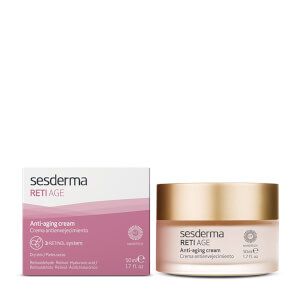
Sesderma Retiage Face Cream
Works for
2 of 2 advertised claims delivered
MoisturizingCaprooyl tetrapeptide-3, Nicotiana benthamiana sh-polypeptide-15 hexapeptide-40 + 15 moreStrong evidence
“Retiage Face Cream”
This product can help improve hydration of the skin with the two types of ingredients.
The first type is called “humectants”:
these ingredients help attract water.
When humectants are on the surface of the skin, they “pull in” the moisture from the outside environment, or from
within deeper layers of the skin. The following ingredients in this product do the job:
dextran, glycerin.
This product also contains ingredients called “occlusives”. They help reduce the speed with which our skin loses moisture to the outside environment. These ingredients also help soften the upper layer of the skin, so it feels less tight and nicer to the touch. The following ingredients in this product do the job: dimethicone, helianthus annuus seed oil.
The following ingredients in this product are especially good for supporting the skin barrier and helping with the hydration level: caprooyl tetrapeptide-3
Anti-agingRetinal, Retinol + 7 moreStrong evidence
“Glycerin helps lock in a layer of moisture, supporting a supple, youthful-looking visage.”
This product can help reduce and prevent fine lines and wrinkles, improve skin elasticity and firmness because it contains retinal, retinol.
These ingredients in the product can also be helpful, even though there is less evidence for their effectiveness: caprooyl tetrapeptide-3, retinyl propionate.
Keep in mind that it typically takes at least 6 weeks to notice any results because the changes that are needed to improve fine lines and elasticity happen in the deeper layers of the skin. No topical anti-aging product can “erase” wrinkles or fully reverse signs of aging.
ExfoliationNot advertised by the brand · RetinolStrong evidence
This product can help exfoliate the skin. In other words, it helps break down the bonds between dead cells on the surface of the skin and speed up the skin turnover. Skin often appears softer and brighter after exfoliation, but overdoing it can result in disrupted skin barrier. The following ingredient is doing the exfoliating job in this product: retinol.
Anti-blemishNot advertised by the brand · Retinol, Retinal + 1 moreStrong evidence
This product can help reduce breakouts and clogged pores because it contains the following ingredient: retinal, retinol. These ingredients is used for treating acne and can have a noticeable effect.
The following ingredient (ingredients) in this product might be helpful, but there is no evidence to confirm that it actually works: retinyl propionate
Anti-oxidationNot advertised by the brand · Retinol, Resveratrol dimethyl ether + 4 moreStrong evidence
This product contains antioxidants (retinol) that can help neutralize free radicals in skin. By doing so, they can lessen the damage the skin gets from the UV light (sun).
Evens skin toneNot advertised by the brand · Retinal, Retinol + 3 moreStrong evidence
This product can help reduce hypepigmentation and even out the skin tone because it contains the following effective ingredients: retinal, retinol.
The following ingredient (ingredients) in this product might be helpful, but there is no evidence to confirm that it actually can help even out the skin tone: resveratrol dimethyl ether, retinyl propionate.
Keep in mind that you would need to apply any topical skincare targetted at hypigmentation consistently for a couple of months to get a result. No topical skincare product can help get rid of hyperpigmentation (including post-acne marks and age spots) instantly.
Can it cause trouble?
Irritancy5 strong irritants: Alcohol, Parfum + 3 more — patch-test recommendedHigh risk
ComedogenicClean of flagged comedogenic ingredientsNone flagged


User reviews
Be the first — your take helps the next person decide.
Ingredients
Filter by role to see what each ingredient is doing.
Water~45–55%
Hydrogenated polydecene~5.2–6.3%
- Irritation risk
- Low
Helps to soften the upper layer of the skin and create a nice product texture
More about Hydrogenated polydeceneCetearyl ethylhexanoate~4.1–5.1%
- Irritation risk
- Low
An emollient that helps soften the skin
More about Cetearyl ethylhexanoateSorbitan stearate~2.7–3.3%
Propanediol~2.2–2.7%
- Irritation risk
- Low
Acts as a solvent for other ingredients. Speeds up the absorption of other ingredients into the skin
More about PropanediolGlycerin~1.9–2.3%
- Irritation risk
- Low
One of the best moisturizing ingredients. Naturally present in skin. It attracts water to the upper layer of the skin working as a humectant
More about GlycerinCyclopentasiloxane~1.6–1.9%
- Irritation risk
- Low
A silicone that helps improve the product texture and spreadability. Can absorb oil creating a short-term mattifying effect on the skin
More about CyclopentasiloxanePrunus amygdalus dulcis oil~1.4–1.7%
- Irritation risk
- Low
An emollient that softens the skin
More about Prunus amygdalus dulcis oilGlyceryl stearate~1.1–1.4%
- Irritation risk
- Low
An emollient that softens the skin and forms a protective layer on its surface. Helps water and oil mix together
More about Glyceryl stearateCetyl alcohol~0.95–1.15%
- Irritation risk
- Low
A non-drying alcohol that works to soften the skin and stabilize product formulations helping oil and water mix together
More about Cetyl alcoholPolymethyl methacrylate~0.65–0.95%
- Irritation risk
- Low
Is used to enhance product texture and can help to optically mask skin imperfections
More about Polymethyl methacrylateGlyceryl behenate~0.55–0.8%
- Irritation risk
- Medium
Used to create a thicker product consistency and help soften the upper layer of the skin
More about Glyceryl behenateAcrylates/c10-30 alkyl acrylate crosspolymer~0.45–0.7%
- Irritation risk
- Medium
Maintains the texture of skincare products. Allows the product to spread evenly. Helps oil and water mix together
More about Acrylates/c10-30 alkyl acrylate crosspolymerDimethicone/vinyl dimethicone crosspolymer~0.35–0.65%
- Irritation risk
- Low
Used to stabilize product formulations and create a nice product texture
More about Dimethicone/vinyl dimethicone crosspolymerNicotiana benthamiana hexapeptide-40 sh-polypeptide-76~0.3–0.55%
- Irritation risk
- Low
A fusion peptide that combines peptides produced by human and plant cells. It might have anti-aging effect in skin and can help the skin moisturization
More about Nicotiana benthamiana hexapeptide-40 sh-polypeptide-76Nicotiana benthamiana sh-polypeptide-15 hexapeptide-40~0.3–0.55%
- Irritation risk
- Low
Alcohol~0.3–0.55%
- Irritation risk
- High
Can be drying and contribute to skin irritation. Used in formulars to dissolve other ingredients, create a thinner product consistency or for its antibacterial properties
More about AlcoholAscorbyl glucoside~0.25–0.5%
- Irritation risk
- Medium
A vitamin C derivative that is more stable but less potent than pure form of vitamin C. Has a potential to boost collagen production, nutralise free radicals and reduce hyperpigmentation, but the required concentration is likely to be much higher than for the pure form of vitamin C, limiting the ingredient's effectiveness in products
More about Ascorbyl glucosideBha~0.25–0.45%
Bht~0.2–0.4%
Caprooyl tetrapeptide-3~0.25–0.45%
- Irritation risk
- Low
A type of peptide. Peptides are excellent moisturizers and might be able support collagen production reducing fine lines and wrinkles
More about Caprooyl tetrapeptide-3Ceteth-20~0.3–0.6%
Ci 17200~0.2–0.4%
Cyclohexasiloxane~0.25–0.45%
- Irritation risk
- Low
A silicone that serves as an emollient. Helps create a nice non-greasy feels
More about CyclohexasiloxaneDextran~0.2–0.35%
- Irritation risk
- Low
Helps attract water to the most upper layer of the skin. Derived from sugar
More about DextranDimethicone~0.25–0.45%
- Irritation risk
- Low
A silicone that helps to reduce water loss from the surface of the skin. Can temporarily "fill in" lines and wrinkles, absorb oil, and create a nice product finish
More about DimethiconeDipotassium phosphate~0.2–0.35%
Disodium edta~0.2–0.35%
Tocopherol~0.2–0.4%
- Irritation risk
- Low
Pure form of vitamin E. Can help moisturise and protect the skin from free radicals. Often used to help stabilise other ingredients or the formula itself
More about TocopherolErgothioneine~0.2–0.35%
- Irritation risk
- Low
Can help neutralize free radicals in skin. Preliminary studies show that it can be more effective than coenzyme Q10 but studies on effective concentration for topical applications are lacking
More about ErgothioneineEthylhexylglycerin~0.2–0.35%
Helianthus annuus seed oil~0.2–0.4%
- Irritation risk
- Low
A great emollient due to its high linoleic acid content. One of the most effective plant oils in helping skin hydration and repairing skin barrier function
More about Helianthus annuus seed oilHydrochloric acid~0.2–0.35%
- Irritation risk
- Low
Hydrolyzed sodium hyaluronate~0.2–0.35%
- Irritation risk
- Low
Attracts water into the upper layer of the skin
More about Hydrolyzed sodium hyaluronateLecithin~0.25–0.45%
- Irritation risk
- Low
Used mostly for creating emulsions - helping oil and water mix together. Helps soften the upper layer of the skin
More about LecithinParfum~0.15–0.3%
- Irritation risk
- High
An aromatic blend of unspecified and possibly irritating ingredients
More about ParfumPeg-75 stearate~0.2–0.4%
Phenoxyethanol~0.2–0.4%
- Irritation risk
- Low
A preservative. It helps prevent bacterial growth in cosmetic products
More about PhenoxyethanolPolysorbate 20~0.2–0.4%
Potassium phosphate~0.2–0.35%
Resveratrol dimethyl ether~0.2–0.35%
- Irritation risk
- Low
A more stable derivative of anti-oxidant resveratrol. There is not enough research to confirm its efficacy in skin
More about Resveratrol dimethyl etherRetinal~0.2–0.35%
- Irritation risk
- High
One step removed from the biologically active in skin form of vitamin A. Once converted to the retinoic acid in the skin, retinal is proven to be effective against all signs of aging. It improves skin cell turnover, helps fight blemishes and clogged pores, can regulate excess oil production and even skin tone. Concentrations of 0.05% and 0.1% are shown to be effective. It can, however, be irritating
More about RetinalRetinol~0.15–0.3%
- Irritation risk
- High
Two steps removed from the active form of vitamin A - retinoic acid. Once converted to the retinoic acid in the skin, retinol is proven to be effective against all signs of aging. It improves skin cell turnover, helps fight blemishes and clogged pores, can regulate excess oil production and even skin tone. It can, however, be quite irritating
More about RetinolRetinyl propionate~0.2–0.35%
- Irritation risk
- High
Three steps removed from the active form of vitamin A - retinoic acid. To have an effect in the skin, it first needs to be converted twice to become the retinoic acid. This means it is less potent than retinol, but could also be less irritating. Once converted to the retinoic acid in the skin, it helps against all signs of aging, improves skin cell turnover and helps fight blemishes and clogged pores, even thought its potency is not as well established as in case of retinol or retinaldehyde
More about Retinyl propionateSodium chloride~0.2–0.35%
- Irritation risk
- Low
Used to stabilize mixtures of oil and water, and create thicker, gel-like product textures
More about Sodium chlorideSodium cholate~0.15–0.25%
- Irritation risk
- Low
Sodium hydroxide~0.1–0.2%
Steareth-20~0.2–0.4%
Triethanolamine~0.1–0.2%
- Irritation risk
- Medium
Used to adjust pH of the product and can help improve the product's smell
More about TriethanolamineXanthan gum~0.05–0.1%
- Irritation risk
- Low
Used to create a thicker product consistency
More about Xanthan gumZinc chloride~0.05–0.1%
- Irritation risk
- Low
Ingredient list view
Water, Hydrogenated polydecene, Cetearyl ethylhexanoate, Sorbitan stearate, Propanediol, Glycerin, Cyclopentasiloxane, Prunus amygdalus dulcis oil, Glyceryl stearate, Cetyl alcohol, Polymethyl methacrylate, Glyceryl behenate, Acrylates/c10-30 alkyl acrylate crosspolymer, Dimethicone/vinyl dimethicone crosspolymer, Nicotiana benthamiana hexapeptide-40 sh-polypeptide-76, Nicotiana benthamiana sh-polypeptide-15 hexapeptide-40, Alcohol, Ascorbyl glucoside, Bha, Bht, Caprooyl tetrapeptide-3, Ceteth-20, Ci 17200, Cyclohexasiloxane, Dextran, Dimethicone, Dipotassium phosphate, Disodium edta, Tocopherol, Ergothioneine, Ethylhexylglycerin, Helianthus annuus seed oil, Hydrochloric acid, Hydrolyzed sodium hyaluronate, Lecithin, Parfum, Peg-75 stearate, Phenoxyethanol, Polysorbate 20, Potassium phosphate, Resveratrol dimethyl ether, Retinal, Retinol, Retinyl propionate, Sodium chloride, Sodium cholate, Sodium hydroxide, Steareth-20, Triethanolamine, Xanthan gum, Zinc chloride
Compare prices
Retailers ranked by price — lowest first.
Affiliate links · prices updated regularly · As an Amazon Associate, WIMJ earns from qualifying purchases.
Worth comparing, line by line.
Match % combines shared ingredients, the first five ingredients, shared actives and hero ingredients, irritancy (lower counts in the alternative's favour), texture and body area. Only products in the same routine step are compared.
| SesdermaRetiage Face CreamYOUR PRODUCT | Skincare by Dr VHPC CLEAR Cream | StriVectinAdvanced Retinol Nightly Renewal Moisturizer | SCINICCicanoid Retinal Cream | |
|---|---|---|---|---|
| Match | — | 72% | 72% | 71% |
| Price | $42.60 | $2783.28+$2740.68 | $39.50−$3.10 | $22.30−$20.30 |
| Shared key ingredients | — | 4 of 14 | 5 of 14 | 4 of 14 |
| Key difference | — | Salicylic Acid | Vitamin C | Niacinamide |
| Irritancy | High | High | High | High |
| Drying alcohol | Contains drying alcohol | — | — | — |
| View product | Shop | Shop | Shop |

Product summary
Judging from the ingredient list, "Sesderma - Retiage Face Cream" works well for improving skin hydration The formulation is based on a combination of good humectants and emollients. Both are needed to increase the skin hydration level. Dextran and glycerin in this product (humectants) attract water molecules to the upper layer of the skin (the water comes from the outside air or from the deeper layers of the skin if the air is dry). Caprooyl tetrapeptide-3, dimethicone, helianthus annuus seed oil, cetyl alcohol and cyclopentasiloxane in this product help decrease the water evoporation from the skin, so that it stays hydrated for longer. These ingredients also soften the skin and take away the feeling of tightness and dryness.
Ingredient callouts
- this moisturizer contains an effective form of retinoids (vitamin A): retinol 0.15% - 0.30% and retinal 0.20% - 0.35%. Retinoids are potent multitasking actives. They work to improve and prevent early signs of aging, reduce hyperpigmentation (age spots and post-acne marks), and prevent inflamed blemishes and clogged pores. The downside of retinoids is that they can be irritating. If you are not already using a retinoid in your routine, it is best to start slowly and apply the retinoid product only a few times per week. If your skin tolerates it well, you can gradually increase the frequency to daily. Because of the irritation risk of retinoids, we recommend to have another, retinoid-free moisturizer in your routine to use on the alternative days or when your skin feels dry.
- We like that this moisturizer contains peptides (caprooyl tetrapeptide-3 0.25% - 0.45%). There are many different kind of peptides and they are naturally present in our skin. They all are a combination of amino-acids. Some of them work as natural anti-biotics, promote wound-healing and production of collagen. The science is still not settled on how effective peptides in skincare are, but it is very likely that they have a benefit. Peptides might help restore the skin barrier and fight the signs of aging. At the very least, peptides work as humectants: they attract water to the upper layer of the skin and improve its hydration.
Irritation risk
This formulation includes some common irritants, including ingredients that do not provide a benefit for the skin. We assess the overall irritancy of this moisturizer to be high. For a detailed overview of all potential irritants: click here
You can see the detailed formula review with the breakdown of all actives in the product and the full ingredient list with estimated concentrations in the tables below.
Price
The product retails for 55.20$ in the United States, for 70.00CA$ in Canada and for 40.00£ in the United Kingdom.
For a detailed price comparison: click here.
Sources cited in this review
Every concentration estimate and effectiveness label is anchored to one of these 21 studies and safety reviews.
- 1Safety Assessment of Polyene Group as Used in Cosmeticscir-safety.org
- 2
- 3
- 4The Roles of Vitamin C in Skin Healthncbi.nlm.nih.gov
- 5
- 6

Affiliate links · As an Amazon Associate, WIMJ earns from qualifying purchases.