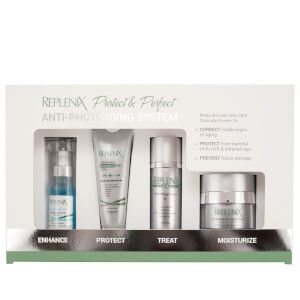
Replenix Anti-Photoageing System
Works for
3 of 4 advertised claims delivered
Sun protectionSPF 50 · 1 UV filter · Broad spectrumWeak protectionLow zinc dose
This product uses a single UV filter (zinc oxide) in a relatively low concentration and might not be able to provide a reliable sun protection.
This product can be considered "reef safe" because it does not contain the UV filters (oxybenzone and octinoxate) that can be harmful to coral reefs when present in the water in high concentrations.
Anti-oxidation13 ingredients credited for this claimStrong support
This product contains antioxidants (glutathione, resveratrol, retinol, ubiquinone) that can help neutralize free radicals in skin. By doing so, they can lessen the damage the skin gets from the UV light (sun).
The following ingredients - camellia sinensis extract, emblica officinalis fruit extract also can have an antioxidant effect, but there is less evidence to confirm their effectiveness in skin.
Moisturizing32 ingredients credited for this claimStrong support
“Awaken to younger, hydrated, healthier looking skin.”
This product can help improve hydration of the skin with the two types of ingredients.
The first type is called “humectants”:
these ingredients help attract water.
When humectants are on the surface of the skin, they “pull in” the moisture from the outside environment, or from
within deeper layers of the skin. The following ingredients in this product do the job:
copper pca, cyclomethicone.
This product also contains ingredients called “occlusives”. They help reduce the speed with which our skin loses moisture to the outside environment. These ingredients also help soften the upper layer of the skin, so it feels less tight and nicer to the touch. The following ingredients in this product do the job: squalane, cholesterol.
The following ingredients in this product are especially good for supporting the skin barrier and helping with the hydration level: ceramide 2, ceramide ap, ceramide eop, ceramide np, phytosphingosine, tetrapeptide-21
Anti-aging10 ingredients credited for this claimStrong support
“The appearance of fine lines is minimised.”
This product can help reduce and prevent fine lines and wrinkles, improve skin elasticity and firmness because it contains retinol.
These ingredients in the product can also be helpful, even though there is less evidence for their effectiveness: palmitoyl tripeptide-28, resveratrol, tetrapeptide-21.
Keep in mind that it typically takes at least 6 weeks to notice any results because the changes that are needed to improve fine lines and elasticity happen in the deeper layers of the skin. No topical anti-aging product can “erase” wrinkles or fully reverse signs of aging.
Evens skin toneNot advertised by the brand · 6 ingredients credited for this claimStrong support
This product can help reduce hypepigmentation and even out the skin tone because it contains the following effective ingredients: retinol.
In addition, this product contains glutathione. This ingredient (ingredients) might help reduce hyperpigmentation, but the effect, if any, is likely to be small.
The following ingredient (ingredients) in this product might be helpful, but there is no evidence to confirm that it actually can help even out the skin tone: emblica officinalis fruit extract, resveratrol.
Keep in mind that you would need to apply any topical skincare targetted at hypigmentation consistently for a couple of months to get a result. No topical skincare product can help get rid of hyperpigmentation (including post-acne marks and age spots) instantly.
This product can also help with skin tone because it offers sun protection. Sun damage is the main factor causing age spots, darkening of post-acne marks and other discolorations. This is why sun protection is the best strategy for maintaining an even skin tone. We, however, do not recommend using this product as a sunscreen because the protection it offers is not strong enough).
ExfoliationNot advertised by the brand · 2 ingredients credited for this claimStrong support
This product can help exfoliate the skin. In other words, it helps break down the bonds between dead cells on the surface of the skin and speed up the skin turnover. Skin often appears softer and brighter after exfoliation, but overdoing it can result in disrupted skin barrier. The following ingredient is doing the exfoliating job in this product: retinol.
Anti-blemishNot advertised by the brand · 4 ingredients credited for this claimStrong support
This product can help reduce breakouts and clogged pores because it contains the following ingredient: retinol. This ingredient is used for treating acne and can have a noticeable effect.
The following ingredient (ingredients) in this product might be helpful, but there is no evidence to confirm that it actually works: zinc pca
Can it cause trouble?
Irritancy3 strong irritants: Retinyl palmitate, Retinol + 1 more — patch-test recommendedHigh risk
Comedogenic2 ingredients rated 2 or more on the 0–5 pore-clogging scale2 flagged


User reviews
Be the first — your take helps the next person decide.
Ingredients
Filter by role to see what each ingredient is doing.
Water~45–55%
Glycerin~4.3–5.2%
- Irritation risk
- Low
One of the best moisturizing ingredients. Naturally present in skin. It attracts water to the upper layer of the skin working as a humectant
More about GlycerinSodium pca~3.9–4.8%
- Irritation risk
- Low
Naturally present in skin and helps to attract water to its upper layer
More about Sodium pcaSodium hyaluronate~3–3.6%
- Irritation risk
- Low
One of the best moisturizing ingredients. Attracts water into the upper layer of the skin
More about Sodium hyaluronateHydrolyzed sodium hyaluronate~2.2–2.7%
- Irritation risk
- Low
Attracts water into the upper layer of the skin
More about Hydrolyzed sodium hyaluronateCamellia sinensis extract~1.8–2.1%
- Irritation risk
- Low
Tea extract. Might be helpful in neutralizing free radicals in skin
More about Camellia sinensis extractPalmitoyl tripeptide-28~1.5–1.9%
Ergothioneine~1.3–1.6%
- Irritation risk
- Low
Can help neutralize free radicals in skin. Preliminary studies show that it can be more effective than coenzyme Q10 but studies on effective concentration for topical applications are lacking
More about ErgothioneineGlutathione~1.1–1.4%
- Irritation risk
- Medium
A peptide that can help neutralize free radicals in skin and reduce melanin production resulting in skin lightening effect and reduction in hyperpigmentation. It can also help attract moisture to the upper layer of the skin
More about GlutathioneZinc pca~0.95–1.15%
- Irritation risk
- Low
A compound that combines zinc with a hydrating ingredient PCA. Might to be helpful against acne and clogged pores. Can help calm down inflammation in skin. Could be helpful in reducing the formation of free radicals in skin. Might help to reduce fine lines in wrinkles, but solid evidence is missing
More about Zinc pcaCopper pca~0.65–0.95%
- Irritation risk
- Low
Helps attract water to the upper layer of the skin
More about Copper pcaPhenoxyethanol~0.55–0.8%
- Irritation risk
- Low
A preservative. It helps prevent bacterial growth in cosmetic products
More about PhenoxyethanolDisodium edta~0.5–0.7%
Zinc oxide13.75%
- Irritation risk
- Low
A broad spectrum sunblock (protects from both UVA and UVB rays). Is suitable for most sensitive skins. In small concentrations, can be used as a colorant
More about Zinc oxideAcrylates crosspolymer-4~0.45–0.7%
Ascorbic acid~0.4–0.6%
- Irritation risk
- High
The most well-researched antioxidant that works in skin. Helps neutralize free radicals supporting collagen production, helping to even out the skin tone and preventing early signs of aging
More about Ascorbic acidAscorbyl palmitate~0.4–0.6%
- Irritation risk
- Medium
Being a lipid soluble form of vitamin C, it is more stable and can penetrate the skin better than L-Ascorbic acid. It is effective in protecting the skin from free radicals, as well as evening the skin tone, but is less effective in stimulating collagen production compared to L-Ascorbic acid.
More about Ascorbyl palmitateBiotin~0.35–0.65%
- Irritation risk
- Low
Might have some moisturising properties. Is not effective when applied topically beyond some moisturizing effect
More about BiotinCamellia sinensis polyphenols~0.4–0.65%
- Irritation risk
- Low
Cetearyl alcohol~0.35–0.65%
- Irritation risk
- Low
- Comedogenicity
- 2/5
A non-drying alcohol. Works as an emollient. Helps water and oil mix together and creates a nice product texture
More about Cetearyl alcoholCeteth-10 phosphate~0.4–0.6%
Cetyl peg/ppg-10/1 dimethicone~0.25–0.5%
- Irritation risk
- Low
A type of silicone that helps water and oil mix together. Can help to soften upper layer of the skin
More about Cetyl peg/ppg-10/1 dimethiconeCyclopentasiloxane~0.3–0.55%
- Irritation risk
- Low
A silicone that helps improve the product texture and spreadability. Can absorb oil creating a short-term mattifying effect on the skin
More about CyclopentasiloxaneDicetyl phosphate~0.25–0.5%
Disodium edta~0.25–0.45%
Emblica officinalis fruit extract~0.25–0.45%
- Irritation risk
- Medium
A plant extract that might be helping in neutralizing free radicals in skin. It could help reduce hyperpigmentation. There is some research to confirm its effectiveness in skin
More about Emblica officinalis fruit extractGlyceryl isostearate~0.3–0.55%
Lauryl peg/ppg-18/18 methicone~0.25–0.45%
- Irritation risk
- Medium
Helps oil and water mix together. It might be irritating for some people
More about Lauryl peg/ppg-18/18 methiconeNeopentyl glycol diheptanoate~0.25–0.5%
- Irritation risk
- Low
Helps soften the upper layer of the skin and create a nice product consistency
More about Neopentyl glycol diheptanoatePhenoxyethanol~0.25–0.5%
- Irritation risk
- Low
A preservative. It helps prevent bacterial growth in cosmetic products
More about PhenoxyethanolPhospholipids~0.25–0.45%
- Irritation risk
- Low
Emollients that are naturaly present in skin. In addition, they help water and oil mix together in the product
More about PhospholipidsPolyhydroxystearic acid~0.3–0.5%
- Irritation risk
- Medium
Used to create a thicker product consistency and stabilize the formulation
More about Polyhydroxystearic acidPotassium cetyl phosphate~0.3–0.5%
- Irritation risk
- Medium
Helps oil and water mix together
More about Potassium cetyl phosphatePotassium hydroxide~0.25–0.5%
Water~0.25–0.45%
Retinyl palmitate~0.2–0.4%
- Irritation risk
- High
Three steps removed from the active form of vitamin A - retinoic acid. To have an effect in the skin, it first needs to be converted twice to become the retinoic acid. This means it is less potent than retinol, but could also be less irritating. Once converted to the retinoic acid in the skin, it helps against all signs of aging, improves skin cell turnover and helps fight blemishes and clogged pores. However, in many cosmetic formulations, it is used in a concentration that is too low to have the full effect
More about Retinyl palmitateResveratrol~0.25–0.5%
- Irritation risk
- Medium
Helps neutralize free radicals in skin and might help reduce fine lines and wrinkles, as well as even out the skin tone
More about ResveratrolTocopheryl acetate~0.25–0.5%
- Irritation risk
- Medium
A more stable but less bio-available form of vitamin E compared to Tocopherol. Might help moisturize and protect the skin from free radicals, but mostly used in low concentrations to stabilize other ingredients.
More about Tocopheryl acetateUbiquinone~0.25–0.45%
- Irritation risk
- Low
Coenzyme Q10. It helps neutralize free radicals in skin, improves skin hydration and might be helpful agains fine lines and wrinkles. It can be an allergen
More about UbiquinoneXanthan gum~0.25–0.5%
- Irritation risk
- Low
Used to create a thicker product consistency
More about Xanthan gumCyclopentasiloxane~0.3–0.55%
- Irritation risk
- Low
A silicone that helps improve the product texture and spreadability. Can absorb oil creating a short-term mattifying effect on the skin
More about CyclopentasiloxaneDimethicone crosspolymer~0.25–0.45%
- Irritation risk
- Low
Used to create a thicker product texture. Helps soften the upper layer of the skin and might be able to prevent moisture loss from its surface
More about Dimethicone crosspolymerCyclomethicone~0.3–0.5%
- Irritation risk
- Low
A type of silicone that leaves a nice silky finish on the skin and can help soften its upper layer
More about CyclomethiconePeg/ppg-18/18 dimethicone~0.3–0.5%
- Irritation risk
- Low
A silicone that mixes with water creating nice light-weight product texture
More about Peg/ppg-18/18 dimethiconeCaffeine~0.25–0.45%
- Irritation risk
- Medium
Might be helpful in neutralizing free radicals. Can have a dehydration effect that might somewhat decrease the look of puffy eyes
More about CaffeineCamellia sinensis polyphenols~0.25–0.45%
- Irritation risk
- Low
Retinol~0.2–0.4%
- Irritation risk
- High
Two steps removed from the active form of vitamin A - retinoic acid. Once converted to the retinoic acid in the skin, retinol is proven to be effective against all signs of aging. It improves skin cell turnover, helps fight blemishes and clogged pores, can regulate excess oil production and even skin tone. It can, however, be quite irritating
More about RetinolPolysorbate 20~0.3–0.5%
Water~0.25–0.45%
Hyaluronic acid~0.25–0.45%
- Irritation risk
- Low
One of the best moisturizing ingredients. Attracts water into the upper layer of the skin. Naturally present in skin. Typically has large molecule size unless advertised otherwise on the product label. Helps support skin's barrier function and may help to reduce inflammation
More about Hyaluronic acidWater~0.25–0.45%
Cyclopentasiloxane~0.3–0.55%
- Irritation risk
- Low
A silicone that helps improve the product texture and spreadability. Can absorb oil creating a short-term mattifying effect on the skin
More about CyclopentasiloxaneSodium pca~0.25–0.45%
- Irritation risk
- Low
Naturally present in skin and helps to attract water to its upper layer
More about Sodium pcaGlycerin~0.3–0.55%
- Irritation risk
- Low
One of the best moisturizing ingredients. Naturally present in skin. It attracts water to the upper layer of the skin working as a humectant
More about GlycerinCaprylic/capric triglyceride~0.3–0.55%
- Irritation risk
- Medium
A good mix of fatty acids that forms a protective layer on the skin. Improves the shelf life of products. Derived from coconut and glycerin
More about Caprylic/capric triglyceridePolysorbate 60~0.3–0.5%
Cetearyl alcohol~0.3–0.55%
- Irritation risk
- Low
- Comedogenicity
- 2/5
A non-drying alcohol. Works as an emollient. Helps water and oil mix together and creates a nice product texture
More about Cetearyl alcoholYucca glauca root extract~0.25–0.45%
- Irritation risk
- Low
Polyacrylamide~0.3–0.5%
- Irritation risk
- Medium
Used to improve product texture and help oil and water mix together
More about PolyacrylamideC13-14 isoparaffin~0.3–0.55%
- Irritation risk
- Low
Helps soften the upper layer of the skin, dissolve other ingredients and create a thicker product consistency
More about C13-14 isoparaffinLaureth-7~0.25–0.5%
Ceramide np~0.3–0.55%
- Irritation risk
- Low
A type of lipid similar to ceramides naturally present in skin. Helps to soften the upper layer of the skin and supports the skin barrier function to keep it hydrated. Can help to prevent inflammation in skin
More about Ceramide npCeramide ap~0.25–0.45%
- Irritation risk
- Low
A type of lipid similar to ceramides naturally present in skin. Helps to soften the upper layer of the skin and supports the skin barrier function to keep it hydrated. Can help to prevent inflammation in skin
More about Ceramide apCeramide eop~0.25–0.5%
- Irritation risk
- Low
A type of lipid similar to ceramides naturally present in skin. Helps to soften the upper layer of the skin and supports the skin barrier function to keep it hydrated. Can help to prevent inflammation in skin
More about Ceramide eopSodium hyaluronate~0.25–0.45%
- Irritation risk
- Low
One of the best moisturizing ingredients. Attracts water into the upper layer of the skin
More about Sodium hyaluronatePhytosphingosine~0.3–0.55%
- Irritation risk
- Low
A type of lipid that is naturally present in skin. It might help in repairing skin barrier function and has anti-bacterial effect
More about PhytosphingosineCholesterol~0.3–0.55%
- Irritation risk
- Low
An emollient that is naturally found in skin
More about CholesterolSodium lauroyl lactylate~0.25–0.5%
- Irritation risk
- Medium
Helps water and oil mix together
More about Sodium lauroyl lactylateCamellia sinensis polyphenols~0.25–0.45%
- Irritation risk
- Low
Malus domestica fruit cell culture extract~0.25–0.45%
- Irritation risk
- Low
Squalane~0.3–0.55%
- Irritation risk
- Low
An oil naturally present in skin. Works as an emollient to soften the skin and form a protective layer on its surface without a greasy feeling.
More about SqualaneCeramide 2~0.25–0.5%
- Irritation risk
- Low
A type of lipid similar to ceramides naturally present in skin. Helps to soften the upper layer of the skin and supports the skin barrier function to keep it hydrated. Can help to prevent inflammation in skin
More about Ceramide 2Tetrapeptide-21~0.25–0.45%
- Irritation risk
- Low
A type of peptide. Peptides are excellent moisturizers and might be able support collagen production reducing fine lines and wrinkles
More about Tetrapeptide-21Resveratrol~0.25–0.5%
- Irritation risk
- Medium
Helps neutralize free radicals in skin and might help reduce fine lines and wrinkles, as well as even out the skin tone
More about ResveratrolBisabolol~0.25–0.4%
- Irritation risk
- Low
An active component of chamomile plant that historically has been used to calm down irritated skin. A recent study shows that bisabolol indeed can have some anti-inflammatory effect on skin, even though conclusive data is lacking. Bisabolol has a sweet floral scent and can be added to products for its aromatic properties
More about BisabololCaffeine~0.25–0.45%
- Irritation risk
- Medium
Might be helpful in neutralizing free radicals. Can have a dehydration effect that might somewhat decrease the look of puffy eyes
More about CaffeineLecithin~0.25–0.5%
- Irritation risk
- Low
Used mostly for creating emulsions - helping oil and water mix together. Helps soften the upper layer of the skin
More about LecithinGlyceryl stearate~0.25–0.5%
- Irritation risk
- Low
An emollient that softens the skin and forms a protective layer on its surface. Helps water and oil mix together
More about Glyceryl stearatePeg-100 stearate~0.3–0.55%
- Irritation risk
- Low
Helps oil and water mix togehter and creates a nice product texture
More about Peg-100 stearateDimethicone crosspolymer~0.2–0.35%
- Irritation risk
- Low
Used to create a thicker product texture. Helps soften the upper layer of the skin and might be able to prevent moisture loss from its surface
More about Dimethicone crosspolymerCarbomer~0.2–0.35%
- Irritation risk
- Low
Helps create a thicker or gel-like product texture. It is not a surfactant but can be used in gentle cleansing formulations
More about CarbomerXanthan gum~0.15–0.3%
- Irritation risk
- Low
Used to create a thicker product consistency
More about Xanthan gumPhenoxyethanol~0.1–0.2%
- Irritation risk
- Low
A preservative. It helps prevent bacterial growth in cosmetic products
More about PhenoxyethanolSorbic acid~0.15–0.25%
Caprylyl glycol~0.15–0.3%
- Irritation risk
- Medium
Helps preserve products and creates a nice product texture
More about Caprylyl glycolDisodium edta~0.05%
Parfum~0.05–0.1%
- Irritation risk
- High
An aromatic blend of unspecified and possibly irritating ingredients
More about ParfumIngredient list view
Water, Glycerin, Sodium pca, Sodium hyaluronate, Hydrolyzed sodium hyaluronate, Camellia sinensis extract, Palmitoyl tripeptide-28, Ergothioneine, Glutathione, Zinc pca, Copper pca, Phenoxyethanol, Disodium edta, Zinc oxide, Acrylates crosspolymer-4, Ascorbic acid, Ascorbyl palmitate, Biotin, Camellia sinensis polyphenols, Cetearyl alcohol, Ceteth-10 phosphate, Cetyl peg/ppg-10/1 dimethicone, Cyclopentasiloxane, Dicetyl phosphate, Disodium edta, Emblica officinalis fruit extract, Glyceryl isostearate, Lauryl peg/ppg-18/18 methicone, Neopentyl glycol diheptanoate, Phenoxyethanol, Phospholipids, Polyhydroxystearic acid, Potassium cetyl phosphate, Potassium hydroxide, Water, Retinyl palmitate, Resveratrol, Tocopheryl acetate, Ubiquinone, Xanthan gum, Cyclopentasiloxane, Dimethicone crosspolymer, Cyclomethicone, Peg/ppg-18/18 dimethicone, Caffeine, Camellia sinensis polyphenols, Retinol, Polysorbate 20, Water, Hyaluronic acid, Water, Cyclopentasiloxane, Sodium pca, Glycerin, Caprylic/capric triglyceride, Polysorbate 60, Cetearyl alcohol, Yucca glauca root extract, Unknown, Polyacrylamide, C13-14 isoparaffin, Laureth-7, Ceramide np, Ceramide ap, Ceramide eop, Sodium hyaluronate, Phytosphingosine, Cholesterol, Sodium lauroyl lactylate, Camellia sinensis polyphenols, Malus domestica fruit cell culture extract, Squalane, Ceramide 2, Tetrapeptide-21, Resveratrol, Bisabolol, Caffeine, Lecithin, Glyceryl stearate, Peg-100 stearate, Dimethicone crosspolymer, Carbomer, Xanthan gum, Phenoxyethanol, Sorbic acid, Caprylyl glycol, Disodium edta, Parfum
Compare prices
Retailers ranked by price — lowest first.

Worth comparing, line by line.
Match % combines shared ingredients, the first five ingredients, shared actives and hero ingredients, irritancy (lower counts in the alternative's favour), texture and body area. Only products in the same routine step are compared.
| ReplenixAnti-Photoageing SystemYOUR PRODUCT | CeraVeSkin Renewing Day Cream SPF 30 | Rohto Mentholatum50 Megumi Anti-UV Cream SPF 50+ PA++++ | ExuvianceAge Reverse Day Repair SPF 30 | |
|---|---|---|---|---|
| Match | — | 65% | 60% | 58% |
| Price | $286.50 | $15.22−$271.28 | $19.53−$266.97 | $21.00−$265.50 |
| Shared key ingredients | — | 11 of 31 | 8 of 31 | 3 of 31 |
| Key difference | — | Phenyl Trimethicone | Petrolatum | Acetyl Glucosamine |
| Irritancy | High | Medium | High | Medium |
| SPF | SPF 50 | SPF 30 | SPF 50 | SPF 30 |
| Drying alcohol | — | Contains drying alcohol | Contains drying alcohol | — |
| View product | Shop | Shop | Shop |

Product summary
"Replenix - Anti-Photoageing System" uses a single UV filter (zinc oxide) in a relatively low concentration and might not be able to provide reliable sun protection.
It also works as a moisturizer, so you do not have to use an additional hydrating product. This product prevents early signs of aging by protecting against sun damage (all broad spectrum sunscreens do that).
Sunscreen filters
This product is a mineral sunscreen. It uses zinc oxide for sun protection. Zinc oxide almost never irritates the skin or stings eyes, but it can leave a white cast.
Irritation risk
This sunscreen contains some common irritants, including those without a benefit for the skin. We assess the overall irritancy of this product to be medium. For a detailed overview of all potential irritants: click here
You can see the detailed formula review with the breakdown of all actives in the product and the full ingredient list with estimated concentrations in the tables below.
Price
The product retails from 286.50$ up to 293.50$ in the United States.
For a detailed price comparison: click here.
Sources cited in this review
Every concentration estimate and effectiveness label is anchored to one of these 33 studies and safety reviews.
- 1
- 2Hyaluronic acid: A key molecule in skin agingncbi.nlm.nih.gov
- 3
- 4A comparison of the relative antioxidant potency of L‐ergothioneine and idebenoneonlinelibrary.wiley.com
- 5
- 6

Affiliate links · As an Amazon Associate, WIMJ earns from qualifying purchases.