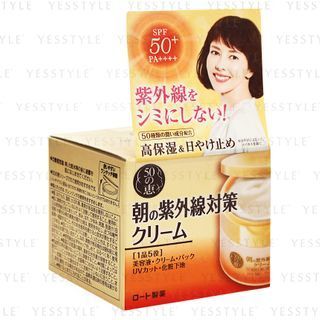
Rohto Mentholatum 50 Megumi Anti-UV Cream SPF 50+ PA++++
Works for
2 of 2 advertised claims delivered
Sun protectionSPF 50 · 3 UV filtersBroad spectrum
This product offers a good level of protection against both UVB and UVA rays.
This sunscreen uses organic (so-called "chemical") sunscreen filters. Organic, or "chemical" filters usually provide reliable sun protection and rarely leave a white cast. Sunscreens with organic filters can sting eyes.
Anti-aging10 ingredients credited for this claimStrong evidence
“50 Megumi Anti-UV Cream SPF 50+ PA++++”
This product can help reduce and prevent fine lines and wrinkles, improve skin elasticity and firmness because it contains retinol.
These ingredients in the product can also be helpful, even though there is less evidence for their effectiveness: lysine, serine, threonine.
Keep in mind that it typically takes at least 6 weeks to notice any results because the changes that are needed to improve fine lines and elasticity happen in the deeper layers of the skin. No topical anti-aging product can “erase” wrinkles or fully reverse signs of aging.
This product can also help prevent early signs of skin aging because it offers a good level of broad spectrum sun protection. Sun damage is the main cause of premature skin aging, and protecting your skin from the sun is the best anti-aging strategy.
Anti-oxidationNot advertised by the brand · 13 ingredients credited for this claimStrong evidence
This product contains antioxidants (retinol, ubiquinone) that can help neutralize free radicals in skin. By doing so, they can lessen the damage the skin gets from the UV light (sun).
Anti-blemishNot advertised by the brand · 1 ingredient credited for this claimStrong evidence
This product can help reduce breakouts and clogged pores because it contains the following ingredient: retinol. This ingredient is used for treating acne and can have a noticeable effect.
ExfoliationNot advertised by the brand · 1 ingredient credited for this claimStrong evidence
This product can help exfoliate the skin. In other words, it helps break down the bonds between dead cells on the surface of the skin and speed up the skin turnover. Skin often appears softer and brighter after exfoliation, but overdoing it can result in disrupted skin barrier. The following ingredient is doing the exfoliating job in this product: retinol.
Evens skin toneNot advertised by the brand · 6 ingredients credited for this claimStrong evidence
This product can help reduce hypepigmentation and even out the skin tone because it contains the following effective ingredients: retinol.
The following ingredient (ingredients) in this product might be helpful, but there is no evidence to confirm that it actually can help even out the skin tone: alanine, glycine soja protein, glycine soja seed extract.
Keep in mind that you would need to apply any topical skincare targetted at hypigmentation consistently for a couple of months to get a result. No topical skincare product can help get rid of hyperpigmentation (including post-acne marks and age spots) instantly.
This product offers broad spectrum sun protection. It means that it can prevent hyperpigmentation and help keep the skin tone even (sun damage is the main factor causing age spots, darkening of post-acne marks and other discolorations).
MoisturizingNot advertised by the brand · 38 ingredients credited for this claimGood evidence
This product can help improve hydration of the skin with the two types of ingredients.
The first type is called “humectants”:
these ingredients help attract water.
When humectants are on the surface of the skin, they “pull in” the moisture from the outside environment, or from
within deeper layers of the skin. The following ingredients in this product do the job:
alanine, arginine.
This product also contains ingredients called “occlusives”. They help reduce the speed with which our skin loses moisture to the outside environment. These ingredients also help soften the upper layer of the skin, so it feels less tight and nicer to the touch. The following ingredients in this product do the job: arginine, helianthus annuus seed oil.
Can it cause trouble?
Irritancy3 strong irritants: Sorbitan sesquioleate, Rosa damascena extract + 1 more — patch-test recommendedHigh risk
ComedogenicClean of flagged comedogenic ingredientsNone flagged


User reviews
Be the first — your take helps the next person decide.
Ingredients
Filter by role to see what each ingredient is doing.
Water~45–55%
Cyclopentasiloxane~5.9–7.3%
- Irritation risk
- Low
A silicone that helps improve the product texture and spreadability. Can absorb oil creating a short-term mattifying effect on the skin
More about CyclopentasiloxaneButylene glycol~4.2–5.2%
- Irritation risk
- Low
Used to create a nice product texture and help delivery of other ingredients. Might be somewhat helpful in attracting water to the upper layer of the skin
More about Butylene glycolZinc oxide~3.9–4.8%
- Irritation risk
- Low
A broad spectrum sunblock (protects from both UVA and UVB rays). Is suitable for most sensitive skins. In small concentrations, can be used as a colorant
More about Zinc oxideEthylhexyl methoxycinnamate~3.2–3.9%
- Irritation risk
- High
Octinoxate. When used in higher concentrations, works as a sunscreen protecting the skin from UVB rays. When used in lower concentration, helps to preserve the product formulation. Is shown to be harmful to coral reefs - consider avoiding bathing in coral reef areas when wearing a product with this ingredient. It can be irritating
More about Ethylhexyl methoxycinnamateTriethylhexyl trimellitate~2–2.4%
- Irritation risk
- Low
Glycerin~1.7–2.1%
- Irritation risk
- Low
One of the best moisturizing ingredients. Naturally present in skin. It attracts water to the upper layer of the skin working as a humectant
More about GlycerinPolymethylsilsesquioxane~1.4–1.8%
- Irritation risk
- Low
A silicone that improves product texture and helps dissolve other ingredients. Can form a non-greasy film on the skin to prevent moisture loss
More about PolymethylsilsesquioxaneDisteardimonium hectorite~1.1–1.4%
- Irritation risk
- Low
A type of clay that is used to thicken the product consistency
More about Disteardimonium hectoriteDiphenylsiloxy phenyl trimethicone~0.95–1.15%
- Irritation risk
- Low
Help improve the product's texture
More about Diphenylsiloxy phenyl trimethiconeLauryl peg-9 polydimethylsiloxyethyl dimethicone~0.7–1.05%
- Irritation risk
- Low
A type of silicone that helps to soften upper layer of the skin and create a nice product texture
More about Lauryl peg-9 polydimethylsiloxyethyl dimethiconePeg-9 polydimethylsiloxyethyl dimethicone~0.6–0.9%
- Irritation risk
- Medium
A type of silicone that helps water and oil mix together
More about Peg-9 polydimethylsiloxyethyl dimethiconeSqualane~0.55–0.85%
- Irritation risk
- Low
An oil naturally present in skin. Works as an emollient to soften the skin and form a protective layer on its surface without a greasy feeling.
More about SqualaneSorbitan sesquioleate~0.5–0.75%
- Irritation risk
- High
Used to help oil and water mix together. Can be irritating
More about Sorbitan sesquioleateDiethylamino hydroxybenzoyl hexyl benzoate~0.6–0.9%
- Irritation risk
- Medium
Uvinul A Plus. A new generation broad spectrum sunscreen that offers an effective protection especially in the UVA range. It is stable in formulations. Unfortunately, is not approved by the FDA (US) yet
More about Diethylamino hydroxybenzoyl hexyl benzoateHydrolyzed collagen~0.5–0.7%
- Irritation risk
- Low
A typically plant-derived compound that is supposed mimic human collagen. Cannot penetrate the skin barrier so is not particularly useful in skincare products beyond attracting water to the upper layer of the skin
More about Hydrolyzed collagenSoluble collagen~0.45–0.65%
- Irritation risk
- Low
A typically plant-derived compound that is supposed mimic human collagen. Cannot penetrate the skin barrier so is not particularly useful in skincare products beyond attracting water to the upper layer of the skin
More about Soluble collagenSuccinoyl atelocollagen~0.35–0.6%
- Irritation risk
- Low
Sodium hyaluronate~0.3–0.6%
- Irritation risk
- Low
One of the best moisturizing ingredients. Attracts water into the upper layer of the skin
More about Sodium hyaluronateUbiquinone~0.3–0.6%
- Irritation risk
- Low
Coenzyme Q10. It helps neutralize free radicals in skin, improves skin hydration and might be helpful agains fine lines and wrinkles. It can be an allergen
More about UbiquinoneHydrolyzed hyaluronic acid~0.3–0.55%
- Irritation risk
- Low
One of the best moisturizing ingredients. Attracts water into the upper layer of the skin. A version of it is naturally present in skin
More about Hydrolyzed hyaluronic acidGlycine soja protein~0.3–0.6%
- Irritation risk
- Low
A plant extract that helps to attract water to the upper layer of the skin and soften it. It might be helpful in neutralizing free radicals. It might be somewhat helpful for evening out the skin tone. It might be able to support elastin production but solid research is lacking
More about Glycine soja proteinMortierella oil~0.25–0.5%
- Irritation risk
- Low
Helianthus annuus seed oil~0.3–0.55%
- Irritation risk
- Low
A great emollient due to its high linoleic acid content. One of the most effective plant oils in helping skin hydration and repairing skin barrier function
More about Helianthus annuus seed oilPetrolatum~0.3–0.55%
- Irritation risk
- Low
One of the most effective and the most studied occlusive ingredients that creates a protective layer on top of the skin preventing moisture loss
More about PetrolatumHoney~0.25–0.5%
- Irritation risk
- Low
Helps attract water to the skin and might have some anti-bacterial properties. Can be an allergen
More about HoneyRoyal jelly~0.3–0.5%
- Irritation risk
- High
Helps attract water to the upper layer of the skin
More about Royal jellyYeast extract~0.3–0.5%
- Irritation risk
- Low
Helps attract water to the upper layer of the skin and might have some anti-oxidant and skin lightening properties. It can help calm down inflammation in skin
More about Yeast extractHoney extract~0.25–0.5%
- Irritation risk
- Medium
Helps attract water to the upper layer of the skin
More about Honey extractBeta vulgaris root extract~0.25–0.5%
- Irritation risk
- Medium
A plant extract that might have some antioxidant properties, but mostly used in cosmetics for its color
More about Beta vulgaris root extractRosa damascena extract~0.3–0.5%
- Irritation risk
- High
Oil of a very fragrant pink rose used as fragrance in cosmetics. Extensive research has shown it has mixed benefits. In the pro column, inhaling this flower’s scent seems to have relaxing properties and the plant’s petals contain skin-soothing and antioxidant compounds that can benefit skin. On the flipside, the numerous chemicals that create this rose’s distinctive fragrance pose a risk of causing skin aggravation.
More about Rosa damascena extractScutellaria alpina flower/leaf/stem extract~0.25–0.5%
- Irritation risk
- Low
Rosa damascena extract~0.3–0.5%
- Irritation risk
- High
Oil of a very fragrant pink rose used as fragrance in cosmetics. Extensive research has shown it has mixed benefits. In the pro column, inhaling this flower’s scent seems to have relaxing properties and the plant’s petals contain skin-soothing and antioxidant compounds that can benefit skin. On the flipside, the numerous chemicals that create this rose’s distinctive fragrance pose a risk of causing skin aggravation.
More about Rosa damascena extractPropolis extract~0.3–0.55%
- Irritation risk
- High
A complex substance produced by honey bees. Can have anti-bacterial and some anti-oxidant effect. Is an allergen and can be irritating
More about Propolis extractRosa damascena extract~0.3–0.55%
- Irritation risk
- High
Oil of a very fragrant pink rose used as fragrance in cosmetics. Extensive research has shown it has mixed benefits. In the pro column, inhaling this flower’s scent seems to have relaxing properties and the plant’s petals contain skin-soothing and antioxidant compounds that can benefit skin. On the flipside, the numerous chemicals that create this rose’s distinctive fragrance pose a risk of causing skin aggravation.
More about Rosa damascena extractMel~0.3–0.6%
- Irritation risk
- Low
Helps to soften the upper layer of the skin and attract water to it
More about MelLac~0.3–0.5%
- Irritation risk
- Low
Helps form a film on the surface of the skin and disperse other ingredients (like colorants) in cosmetics. Lac is a resinous substance secreted by parasite insects living on trees
More about LacPanax ginseng root extract~0.35–0.6%
- Irritation risk
- High
A plant extract that might have some anti-inflammatory properties, but solid evidence is lacking. It can be irritating
More about Panax ginseng root extractRose extract~0.3–0.5%
Glycine soja seed extract~0.35–0.6%
- Irritation risk
- Medium
An emollient that helps soften the skin. Might be somewhat helpful in evening the skin tone.
More about Glycine soja seed extractVaccinium myrtillus leaf extract~0.3–0.5%
- Irritation risk
- Low
Chalk~0.45–0.7%
- Irritation risk
- Low
Rosa damascena extract~0.3–0.55%
- Irritation risk
- High
Oil of a very fragrant pink rose used as fragrance in cosmetics. Extensive research has shown it has mixed benefits. In the pro column, inhaling this flower’s scent seems to have relaxing properties and the plant’s petals contain skin-soothing and antioxidant compounds that can benefit skin. On the flipside, the numerous chemicals that create this rose’s distinctive fragrance pose a risk of causing skin aggravation.
More about Rosa damascena extractElaeis guineensis oil~0.35–0.6%
- Irritation risk
- Low
Helps soften the upper layer of the skin
More about Elaeis guineensis oilGlucose~0.3–0.55%
- Irritation risk
- Low
Helps attract water to the upper layer of the skin. Could be helpful in restoring the skin barrier function
More about GlucoseHydrolyzed silk~0.3–0.55%
- Irritation risk
- Medium
Can help attract water to the upper layer of the skin
More about Hydrolyzed silkAlanine~0.3–0.5%
- Irritation risk
- Low
An amino-acid that helps to attract water to the upper layer of the skin and might help to lighten the skin, but solid evidence is lacking
More about AlanineArginine~0.25–0.5%
- Irritation risk
- Low
An amino acid that is naturally present in skin and helps keep it hydrated. When used together with AHAs, it can reduce their irritating effect on the skin
More about ArginineLysine~0.3–0.5%
- Irritation risk
- Low
An amino-acid that helps to attract water to the upper layer of the skin. In combination with other amino-acids, might help to reduce fine lines and wrinkles
More about LysineSerine~0.3–0.5%
- Irritation risk
- Low
An amino-acid that helps to attract water to the upper layer of the skin. In combination with other amino-acids, might help to reduce fine lines and wrinkles
More about SerineGlycine~0.3–0.5%
- Irritation risk
- Low
Helps to attract water to the upper layer of the skin and can help restore the skin barrier function
More about GlycineGlutamic acid~0.3–0.55%
- Irritation risk
- Low
An amino-acid that helps attract water to the upper layer of the skin
More about Glutamic acidThreonine~0.3–0.55%
- Irritation risk
- Low
An amino-acid that helps to attract water to the upper layer of the skin. In combination with other amino-acids, might help to reduce fine lines and wrinkles
More about ThreonineProline~0.3–0.55%
Glucosyl hesperidin~0.3–0.5%
- Irritation risk
- Low
Might be able to neutralize free radicals in skin. Also works as a humectant
More about Glucosyl hesperidinTocopherol~0.3–0.55%
- Irritation risk
- Low
Pure form of vitamin E. Can help moisturise and protect the skin from free radicals. Often used to help stabilise other ingredients or the formula itself
More about TocopherolTocopheryl nicotinate~0.3–0.55%
- Irritation risk
- Low
Tocopheryl acetate~0.3–0.55%
- Irritation risk
- Medium
A more stable but less bio-available form of vitamin E compared to Tocopherol. Might help moisturize and protect the skin from free radicals, but mostly used in low concentrations to stabilize other ingredients.
More about Tocopheryl acetateBetaine~0.3–0.5%
- Irritation risk
- Low
Helps attract water to the upper layer of the skin and improves the product texture
More about BetaineHydrogen dimethicone~0.3–0.55%
- Irritation risk
- Low
Helps the function of sunscreen and pigment ingredients in the formulation
More about Hydrogen dimethiconeMagnesium ascorbyl phosphate~0.3–0.55%
- Irritation risk
- Medium
A derivative of vitamin C that is more stable, but less bioavailable than the pure form of vitamin C. It does not penetrate the skin well, but has been shown to convert to pure vitamin C once in skin. It can be helpful in stimulating collagen production and lightening the skin tone, but the required concentration is likely to be very high
More about Magnesium ascorbyl phosphateElaeis guineensis extract~0.3–0.5%
- Irritation risk
- Low
Ascorbyl palmitate~0.25–0.5%
- Irritation risk
- Medium
Being a lipid soluble form of vitamin C, it is more stable and can penetrate the skin better than L-Ascorbic acid. It is effective in protecting the skin from free radicals, as well as evening the skin tone, but is less effective in stimulating collagen production compared to L-Ascorbic acid.
More about Ascorbyl palmitateRetinol~0.25–0.45%
- Irritation risk
- High
Two steps removed from the active form of vitamin A - retinoic acid. Once converted to the retinoic acid in the skin, retinol is proven to be effective against all signs of aging. It improves skin cell turnover, helps fight blemishes and clogged pores, can regulate excess oil production and even skin tone. It can, however, be quite irritating
More about RetinolSodium pca~0.25–0.5%
- Irritation risk
- Low
Naturally present in skin and helps to attract water to its upper layer
More about Sodium pcaSorbitol~0.2–0.4%
- Irritation risk
- Low
Helps attract water to the upper layer of the skin and improves the product texture
More about SorbitolAlcohol~0.2–0.4%
- Irritation risk
- High
Can be drying and contribute to skin irritation. Used in formulars to dissolve other ingredients, create a thinner product consistency or for its antibacterial properties
More about AlcoholDisodium edta~0.15–0.3%
Hydrated silica~0.2–0.4%
Methylparaben~0.15–0.25%
Ingredient list view
Water, Cyclopentasiloxane, Butylene glycol, Zinc oxide, Ethylhexyl methoxycinnamate, Triethylhexyl trimellitate, Glycerin, Polymethylsilsesquioxane, Disteardimonium hectorite, Diphenylsiloxy phenyl trimethicone, Lauryl peg-9 polydimethylsiloxyethyl dimethicone, Peg-9 polydimethylsiloxyethyl dimethicone, Squalane, Sorbitan sesquioleate, Diethylamino hydroxybenzoyl hexyl benzoate, Hydrolyzed collagen, Soluble collagen, Succinoyl atelocollagen, Sodium hyaluronate, Ubiquinone, Hydrolyzed hyaluronic acid, Glycine soja protein, Mortierella oil, Helianthus annuus seed oil, Petrolatum, Honey, Royal jelly, Yeast extract, Honey extract, Beta vulgaris root extract, Rosa damascena extract, Scutellaria alpina flower/leaf/stem extract, Rosa damascena extract, Propolis extract, Rosa damascena extract, Mel, Lac, Panax ginseng root extract, Rose extract, Glycine soja seed extract, Vaccinium myrtillus leaf extract, Chalk, Rosa damascena extract, Unknown, Elaeis guineensis oil, Unknown, Glucose, Hydrolyzed silk, Alanine, Arginine, Lysine, Serine, Glycine, Glutamic acid, Threonine, Proline, Glucosyl hesperidin, Tocopherol, Tocopheryl nicotinate, Tocopheryl acetate, Betaine, Hydrogen dimethicone, Magnesium ascorbyl phosphate, Elaeis guineensis extract, Ascorbyl palmitate, Retinol, Sodium pca, Sorbitol, Alcohol, Unknown, Disodium edta, Hydrated silica, Methylparaben
Compare prices
Retailers ranked by price — lowest first.

Affiliate links · prices updated regularly
Worth comparing, line by line.
Match % combines shared ingredients, the first five ingredients, shared actives and hero ingredients, irritancy (lower counts in the alternative's favour), texture and body area. Only products in the same routine step are compared.
| Rohto Mentholatum50 Megumi Anti-UV Cream SPF 50+ PA++++YOUR PRODUCT | CeraVeSkin Renewing Day Cream SPF 30 | THE PLANT BASEDailiben Innocent Sun Cream SPF50+ PA+++ | Exuviance ProfessionalTotal Correct Day SPF 30 | |
|---|---|---|---|---|
| Match | — | 71% | 71% | 67% |
| Price | $19.53 | $15.22−$4.31 | $11.30−$8.23 | $83.16+$63.63 |
| Shared key ingredients | — | 6 of 27 | 6 of 27 | 4 of 27 |
| Key difference | — | Ceramide Np | Niacinamide | Acetyl Glucosamine |
| Irritancy | High | Medium | High | Medium |
| SPF | SPF 50 | SPF 30 | SPF 50 | SPF 30 |
| Drying alcohol | Contains drying alcohol | Contains drying alcohol | — | — |
| View product | Shop | Shop | Shop |


Product summary
We believe that "Rohto Mentholatum - 50 Megumi Anti-UV Cream SPF 50+ PA++++" can provide reliable sun protection based on the ingredients listed. It can protect from both UVA and UVB rays. This is great news because not all sunscreens with SPF ratings give UVA protection. (UVA rays do not cause sunburn, but still damage our skin and lead to early aging).
Because it includes good moisturizing ingredients, it can also work as a hydrating day cream. Like all broad-spectrum sunscreens, this product helps prevent early signs of aging.
Sunscreen filters
This sunscreen uses a mixture of both mineral and organic (so-called "chemical") UV filters. Here are the organic filters this product uses: uvinul a plus and octinoxate. As for the mineral filters, this sunscreen uses zinc oxide.
Irritation risk
This product contains a bunch of common irritants, including ingredients that do not provide any known benefit for the skin. It might not be the best choice if your skin is sensitive. We assess the overall irritancy of this product to be high. For a detailed overview of all potential irritants: click here
You can see the detailed formula review with the breakdown of all actives in the product and the full ingredient list with estimated concentrations in the tables below.
Price
The product retails for 19.53$ in the United States.
For a detailed price comparison: click here.
Sources cited in this review
Every concentration estimate and effectiveness label is anchored to one of these 37 studies and safety reviews.
- 1A review of inorganic UV filters zinc oxide and titanium dioxideonlinelibrary.wiley.com
- 2
- 3
- 4
- 5
- 6

Affiliate links · As an Amazon Associate, WIMJ earns from qualifying purchases.