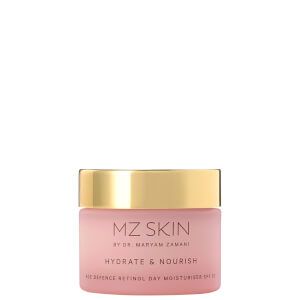
MZ Skin Hydrate & Nourish Age Defence Retinol Day Moisturiser SPF30
Works for
5 of 5 advertised claims delivered
Sun protectionSPF 30 · 4 UV filtersBroad spectrum
This product offers a good level of protection against both UVB and UVA rays.
This sunscreen uses organic (so-called "chemical") sunscreen filters. Organic, or "chemical" filters usually provide reliable sun protection and rarely leave a white cast. Sunscreens with organic filters can sting eyes.
Exfoliation1 ingredient credited for this claimStrong support
“Promoting a replenished, smoother-looking visage, MZ Skin's HYDRATE and NOURISH Age Defence Retinol Day Moisturiser SPF, is a velvety-smooth day cream that seeks to refine, resurface and protect the skin.”
This product can help exfoliate the skin. In other words, it helps break down the bonds between dead cells on the surface of the skin and speed up the skin turnover. Skin often appears softer and brighter after exfoliation, but overdoing it can result in disrupted skin barrier. The following ingredient is doing the exfoliating job in this product: retinol.
Moisturizing14 ingredients credited for this claimStrong support
“The moisturiser is also rich in hyaluronic acid that provides an instant burst of hydration while also locking in moisture for long-lasting results.”
This product can help improve hydration of the skin with the two types of ingredients.
The first type is called “humectants”:
these ingredients help attract water.
When humectants are on the surface of the skin, they “pull in” the moisture from the outside environment, or from
within deeper layers of the skin. The following ingredients in this product do the job:
glycerin, sodium hyaluronate.
This product also contains ingredients called “occlusives”. They help reduce the speed with which our skin loses moisture to the outside environment. These ingredients also help soften the upper layer of the skin, so it feels less tight and nicer to the touch. The following ingredients in this product do the job: butyrospermum parkii butter, caprylic/capric triglyceride.
The following ingredients in this product are especially good for supporting the skin barrier and helping with the hydration level: ceramide 3
Anti-aging4 ingredients credited for this claimStrong support
“It works to boost collagen production to help smooth fine lines and wrinkles, while protecting the skin against the ageing effects of UVA/UVB rays and free radicals.”
This product can help reduce and prevent fine lines and wrinkles, improve skin elasticity and firmness because it contains retinol.
Keep in mind that it typically takes at least 6 weeks to notice any results because the changes that are needed to improve fine lines and elasticity happen in the deeper layers of the skin. No topical anti-aging product can “erase” wrinkles or fully reverse signs of aging.
This product can also help prevent early signs of skin aging because it offers a good level of broad spectrum sun protection. Sun damage is the main cause of premature skin aging, and protecting your skin from the sun is the best anti-aging strategy.
Evens skin tone2 ingredients credited for this claimStrong support
“Rich in Vitamin A, C and E to protect against free radicals, boost cell renewal, correct imperfections and brighten skin tone”
This product offers broad spectrum sun protection. It means that it can prevent hyperpigmentation and help keep the skin tone even (sun damage is the main factor causing age spots, darkening of post-acne marks and other discolorations).
Anti-oxidationNot advertised by the brand · 5 ingredients credited for this claimStrong support
This product contains antioxidants (retinol) that can help neutralize free radicals in skin. By doing so, they can lessen the damage the skin gets from the UV light (sun).
Anti-blemishNot advertised by the brand · 1 ingredient credited for this claimStrong support
This product can help reduce breakouts and clogged pores because it contains the following ingredient: retinol. This ingredient is used for treating acne and can have a noticeable effect.
Can it cause trouble?
Irritancy11 strong irritants: Parfum, Retinol + 9 more — patch-test recommendedHigh risk
Comedogenic4 ingredients rated 2 or more on the 0–5 pore-clogging scale4 flagged


User reviews
Be the first — your take helps the next person decide.
Ingredients
Filter by role to see what each ingredient is doing.
Water~45–55%
Ethylhexyl methoxycinnamate~6.2–7.6%
- Irritation risk
- High
Octinoxate. When used in higher concentrations, works as a sunscreen protecting the skin from UVB rays. When used in lower concentration, helps to preserve the product formulation. Is shown to be harmful to coral reefs - consider avoiding bathing in coral reef areas when wearing a product with this ingredient. It can be irritating
More about Ethylhexyl methoxycinnamateEthylhexyl salicylate~5.3–6.5%
- Irritation risk
- Low
Octisalate. A UV filter. It offers some protection against the sun rays that cause sunburn (UVB), but does not protect against the most aging sun rays (UVA). It loses its effectiveness quickly when exposed to sunlight. It is an organic, or so called "chemical" sunscreen
More about Ethylhexyl salicylateIsoamyl laurate~3.5–4.3%
- Irritation risk
- Medium
Helps stabilize emulsions and create a nice product texture
More about Isoamyl laurateTribehenin peg-20 esters~2.6–3.1%
- Irritation risk
- Medium
Helps oil and water mix together
More about Tribehenin peg-20 estersButyrospermum parkii butter~2.2–2.7%
- Irritation risk
- Low
- Comedogenicity
- 3/5
A great moisturising ingredient that softens the skin and reduces water loss from its upper layer. It also can be helpful in protecting skin from free radicals
More about Butyrospermum parkii butterGlycerin~1.9–2.3%
- Irritation risk
- Low
One of the best moisturizing ingredients. Naturally present in skin. It attracts water to the upper layer of the skin working as a humectant
More about GlycerinSilica~1.8–2.2%
Caprylic/capric triglyceride~1.4–1.7%
- Irritation risk
- Medium
A good mix of fatty acids that forms a protective layer on the skin. Improves the shelf life of products. Derived from coconut and glycerin
More about Caprylic/capric triglycerideCaryodendron orinocense nut oil~1.1–1.3%
- Irritation risk
- Low
Squalane~0.95–1.15%
- Irritation risk
- Low
An oil naturally present in skin. Works as an emollient to soften the skin and form a protective layer on its surface without a greasy feeling.
More about SqualaneTitanium dioxide~0.95–1.2%
- Irritation risk
- Low
Works as a UV filter when used in high concentrations. It is photostable and is effective mostly against the UVB light, with some protection in the UVA range. In small concentrations, used for its ability to improve the color of cosmetic products. Is usually well tolerated by the skin
More about Titanium dioxideButyl methoxydibenzoylmethane~0.8–1.2%
- Irritation risk
- Medium
Avobenzone. An organic, or so-called "chemical" UV filter. Protects against both UVA and UVB rays. Needs to be combined with other filters in a formulation to be stable.
More about Butyl methoxydibenzoylmethaneCetearyl alcohol~0.65–0.95%
- Irritation risk
- Low
- Comedogenicity
- 2/5
A non-drying alcohol. Works as an emollient. Helps water and oil mix together and creates a nice product texture
More about Cetearyl alcoholMyristyl myristate~0.55–0.8%
- Irritation risk
- Medium
- Comedogenicity
- 3/5
An emollient. Is not recommended for acne-prone skin as it can be comedogenic
More about Myristyl myristatePhenoxyethanol~0.5–0.75%
- Irritation risk
- Low
A preservative. It helps prevent bacterial growth in cosmetic products
More about PhenoxyethanolAdipic acid/neopentyl glycol crosspolymer~0.5–0.75%
- Irritation risk
- Low
Helps optically blurr skin imperfections such as fine lines and pores
More about Adipic acid/neopentyl glycol crosspolymerOlive glycerides~0.45–0.7%
Sucrose palmitate~0.45–0.7%
Ascorbyl tetraisopalmitate~0.4–0.6%
- Irritation risk
- Medium
A vitamin C derivative. Studies show that is might be effective in reducing hyperpigmentation, but there are no studies confirming that it is effectively converted into the bioavailable form of Vitamin C in skin. It is not clear how this derivative compares in effectiveness to the topical application of bioavailable form of vitamin C (L-ascorbic acid)
More about Ascorbyl tetraisopalmitateBenzyl alcohol~0.3–0.55%
- Irritation risk
- High
A preservative. Can be used to mask unpleasant smell. Can be irritating
More about Benzyl alcoholGlycine soja oil~0.35–0.6%
- Irritation risk
- Medium
- Comedogenicity
- 2/5
A good emollient that helps soften the skin and helps repair its barrier function. It can clog pores if used in high concentrations.
More about Glycine soja oilTriethanolamine~0.3–0.6%
- Irritation risk
- Medium
Used to adjust pH of the product and can help improve the product's smell
More about TriethanolamineGlyceryl linoleate~0.4–0.6%
- Irritation risk
- Medium
Helps oil and water mix together
More about Glyceryl linoleateSodium hyaluronate~0.3–0.55%
- Irritation risk
- Low
One of the best moisturizing ingredients. Attracts water into the upper layer of the skin
More about Sodium hyaluronateTocopheryl acetate~0.3–0.6%
- Irritation risk
- Medium
A more stable but less bio-available form of vitamin E compared to Tocopherol. Might help moisturize and protect the skin from free radicals, but mostly used in low concentrations to stabilize other ingredients.
More about Tocopheryl acetateCarbomer~0.3–0.55%
- Irritation risk
- Low
Helps create a thicker or gel-like product texture. It is not a surfactant but can be used in gentle cleansing formulations
More about CarbomerCeramide 3~0.35–0.65%
- Irritation risk
- Low
A type of lipid similar to ceramides naturally present in skin. Helps to soften the upper layer of the skin and supports the skin barrier function to keep it hydrated. Can help to prevent inflammation in skin
More about Ceramide 3Parfum~0.3–0.55%
- Irritation risk
- High
An aromatic blend of unspecified and possibly irritating ingredients
More about ParfumPolyacrylamide~0.35–0.6%
- Irritation risk
- Medium
Used to improve product texture and help oil and water mix together
More about PolyacrylamideC13-14 isoparaffin~0.35–0.65%
- Irritation risk
- Low
Helps soften the upper layer of the skin, dissolve other ingredients and create a thicker product consistency
More about C13-14 isoparaffinDisodium edta~0.3–0.6%
Ethylhexylglycerin~0.3–0.55%
Tocopherol~0.3–0.6%
- Irritation risk
- Low
Pure form of vitamin E. Can help moisturise and protect the skin from free radicals. Often used to help stabilise other ingredients or the formula itself
More about TocopherolAlumina~0.45–0.7%
- Irritation risk
- Low
The same compound that is used safely in dental implants and bone cements. In cosmetics, it is used to improve the consistency of products
More about AluminaPolyurethane crosspolymer-1~0.3–0.6%
- Irritation risk
- Low
Dehydroacetic acid~0.3–0.55%
Retinol~0.3–0.5%
- Irritation risk
- High
Two steps removed from the active form of vitamin A - retinoic acid. Once converted to the retinoic acid in the skin, retinol is proven to be effective against all signs of aging. It improves skin cell turnover, helps fight blemishes and clogged pores, can regulate excess oil production and even skin tone. It can, however, be quite irritating
More about RetinolLaureth-7~0.3–0.6%
Caprylyl glycol~0.35–0.65%
- Irritation risk
- Medium
Helps preserve products and creates a nice product texture
More about Caprylyl glycolCitric acid~0.3–0.55%
- Irritation risk
- Medium
Can work as an exfoliant but is typically used to adjust the product pH
More about Citric acidPotassium sorbate~0.3–0.6%
Bht~0.3–0.55%
Glyceryl caprylate~0.35–0.65%
- Irritation risk
- Low
An emollient that can also help water and oil mix together, as well as prevent bacteria growth in products
More about Glyceryl caprylateBenzyl salicylate~0.25–0.45%
Citronellol~0.25–0.45%
Geraniol~0.25–0.45%
Hexyl cinnamal~0.2–0.4%
Butylphenyl methylpropional~0.2–0.35%
- Irritation risk
- High
A fragrance. Can trigger allergic reactions and be irritating
More about Butylphenyl methylpropionalLimonene~0.2–0.4%
- Irritation risk
- High
A common frangrance that can easily irritate skin, especially if exposed to air, light or heat
More about LimoneneLinalool~0.2–0.35%
Hydroxyisohexyl 3-cyclohexene carboxaldehyde~0.15–0.25%
- Irritation risk
- High
A fragrance. Can be irritating
More about Hydroxyisohexyl 3-cyclohexene carboxaldehydeAlpha-isomethyl ionone~0.15–0.25%
- Irritation risk
- High
A fragrance. Potential allergen and can be irritating
More about Alpha-isomethyl iononeIngredient list view
Water, Ethylhexyl methoxycinnamate, Ethylhexyl salicylate, Isoamyl laurate, Tribehenin peg-20 esters, Butyrospermum parkii butter, Glycerin, Silica, Caprylic/capric triglyceride, Caryodendron orinocense nut oil, Squalane, Titanium dioxide, Butyl methoxydibenzoylmethane, Cetearyl alcohol, Myristyl myristate, Phenoxyethanol, Adipic acid/neopentyl glycol crosspolymer, Olive glycerides, Sucrose palmitate, Ascorbyl tetraisopalmitate, Benzyl alcohol, Glycine soja oil, Triethanolamine, Glyceryl linoleate, Sodium hyaluronate, Tocopheryl acetate, Carbomer, Ceramide 3, Parfum, Polyacrylamide, C13-14 isoparaffin, Disodium edta, Ethylhexylglycerin, Tocopherol, Alumina, Polyurethane crosspolymer-1, Dehydroacetic acid, Retinol, Laureth-7, Caprylyl glycol, Citric acid, Potassium sorbate, Bht, Glyceryl caprylate, Benzyl salicylate, Citronellol, Geraniol, Hexyl cinnamal, Butylphenyl methylpropional, Limonene, Linalool, Hydroxyisohexyl 3-cyclohexene carboxaldehyde, Alpha-isomethyl ionone
Compare prices
Retailers ranked by price — lowest first.


Worth comparing, line by line.
Match % combines shared ingredients, the first five ingredients, shared actives and hero ingredients, irritancy (lower counts in the alternative's favour), texture and body area. Only products in the same routine step are compared.
| MZ SkinHydrate & Nourish Age Defence Retinol Day Moisturiser SPF30YOUR PRODUCT | Skin79Super Plus Beblesh Triple Functions Balm SPF50+ PA+++ - Orange | ExuvianceAge Reverse Day Repair SPF 30 + Retinol Antiaging Moisturizer | RoC SkincareRETINOL CORREXION Deep Wrinkle Daily Moisturizer SPF 30 | |
|---|---|---|---|---|
| Match | — | 80% | 79% | 78% |
| Price | $125.59 | $36.88−$88.71 | $65.60−$59.99 | — |
| Shared key ingredients | — | 9 of 13 | 5 of 13 | 5 of 13 |
| Key difference | — | Ascorbic Acid Polypeptide | Acetyl Glucosamine | Glycolic Acid |
| Irritancy | High | High | Medium | Medium |
| SPF | SPF 30 | SPF 50 | SPF 30 | SPF 30 |
| Drying alcohol | — | Contains drying alcohol | — | — |
| View product | Shop | Shop | Shop |


Product summary
We believe that "MZ Skin - Hydrate & Nourish Age Defence Retinol Day Moisturiser SPF30" can provide reliable sun protection based on the ingredients listed. It can protect from both UVA and UVB rays. This is great news because not all sunscreens with SPF ratings give UVA protection. (UVA rays do not cause sunburn, but still damage our skin and lead to early aging).
Because it includes good moisturizing ingredients, it can also work as a hydrating day cream. This product prevents early signs of aging by protecting against sun damage (all broad spectrum sunscreens do that).
Sunscreen filters
This sunscreen uses so-called "chemical", or organic UV filters (organic simply means that their molecules contain atoms of carbon). These filters typically give good sun protection and rarely leave a white cast, but they can be irritating for sensitive skin. Here are the exact UV filters in this sunscreen: avobenzone 0.80% - 1.20%, octinoxate 6.20% - 7.60% and octisalate 5.30% - 6.50%.
Irritation risk
This moisturizer contains a bunch of common irritants, including ingredients that do not provide any known benefit for the skin. It might not be the best choice if your skin is sensitive. We assess the overall irritancy of this moisturizer to be high. For a detailed overview of all potential irritants: click here
You can see the detailed formula review with the breakdown of all actives in the product and the full ingredient list with estimated concentrations in the tables below.
Price
The product retails from 130.00$ up to 143.00$ in the United States, for 178.80CA$ in Canada, for 190.00A$ in Australia and from 95.00£ up to 715.00£ in the United Kingdom.
For a detailed price comparison: click here.
Sources cited in this review
Every concentration estimate and effectiveness label is anchored to one of these 17 studies and safety reviews.
- 1
- 2
- 3
- 4
- 5
- 6Hyaluronic acid: A key molecule in skin agingncbi.nlm.nih.gov

Affiliate links · As an Amazon Associate, WIMJ earns from qualifying purchases.